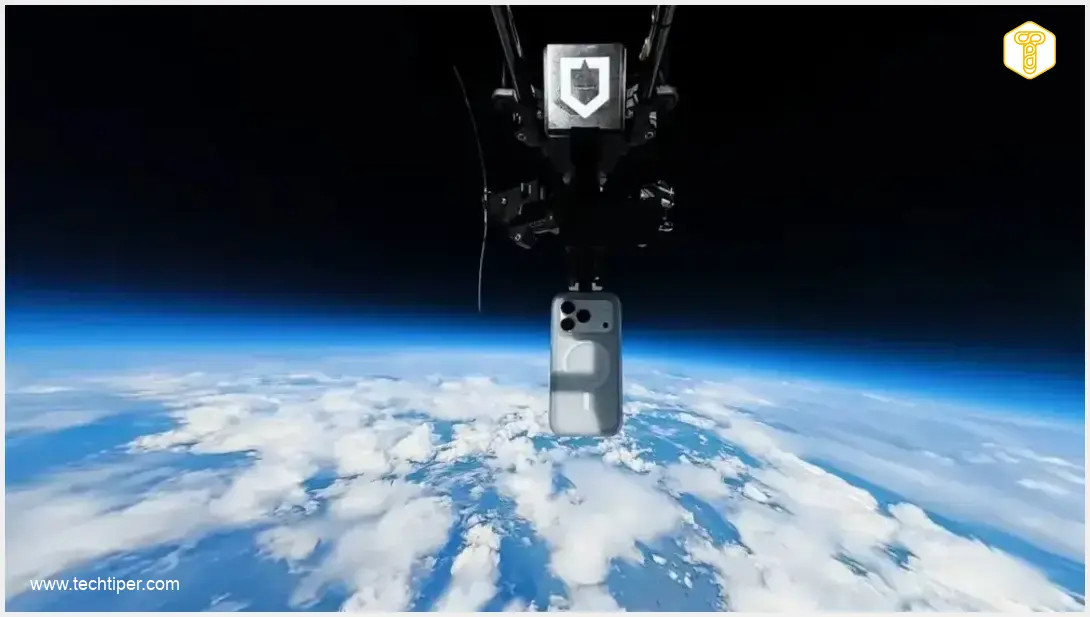
Can a smartphone survive a fall from the stratosphere? Remarkably, yes, it can. However, achieving such a feat requires an exceptionally robust protective case. Recently, the AirX case demonstrated its incredible strength by safeguarding a smartphone dropped from an altitude exceeding 30 kilometers (18.6 miles). This ambitious experiment was a resounding success, earning a place in the Guinness World Records.
Contents
Unprecedented Stratospheric Drop Test: Smartphone Endures 30 KM Fall with AirX Case
Enterprises RHINOSHIELD and Sent Into Space recently collaborated on an attempt to break an extraordinary Guinness World Record. The challenge involved dropping a smartphone encased in the AirX protective cover from a staggering height of 30.6 kilometers (approximately 19 miles). To put this into perspective, this altitude is nearly three times higher than the cruising height of commercial aircraft.
Engineering an Ultra-Durable Smartphone Case
The AirX case is engineered from monomaterials, making it 100% recyclable. Interestingly, its design drew inspiration from various advanced protective technologies, including automotive airbags and the sophisticated cushioning systems found in modern athletic footwear. This blend of innovation contributes to its unparalleled shock absorption capabilities.
According to the stringent guidelines set by Guinness World Records, the smartphone could not be aided by any additional protective measures like parachutes. Its resilience had to be proven through a direct impact with the ground, showcasing the case’s ability to withstand extreme forces independently. This test highlights the advancements in durable smartphone technology and protective accessories.
The Record-Breaking Drop and Recovery
The record attempt took place over the vast territory of the Esrange Space Center in Sweden, an area roughly twice the size of Luxembourg. Following its stratospheric descent, the smartphone was successfully located and recovered just over five hours after impact. The record was officially verified by adjudicator Juliet Dawson, who presented the experiment’s creators with certificating documents.
Choosing a Durable Smartphone
While many consumers prioritize specifications and features when selecting a new smartphone, a significant segment of users actively seeks devices built for exceptional durability. The market offers a variety of such robust devices. For those interested in smartphone resilience, you might also find our comparison on camera quality across different generations of phones intriguing, although durability is a distinct focus.
For instance, one brand renowned for its rugged devices is known for models that meet stringent durability standards. An example is a recently unveiled model that complies with the IP69 ingress protection rating and the MIL-STD-810H military standard. An IP69 rating means the device is highly resistant to dust and high-pressure, high-temperature water jets, while MIL-STD-810H signifies it has undergone rigorous testing for environmental stresses such as drops, shocks, and extreme temperatures. Additionally, such devices often feature advanced screen protection, like a 6.77-inch AMOLED 120 Hz display safeguarded by Schott Xensation Up glass.
Frequently Asked Questions (FAQ)
The AirX case is unique because it’s made from 100% recyclable monomaterials, emphasizing sustainability alongside extreme durability.
The smartphone was dropped from an altitude of 30.6 kilometers (approximately 19 miles), which is nearly three times higher than the cruising altitude of commercial airplanes.

The primary criterion was that the smartphone could not use any auxiliary protection like parachutes, and its case had to prove its durability through a direct impact with the ground.
Durable smartphones often meet standards such as IP69 (indicating high resistance to dust and water jets) and MIL-STD-810H (a military standard for resistance to drops, shocks, vibrations, and extreme temperatures).
Source: Guinness World Records. Opening photo: RHINOSHIELD / YouTube, screenshot
About Post Author