
Suunto Run 2 Review
-
Design and Build Quality
-
Display
-
Smart Features
-
Sports Features
-
GPS and Offline Maps
-
Health Features
-
Battery Life
Robust Running Watch with Premium Features
The Suunto Run 2 is a lightweight and durable running watch with significant improvements over its predecessor, including a bright AMOLED display, dual-band GPS, and accurate heart rate monitoring. While it excels in sports features and offline navigation, its smart functionalities are basic, and the increased price moves it out of the budget category, positioning it against higher-end competitors.
Advantages
- Lightweight and robust design
- Bright AMOLED display with excellent visibility
- Dual-band GPS for improved accuracy
- More accurate wrist-based heart rate monitoring
- Free offline maps for navigation
- Over 30 dedicated sports modes
- Detailed training and health data tracking
- Good battery life (up to 24 hours GPS)
- Durable materials (steel bezel, Gorilla Glass)
Disadvantages
- Higher price tag compared to predecessor
- Basic smartwatch features (no NFC, no cellular)
- No online music streaming (requires pre-loaded MP3s)
- Strap clasp can occasionally come undone
- Weak charging cable magnets
- Can appear massive on very slender wrists
- Initial map setup can be unintuitive
Contents
Suunto Run 2 Review: A Great Running Watch That’s No Longer Budget-Friendly
The Suunto Run 2 is a lightweight and robust running watch that addresses the main shortcomings of its first generation. It boasts a bright display, dual-band GPS, more accurate heart rate monitoring, and offline maps. However, these improvements come with a higher price tag, moving it out of the budget-friendly category. Does it stand up against competitors like Samsung or Garmin? This comprehensive review explores the Suunto Run 2.
Unboxing and Accessories
Suunto has long focused on functionality over flashy packaging for its products. The Run 2 arrives in a minimalist yet practical box, a design choice that perfectly aligns with the watch’s sporty character. The manufacturer emphasizes simplicity: an eco-friendly approach without unnecessary extras. The package includes the watch, a strap that requires self-assembly, a charging cable, and basic documentation.
Design and Build Quality
The Suunto Run 2 features a 46-millimeter case combined with a surprisingly low weight, making it feel light and almost imperceptible on the wrist during a run. This contrast defines the model best: it looks solid and substantial but doesn’t cause fatigue during prolonged wear. The steel bezel, Gorilla Glass, and well-fitted casing give it a visual confidence often missing in typical plastic sports watches.
However, this is a watch with a distinctly sporty character, not an attempt to enter a more elegant segment. The glass fiber-reinforced polyamide case underscores the utilitarian, training-focused heritage of the Run 2. Its dimensions and case size (46 mm) clearly indicate that this will not be a discreet model resting on the wrist.
For those with very slender wrists, the Suunto Run 2 might appear massive, but in return, it offers excellent readability and a design that proves thoughtful and reliable in daily use.
The display contributes significantly to this character. A large 1.32-inch AMOLED panel with a resolution of 466 x 466 pixels and brightness up to 2000 nits harmonizes perfectly with the watch’s overall design. It delivers exactly what you expect from a modern running watch:
- Good visibility
- Vibrant colors
- Quick data glance without stopping during a workout
Customizable watch faces further soften its strictly sporty appearance, allowing users to match it to their personal style.

Operation relies on a touchscreen and three physical buttons, a layout that strikes a good balance between convenience and reliability. The touchscreen is useful for daily browsing of data, maps, and widgets, but the buttons do the real work during a run, in the rain, with gloves on, or when hands are sweaty.
A silicone strap complements the overall design, fitting well with the watch’s athletic nature, though its clasp doesn’t always provide a perfect sense of security, occasionally coming undone.
Smart Features
If banking or music streaming from services like Spotify are essential for you while running, the Suunto Run 2 is not your ideal model. It offers some smartphone integration, including notifications, Bluetooth connectivity, and offline music playback.
However, it does not provide the extensive array of smart features, a vast app store, or the rich ecosystem found in products from Garmin, Samsung, or Apple. For instance, for users interested in Samsung’s ecosystem, you might find valuable information in our review of the Samsung Galaxy Watch 6 Classic’s February security update.
Smartwatch functionalities remain quite basic, including weather, timers, a flashlight, media control, and local music playback. There’s no NFC, meaning no contactless payments. Cellular connectivity is also absent. You won’t be able to listen to music via Spotify or YouTube Music; tracks must be pre-loaded onto the watch’s storage as MP3 files. The same applies to offline maps. In essence, if you’re seeking a versatile, lifestyle-oriented smartwatch, the Suunto Run 2 is not for you.
However, if we focus on the Suunto Run 2 primarily as a sports watch, the situation looks entirely different.
Sports Features
It doesn’t take long with the Suunto Run 2 to realize it’s more of a sports watch for active individuals than a comprehensive smartwatch. For some, this will be an advantage; for others, a significant drawback. As its name suggests, it is primarily designed for runners.
The watch offers modes for outdoor and treadmill running, along with tools useful during races. The Marathon Time function estimates your race completion time, Ghost Runner allows you to compete against a virtual opponent, and training can be guided by heart rate zones, pace, or power.
While designed primarily for running, the Suunto Run 2 supports other activities, including swimming, walking, strength training, cycling, and gym workouts. The watch comes with over 30 pre-loaded sports modes, tracks training volume, recovery, and fitness development, and provides adaptive training guidance in the app. It can estimate metrics such as VO2max, fitness age, lactate threshold, and predicted 5km race times.
GPS and Free Offline Maps
This device is an excellent option for those who enjoy running off the beaten path. Offline maps and activity tracking without a phone are more practical than extensive smartwatch features when training, navigation, and improved battery life are priorities. Users interested in budget-friendly smartwatches might also want to check out our analysis of the Xiaomi Redmi Watch 5 Lite.
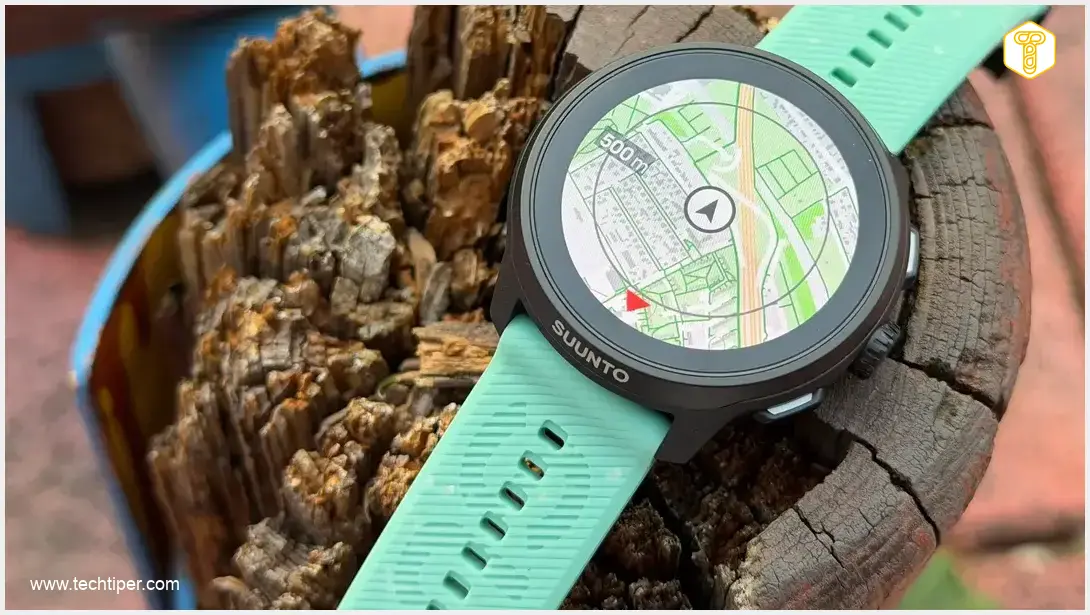
Free offline maps are a strong selling point for the Suunto Run 2. They allow you to check your position, surroundings, and routes without needing to pull out your phone. This feature is particularly useful when navigating an unfamiliar city or training on local trails the user hasn’t explored before.
The ability to download maps via Wi-Fi is convenient, though the initial setup and selection of map data aren’t the most intuitive aspects of the Suunto ecosystem.
Health Features
The improved optical heart rate sensor is a significant change in the Suunto Run 2, as wrist-based measurements are noticeably more reliable than in its predecessor, even during intense exertion. For most amateur runners, this will suffice for daily training, although for very high-intensity sessions, a chest strap would be a beneficial addition.
Any slight differences in readings between the Suunto Run 2 and a blood pressure monitor may be due to body position, measurement timing, wrist placement, and inherent variations between devices. Most measurements were consistent or differed by a maximum of 2–3 beats per minute.
Beyond heart rate, the watch also tracks basic health and recovery indicators, including sleep, training load, and post-exertion recovery time.
The Suunto App
The watch collects detailed data concerning body functions, workouts, and all activities. The primary “command center” and analysis hub for this data is the Suunto app. It synchronizes workouts and health data, allows for planning runs, and personalizes sports settings.
In addition to heart rate tracking, the watch monitors blood oxygen levels, stress levels, and sleep quality and phases. A useful tool is the Body Resources indicator, which combines data on sleep, stress, and activity, helping to assess whether a given day is suitable for an intense workout or rather for recovery.
The Suunto Run 2 is designed primarily for runners, especially those training for a marathon, and the app extends its capabilities beyond the watch screen.
Battery Life
The manufacturer states up to 24 hours of operation in multi-band GPS mode, meaning it should last for a marathon, several long training sessions without recharging, or most single-day outdoor activities. This assumes you won’t be using maximum brightness or the always-on display, which would significantly reduce battery life by several hours.
In typical watch mode, the manufacturer claims up to 10 days of battery life, though this result is highly dependent on individual usage (e.g., number of workouts) and settings (e.g., screen brightness or always-on display function).
I achieved approximately one week of battery life with the screen activated by wrist movement, primarily using health monitoring options and occasionally (3-4 times a week) training functions. Charging is done using Suunto’s proprietary charger, which needs to be aligned with pins on the watch’s underside. The magnets aren’t the strongest, and the watch can easily be dislodged, so care is needed. A full charge takes about two hours.
Specifications and Pricing of the Suunto Run 2
The specifications of the Suunto Run 2 are in many respects similar to the first generation, but the improvements and additional features make a huge difference.
| Feature / Parameter | Description |
|---|---|
| Display | AMOLED, 1.32 inches, 466 × 466 pixels, brightness up to 2000 nits, Corning Gorilla Glass |
| Case | Stainless steel, dimensions: 46 x 46 x 11.7 mm |
| Weight | 35 g (case only) |
| Strap | Silicone strap, width 22 mm, length 125-175 mm |
| Water Resistance | 5 ATM / 50 m |
| Location Systems | Dual-band GNSS (L1 and L5 in GPS, GLONASS, Galileo, BeiDou, and QZSS networks) |
| Connectivity | Bluetooth, compatible with iOS and Android |
| Battery Life | 380 mAh, up to 10 days (watch mode), up to 24 hours (multiband GNSS) |
| Sports Modes | Over 30 modes, including running, walking, cycling, swimming, indoor/outdoor training |
| Sports & Health Features | Wrist heart rate measurement, pedometer, calorie counter, sleep and stress monitoring, recovery assistant, personal records, race simulator, activity indicator, digital compass, distance, speed, pace, temperature measurement, free offline maps |
| Smart Features | Notifications, call answering via Bluetooth, caller ID, music control, alarm, stopwatch, vibration, weather |
| Color Versions | Aloe Green, Feather Gold, and All Black |
Now, let’s move on to what many are probably most interested in—the price. The Suunto Run 2 debuted on September 8, 2026, in two memory versions. The 4GB model costs approximately 290 USD, while the 64GB variant is priced at around 340 USD. The first generation was noticeably less expensive.
The price has increased to the point where the Suunto Run 2 now competes not only with cheaper sports watches for beginners or versatile Huawei and Samsung watches but also with more refined offerings from Garmin and Coros.
Conclusion: Our Opinion on the Suunto Run 2
The Suunto Run 2 is a watch for individuals who prioritize reliable route tracking, a clear display, accurate training data, and extended battery life over contactless payments, extensive apps, or Spotify music streaming. In my opinion, it is one of the better sports smartwatches, and I thoroughly enjoyed using it daily. However, its higher price means it’s no longer the obvious budget-friendly choice that the first generation was.
Frequently Asked Questions (FAQ)
The Suunto Run 2 features a brighter AMOLED screen, dual-band GPS for improved accuracy, more precise heart rate monitoring, and free offline maps, addressing key limitations of the first generation.
While primarily designed for runners, the Suunto Run 2 supports over 30 sports modes, including swimming, cycling, strength training, and walking, making it versatile for various athletic pursuits.
No, the Suunto Run 2 lacks NFC for contactless payments and does not support online music streaming services like Spotify. Music must be pre-loaded onto the watch as MP3 files. Its smart features are basic, prioritizing sports functionalities.
Source: Internal review, Suunto.
Opening photo: Jolanta Szczepaniak.
About Post Author
