
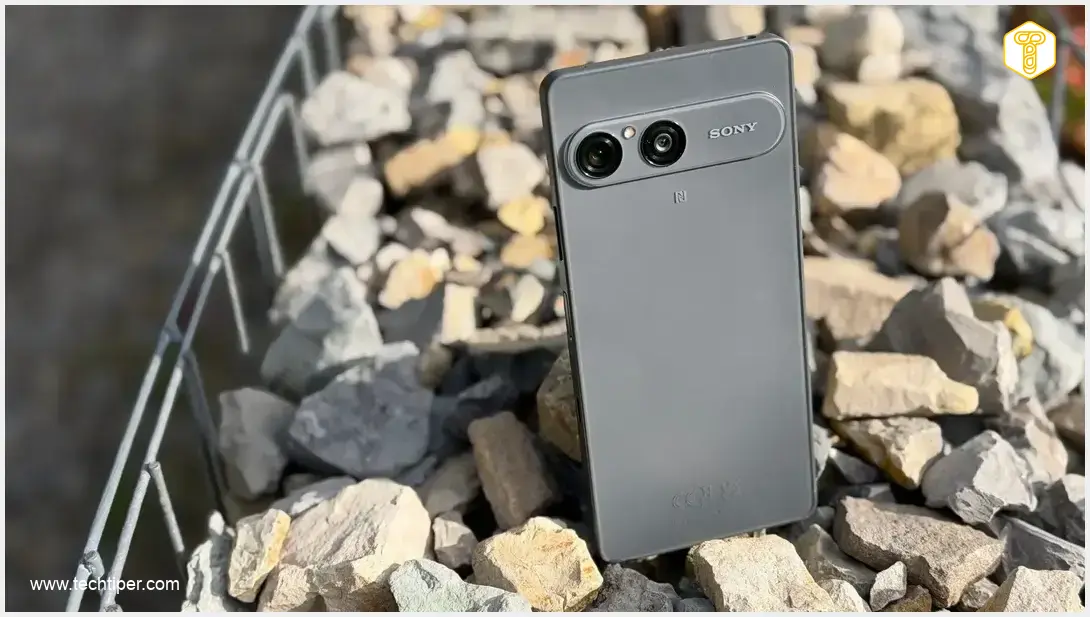
Sony Xperia 10 VIII Review
-
Design, Build & Ergonomics
-
Software & Features
-
Camera System
-
Performance & Storage
-
Battery Life & Connectivity
-
Value for Money
Sony Xperia 10 VIII: Minimalism Meets Mediocre Value
The Sony Xperia 10 VIII offers a refreshingly compact design, excellent battery life, and a dedicated headphone jack. However, its premium price fails to justify the underperforming camera, outdated processor, and limited storage, making it a niche device rather than a strong contender in its price bracket.
Advantages
- Compact, lightweight design
- Exceptional two-day battery life
- IP65/IP68 water and dust resistance
- 3.5mm headphone jack and microSD support
- Clean Android, no bloatware
- Bright 120Hz OLED display
- Excellent connectivity
- Front-facing stereo speakers
Disadvantages
- Significantly overpriced
- Underpowered Snapdragon 6 Gen 3 processor
- Only 128GB internal storage
- Disappointing camera performance
- Slow 30W charging
- Dated software aesthetic
- Large display bezels
- Rear panel attracts smudges
Contents
Sony Xperia 10 VIII Review: Is Japanese Minimalism Worth the Price?
The Sony Xperia 10 VIII is a difficult smartphone to wholeheartedly recommend. While it champions a minimalist design, a compact and lightweight body, the rare inclusion of a headphone jack, and exceptional battery life, its performance and camera system do not particularly shine. This blend of features, especially at its premium price, might not be enough to attract a broad audience. Let’s dive into a comprehensive review of the Sony Xperia 10 VIII to help you decide.
Initial Impressions and Market Reception
Sony’s new mid-range smartphone launched in the global market around late August 2026. However, its release didn’t generate significant buzz, and dedicated fans of the brand didn’t form queues outside stores. While brand loyalty is commendable, it often isn’t enough when a smartphone with a few notable strengths struggles to justify a price tag of around $675.
Design and Build Quality
The Sony Xperia 10 VIII doesn’t aim for a futuristic aesthetic. Instead, it embraces a simple, symmetrical, and minimalist design, characterized by prominent bezels around its display. The flat edges are crafted from plastic, while the front of the device is protected by Corning Gorilla Glass Victus 2, offering enhanced durability against drops and scratches.
The rear panel features a matte gray finish (also available in white and lilac), though it tends to attract fingerprints and smudges easily. A horizontal, rounded camera module stretches across the entire width of the device, housing two cameras and the Sony logo.
Compact and Ergonomic Design
One of the Xperia 10 VIII’s most significant advantages is its small size and weight. It’s noticeably more compact and lighter than many contemporary mid-range phones, making it exceptionally comfortable to hold. Users can easily operate it with one hand and slip it into a pocket without hassle.
Display Features
The phone boasts a 6.1-inch OLED display with a Full HD+ resolution. It supports HDR video playback and offers a refresh rate of either 60Hz or 120Hz, providing excellent brightness levels that ensure readability even in direct sunlight. As an OLED panel, it delivers virtually infinite contrast and rapid response times, making it ideal for consuming media, reading on the go, or outdoor use.
Durability and Practicality
I appreciate its IP65/IP68 dust and water resistance, which offers peace of mind against environmental elements. The SIM card slot is also noteworthy, as it can be opened without a tool and accommodates both a nano-SIM and a microSD card. The inclusion of microSD support is a diminishing feature in modern smartphones, yet it remains invaluable for users with extensive media libraries who wish to store music and videos directly on their device.

The plastic frame houses several ports and buttons. On the right side, you’ll find three buttons: volume controls, a dedicated camera shutter button, and the power/lock button with an integrated fingerprint scanner.
The camera shutter button, however, was a slight disappointment. While it launches the camera app with a long press and takes a screenshot with a short press, it cannot be remapped to other functions and isn’t a two-stage button like those found on some traditional cameras.
A 3.5mm headphone jack is a welcome presence, continuing Sony’s tradition of prioritizing audio features. Further enhancing its multimedia appeal, the front-facing stereo speakers are directed towards the user, providing an immersive audio experience for watching movies, series, or gaming. The bottom edge features a USB-C port (USB 2.0 standard) for charging and data transfer.
Interface and Applications
The smartphone runs on Android 16, offering a relatively fast and fluid user experience. Sony has kept the interface clean, free from advertisements and unnecessary bloatware. The manufacturer promises four system updates for the Xperia 10 VIII. However, it’s worth noting that users of the Xperia 10 VI were initially promised Android 17, a commitment Sony later withdrew. The future will tell if the Xperia 10 VIII receives its promised updates.
Beyond its clean Android experience, the system doesn’t offer many unique features; Sony has opted for a very simplified, visually somewhat dated version of Android. The Japanese manufacturer also doesn’t heavily invest in developing its own artificial intelligence, instead relying on Google’s offerings like Google Gemini or Circle to Search. Users can also utilize AI-powered photo editing features within Google Photos, which serves as the default gallery application.
Cameras and Photo Quality
The camera setup remains unchanged from the previous generation. It features a 50MP main camera with an f/1.9 aperture, a 1/1.56-inch sensor, and optical image stabilization (OIS). This is accompanied by a 13MP ultrawide lens with a 123-degree field of view, and an 8MP front-facing camera. While megapixels aren’t everything, these cameras perform adequately for everyday photography. However, they are easily outclassed by many more expensive models on the market.
Daylight Performance
In good lighting, the main camera captures decent photos with good color reproduction and white balance. However, the contrast can sometimes be too high, and the dynamic range often leaves much to be desired. I frequently encountered photos with overexposed skies, and the bokeh effect wasn’t particularly impressive. This wasn’t due to occasional object detection errors but rather an artificial-looking blur. Furthermore, fans of close-up shots may find the Xperia 10 VIII’s cameras lacking. The only viable option is the 2x zoom camera, but the results are not particularly captivating.
Nighttime Photography
Nighttime results are acceptable, though the phone requires a longer exposure time, and the photos don’t match the quality of the best mid-range devices. In the evening, the main camera handles colors, dynamics, and noise well, but it’s highly susceptible to lens flares. Conversely, the ultrawide lens is practically useless in these conditions, failing to capture dark tones and rendering anything in dim light as completely black.
If you primarily use your camera to document daily life or vacation adventures and share the results mainly on social media, the Xperia 10 VIII will suffice. However, if photography is a priority, many better smartphone cameras are available in the Xperia’s price range.
The ultrawide lens is useful for architectural and landscape photography, but its quality is noticeably inferior to the main camera, and sharpness degrades towards the edges of the frame. There is no optical telephoto lens; only a 6x digital zoom is available.
Selfie Camera
Daytime selfies look decent, with accurate skin tones and a respectable background blur that keeps the subject in focus. However, selfies taken at night or in insufficient lighting are generally not worth bothering with.
Connectivity and Navigation
Regarding wireless connectivity, Sony provides almost full functionality. The Xperia 10 VIII offers Wi-Fi 6E, supports 5G networks, includes NFC for contactless payments, and features Bluetooth 5.4. The phone also supports dual SIM, with one physical nano-SIM and one digital eSIM.
The Xperia 10 VIII supports GPS, GLONASS, GALILEO, BDS, and QZSS for location services. I encountered no issues with navigation or voice calls during testing. The smartphone supports Sony’s LDAC codec and Qualcomm’s aptX codec for compatible headphones. Sony’s 360 Reality Audio and DSEE (Digital Sound Enhancement Engine) Ultimate technologies are also available, enhancing the audio experience.
Performance and Memory
The Xperia 10 VIII utilizes the Snapdragon 6 Gen 3 processor. This is the same chipset found in the previous Xperia 10 VII, as well as in significantly cheaper phones like the Samsung Galaxy A27 5G, Galaxy A36 5G, or POCO M8 5G, which typically retail for under $375.
Memory provisions are also modest. While 8GB of RAM, supplemented by 6GB of virtual RAM, is acceptable, 128GB of internal storage is a significant drawback for a smartphone priced at nearly $675. Even the inclusion of microSD support doesn’t fully alleviate this concern.
In everyday use, the phone is sufficient for messaging apps, web browsing, banking, maps, photos, and multimedia consumption. However, challenges arise with numerous applications running simultaneously, demanding games, and rapid task switching. Users should also not expect swift camera operation (the app experienced occasional delays) or robust artificial intelligence capabilities.
In benchmark tests, the phone achieved 845 points in the single-core test and 2949 points in the multi-core test on Geekbench 7. On AnTuTu v11, it scored approximately 926,000 points. These results are acceptable but notably fall short of what one would expect from a device in this price bracket. For those seeking alternatives with better performance, consider devices like the Nothing Phone (4a) Pro or even a Google Pixel 10, which might offer more bang for your buck.
Battery and Operating Times
The 5000 mAh battery (identical to the Xperia 10 VII) combined with an energy-efficient, though not particularly powerful, processor yields excellent results. In practice, the Xperia 10 VIII should comfortably last a full day of intensive use, and with moderate usage, it can extend to two days. The EPREL label indicates over 53 hours of operation in a single cycle and up to 1400 charging cycles.
Benchmark results from the PC Mark battery application corroborate this. With the refresh rate set to 60Hz, the device achieves over 24 hours of operation, while at 120Hz, the time is noticeably shorter but still a very respectable 17 hours.
The phone only supports wired charging, and it’s not the fastest. The smartphone handles up to 30W, taking over 1.5 hours to fully charge the battery. Many competitors often offer significantly faster power replenishment.
Specifications and Pricing
Here’s a breakdown of the Sony Xperia 10 VIII’s key specifications:
- System: Android 16, 4 major updates, 6 years of security patches
- Display: 6.1-inch OLED, 2340 x 1080 pixels (FHD), 120Hz refresh rate, 422 ppi, 19.5:9 aspect ratio, DCI-P3 100%
- Processor: Qualcomm Snapdragon 6 Gen 3, Adreno 710 GPU
- RAM: 8GB + 6GB virtual RAM
- Internal Storage: 128GB
- Cameras:
- Main: 50MP, Exmor RS 1/1.56″, f/1.9, OIS, 6x hybrid zoom, recording with optical and electronic image stabilization
- Ultrawide: 13MP, 1/3″, f/2.4, 123° field of view
- Selfie: 8MP, 1/4″, f/2.0
- Connectivity: 5G, eSIM, Wi-Fi 6E (2.4/5/6 GHz), Bluetooth 5.4, NFC
- Ports and Connectors: USB-C (USB 2.0), 3.5mm jack
- Navigation: A-GPS, A-GLONASS, BeiDou, Galileo, QZSS
- Other Features: eSIM support, microSD card support up to 2TB, IP65/IP68 rating, Corning Gorilla Glass Victus 2 on the front; Hi-Resolution Audio, High-Resolution Audio Wireless (LDAC); front-facing stereo speakers; Google Cast, fingerprint reader on the side edge
- Battery: 5000 mAh, USB-PD charging
- Dimensions: 153 x 72 x 8.3 mm
- Weight: 168 g
Sony has set the price of the Xperia 10 VIII at approximately $675. This positions it as a decent mid-range device that is, however, significantly overpriced. Frankly, I did not expect this smartphone to be so expensive. Its predecessor, the Sony Xperia 10 VII, cost noticeably less (around $500), yet both devices are almost identical in terms of processor, battery, and cameras.
Moreover, I could list several devices at a similar or lower price point that would be a better choice. I would much rather purchase, for example, a Google Pixel 10, Poco X8 Pro, or a Nothing Phone (4a) Pro than the Sony smartphone.
Conclusion and Our Opinion
The Sony Xperia 10 VIII is an agreeable phone that stands out in several ways. I appreciate its small size and low weight, robust build quality, good speakers, the presence of a headphone jack, and a powerful battery that delivers excellent operating times.
Its biggest drawback, however, is its unfavorable price-to-performance ratio. In other words, it costs as much as a significantly higher-class phone, yet it remains at the level of cheaper constructions in almost every aspect. This makes the Xperia 10 VIII a smartphone for a specific niche audience and brand enthusiasts, rather than for someone seeking the best value for around $675.
Frequently Asked Questions (FAQ)
The Sony Xperia 10 VIII offers a compact and lightweight design, a 6.1-inch OLED display with good brightness, IP65/IP68 dust and water resistance, a 3.5mm headphone jack, front-facing stereo speakers, and exceptional battery life with up to two days of moderate use.
Its main drawbacks include a high price for its specifications, using the same Snapdragon 6 Gen 3 processor as much cheaper phones, only 128GB of internal storage, average camera performance (especially in low light and for zoom), large display bezels, and the absence of a charger or cable in the box.
In good lighting, the 50MP main camera takes decent photos with good color and white balance, but dynamic range can be limited, and bokeh effects are artificial. Night photography is acceptable with the main camera but struggles with flares, and the ultrawide lens performs poorly in low light. There is no optical telephoto lens, and the selfie camera is adequate in daylight but poor at night.
While sufficient for everyday messaging, browsing, and multimedia, the Snapdragon 6 Gen 3 processor limits performance for demanding games, heavy multitasking, or rapid app switching. Benchmark scores are acceptable for a mid-range phone but fall short of expectations for its price point.
Yes, several alternatives offer better value or performance for a similar or lower price, such as the Google Pixel 10, Poco X8 Pro, or Nothing Phone (4a) Pro. These phones often provide more competitive specifications in areas like processing power, camera capabilities, or unique features.
Source: proprietary work, Sony.
Opening photo: Jolanta Szczepaniak / Androidcompl
About Post Author