

Contents
The Ultimate Guide to TV Mounting Height: Ergonomics and Calculations
Mounting your TV at the correct height is about much more than just room aesthetics. Hitting that sweet spot on the wall ensures you avoid neck strain and eye fatigue, whether you are unwinding with your favorite streaming platforms or exploring the new features on Google Gemini TVs. If you have ever felt uncomfortable looking up at a screen, you already know why this matters.
The Golden Rule: Keep It at Eye Level
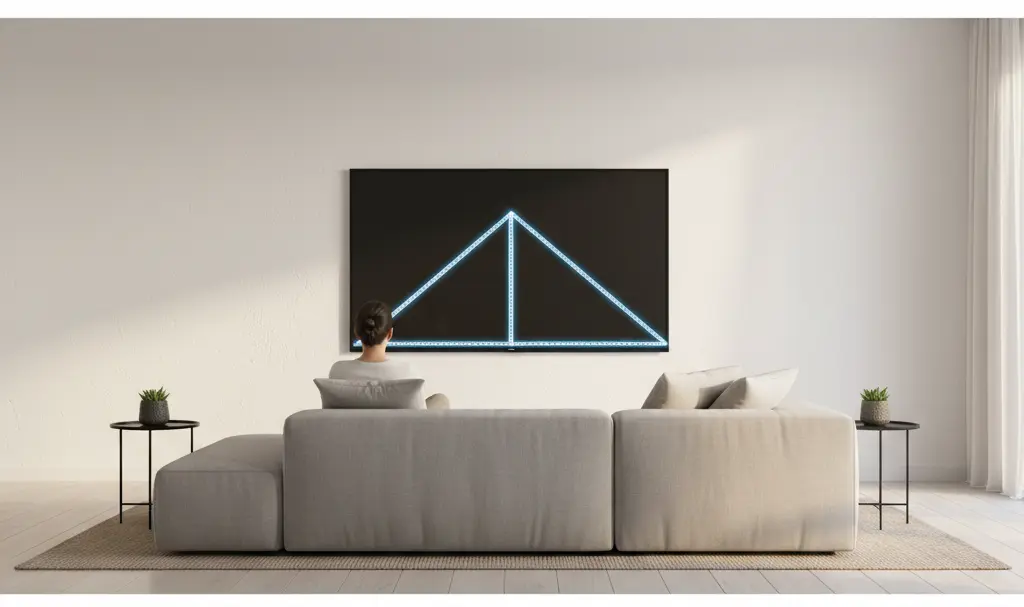
The fundamental principle for mounting a TV in any living space is simple: the center of the screen should align precisely with the viewer’s eye level. Since most television viewing happens while seated on a sofa or armchair, this ideal height is much lower than you might initially think.
For the average adult sitting on standard living room furniture, eye level typically falls between 40 and 43 inches (roughly 100 to 110 cm) from the floor.
If you have a multi-person household, it is a great idea to find an average eye level that works for everyone. Sit comfortably on your couch, find your natural resting gaze, and mark the wall with a sticky note. This simple trick guarantees optimal comfort for the whole family.
How Screen Size Dictates Mounting Position
All televisions are not created equal, and their dimensions heavily influence where the mounting bracket needs to go. While 55-inch and 65-inch displays are incredibly common, modern households are increasingly upgrading to massive screens of 75 inches or larger, much like the impressive latest LG Smart TVs. The crucial takeaway here is: the larger the TV, the lower the bottom edge needs to be mounted.
Because your seated eye level remains constant, the center point of the TV must stay anchored at that 40 to 43-inch mark. As a screen’s physical height grows, its top and bottom edges expand outward. Therefore, a larger panel requires its bottom edge to sit closer to the floor.
Here is a quick comparison assuming an average eye level of 41 inches (105 cm):
- 55-inch TV: The bottom edge will sit approximately 27 to 29 inches (70 to 75 cm) from the floor.
- 65-inch TV: The bottom edge drops lower, sitting at roughly 24 to 25 inches (60 to 63 cm) from the floor.
Step-by-Step: How to Calculate Your Exact Mounting Height
Instead of guessing, use this foolproof mathematical approach to determine exactly where to drill your holes. Just follow these steps:
- Step 1: Determine seated eye level. Sit on your couch and measure the distance from the floor to your eyes (e.g., 43 inches or 110 cm).
- Step 2: Measure the TV’s height. Check your TV’s manual or measure the screen from top to bottom.
- Step 3: Halve the screen height. Divide the total TV height by two. For a standard 55-inch TV, this center-to-bottom measurement is usually about 14 inches (35 cm).
- Step 4: Calculate the bottom edge position. Subtract the halved TV height (Step 3) from your eye level (Step 1). For example: 43 inches – 14 inches = 29 inches (or 110 cm – 35 cm = 75 cm).
The resulting number tells you exactly how high the bottom edge of the television should be from the floor.
Consider Alternatives to Wall Mounting
If dealing with power drills, stud finders, and wall anchors sounds too complicated, remember that media consoles and TV stands remain excellent alternatives. They naturally place televisions at an ergonomically appropriate height and are the perfect, hassle-free solution if you live in a rented apartment where drilling is restricted.
Frequently Asked Questions (FAQ)
How does viewing distance affect the ideal TV mounting height?
While maintaining a seated eye level at the center of the screen is the gold standard, sitting further away gives you a slightly wider margin for error. As viewing distance increases, the viewing angle naturally flattens. However, for standard living room setups where seating is 6 to 10 feet away, sticking to the eye-level rule remains the best way to prevent neck strain over long viewing sessions.
Should I use a tilted mount if I have to hang the TV high above a fireplace?
Yes. If architectural limitations—like a fireplace or tall furniture—force you to mount the television significantly higher than the recommended 40-43 inches from the floor, a tilting wall bracket is essential. Tilting the screen downward by 5 to 15 degrees keeps the display panel perpendicular to your line of sight. This minimizes neck fatigue and prevents color washout and glare that occurs when viewing LED and OLED screens from an off-axis angle.
Source: Gemini
Opening photo: Gemini
About Post Author
