

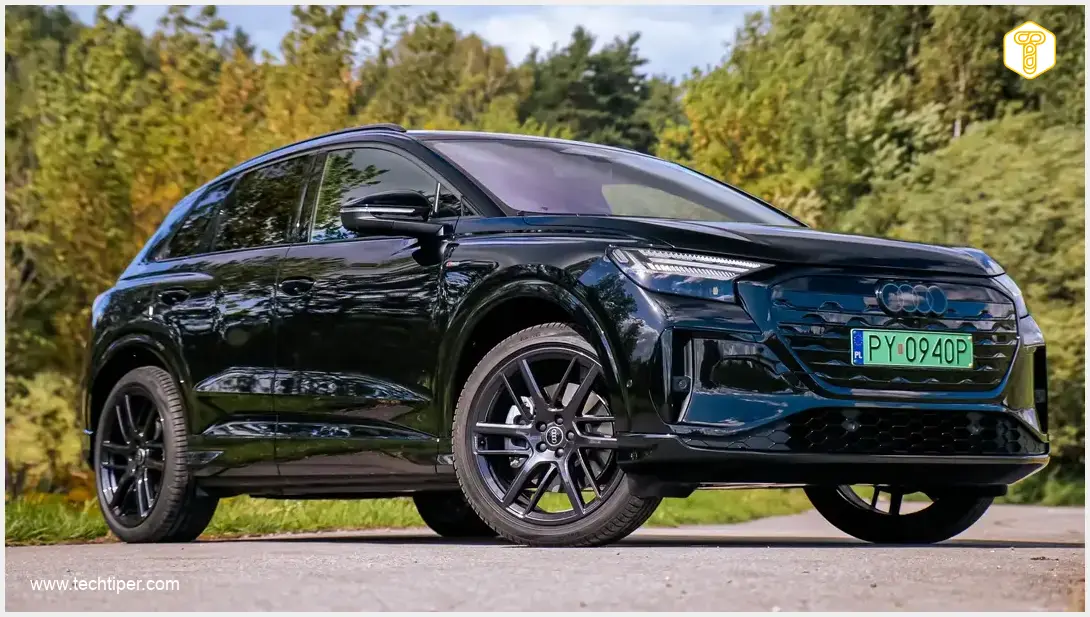
Audi Q4 e-tron Review
-
Technology & Multimedia
-
Driving Dynamics & Comfort
-
Interior & Build Quality
-
Practicality (Space & Trunk)
-
Range & Charging
-
Driver Assistance Systems
Audi Q4 e-tron: A Refreshed Premium EV with Cutting-Edge Tech
The updated Audi Q4 e-tron delivers significant technological advancements, refined driving comfort, and impressive interior space. While excelling in multimedia and overall premium feel, some driver assistance features and charging aspects require further refinement or additional investment in options.
Advantages
- Significant technological upgrades (new multimedia, displays, AI voice assistant).
- Refined driving dynamics and comfort with adaptive suspension.
- Spacious and practical interior, ample rear legroom, large trunk.
- Intuitive Android-based infotainment with extensive customization.
- Excellent sound insulation and premium interior materials.
- Effective Matrix LED headlights and customizable lighting.
- Good urban energy consumption and range.
- Vehicle-to-Load (V2L) capability.
- Ergonomic steering wheel with physical controls.
- Advanced driver account linking and personalization options.
Disadvantages
- Driver assistance systems require adjustment (lane-keeping assist, braking/regeneration).
- Lane-keeping assist impacts steering precision.
- No front trunk (frunk).
- Heat pump, heated seats, heated steering wheel are optional extras.
- Average 360-degree camera image quality.
- Range and charging capabilities are standard, not class-leading (400V architecture).
- Inconsistent automatic lane change feature.
- Brake pedal feel varies due to regeneration integration.
- Passenger display lacks independent Bluetooth headphone connectivity.
- Some optional features raise the price significantly.
Contents
Audi Q4 e-tron Review: Full of Exciting Changes for Tech Fans
We’re diving into a review of the Audi Q4 e-tron, focusing on its practical standard body style, not the Sportback variant. This particular model underwent a significant refresh in 2026, with the most notable changes concentrated on the interior. While the manufacturer primarily aimed to update the underlying technology, there are subtle yet impactful design enhancements that become apparent upon closer inspection.
Our review model was exceptionally well-equipped, underscoring Audi’s commitment to its most compact electric vehicle. It boasts a wealth of modern features typically found in much more expensive Audi models, though the Q4 e-tron itself isn’t a budget option. Let’s explore the capabilities of the Audi Q4 e-tron, uncovering its strengths and weaknesses.
Audi Q4 e-tron: Quick Summary and Opinion
Audi’s recent refresh has significantly enhanced the Q4 e-tron, integrating numerous advanced technologies and making it a highly connected vehicle. Its refined driving dynamics ensure comfortable journeys, capable of swift acceleration when needed. The interior offers ample space for all occupants, and the boot is exceptionally practical. However, some aspects of the driver assistance systems, particularly the braking/regeneration system and lane-keeping assist, require a period of adjustment for the driver.
Pricing and Trim Levels
The Audi Q4 is exclusively available with an electric powertrain, with the “e-tron” designation confirming its all-electric nature. Despite being an SUV, it holds the position of the most affordable electric vehicle in Audi’s lineup. It comes in two body styles: the classic SUV and the sportier Sportback with a more steeply raked roofline.
At the time of this review’s publication, pricing for the Polish market was as follows:
SUV:
- e-tron (204 PS): 222,000 Polish Złoty (PLN)
- e-tron performance (286 PS): 253,300 PLN
- e-tron quattro (299 PS): 267,600 PLN
- e-tron quattro performance (340 PS): 296,800 PLN
Sportback:
- e-tron (204 PS): 232,100 PLN
- e-tron performance (286 PS): 263,400 PLN
- e-tron quattro (299 PS): 277,700 PLN
- e-tron quattro performance (340 PS): 306,900 PLN
Audi offers extensive customization options for the Q4 e-tron rather than rigid trim levels. While pre-configured packages are available, customers have the flexibility to select individual features according to their preferences.
Standard warranty coverage for the Q4 e-tron includes a 2-year basic vehicle warranty, a 3-year paint warranty, and a 12-year warranty against body perforation. Given its electric powertrain, the traction battery is covered for 8 years or 160,000 kilometers (approximately 100,000 miles). Additionally, a 5-year service package can be purchased separately to cover unforeseen repairs.

Insurance Costs
Based on data from a local insurance comparison platform, the third-party liability insurance for a Q4 e-tron (for a driver with several years of experience) could be approximately 460 Polish Złoty (PLN). A comprehensive package including collision coverage might cost around 7,300 PLN. Individual insurance costs will vary based on personal circumstances and provider.
Tested Model Configuration and Value
The Audi Q4 e-tron reviewed here is a quattro variant, with a base price of 267,600 PLN. However, the advanced features highlighted in this review are largely due to the following optional extras:
- Tech Pro Package (~24,700 PLN): Includes adaptive and predictive cruise control, front/rear cross-traffic assist, obstacle avoidance assist, emergency braking assist, parking sensors, 360-degree cameras, digital key, auto-dimming mirrors, Matrix LED headlights, digital LED taillights, and parking assist.
- 21-inch Audi Sport wheels, black metallic (~10,200 PLN)
- Comfort Promotion Package (~9,300 PLN): Adds Audi Phone Box (signal booster), ambient lighting plus, 4-way lumbar support for front seats, and dual inductive charging pads.
- Panoramic sliding roof (~6,500 PLN)
- S line Exterior Package (styling package) (~6,300 PLN)
- S Interior Package with sport seats upholstered in Dinamica microfiber and eco-leather combination (~5,000 PLN)
- Heat pump (~4,900 PLN)
- HUD with augmented reality (~4,700 PLN)
- Dynamic Plus Package (~4,500 PLN): Includes driving modes, adjustable damper stiffness (rear lowered by 5mm), and progressive steering.
- Electrically adjustable front seats + memory function for driver (with mirrors) (~4,400 PLN)
- Mythos Black metallic paint (~4,200 PLN)
- MMI Navigation Pro Package (~3,600 PLN): Features SONOS Premium 580 W sound system, 4x USB-C ports with increased charging power (30 W individual, 45 W paired).
- Black Optic Package (~3,500 PLN): Black mirror housings, black roof rails, dark window trims, and body emblems.
- MMI display for passenger (~3,500 PLN)
- Privacy glass (~2,000 PLN)
- Side airbags front and rear with curtain airbags (~1,800 PLN)
- Climate Control Package (~1,800 PLN): Includes 3-zone climate control, heated front seats, and auxiliary heating/ventilation.
- Anthracite technical fabric decorative inlays (~1,800 PLN)
- Heated, sound- and heat-insulating windshield without visible wires (~1,800 PLN)
- Trunk equipment package (~1,600 PLN): Includes 2 LED lights, net, foldable floor, V2L charging capability.
- Acoustic insulating front door windows (~600 PLN)
- Cargo partition net (~600 PLN)
These optional additions push the price of the reviewed model to over 375,000 PLN, making it a highly specified, though not maximally equipped, variant. Further options like full (eco) leather upholstery, heated steering wheel, heated rear seats, various accessories, a garage door opener, and headlight washers are still available.
While the Q4 e-tron is positioned as a premium vehicle, it’s worth noting some surprising omissions from its standard features, such as a heat pump and heated seats or steering wheel. These often require additional investment. Furthermore, prospective buyers should also factor in the cost of service and repair packages.
Technical Specifications
The Audi Q4 e-tron utilizes powertrains familiar from other electric vehicles within the VW Group. This means it benefits from well-proven solutions, available with single or dual electric motors (quattro) for power delivery. Audi has largely maintained these configurations, including identical speed limitations, which is not a drawback given the demonstrated efficiency of its sibling models.
However, Audi differentiates the Q4 e-tron in terms of dimensions, aligning with its premium segment characteristics. The Q4 e-tron is notably larger than its direct competitors from Mercedes or BMW, a factor Audi hopes will draw customers to its showrooms. A minor point of disappointment is the absence of a front trunk (frunk) during this refresh.
A Brief History of the Audi Q4 e-tron
Audi’s decision to introduce the Q4 e-tron was well-founded, as it has become a relatively popular electric vehicle since its launch. The Q4 e-tron, including the Sportback variant, has been available since 2021. It is built upon the successful Volkswagen MEB platform, which also underpins models such as the Skoda Enyaq and VW ID.4. Consequently, the Q4 e-tron shares a significant number of solutions and components with these vehicles.
However, Audi has gone beyond merely rebranding a Skoda or VW model; it consistently asserts its premium status at every turn, particularly evident in the refreshed interior. A substantial modernization occurred in early 2026, which saw the cabin receive entirely new technologies, including larger displays. Furthermore, the Vehicle-to-Load (V2L) option was finally introduced, and the efficiency of the electric powertrain was refined, alongside a simplified naming convention.
The Audi Q4 e-tron is a premium electric vehicle positioned in the C-segment (bordering on D-segment). Technologically, it shares close ties with the larger Skoda Enyaq, the similarly sized VW ID.4/5, and the Cupra Tavascan. It’s also worth noting that the same MEB platform is used for the upcoming Ford Capri and Explorer EV.
Direct competitors for the Q4 e-tron primarily include the BMW iX1/iX2, Mercedes EQA (with the newer GLA EQ), Volvo EC40, and Tesla Model Y. Other contenders, such as the Xpeng G9 and BYD Seal U, also fall into this category. For those seeking more affordable alternatives, the Hyundai Ioniq 5, Kia EV6, and Ford Mustang Mach-E are strong considerations.
Audi Q4 e-tron Multimedia System: Android-Powered Brilliance
Rest assured, the Audi system offers multiple language options, including English. The phrase “Android-powered” signifies that Audi has taken the Android operating system and extensively customized it, opting for its proprietary services instead of Google Services.
This approach means the system features an app store and a plethora of multimedia enhancements, though some services require subscriptions. Crucially, the entire system operates seamlessly, provided there isn’t a need to download content, which can sometimes lead to a brief loading screen.
Overall, the Q4 e-tron’s infotainment platform is intuitively designed. It avoids overwhelming the user despite its rich feature set, offering extensive customization options. It’s clear that this is a system built for future development, yet it feels complete and capable right now.
With the latest refresh, Audi introduced entirely new displays for the Q4 e-tron, which are consistent across all trim levels. These screens are integrated into a single, raised panel above the dashboard, subtly angled towards the driver. The setup includes an 11.9-inch digital instrument cluster and a 12.8-inch central touchscreen. Optionally, buyers can add a head-up display and a 12-inch passenger-side display.
The Central Screen: A Command Center
Upon initial setup of the Audi Q4 e-tron, it’s highly recommended to link your driver account. This not only enables remote management but also unlocks the full suite of functionalities, including access to the app store and extensive personalization options. While some features are available through subscription, their presence is currently limited.
The main interface is logically divided into upper and lower bars. The upper bar displays essential information, quick shortcuts (e.g., for disabling speed limit warnings), and an expandable notification section. The lower bar is dedicated to climate control operations. On the left side, shortcuts to user-selected modules or applications remain constantly visible. The list of installed applications can be viewed independently, and both the color scheme and main theme are customizable.
Audi is actively developing its integrated voice assistant, which now leverages AI, including ChatGPT, for enhanced capabilities. This means commands are no longer restricted to specific phrases; users have internet access, and conversations are contextually driven, allowing control over most vehicle modules. This functionality performs surprisingly well. Furthermore, the owner’s manual is built-in as an always-updated online resource.
Climate control is fully managed via the central screen. Essential options are conveniently accessible on the lower bar with adequately sized icons for ease of use. A separate, comprehensive menu offers additional settings. Interestingly, the Q4 e-tron lacks predefined settings like “warm feet,” but features like auxiliary heating and ventilation are available as optional extras.
Delving deeper into the system reveals a host of lighting solutions, including ambient and contextual lighting, for which Audi is renowned. Users can even customize the signature of the exterior lights. Simple yet appreciated additions include a configurable steering wheel button, parking mode, a digital key, and a dedicated “mood” section that can enhance comfort during charging stops.
In terms of connectivity, the Audi Q4 e-tron is fully equipped. It offers a generous monthly data package that can be shared with passengers via a Wi-Fi hotspot. The platform can also connect to external Wi-Fi networks, primarily for multimedia streaming and accessing a vast array of applications from the app store, including various music services, VOD platforms, YouTube, a web browser, and games.
The reviewed Q4 e-tron unit featured an upgraded Sonos-branded sound system, a rare sight in the automotive world. Paired with additional speakers and an amplifier, it offers predefined sound profiles that noticeably alter the audio experience. The overall quality from the 10 speakers is pleasing and well-tuned. Our only minor criticism is that at high volumes, some slight distortion can occur, and certain interior materials may resonate, especially with heavy bass. However, for casual listening, the system performs exceptionally, particularly benefiting from the well-insulated cabin, enhanced by optional acoustic windows.
Navigation, Android Auto, and Apple CarPlay Integration
The navigation system in an electric vehicle is crucial, extending beyond simple route guidance to include charging station integration and battery pre-conditioning. Audi’s solution effectively meets all these expectations. The interface is intuitive, and numerous additional settings are available, making it a pleasant navigation system to use, even in urgent situations.
For daily use, many drivers will likely opt for Android Auto or Apple CarPlay. Both platforms operate flawlessly and offer wireless connectivity. Audi has thoughtfully designed its interface to allow users to hide the side section if desired, providing greater screen real estate. While not a feature we felt compelled to use constantly, having the option is certainly a welcome addition. For enhanced EV route planning, users can explore capabilities like those found in Android Auto EV route planning with Google Maps.
Passenger Display: An Additional Multimedia Hub
As if the central display wasn’t enough, an additional screen is available for the front passenger. This feature is becoming increasingly common in Audi models, making its debut in the Q4 e-tron with the latest refresh as an optional extra.
This represents the next generation of such displays. When the vehicle is stationary, the screen is fully visible to the driver. However, as soon as the car begins to move, it completely darkens from the driver’s perspective, maintaining focus on the road.
Its functions are primarily entertainment-focused, and this screen truly highlights the value of the app store. Passengers can comfortably watch movies or play games. One minor oversight noted was the inability to connect Bluetooth headphones independently from the central screen.
Digital Instruments and Head-Up Display
The virtual instrument cluster in the Audi Q4 e-tron has also been redesigned, featuring a distinct, specifically embedded display. From the driver’s perspective, this setup is seamlessly integrated beneath the steering wheel rim. The visuals are remarkably clear, offering a variety of display options.
Drivers can choose from three main themes, focusing on driver assistance systems, the navigation map, or energy consumption data. Within the energy display, specific visualizations can be selected, though these are closely linked to the chosen driving modes. Given Audi’s Android-based platform, it’s somewhat surprising that direct integration of map visualizations from external platforms like Android Auto isn’t immediately available, especially since it exists in other Audi models. This suggests a potential update might be forthcoming.
The left section of the cluster features scrollable widgets, displaying detailed information from the trip computer, multimedia, phone, or additional navigation settings. This ensures all essential data is readily available without cluttering the primary view.
The optional head-up display (HUD) in the Q4 e-tron, while not as elaborate as those in higher-tier Audi models, still incorporates augmented reality. This system clearly indicates specific maneuvers at intersections and highlights the operation of driver assistance systems, such as lane departure warnings.
Audi Q4 e-tron Interior: New Technologies Take Center Stage
As a vehicle in the premium segment, the Audi Q4 e-tron sets high expectations for its interior. However, it’s important to remember that this is Audi’s most accessible electric offering. Consequently, while the cabin features a notable amount of plastic, these materials are pleasing to the touch, complemented by soft-touch accents throughout. The overall fit and finish are excellent.
Surprisingly, Audi’s approach to material selection here is commendable; it uses plastics but avoids the “piano black” finish that has become pervasive in some of the brand’s higher-end models. The material compromise in the Q4 e-tron strikes a pleasant balance, though the specific feel will, of course, vary with the chosen trim and optional equipment.
A key optional feature is the advanced keyless entry system. The Audi Q4 e-tron allows customization of its behavior.
The vehicle can automatically unlock and lock as the driver approaches or walks away. If this feature is deactivated, a simple grab of any door handle will unlock the central locking, or a touch to the handle’s recess will lock it. The trunk is also integrated into this comprehensive system.
First Row: Full SUV Comfort
Opening the front doors of the Audi Q4 e-tron reveals that they fully cover the door sills, eliminating concerns about soiled clothing. Entering the elevated cabin is effortless. While not present, a comfort entry/exit function for the seats would have been a welcome addition.
The front door panels feature a rubberized (or eco-leather) sill, fabric inserts, and an overall pleasing design. The spacious bottle holders, separate from the main storage compartment (which is of average size), are particularly well-received. On the driver’s side, more physical switches are present, a testament to Audi not cutting corners in this area.
Sporty Seats with Excellent Comfort
The reviewed model was equipped with the most advanced seats, part of the S line interior package. Their construction and material combination (Alcantara and eco-leather) are immediately impressive. Lateral support is excellent, and the overall contouring, combined with relatively firm padding, proves highly effective on long journeys. Even the integrated headrest, which is set at an appropriate height, did not pose any comfort issues.
Both front seats offer identical adjustments, though only the driver can save their preferred settings (along with mirror positions). Nearly all adjustments are electric, except for the extendable seat cushions. Three-stage heating is available as an option, as are seatbelt pretensioners. The passenger seat also includes Isofix child seat anchors.
What’s missing? Beyond the aforementioned comfort entry/exit function, ventilated and massage functions would have been welcome. While the Q4 e-tron is Audi’s most affordable electric vehicle, its sibling, the Skoda Enyaq, offers many of these additional features. We couldn’t find these options in the configuration for the reviewed car.
Steering Wheel: Physical Dials for Improved Ergonomics
The Audi Q4 e-tron introduces a new steering wheel that builds upon familiar designs while significantly enhancing control ergonomics. Its perforated, flattened top and bottom rim fits comfortably in the driver’s hands. Adjustment is manual and two-way, with heating available as an optional extra.
The ergonomic improvements stem from the addition of physical rotary dials on both spokes, which offer tactile feedback with a satisfying click during scrolling. This is a considerable upgrade from previous iterations that relied on indistinguishable buttons. While other buttons, particularly those at the top, still require a brief glance away from the road (e.g., to confirm a selection instead of changing the digital instrument cluster theme), the dials improve common interactions.
The left section of the steering wheel manages the digital instrument cluster, while the right controls multimedia functions. Behind the spokes are paddles for adjusting the regenerative braking intensity. A separate stalk operates the cruise control. It’s also worth noting that the turn signal stalk houses the switch for disabling the lane-keeping assist system.
Redesigned Dashboard in the Q4 e-tron
One of the most significant changes in the Q4 e-tron’s refresh is the redesigned dashboard, which now aligns with other contemporary Audi models. This emphasizes the digital displays while reducing the number of physical switches. Fortunately, the reviewed model avoids an excessive use of glossy black surfaces. The overall feel is distinctly premium, yet Audi has adopted a minimalist approach to practicality.
Before delving into the dashboard itself, it’s worth noting the electrically heated windshield, which is free of visible wires. Along the base of the windshield, an LED strip is present.
This is not for ambient lighting but serves as an element of the driver assistance systems. Its colored flashing can signal emergency situations, indicate a change in driving direction, or even provide navigation cues for upcoming turns.
The top of the dashboard integrates part of the audio system (+ on the A-pillars) and the head-up display projector. The main screens are set within a protruding, curved piano black panel, which does show smudges when the displays are off. The optional passenger screen exhibits similar characteristics.
Below the central display is a curved air vent, and further down, two highly convenient inductive charging pads. Next, an anthracite panel surrounds cup holders and the only set of physical buttons, integrated into a single, pressable panel. Separate, simplified multimedia controls allow for touch-sensitive volume adjustment.
Further back, a straightforward gear selector is accompanied by buttons for activating cameras and accessing a menu of preferred driver assistance systems for quick toggling.
A separate button for starting and stopping the car is present, but often unnecessary; pressing the brake starts the car, and shifting to P and exiting will switch it off.
Beneath the entire center console panel, a spacious storage area accommodates larger items. Its high walls and rubberized lining prevent objects from sliding out.
Moving upwards, the armrest is height-adjustable over a considerable range. Lifting it reveals a moderately sized compartment capable of holding a 0.5-liter bottle. This is also where two USB-C ports are located.
The glove compartment is surprisingly roomy, even featuring a simple coin holder. Overhead, touch-sensitive panels control the lighting and panoramic sunroof. The e-call system and passenger airbag status indicator are also present.
The auto-dimming rearview mirror offers adequate visibility despite the relatively small rear window. Audi has subtly integrated a driver drowsiness monitoring system within the mirror, which operates completely imperceptibly.
We only discovered its infrared sensor by chance, and it never became obtrusive or issued warnings during our test.
Second Row: Comfort for Long Journeys
Accessing the second row remains straightforward. While the door panels here feel slightly more plastic-intensive, they still maintain a good level of quality and practicality, including generous bottle holders.
Hard plastics are used in less critical areas, but soft-touch materials are present where they matter most.
The amount of space in the Audi Q4 e-tron’s rear seats is genuinely impressive. While Audi hasn’t stretched the MEB platform as extensively as Skoda has for some of its models, the available space still significantly outperforms offerings from Mercedes and BMW. Even individuals up to 2 meters (6’6″) tall can enjoy comfortable long journeys, particularly when traveling with only two passengers to utilize the armrest with integrated cup holders.
Audi has equipped the second row with numerous conveniences, including a third climate control zone, two USB-C ports, and a 12V socket. Hooks, mounting points for cargo nets, and seatback pockets are also present. The Isofix child seat anchors are very user-friendly, featuring hinged covers. Seat heating is available as an optional extra.
Lighting and Panoramic Roof
Audi takes a comprehensive approach to lighting in every aspect. As you approach the vehicle, it illuminates, creating a welcoming effect. Exterior projectors in the mirrors display the Audi logo while also effectively lighting the car’s sides. The charging port is also illuminated.
Inside, the standard lighting is excellent, providing bright and thorough illumination for every part of the cabin. This is complemented by an equally impressive two-zone ambient lighting system, casting a glow around the car’s perimeter and featuring an additional, continuous strip on the dashboard. The colors for individual zones can be managed independently.
The optional panoramic sunroof further enhances the interior’s brightness. It’s quite large, extending well into the second row without compromising functionality. Both the electric sunshade and the panoramic roof itself are electrically operated.
Practicality of the Trunk
The Q4 e-tron SUV, on paper, has a slightly smaller trunk capacity than the Sportback variant. However, this is largely due to how measurements are often taken; in practice, the situation can differ. Specifically, the base trunk volume for the Q4 SUV is 520 liters, compared to the Sportback’s 535 liters. This difference is mainly attributed to the varied roofline and the design of the double floor. When the rear seatbacks are folded, the SUV takes the lead with 1,490 liters, surpassing the Sportback’s 1,460 liters, allowing for significantly more cargo to be loaded up to the roof.
Thanks to the extensive optional equipment, the trunk’s practicality is outstanding. A power-operated tailgate with a foot-activated gesture control is available. It can also be closed simultaneously with the central locking system, offering complete convenience. The tailgate opens sufficiently high, and the loading sill is at a typical height for an SUV in this segment.
The dual-level floor with adjustable height is particularly convenient, partially compensating for the lack of a front trunk (frunk). Additionally, the rear seatbacks fold in a versatile 40:20:40 split, and the powerful lighting is a welcome feature.
Among other valuable options, a 230 V (3.6 kW) power outlet is available. Smaller additions include two hooks and optimized wheel arch areas for storage. Audi also offers a towing hitch option for the Q4 e-tron.
Driving Impressions: Comfort with a Sporty Edge
The Audi Q4 e-tron tested was equipped with a suite of optional features that significantly enhance the driving experience, infusing it with a hint of sportiness. Overall, however, this SUV is best characterized as a supremely comfortable and well-tuned vehicle. In virtually every aspect, the Audi performs at least commendably.
Starting with the suspension, our review model featured adaptive dampers, which noticeably stiffen the ride depending on the selected driving mode. While the Q4 can adopt a firmer character when desired, in everyday driving, it remains remarkably planted, confidently absorbing road imperfections. Body roll during cornering is minimal, and surprisingly, even the 21-inch wheels don’t detract from comfort. The Audi seems to glide over most potholes and speed bumps without transmitting harsh feedback to the occupants. Stability and predictability define its behavior in all scenarios.
The progressive steering system, also an optional extra, is a worthwhile investment. Its assistance adjusts smoothly, providing light and effortless steering during parking maneuvers. The turning circle is quite respectable, measuring 10.2 meters (33.5 feet) curb-to-curb and 11.5 meters (37.7 feet) wall-to-wall. At higher speeds, the system stiffens, offering exceptional precision. The Audi Q4 e-tron is a pleasure to drive on expressways and highways, though there’s a minor caveat that will be discussed further when covering the lane-keeping assist system.
Driving Dynamics: Highlighting EV Advantages
The Audi Q4 e-tron can be configured with a single electric motor on the rear axle, or with the “quattro” designation, which adds a second motor on the front axle. Both variants are further divided into standard and “performance” versions.
The tested model is the base quattro variant, featuring a rear motor generating 204 PS (201 hp / 350 Nm) and a front motor producing 109 PS (108 hp / 134 Nm). The combined system output is 299 PS (295 hp) and 484 Nm (357 lb-ft).
On paper, this configuration allows for a 0-100 km/h (0-62 mph) sprint in 6.2 seconds. However, during initial measurements, we managed to shave off a fraction of a second. Subsequent, repeated tests consistently yielded around 6.5 seconds, which is still a very respectable figure. The top speed is electronically limited to 180 km/h (112 mph), though the base Q4 e-tron variant has a limiter set at 160 km/h (99 mph).
Not all Q4 e-tron models come with driving modes, as these are part of the optional equipment, bundled with adjustable dampers and progressive steering. As mentioned, this is a worthwhile upgrade, offering “balanced,” “dynamic,” “comfort,” “efficiency,” and “individual” profiles. In practice, the “balanced” and “comfort” modes feel somewhat redundant.
For daily driving, the “efficiency” mode was the most comfortable. While throttle response is reduced in this setting, the available dynamics remain more than adequate.
A “kickdown” function is always available to instantly unleash full power. Interestingly, in this mode there is no artificial 130 km/h (81 mph) speed limit found in other vehicles on this platform. The “individual” mode is also highly recommended, as it effectively combines selected characteristics from the other profiles.
So, what’s it like to drive the Audi Q4 e-tron quattro? Exceptionally pleasant. It’s a well-tuned electric vehicle that doesn’t constantly urge you to use its full power or torque.
Therefore, traveling is remarkably smooth, and only when deliberately pressing the accelerator harder do you fully access its performance capabilities.
Thus, the behavior and character of the reviewed Audi are closely tied to the driver’s own style. It doesn’t demand an aggressive approach, but if the need arises, it will accelerate quickly from a standstill.
The suspension and steering system are always prepared for such demands. Conversely, calm and composed driving is equally feasible. It’s worth reiterating that the car doesn’t overtly encourage either driving style.
The cabin’s sound insulation in the Q4 e-tron is also highly commendable. While some wind noise is audible, the overall impression is one of remarkable tranquility. Regardless of whether you’re traveling at 40 km/h (25 mph) in the city, 90 km/h (56 mph) on rural roads, or 180 km/h (112 mph) on a German autobahn, the cabin experience feels consistently serene. Our only minor complaint was a temporary issue with a door seal on the tested model, which was quickly resolved.
Finally, the advanced regenerative braking system in the Q4 e-tron warrants discussion. By default, Audi offers an automatic mode that is fundamentally excellent. It seamlessly blends one-pedal driving with predictive cruise control. The car detects other vehicles and intersections, intelligently adjusting braking force and even bringing itself to a complete stop. It appears the cameras might even detect red traffic lights. Alternatively, drivers can manually select specific energy recovery levels using the steering wheel paddles or the “B” mode on the gear selector.
However, in automatic mode, the operation of the physical brake pedal also adapts to road conditions. This means that depending on the situation, the degree to which the pedal needs to be pressed can result in varying braking forces, which definitely requires some getting used to. In everyday driving, a significant press is often required to engage the hydraulic braking system, as the transition from regeneration isn’t always perfectly smooth.
Naturally, one can adapt to anything, but in such a critical system, a more consistent braking feel would be preferred. Fortunately, there are no complaints regarding its overall braking efficiency. This holds true even with the presence of rear drum brakes, an “eco-friendly” choice that we would have been completely unaware of if not for a closer inspection.
Energy Consumption, Range, and Charging
Beyond the base variant, the Audi Q4 e-tron houses a traction battery with a usable capacity of 77 kWh (82 kWh gross) beneath its floor. This is a perfectly acceptable figure for a vehicle in this segment. It’s a slight drawback that the heat pump remains an optional extra, though it was present in our tested model. During our measurements, the ambient temperature was approximately 20 degrees Celsius (68 degrees Fahrenheit).
Thanks to its smooth and calm acceleration capabilities, the Audi Q4 e-tron quattro can deliver surprisingly positive energy consumption figures in urban environments. Coupled with the intelligent automatic recuperation system, drivers will be pleased with the efficiency. We frequently concluded city drives with the onboard computer displaying around 13.7 kWh/100 km (approximately 560 km or 348 miles of range).
Two other driving scenarios are worth noting:
- Highly Economical Driving: Achieves figures around 11 kWh/100 km, with dedicated drivers potentially reaching even lower.
- Spirited Driving: Can push consumption easily above 23 kWh/100 km.
During steady suburban driving at approximately 80 km/h (50 mph), the Audi Q4 e-tron quattro consumed around 15 kWh/100 km (resulting in a range of approximately 510 km or 317 miles). However, it’s worth noting that the tested vehicle is quite sensitive to inclines, where instantaneous energy consumption rises disproportionately.
On highways, expect the following consumption figures:
- 100 km/h (62 mph): 17.3 kWh/100 km (range: ~440 km / 273 miles)
- 120 km/h (75 mph): 21 kWh/100 km (range: ~360 km / 224 miles)
- 130 km/h (81 mph): 23 kWh/100 km (range: ~330 km / 205 miles)
- 140 km/h (87 mph): 26.5 kWh/100 km (range: ~290 km / 180 miles)
These figures, while not groundbreaking, are not discouraging either. They simply reflect that this is a vehicle from 2021 that received a refresh in 2026. A true revolution in this area will likely come with the next generation.
With a new generation, Audi (and the entire VAG group) will likely transition to an 800V architecture. The tested Q4 e-tron still operates on a 400V system, which theoretically has limitations at charging stations. However, its charging speeds are still well-suited for most public charging points.
At fast chargers, expect peak power of up to 165 kW, though in practice, it’s more realistically around 140 kW (CCS, DC). While these numbers might not be class-leading today, charging from 10% to 80% still takes under 30 minutes, which aligns with current industry standards.
For home and hotel charging using compatible wallboxes, the Q4 e-tron can accept a maximum of 11 kW (Type 2, AC). In this scenario, a full charge takes approximately 8.5 hours. It’s a minor disappointment that Audi didn’t offer 22 kW AC charging, even as an option, which is likely a platform limitation.
A notable addition after the refresh is Vehicle-to-Load (V2L) capability, allowing the car to power external devices. This feature requires an additional cost and a compatible adapter. The vehicle’s software also provides numerous useful functions and data, including detailed historical information on battery usage and cell health.
Furthermore, battery pre-conditioning before reaching a charging station is a standard feature. The car can automatically initiate this process when a charging stop is set as a navigation destination, or drivers can manually force it. Audi has also included Plug & Charge services for seamless charging.
Audi Q4 Driver Assistance Systems
The Q4 e-tron’s new software deserves considerable praise for how effectively it allows users to understand and manage the vehicle’s extensive suite of driver assistance systems. Everything is logically organized, featuring detailed descriptions and intuitive toggles. This level of clarity is crucial for such advanced implementations, though it’s important to remember that the availability of specific features depends heavily on the chosen optional extras.
The traffic sign recognition system occasionally makes errors but is generally not intrusive. It can be quickly disabled in several ways: via a constantly visible button in the top right corner of the central screen, or a configurable shortcut on the steering wheel’s universal key. However, we rarely felt the need to use these options, as the audio alerts were not irritating.
The mirrors are highly effective—generously sized and fully functional. Both the left and right mirrors are auto-dimming. A clear blind-spot monitoring system features bright, adjustable LEDs on the inner side of the housings. Cross-traffic alerts (front and rear) are also included, complemented by an automatic tilt-down function for the right mirror when reversing.
The tested Audi Q4 e-tron includes the most comprehensive cruise control system, which is both adaptive and predictive. It can adjust to road contours and changes in speed limits (using map data), performing quite well. The cruise control itself operates smoothly, accelerating without harshness.
This is augmented by lane-keeping assist, including automatic lane changes initiated by activating the turn signal. The software verifies the feasibility of such maneuvers, which are available at speeds above 90 km/h (56 mph).
However, we encountered a significant issue with these systems: we were unable to activate the automatic lane change on expressways, despite competitors performing this function flawlessly on the same road sections. This might be addressed in future updates, though similar behavior has been observed in other VAG models built on the MEB platform for some time.
A particularly peculiar behavior is exhibited by the lane-keeping assist itself. When activated, it disables the progressive steering, causing the steering wheel to feel very light and less precise. While one can adapt to this, as the Audi effectively maintains its lane, the steering noticeably stiffens upon deactivation of the assist system.
Audi is renowned for its lighting systems, which serve both to enhance visibility and enable personalization. The Q4 e-tron offers four selectable light signatures for both the headlights and taillights.
The Q4 e-tron provides an excellent light beam, making night driving very pleasant. This is further improved by “all-weather” lights, which act as sophisticated fog lights and continuously illuminate the sides of the road.
The Matrix LED headlights are segmented, allowing them to selectively dim portions of the beam to avoid dazzling other road users. Audi accurately identifies other vehicles, and we never noticed any instance of blinding oncoming traffic during night drives. This system significantly enhances visibility due to its numerous segments and precise control.
Finally, the 360-degree camera systems were reviewed. While the sheer number of available visualizations and the ease of selecting them are impressive, the image quality is only average for a premium segment vehicle. In low light, considerable noise appears, and the level of detail is merely adequate.
While it should still highlight major obstacles, more is expected from Audi. On the positive side, the rear camera features a washer, the system is easy to operate, displays distances to obstacles in centimeters, and provides clear visuals.
Audi also includes various automatic parking systems and a memory function for tracing exit paths, allowing the car to reverse along a previously driven route. While these systems function reasonably well, an experienced driver will typically execute such maneuvers more efficiently.
Conclusion and Our Opinion
This concludes our review of the refreshed Audi Q4 e-tron quattro. This update has brought many welcome improvements to an already competent electric vehicle. Rather than introducing radical changes, it primarily harmonizes the Q4 e-tron’s technology with other current models in Audi’s lineup.
Crucially, these are excellent technologies. The new multimedia system is superb in every aspect, as are most of the driver assistance solutions. For example, further improvements could leverage ChatGPT, Apple CarPlay, Android Auto, and Gemini integration.
The Q4 e-tron is, unequivocally, a very enjoyable car to drive. It is meticulously tuned, especially with the equipment present in our test model. It empowers the driver without dictating a specific style, offering flexibility for various driving behaviors. Throughout, it maintains a level of comfort and cabin refinement truly befitting a premium segment vehicle.
However, a few points of concern must be raised, two of which relate to lightness. Firstly, the steering system becomes overly light when the lane-keeping assist is active, impacting precision. Secondly, the brake pedal feels too light, and its behavior varies depending on driving conditions, which requires adaptation. Among other minor details, it’s occasionally apparent that the Q4 e-tron is Audi’s entry-level EV, leaving room for a touch more “premium within premium” in certain areas.
Frequently Asked Questions (FAQ)
The refreshed Audi Q4 e-tron features significant interior technology upgrades, including new, larger displays (11.9-inch digital instrument cluster and 12.8-inch central screen), an Android-based multimedia system with an app store and AI-powered voice assistant (ChatGPT integration), and the introduction of Vehicle-to-Load (V2L) capability.
The Q4 e-tron offers a very pleasant and well-tuned driving experience, especially with adaptive suspension and progressive steering. It provides excellent comfort and sound insulation, even at high speeds, and handles road imperfections admirably. Its larger dimensions compared to some Mercedes and BMW rivals contribute to its spacious interior.
The Q4 e-tron (77 kWh net battery) demonstrates varying range depending on conditions. In urban driving, it can achieve around 560 km (348 miles) with consumption of 13.7 kWh/100 km. On highways, range drops to about 360 km (224 miles) at 120 km/h (75 mph). It supports fast charging up to 165 kW (DC), taking under 30 minutes for a 10-80% charge, and 11 kW (AC) for home charging (approx. 8.5 hours for a full charge).
While generally advanced, some driver assistance systems require adjustment. The automatic lane change function on expressways was found to be inconsistent, and activating the lane-keeping assist causes the progressive steering to become overly light, reducing precision. The regenerative braking system’s interaction with the physical brake pedal also requires drivers to adapt to its varying feel.
Key optional features that greatly improve the Q4 e-tron include the Tech Pro Package (advanced driver assists, 360-degree cameras, Matrix LEDs), the Dynamic Plus Package (adaptive suspension, progressive steering, driving modes), a heat pump for efficiency, augmented reality head-up display, a passenger display, and the MMI Navigation Pro package with a Sonos sound system.
Source: Self-developed
Opening photo: Lukasz Pajak
About Post Author
