

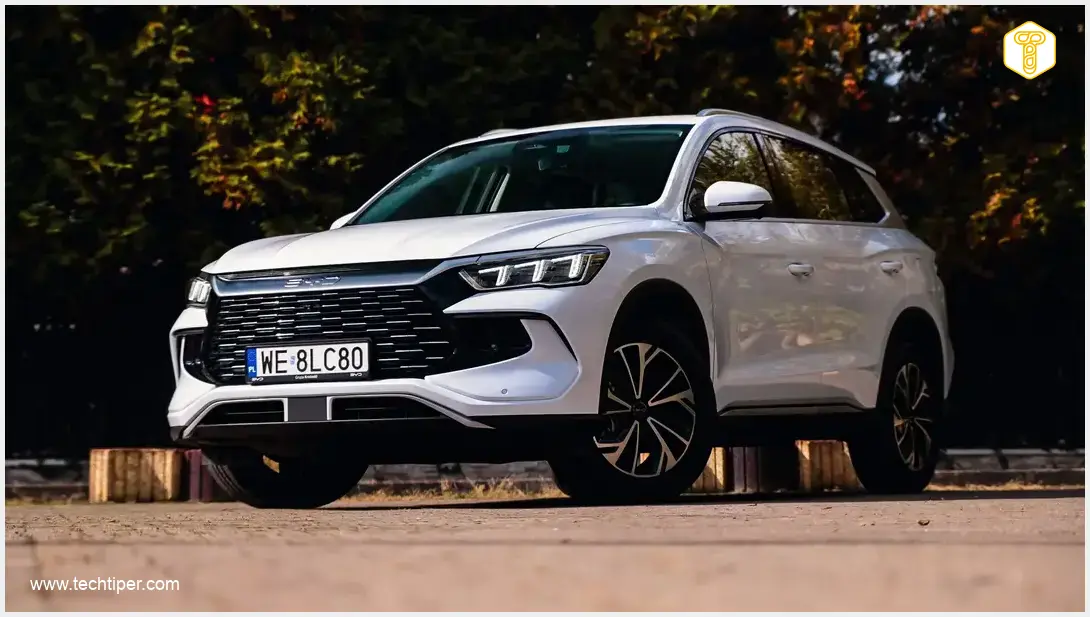
BYD Sealion 5 DM-i Review
-
Powertrain & Driving Experience
-
Interior Quality & Comfort
-
Technology & Multimedia
-
Practicality (Space & Trunk)
-
Value for Money & Pricing
-
Driver Assistance Systems
A Well-Priced, Practical Hybrid SUV with Room for Software Refinement
The BYD Sealion 5 DM-i stands out as a large, comfortable, and well-priced SUV, primarily thanks to its highly effective and fuel-efficient plug-in hybrid powertrain. It delivers a smooth, electric-like driving experience with impressive range and ample cabin space for families. While its interior quality and overall value are strong, BYD still needs to refine its software, particularly regarding localization and the intrusiveness of some driver assistance systems. Limited customization options and a modest trunk capacity are also points for consideration.
Advantages
- Highly effective and sensible plug-in hybrid powertrain
- Low fuel consumption and impressive electric range
- Smooth, electric-like driving experience
- Spacious and comfortable cabin, especially for passengers
- Good quality interior materials and solid fit-and-finish
- Competitive pricing and impressive warranty package
- Excellent 360-degree camera system with detailed views
- Wireless Android Auto and Apple CarPlay functionality
Disadvantages
- Software localization issues (translation errors, truncated messages)
- Overly sensitive driver monitoring camera
- Adaptive cruise control can be jerky and slow to accelerate
- Limited customization options for interior features
- Modest trunk capacity for a vehicle of its size
- Slow 3.3 kW onboard charger
- Integrated, non-adjustable headrests
- Extensive use of “piano black” trim in the interior
- Large turning circle for its segment
Contents
BYD Sealion 5 DM-i Review: A Great Large Hybrid That Isn’t Designed to Excite
We’re diving into a comprehensive review of the BYD Sealion 5 DM-i, a substantial SUV featuring a plug-in hybrid powertrain. While its pricing is undeniably a factor, this model isn’t solely aiming to compete on cost. It exemplifies how Chinese brands are becoming increasingly confident in the global market, prompting consumers to consider if investing in a different offering from the same manufacturer might even be worthwhile. BYD aspires to position itself closer to the premium segment, which presents considerable challenges for the Sealion 5 DM-i. Our goal is to dissect this model thoroughly to help you understand who this vehicle is best suited for.
Pricing and Configuration
The BYD Sealion 5 DM-i is offered with a straightforward configuration, making the buying process simple. There’s only one powertrain available—the DM-i plug-in hybrid—and a single trim level, “Design.” This streamlined approach leads to a base price of approximately $37,500 USD. During the publication of this review, a promotional offer reduced the price to around $34,125 USD (Note: these are approximate conversions from Polish Zloty and actual prices may vary by region and exchange rate).
BYD stands out with an impressive warranty package: the Sealion 5 DM-i is fully covered for 6 years or 150,000 kilometers (approximately 93,000 miles). The traction battery boasts an 8-year or 250,000-kilometer (approximately 155,000 miles) warranty, and protection against body perforation extends for 12 years.
Customization Options
The customization options for the BYD Sealion 5 are minimal. The only choice impacting the price is the exterior paint color. A basic blue is standard, while white, gray, or black metallic paints incur an additional cost of roughly $975 USD. Interior personalization is limited to color schemes: either an all-black cabin or a combination of white and brown, a choice purely based on personal taste.
The reviewed model, for instance, is white with a dark interior, bringing its final price to about $38,475 USD. With promotional discounts, this dropped to approximately $35,100 USD. While this pricing is competitive, it brings the Sealion 5 DM-i close to the cost of a better-equipped BYD Seal U DM-i, which starts around $38,025 USD.
Estimated Insurance Costs
Insurance costs for the BYD Sealion 5 DM-i will vary significantly based on location, driver profile, and chosen coverage. As an estimate, basic third-party liability insurance for a driver with several years of experience could be around $170 USD annually, while a comprehensive package (including collision) might cost approximately $775 USD. We recommend obtaining personalized quotes from local providers for accurate figures.
Technical Specifications
Under the hood, the BYD Sealion 5 DM-i features a 1.5-liter naturally aspirated gasoline engine producing 98 horsepower (hp) and 126 Nm of torque. Its primary role is to charge the traction battery, allowing the electric motor to handle most of the propulsion. The electric motor delivers 197 hp and 300 Nm of torque. In demanding situations, both engines can power the front wheels, resulting in a combined system output of 212 hp and 300 Nm. Power is sent to the front wheels via a CVT (Continuously Variable Transmission).

As a Plug-in Hybrid Electric Vehicle (PHEV), the 18.3 kWh battery can be charged from an external power source, offering an estimated 86 kilometers (approximately 53 miles) of electric range in a mixed driving cycle. The Sealion 5 DM-i is a sizable SUV, measuring just over 4.7 meters (about 15.4 feet) in length. While it sits at the intersection of C and D segments, it formally falls into the latter, making it a robust family vehicle prioritizing comfort over sporty performance.
A Brief History of the BYD Sealion 5 DM-i
Understanding the Sealion 5’s lineage requires clarifying its global nomenclature. The model sold as the Sealion 5 DM-i in international markets is known as the Song Pro in its home market. The Song Pro first debuted in 2015, with its second generation, which forms the basis of the reviewed model, arriving in 2019. Despite its age by European standards, it was introduced to markets like Poland in June 2023.
Over the years, the Song Pro has undergone three facelifts, with the most recent in 2024, sometimes presented as a new generation. However, the variant available in many international markets is based on the second facelift from 2023, which brought not only stylistic changes but also a notable increase in length by 8 centimeters (about 3.15 inches).
Further complicating matters, China has already seen the second generation of the Sealion 05 (not to be confused with our review subject) debut in early 2026. This highlights the intricate and sometimes region-specific product strategies of Chinese manufacturers, with no immediate plans announced for the global expansion of this particular model. Similarly, the Sealion 05 EV, a smaller variant with distinct styling and technology, has not been introduced internationally, underscoring the fragmented approach to model rollouts.
The BYD Sealion 5 DM-i competes in the D-segment SUV class, directly challenging other Chinese PHEV offerings like the Omoda 7 Super Hybrid and Jaecoo 7 Super Hybrid. Its broader, more expensive rivals include established models such as the Hyundai Tucson, Kia Sportage, Toyota RAV4, Skoda Kodiaq, and Ford Kuga.
BYD Multimedia System
The BYD Sealion 5 welcomes occupants with a deeply customized Android-based infotainment system. While the Android foundation is evident, it still feels somewhat hastily adapted for international markets. This is apparent in translation errors and truncated messages, though the system performs well in terms of functionality and speed. An improved interface could better utilize the available screen space ergonomically, though the split-screen mode offers some relief. Users generally adapt to its quirks after a few days.
Central Screen
Unlike some BYD models known for their rotating central displays, the Sealion 5 features a fixed, horizontal 12.8-inch screen. The system doesn’t require a driver profile, granting full access to all features, though some functionalities depend on an internet connection. The factory-provided 3GB monthly data plan is often insufficient, necessitating an external Wi-Fi connection. Unfortunately, connecting to external Wi-Fi disables Android Auto and Apple CarPlay, which is a clear area for improvement.
The main screen features a large wallpaper and customizable, scrollable widgets. Themes and background images can be personalized, alongside a persistent bottom bar for managing icons and a pull-down notification shade. The app list includes useful options like Spotify and YouTube, though it could benefit from expansion to rival other platforms.
The integrated user manual is only available in English, with no option to change the language. The voice assistant understands commands but requires precise articulation of predefined phrases. Climate control is fully managed via the central screen; however, the temperature adjustment buttons on the bottom bar are small and lack tactile feedback, requiring visual confirmation. Quick settings for features like heated seats can be added as shortcuts for easier access while driving.
Additional comfort functions, such as lighting and central locking, are basic. A positive feature is the simple system for adjusting the power tailgate’s opening height. However, the customizable button on the steering wheel has a very limited list of functions, often duplicating existing controls.
The 6-speaker audio system is a standard setup without external brand partnership. This results in average sound quality, acceptable for casual listening but lacking in detailed reproduction, particularly in the lower frequencies.
Navigation, Android Auto, and Apple CarPlay
The built-in navigation offers a good map database, though some recently added roads might be missing. Google-backed search functionality for points of interest is a plus, but zooming can be sluggish. A useful feature is the live display of available charging stations. The system also provides alerts for traffic congestion and school zones (30 mph limits), with customizable notifications to prevent sensory overload.
Both Android Auto and Apple CarPlay are available wirelessly and function seamlessly. Unlike some other BYD models where the top and bottom bars are hidden, the Sealion 5 utilizes the full screen, improving user experience. The digital instrument cluster, however, only displays multimedia details (with album art) from these platforms, not navigation information.
Digital Displays
The 8.8-inch TFT digital instrument cluster, while not large, is adequately clear. Although it presents a substantial amount of information, drivers quickly learn to focus on relevant data. Customization is basic, with two themes that primarily change whether driver assistance views or a larger speedometer are central. Side widgets can also be removed for a cleaner look.
After each journey, a summary displays journey time, distance, energy consumption, and fuel used. Notably, there’s no option for an overall average fuel consumption figure, a common omission in some Chinese vehicles. While a 50-kilometer (approximately 31-mile) consumption history is available, calculating the average for an entire trip requires manual computation using the central screen—a simple parameter that many might find frustratingly absent.
BYD Sealion 5 Interior
The interior of the BYD Sealion 5 aims for a premium feel. Despite its relatively affordable price point and the platform’s age, the cabin doesn’t feel dated. Instead, it impresses with good quality materials and solid fit-and-finish, generally exceeding expectations for its segment. The pervasive use of “piano black” trim, however, is a drawback, as it quickly collects dust and shows fingerprints.
Keyless entry is standard, though its implementation is basic, requiring physical presses on buttons located on the rear door handles or tailgate. There are no internal sensors for automatic locking/unlocking. A convenient alternative is the hidden NFC module in the driver’s side mirror, which allows a paired smartphone to act as a digital key, eliminating the need for the physical fob.
First Row
Upon opening the doors of the BYD Sealion 5 DM-i, the first thing to appreciate is how they fully cover the body sill, preventing trousers from getting dirty when entering or exiting. As an SUV, its slightly elevated ride height ensures comfortable ingress and egress. The door panels feature a dark, well-executed design with soft-touch inserts, comfortable handles, and a reasonably sized storage compartment, all contributing to excellent ergonomics.
Seats
The front seats are notably comfortable and offer decent lateral support during cornering. Their soft cushioning contributes significantly to comfort, even on long journeys, defying the usual expectation that soft seats can lead to back fatigue. However, a significant drawback is the integrated, non-adjustable headrests. They are positioned forward, making it difficult to sit fully upright and potentially encouraging a slightly hunched posture, which can be noticeable on extended drives.
Both driver and passenger seats offer full electric adjustment, albeit limited to basic directions (forward/back, recline) with the added benefit of seat tilt. Both seats are heated, and the passenger seat is equipped with ISOFIX child seat anchors.
Steering Wheel
The BYD Sealion 5’s steering wheel is generally pleasant to hold, with a comfortable rim, though it lacks heating. Its two-way adjustment (tilt and telescopic) has a limited range, which might pose a challenge for taller drivers in finding an optimal driving position. The layout of the physical controls on the steering wheel spokes is intuitive, with clearly marked buttons and scroll wheels that are easy to locate by touch. However, the functionality of the customizable “star” button is quite restricted, often duplicating other controls or offering less critical functions like toggling Wi-Fi.
The left side of the wheel primarily manages cruise control functions, while the right side handles the digital instrument cluster and multimedia. An unusual detail is the light switch on the left stalk: the “0” position still activates automatic lights, switching to parking lights only when the transmission is in Park. A small, practical storage compartment for minor items is located near the driver’s left knee.
Dashboard
The dashboard design of the BYD Sealion 5, while relatively simple and showing some age, remains aesthetically pleasing and well-integrated. The floating screens are a matter of taste, but the overall fit-and-finish is commendable. The extensive use of “piano black” trim is a notable issue, as it quickly shows dust and fingerprints.
A camera on the driver’s A-pillar provides overly sensitive driver monitoring. Even glancing down at a traffic light can trigger “unfocused driver” warnings within seconds. Squinting in the sun or singing along to music also elicits alerts, leading to an abundance of notifications that often need to be manually deactivated.
Below the central screen are low-set air vents and a 15W wireless charging pad, offering convenient smartphone access. The center console between the seats features a substantial design with a gear selector and a series of physical buttons. While the presence of physical buttons is welcome, their functions are often limited to rarely used options, with essential controls like temperature adjustment being notably absent. This area also suffers from the ubiquitous “piano black” trim.
Further back, there are two cup holders and a non-adjustable, somewhat firm armrest positioned slightly too far rearward. Beneath it lies a reasonably deep storage compartment. The upper console’s limited practicality is somewhat offset by additional storage underneath, which also serves as a power hub. It includes a robust 12V (120W) socket and two impressive USB-C ports (one 18W, one 60W). An SD card slot is also present for playing media on the central screen.
The passenger-side glove compartment is adequately sized, and an overhead compartment is perfectly placed for glasses. Global lighting controls have been relocated to the central screen. The rearview mirror is not auto-dimming, and a constantly illuminated red eCall system diode can be distracting at night.
Second Row
The rear doors also effectively shield the sills from dirt. The trim quality in the rear matches the front, ensuring a consistent premium feel throughout the cabin. Entering the rear of the Sealion 5 is effortless. The rear bench offers ample space, comfortably accommodating passengers up to 2 meters (6.5 feet) tall. The completely flat floor allows for comfortable seating of three adults, though two passengers will find it more luxurious with the central armrest and integrated cup holders.
Additional amenities include seat-back pockets, two coat hooks, central air vents, and two USB-C ports (18W and 60W). ISOFIX child seat anchors are provided, though without upholstery protectors, care must be taken during installation.
Lighting
Upon first encountering the BYD Sealion 5 at night, the quality of its exterior lighting is impressive. Bright LEDs in the side mirrors illuminate the ground, and additional lights appear when the front doors open, ensuring puddles are visible. The charging port is also clearly illuminated, simplifying nighttime hook-ups.
However, the interior lighting is more basic, consisting of just four simple LED diodes that provide fundamental cabin illumination without any ambient or mood lighting. The trunk also features only minimal lighting. The lack of a panoramic sunroof, despite being depicted in digital displays and 360-degree camera views (suggesting its availability in other markets), is also a missed opportunity for the international model.
Trunk
Access to the Sealion 5’s trunk is generally good, with a wide opening typical of an SUV, though the load sill is slightly high. The power tailgate operates quietly (though a bit slowly) and its opening height can be precisely adjusted. However, the control button is awkwardly placed low, near the bumper. While gesture control for the tailgate is absent, a convenient central locking button inside the tailgate is a thoughtful addition.
The trunk offers a modest 463 liters (approximately 16.35 cubic feet) of capacity, which is not particularly generous for a vehicle of this length, primarily due to the traction battery’s placement. This somewhat limits cargo organization. Folding the 60:40 split rear seatbacks (without a ski pass-through) expands the capacity to 1410 liters (approximately 49.79 cubic feet). The trunk also includes a false floor with a simple organizer. Amenities are sparse, with only net hooks, a single light, and wheel well recesses—conspicuously missing features like cargo hooks or a 12V outlet. For those needing more capacity, the BYD Sealion 5 DM-i has a towing capacity of up to 750 kg (approximately 1,650 lbs) for a braked trailer.
Driving Impressions
The BYD Sealion 5 DM-i is engineered for comfortable, everyday travel rather than exhilarating performance. It’s a reliable and pleasant means of transport, with a well-balanced chassis that prioritizes comfort. It isn’t a sports car, and that’s perfectly fine.
A notable drawback is its turning circle. The Sealion 5 requires a substantial 12 meters (about 39.4 feet) to make a U-turn, which is considerable for an SUV just over 4.7 meters (15.4 feet) long. This demands extra caution in tight maneuvers.
Beyond this, the steering system performs well. Its stiffness can be adjusted independently of the driving mode, and the difference in power assistance is palpable. While precision is adequate, the steering feels light during parking and low-speed maneuvers, allowing drivers to quickly become accustomed to the vehicle’s behavior. The suspension, combined with 18-inch wheels and higher-profile tires, might initially feel overly soft. However, it exhibits a pleasant balance of firmness and stability, effectively absorbing road imperfections without creating an overly plush “floating” sensation.
Driving Dynamics
The Sealion 5 DM-i’s powertrain delivers satisfying driving dynamics. Its DM-i plug-in hybrid system features a 1.5-liter naturally aspirated engine (98 hp, 126 Nm) that primarily acts as a generator, and a 197 hp (300 Nm) electric motor that provides the main propulsion. The combined system output of 212 hp and 300 Nm is directed to the front wheels via a CVT. This isn’t a traditional hybrid setup; the electric motor takes the lead, with the gasoline engine mostly charging the battery and only assisting directly under extreme conditions, ensuring remarkably smooth power delivery.
On paper, the Sealion 5 DM-i accelerates from 0 to 100 km/h (0-62 mph) in 8.1 seconds. In practice, our tests showed a quicker 7.8 seconds, a consistently good result achieved with little effort, though drivers need to manage potential wheel slip from the front-wheel drive. The in-built digital timer in the instrument cluster was found to be inaccurate, often understating acceleration times by about 0.5 seconds.
BYD offers three standard driving modes: Eco, Normal, and Sport, plus a Snow mode. These primarily adjust throttle response and the frequency of the gasoline engine’s activation. Snow mode specifically limits electric motor torque to prevent wheel spin on slippery surfaces.
The DM-i system is exceptional, blending the best attributes of electric driving with the extended range of a conventional internal combustion engine. It delivers a remarkably smooth and serene experience, akin to driving an EV, particularly in urban settings. Transitions between EV and HEV (Hybrid Electric Vehicle) modes are almost imperceptible, and the vehicle’s character remains consistent regardless of battery charge level. This makes for a highly refined and intuitive driving experience.
Despite not being a performance vehicle, the electric-first propulsion provides dynamic acceleration that is smooth and comfortable, without any harshness. This overall dynamism perfectly suits the needs of the Sealion 5’s target audience, enabling confident cruising, safe overtakes, and capable highway performance. In the city, the vehicle feels distinctly electric—quiet, responsive from a standstill, and completely silent if the battery is charged.
The cabin is generally quiet, with surprisingly good engine sound insulation. The engine’s operation is only clearly audible under maximum load; otherwise, it’s barely noticeable, even during transitions, making the CVT virtually unnoticeable. However, wind noise at higher speeds is more pronounced, particularly around the side windows, A-pillars, and wheel arches, although it’s still not excessively loud.
While the BYD Sealion 5 DM-i features a sophisticated hybrid system, regenerative braking options are available in the settings: “Standard” and “High.” We recommend selecting “High” for more effective energy recovery, even if its overall strength isn’t exceptionally strong. The steering assist can also be adjusted, as can the brake pedal feel, with “Comfort” and “Sport” settings. The “Sport” brake mode provides aggressive deceleration with light pedal pressure but reduces regenerative braking efficiency, making “Comfort” the more suitable choice for the vehicle’s character.
Fuel Consumption, Energy Usage, and Range
The BYD Sealion 5 DM-i comes equipped with a 52-liter (approximately 13.7-gallon) fuel tank and an 18.3 kWh battery, a sensible combination for a large SUV. BYD claims a total combined range of over 1,000 kilometers (approximately 620 miles) without refueling or recharging. Our tests were conducted at an ambient temperature of approximately 15 degrees Celsius (59 degrees Fahrenheit).
Hybrid Mode (Depleted Battery)
Operating with a depleted battery (around 25% charge, where EV mode is unavailable), the Sealion 5 DM-i behaves like a conventional hybrid. In city driving, fuel consumption is impressive, easily achieving 4.7 liters per 100 kilometers (approximately 50 miles per gallon), potentially offering a range of around 1,100 km (683 miles). Even with dynamic driving, it’s challenging to exceed 7 L/100km (approximately 33.6 mpg).
Suburban driving at a constant speed of around 80 km/h (50 mph) yields about 5.3 L/100km (approximately 44.4 mpg), translating to a range of around 980 km (609 miles). On highways, the gasoline engine is more actively engaged, leading to the following consumption figures:
- 100 km/h (62 mph): 5.7 L/100km (approximately 41.3 mpg), range ~910 km (565 miles)
- 120 km/h (75 mph): 7.3 L/100km (approximately 32.2 mpg), range ~710 km (441 miles)
- 130 km/h (81 mph): 8 L/100km (approximately 29.4 mpg), range ~650 km (404 miles)
- 140 km/h (87 mph): 8.6 L/100km (approximately 27.3 mpg), range ~600 km (373 miles)
The electric motor is highly effective up to about 100 km/h (62 mph). At higher speeds, the gasoline engine consistently contributes, but these figures remain very respectable for a large SUV operating with a discharged battery.
Electric Range and Charging
As a PHEV, the Sealion 5 can be driven purely on electric power for significant distances. BYD claims up to 120 km (75 miles) in urban conditions or 80 km (50 miles) in a mixed cycle. Our tests achieved 70 kilometers (43 miles) without engaging the gasoline engine, covering roughly 40 km (25 miles) in the city, 15 km (9 miles) on country roads, and 15 km (9 miles) on expressways. With careful driving, over 100 km (62 miles) in city conditions seems achievable.
Despite the impressive electric range, the Sealion 5 DM-i features a slow 3.3 kW (Type 2) onboard charger. This is one of the lowest ratings on the market, requiring approximately 6 hours for a full charge, whereas many competitors achieve this in around 2 hours. The advantage, however, is that virtually any standard electrical outlet can provide its maximum charging power. For those interested in faster charging solutions, you can learn more about BYD’s Megawatt EV charging in Europe.
The vehicle also supports V2L (Vehicle-to-Load) technology, allowing it to power external devices, and offers charging schedules. A “SAVE” mode can be activated to maintain a specific battery charge level, even using the gasoline engine to achieve it, though this is not the most efficient method.
Driver Assistance Systems
The BYD Sealion 5 DM-i comes equipped with a comprehensive suite of driver assistance systems, which appear robust on paper for its price and size. These systems are well-documented and offer basic customization. We recommend taking time after your first long drive to deactivate the more intrusive alerts, particularly the overly sensitive driver monitoring camera.
The traffic sign recognition system is generally accurate, though it occasionally misreads speed limits from side roads. The audible alert for exceeding the speed limit is clear but can be quickly dismissed via an icon on the central screen. The side mirrors are well-sized and effective, complemented by blind-spot monitoring and rear cross-traffic alert systems.
The adaptive cruise control, while offering predictive capabilities, has some quirks. It’s advisable to disable the predictive function for smoother driving, as deceleration can be jerky and abrupt, especially when detecting other vehicles. Acceleration, conversely, is quite slow. While these characteristics are more uncomfortable than unsafe, they require adjustment.
Lane-keeping assist effectively and quickly identifies lane markings, maintaining the vehicle’s position well. However, the steering wheel stiffens significantly when this system is active, making minor corrections (e.g., to avoid debris) feel counterintuitive and requiring a period of adaptation.
The standard LED headlights, despite appearing basic, provide an impressively wide and consistent beam, almost resembling active cornering lights. While their overall range could be better, the brightness and light distribution are commendable. The automatic high beam function is overly cautious, often requiring manual activation before the system engages.
The 360-degree camera system is a standout feature, offering excellent image quality, particularly from the side cameras. It provides numerous detailed visualizations, including precise views of the front wheels, aided by constant illumination from projectors in the mirrors. The system also rapidly adapts its view type to prevailing conditions. However, this adaptability can be a drawback in tight spaces like garages, where the system might stubbornly prioritize side views even when a front or rear view is preferred for maneuvering towards a wall.
Summary and Our Opinion
The BYD Sealion 5 DM-i is a large, well-priced SUV distinguished by its highly effective and sensible plug-in hybrid powertrain. Its low fuel consumption, smooth electric-like driving (even when using gasoline), and spacious cabin make it a comfortable and practical vehicle for everyday travel. The DM-i system is a significant strength, offering a refined driving experience that blends electric efficiency with the convenience of extended range.
However, BYD still needs to refine its software. Localization issues, including translation errors and ergonomic quirks, are noticeable. The driver assistance systems, particularly the driver monitoring camera, are overly sensitive and would benefit from reduced intrusiveness or greater user control over their intensity. Furthermore, the Sealion 5 offers very limited configuration options; some buyers might appreciate the ability to upgrade to a better audio system, a heated steering wheel, or an auto-dimming rearview mirror, or to reduce the amount of “piano black” trim in the interior.
Frequently Asked Questions (FAQ)
The Sealion 5 DM-i features an excellent plug-in hybrid system that delivers a smooth, electric-like driving experience, even when the gasoline engine is active. It offers impressive fuel efficiency and a substantial electric-only range, making it highly economical for daily commutes and longer journeys.
As a large SUV, the Sealion 5 DM-i offers a spacious interior, comfortably accommodating up to five adults with ample legroom. Its thoughtful design includes features like doors that cover the sills to prevent dirt, multiple USB-C ports, and ISOFIX anchors. While the trunk capacity is modest due to the battery, the overall comfort and size make it a practical choice for family use.
Key areas for improvement include software localization (translation errors), refinement of driver assistance systems (reducing over-sensitivity), and expanding customization options. Buyers would appreciate choices for audio upgrades, a heated steering wheel, an auto-dimming rearview mirror, and less “piano black” trim in the interior.
The BYD Sealion 5 DM-i offers a compelling value proposition, providing a well-equipped, large plug-in hybrid SUV at a competitive price point. Its impressive powertrain, generous warranty, and spacious cabin make it an attractive option, even when compared to more established and often pricier rivals in the D-segment SUV market.
Source: self-prepared. Opening photo: Lukas Pajak
About Post Author
