

Contents
China’s Quantum Leap: A Cryogenics-Free Computer for Data Centers
At the World Artificial Intelligence Conference (WAIC) 2026 in Shanghai, a groundbreaking quantum computer was unveiled, promising to redefine the landscape of quantum technology. The device, developed by Chinese startup Zhongqi Wuliang, claims it can be integrated directly into standard server racks without requiring the complex and costly cryogenic infrastructure typically associated with quantum systems.
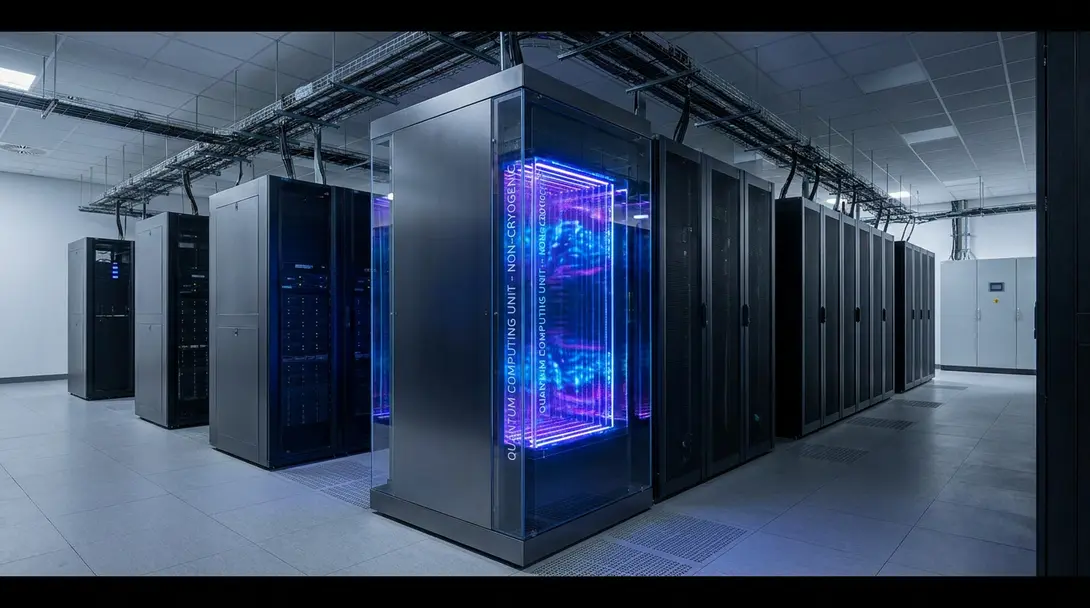
The Qinghe No. 1: A Quantum Computer for Standard Data Centers
Named “Qinghe No. 1,” this quantum computer was designed with a revolutionary approach: compatibility with existing data center environments. Its key innovation lies in eliminating the need for large cryogenic cooling systems and specialized, expensive laboratories. This presents a stark contrast to most quantum computers currently under development, particularly those based on superconducting technologies.
Superconducting quantum computers, championed by many Western market leaders, demand extremely low temperatures – often near absolute zero. Achieving these conditions requires elaborate and costly cooling setups, necessitating dedicated infrastructure and significant operational expenses. The Qinghe No. 1 aims to bypass these challenges entirely.
Neutral Atom Architecture: The Key to Simplicity
The innovation behind Qinghe No. 1 is its reliance on a neutral atom architecture. In this design, individual atoms are precisely controlled using focused laser beams and cooled through laser-based techniques within a vacuum chamber. This method inherently removes the dependency on external cryogenic installations, making the system far more compact and accessible.
This development signifies a potential paradigm shift, making quantum computing more amenable to widespread deployment in commercial data centers. It also aligns with broader trends in AI innovation, including advancements in conversational AI and visual search, which will increasingly benefit from more powerful and accessible computing capabilities. Discover more about Google Gemini 3.1 Flash, live AI conversations, and visual search.
The Quantum Race Accelerates: Questions Remain
While the prospect of a cryogenics-free quantum computer is exciting, Zhongqi Wuliang has yet to disclose crucial technical specifications. Key parameters such as the number of qubits, coherence time, and the accuracy of quantum gates remain undisclosed. Therefore, claims regarding the device’s competitive performance require independent verification by the scientific community.
The growing interest in neutral atom architecture is not confined to China. In recent months, tech giants like Google have launched new research programs exploring neutral atom quantum computers, viewing them as a complementary technology to their long-standing work with superconductors. Similarly, companies such as QuEra, Pasqal, Atom Computing, and Infleqtion are actively pursuing similar solutions, underscoring that this approach is moving beyond pure scientific experimentation and into serious commercial development.
Experts emphasize that the ultimate success of Qinghe No. 1 will not be determined by impressive demonstrations at trade shows alone. Instead, it will hinge on the publication of detailed research results and their subsequent confirmation by independent scientific bodies. Only then can a conclusive assessment be made regarding whether its compact design genuinely delivers the performance required for practical applications in areas such as optimization, logistics, and material simulations. This continued pursuit of advanced computing power highlights the ongoing global effort to push technological boundaries, even as some debates about the future of AI unfold, as seen in discussions around whether the AI revolution has been canceled and Microsoft’s strategic shifts.
Frequently Asked Questions (FAQ)
The Qinghe No. 1 quantum computer’s primary advantage is its ability to operate without costly and bulky cryogenic cooling infrastructure, allowing it to be integrated directly into standard server racks within conventional data centers. This significantly reduces the complexity and expense of deploying quantum computing technology.

Traditional superconducting quantum computers require extreme sub-zero temperatures, necessitating complex cryogenic cooling systems. In contrast, neutral atom architecture, as used by Qinghe No. 1, controls and cools individual atoms using precise laser beams within a vacuum chamber, eliminating the need for external cryogenic installations.
Independent scientific verification is crucial because it ensures the credibility and accuracy of performance claims. Without published data on key metrics like qubit count, coherence time, and quantum gate accuracy, and their validation by the broader scientific community, it is difficult to assess a quantum computer’s true capabilities and its potential for practical, real-world applications beyond laboratory demonstrations.
Source: Tech Times, Own elaboration.
Opening photo: Audio und werbung / Shutterstock
About Post Author
