

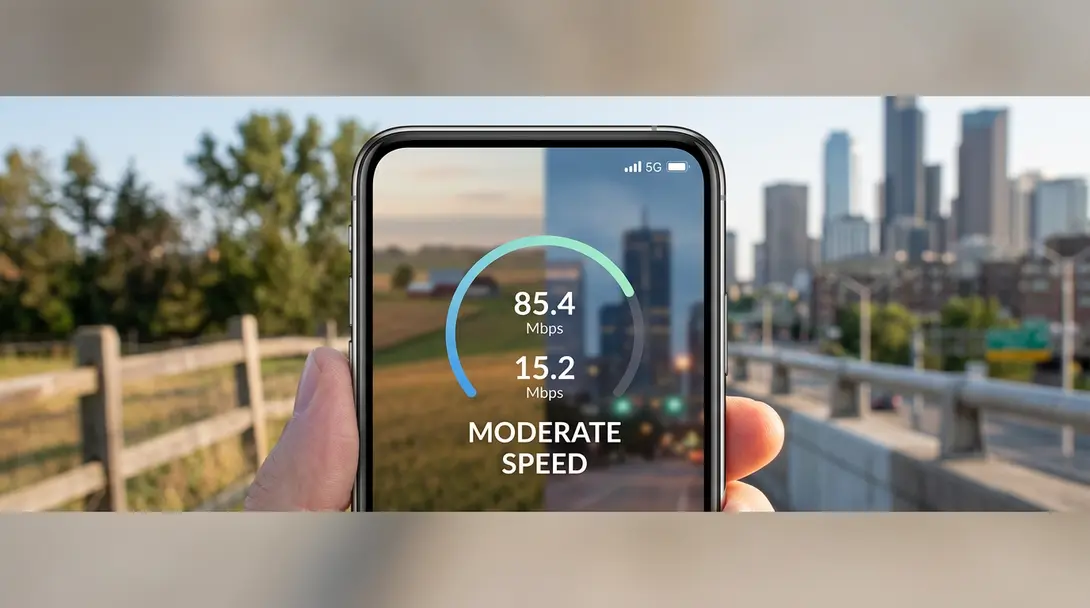
It’s a common assumption: the more signal bars on your phone, the faster your internet connection. However, the complex reality of modern mobile networks often challenges this straightforward belief. While urban environments can make verifying this difficult due to ubiquitous coverage, our dedicated TechBusters tester embarked on a journey deep into a rural region to conduct a definitive test.
Contents
The Signal Bar Myth: Is More Always Faster?
The idea that full signal bars equate to lightning-fast internet is deeply ingrained in how we perceive mobile connectivity. But is this perception truly accurate in today’s technologically advanced landscape? Our investigation aimed to settle this debate once and for all.
Real-World Testing: From Rural Villages to Urban Hubs
After weeks of exploring various locations, our TechBusters tester focused on the task at hand. The planned study, part of our ongoing TechBusters series, was carried out in a small village named Suchodębie, located in a rural region of Poland. According to the 2021 Polish National Census, the village had a population of just 42 residents, providing an ideal low-density environment for testing.
@techbusterspl Obalamy najpopularniejszy technologiczny mit. Czy zasięg = szybkość internetu? #techbusters #mity #telefon #internet #dc ♬ oryginalny dźwięk – TechBusters
Upon arriving at the designated spot, our tester observed five signal bars and an active 5G connection on his smartphone. A subsequent internet speed test yielded approximately 61 Mbps. Interestingly, when inside a cottage in the same village, where the signal dropped to four bars, the measurement surprisingly showed a faster speed of up to 75 Mbps. This initial finding immediately suggested that the number of bars might not be the sole indicator of speed.
Our tester then proceeded to a larger city, Zamość. As soon as four bars with a 5G connection appeared, he repeated the speed tests. Here, the results were more aligned with expectations, with measurements ranging from 118 to 131 Mbps, significantly higher than in the rural setting.
Unpacking the Signal Icon: What Your Phone Really Shows
These results become less perplexing once we understand what the signal icon on your screen truly represents. It indicates the approximate strength of the signal your device is receiving, which is only one of many factors influencing internet connection speed.
Signal bars held more significance in the early 2000s when mobile network coverage wasn’t as widespread or robust. At that time, a strong signal often directly correlated with a usable connection, making the system more informative in a simpler network environment.
It’s also crucial to note the network type displayed – whether it’s 5G or LTE. While 5G generally promises significantly higher speeds, LTE (Long-Term Evolution) typically delivers noticeably lower performance, even with a strong signal.

Beyond the Bars: True Determinants of Mobile Internet Speed
The actual speed of your mobile internet connection depends on several parameters that aren’t visible on your smartphone’s status bar. Understanding these helps demystify why full bars don’t always mean fast internet:
- Transmitter Load: The most critical factor is the load on the cell tower (transmitter) you are connected to. Even with a strong signal, if many users are connected to the same tower and actively using data, your speed will decrease due to network congestion. This is comparable to a highway – even if it’s well-built, traffic jams will slow everyone down.
- Network Congestion: High usage within a specific cell sector or overall network traffic can drastically reduce speeds.
- External Interference: Obstacles such as buildings, dense foliage, topography, and even weather conditions can weaken signal quality and introduce interference, irrespective of the displayed bars.
- Network Technology: The generation of network you’re connected to (e.g., 5G, 4G/LTE, 3G) inherently limits the maximum possible speeds.
- Device Capabilities: Your smartphone’s hardware and software also play a role. Older devices may not support the latest network technologies or efficiently process high speeds.
This explains phenomena like why coastal tourist towns sometimes faced severe internet issues during peak holiday seasons. The local infrastructure, designed for a smaller resident population, was simply overwhelmed by the sudden influx of thousands of tourists all trying to use the internet simultaneously. Understanding these factors can help you make the most of your mobile connection, perhaps even by learning how to turn an old phone into a Wi-Fi hotspot extender to improve signal distribution at home.
Debunking More Tech Myths with TechBusters
As TechBusters, we’ve investigated and debunked many other common technological myths. Explore some of our other findings:
- Does a thermal blanket actually cool a room?
- Can you build an electric motor at home?
- Can a photo of your face unlock your smartphone?
- Do washing machines lie about wash times? We measured it!
- Change this color on your phone screen to instantly see if you have a problem.
For users exploring advanced connectivity options, understanding network limitations is key, especially with emerging technologies like satellite connectivity apps on devices like the Samsung Galaxy. Staying informed about how your devices connect and perform is crucial in today’s connected world.
Frequently Asked Questions (FAQ)
Full signal bars indicate strong signal strength from the nearest cell tower, but not necessarily fast internet speed. Your speed can be significantly affected by factors like network congestion (too many users on the same tower), the tower’s overall capacity, and external interference, regardless of how strong your signal appears.
5G is the fifth generation of cellular technology, designed to deliver much higher speeds, lower latency, and greater capacity compared to its predecessor, LTE (Long-Term Evolution, or 4G). While LTE offers reliable speeds for everyday tasks, 5G networks can achieve speeds many times faster, enabling smoother streaming, quicker downloads, and supporting more advanced applications. Your phone will usually display which network type you are connected to.
Yes, absolutely. Physical obstructions such as thick walls, large buildings, hills, or even dense foliage can block or weaken cellular signals, leading to slower speeds or dropped connections. Severe weather conditions like heavy rain or snow can also interfere with signal transmission, temporarily degrading your mobile internet performance. These factors affect the quality of the signal, even if your phone might still display a moderate number of bars.
Source: TechBusters own research. Opening photo: Gemini
About Post Author
