

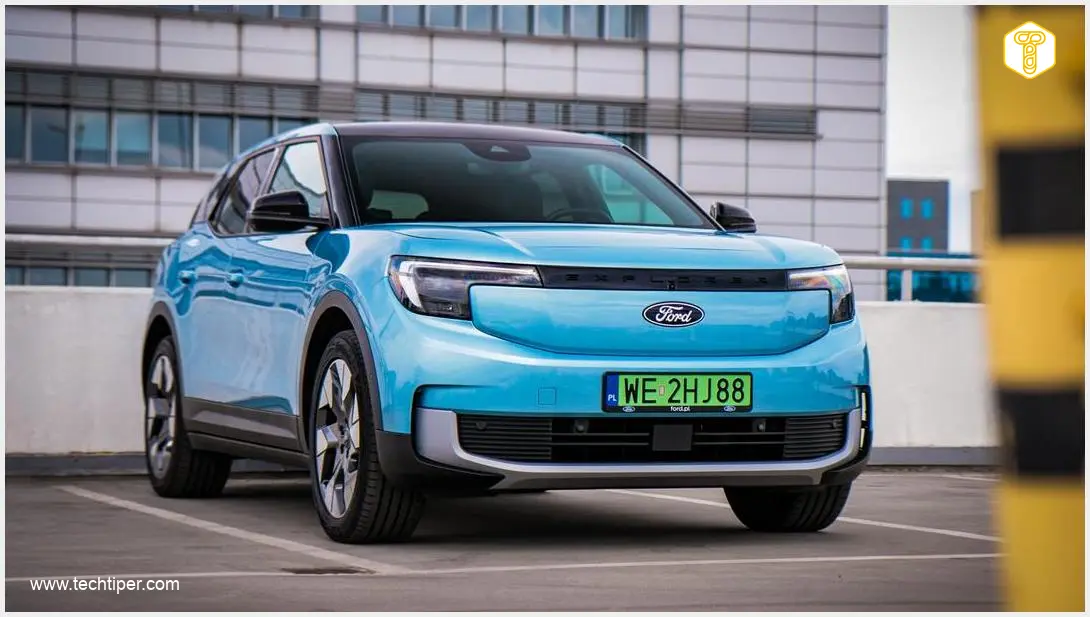
Ford Explorer EV Review
-
Comfort
-
Practicality
-
Driving Dynamics
-
Infotainment
-
Charging & Range
-
Driver Assistance
A Comfortable and Practical Electric SUV with a Ford Touch

The Ford Explorer EV, built on VW’s MEB platform, delivers a surprisingly comfortable and practical driving experience. While borrowing heavily from VAG technology, Ford successfully infuses its own identity, offering ample interior space, effective driver assistance, and decent charging capabilities, making it a compelling family EV despite some minor material and infotainment quirks.

Advantages
- High Comfort & Smooth Ride: Suspension prioritizes comfort, effective bump absorption, and good sound insulation.
- Exceptional Practicality & Interior Space: Ample room, clever storage solutions (movable screen, spacious console), optional frunk, and large trunk.
- Effective Driver Assistance Systems: Unobtrusive and reliable adaptive cruise control, lane-keeping assist, 360-degree cameras, and lighting.
- Strong Drivability & Maneuverability: Ample power for swift travel, good steering precision, and excellent turning circle.
Disadvantages
- Mixed Interior Material Quality & Controls: Noticeable drop in material quality in the second row, cumbersome touch-sensitive steering wheel and window controls.
- Infotainment System Quirks: While robust, it’s a VAG system with less Ford character; some charging status issues and camera display limitations.
- Key Features as Optional Extras: Heat pump and frunk are crucial EV features but are optional.
- No 22 kW AC Charging: Limits home/hotel charging flexibility compared to some rivals.
Contents
Ford Explorer EV Review: A Comfortable and Practical Electric SUV
We’re embarking on a test drive of the Ford Explorer EV, a vehicle that has achieved considerable popularity, particularly in the United States, though perhaps not always with the “EV” suffix. Naturally, these two letters signify an electric vehicle, which means we’re dealing with not just a different powertrain, but a fundamentally distinct design compared to the larger internal combustion engine (ICE) SUVs familiar from the US market. While its underpinnings are familiar from other Volkswagen Group (VAG) electric models, Ford has imbued it with its characteristic American essence.
With that distinction established, it’s time to delve into Ford’s latest foray into electromobility. In this instance, Volkswagen contributed significantly to the platform, but Ford has unmistakably infused it with its own brand identity. Let’s explore the outcome of this collaboration and examine the advantages and disadvantages of the Ford Explorer EV.
Ford Explorer EV Pricing and Trim Levels
The Ford Explorer EV is available in a single body style but offers three powertrain options and four trim levels. As of this review’s publication, the pricing for available configurations in the local market (Polish Zloty – PLN) is as follows:
- Style:
- 58 kWh, 190 HP, RWD: 203,750 PLN
- Explorer:
- 79 kWh, 286 HP, RWD: 218,750 PLN
- 77 kWh, 340 HP, AWD: 247,750 PLN
- Collection:
- 79 kWh, 286 HP, RWD: 235,750 PLN
- 77 kWh, 340 HP, AWD: 260,750 PLN
- Premium:
- 58 kWh, 190 HP, RWD: 224,750 PLN
- 79 kWh, 286 HP, RWD: 235,750 PLN
- 77 kWh, 340 HP, AWD: 260,750 PLN
It’s worth noting that these are regular prices, which are frequently subject to significant discounts, sometimes up to 35,000 PLN (gross). This can bring the cost of the most expensive models down to under 226,000 PLN, making it a highly compelling offer in the market. Additionally, a complimentary wallbox charger is included with the purchase.
The standard warranty for the Ford Explorer EV is 2 years with unlimited mileage. However, this can be extended to 8 years (or 160,000 kilometers), matching the warranty period for the traction battery. Opting for Ford Protect packages is advisable for extended peace of mind, though it requires servicing exclusively at authorized service centers.
Optional Equipment on the Tested Model
The tested Ford Explorer EV is the Premium variant with the most powerful AWD powertrain, initially priced at 260,000 PLN, or 225,000 PLN with discounts applied. Additional optional equipment included:
- Driver Assistance Package (including 360-degree cameras, lane-keeping assist, V2L support, HUD): 8,900 PLN
- Heat Pump: 6,300 PLN
- Panoramic Roof: 5,400 PLN
- Electrically deployable (partially) Tow Bar: 4,500 PLN
- B&O Sound System: 2,400 PLN
- AGR front seats with extended adjustment and massage function: 1,800 PLN
The final price of the tested model, with discounts and nearly all available options, exceeded 255,000 PLN. Unselected options included larger wheels (up to 21-inch) and a travel package (which includes a front trunk, or “frunk”). It’s particularly surprising that Ford charges extra for the heat pump, a crucial feature for EV efficiency, which buyers should definitely consider adding.
Ford Explorer EV Insurance Costs
According to data from Rankomat, comprehensive insurance (OC + AC) for the tested Explorer for a driver with several years of experience could cost approximately 7,000 PLN, with liability-only (OC) coverage around 470 PLN.
Technical Specifications of the Ford Explorer EV
Ford utilizes powertrains well-known from the Volkswagen Group, but beyond raw power, it’s worth noting the battery capacities. The base model, from 2026, features a noticeably larger battery (58 kWh compared to the previous 52 kWh). Nevertheless, the performance capabilities of the Explorer EV are quite impressive. As expected from an electric vehicle, dynamic driving is readily available, particularly with the AWD version.
From a practical standpoint, Ford has clearly strived to maximize interior space within this architecture, a necessity when considering its direct competitors. The result is ample room and convenient storage solutions. However, it’s advisable to thoroughly review the configurator (e.g., the Travel package with the frunk) to ensure all desired practical features are included.
Key dimensions include a length of approximately 4.5 meters, positioning it firmly within the C-segment SUV category.
A Brief History of the Ford Explorer EV
As mentioned earlier, the name “Explorer” often brings to mind a large, American SUV, almost an off-roader, produced since the 1990s. Over six generations, this traditional Explorer grew to over 5 meters in length, typically powered by robust gasoline engines. However, when we add the “EV” suffix, that image should be completely set aside.
The Explorer EV is an entirely different model, unrelated to its US counterpart and significantly smaller, measuring around 4.5 meters. In 2022, Ford decided to focus on electric vehicles in collaboration with Volkswagen, leading to models like the Explorer EV, which was launched at the end of 2023. The entire vehicle is based on the MEB platform, familiar from electric Skoda and VW models. While not merely a rebadged vehicle, similarities are noticeable throughout.
The Ford Explorer EV is a classic example of a C-segment electric SUV. Naturally, it competes with its platform siblings like the Skoda Elroq, VW ID.4, and Cupra Born, but also with a host of other models including the Leapmotor B10, MG S5 EV, Renault Scenic E-Tech, Kia EV5, or Hyundai Ioniq 5. This segment has become increasingly popular, underscoring the growing demand for electric powertrains.
Ford Explorer EV Infotainment System: Familiar Yet Different
The default operating system in most Fords is SYNC. However, the Explorer EV is an exception, featuring a fundamentally restyled platform from Volkswagen. Is this a drawback? Not necessarily, as some solutions are better here, and some are better elsewhere. Crucially, the Explorer EV reverses the vertical screen concept familiar from the VAG group, introducing a vertical display. Despite this, the overall principles remain nearly identical. Performance is robust, available functions are comprehensive, and the aesthetics are a matter of personal preference.
Regardless of the trim level, the Ford Explorer EV features two displays inside. The central, vertical screen measures 14.6 inches and is movable—more on that later. The second is a minimalist 5.3-inch digital instrument cluster. An optional head-up display (HUD) was also present in the tested model.
Central Screen Usability
Although Ford utilizes software developed by the VAG Group, it has streamlined the number of additional applications and various services, focusing on essential functionalities. Nevertheless, it’s still beneficial to log in with your driver’s account to unlock the full suite of features. While the differences aren’t drastic, this provides access to useful solutions, especially for remote management via smartphone.
The interface uses familiar “tiles” but arranged differently. What remains consistent with VAG systems is the extensive customization potential. Nearly all icons can be arranged to suit personal preferences, from the scrollable widget dashboard to the upper shortcut bar and the app list itself. A pull-down menu further complements this with additional quick-access functions.
The built-in voice assistant is functional, focusing on the car’s core features. There’s also an integrated owner’s manual and even a digital service book. Both are straightforward to use, offering basic information without advanced contextual assistance.
For navigation, a bar with essential controls is always visible at the bottom of the screen. Adjusting temperature or operating other functions is relatively convenient. You can also open a full-screen view to access smaller switches, including quick settings, which is a commendable feature.
Overall, Ford has adopted many excellent VAG solutions, including the ability to personalize various options related to seat behavior, central locking, and other modules. Ambient lighting with various color variations is also available, adding to the cabin’s appeal.
Unlike its VAG counterparts, the Explorer EV doesn’t feature an app store or extensive multimedia conveniences. Ford has focused on essential applications but hasn’t limited connectivity modules. A 5G modem, fully functional Wi-Fi, and Bluetooth are all standard.
In standard versions, the Explorer EV plays music through 7 speakers, while higher trims feature 10 speakers (including a subwoofer) and an additional amplifier, all branded with the B&O logo. The sound quality is quite good; while not truly premium, it certainly surpasses systems found in many other vehicles, including some Skoda models. There are no rattles, bass is impactful without being overwhelming, and sound separation is decent.
Navigation, Android Auto, and Apple CarPlay
The navigation system is another component Ford has borrowed from the VW Group, and this is a positive. The system is user-friendly due to its simplicity and additional settings options. It naturally includes a built-in database of charging stations. Our only minor criticism is that while live charging station status is displayed, it’s not always up-to-date. However, route calculation, map accuracy, and overall performance are excellent. For extended journeys, especially when considering charging stops, tools like EV route planning in Android Auto and Google Maps can significantly enhance the driving experience.
We have no complaints regarding Android Auto and Apple CarPlay. Both platforms operate wirelessly and effectively utilize the vertical interface. Performance is as expected, and navigation prompts are seamlessly transferred to both the digital instrument cluster and the head-up display.
Digital Instrument Cluster and HUD
The Ford Explorer EV, like many contemporary vehicles, features a compact digital instrument cluster. Despite its small size (5.3 inches), it is very clear and legible. There are no traditional dials, just concise indications without unnecessary embellishments, which proves entirely effective. Basic customization options are available.
Customization primarily involves selecting what information to display. This can include basic details like speed, battery charge level, and cruise control data. More comprehensive visualization of assistance systems, coupled with navigation prompts, can also be shown, or replaced with trip computer information.
Beyond these elements, the digital gauges in the tested Ford display contextual information such as lighting settings, cruise control status, and other notifications. The design prioritizes simplicity and achieves it effectively.
The head-up display (HUD) similarly focuses on providing essential information. It can also be customized to show the desired number of indications. Thus, alongside speed, navigation information and assistance system alerts can appear. Furthermore, Ford allows changing the display color from white to blue, which is useful in winter conditions to maintain readability when the surroundings are covered in snow.
Ford Explorer EV Interior: Prioritizing Practicality
While the operating system shares many similarities with VW, the Explorer EV’s interior also features elements common to models built on the same platform. Nevertheless, the Explorer EV is far from a mere rebadged vehicle. It incorporates numerous proprietary innovations, all contributing to a practical cabin that enhances the travel experience.
Regarding material selection, it’s difficult to pinpoint significant flaws. While the tested model doesn’t aim for the premium segment, there’s no squeaking or unpleasant-to-touch plastics. Yes, some harder plastics are present, but they don’t detract from the overall positive impression of the Explorer’s interior.
The keyless entry system in the Ford is a feature adopted from VW, and it’s implemented very well. It’s a comprehensive solution covering the front door handles, which feature sensors for both unlocking and locking the Explorer. Additionally, automatic central locking and unlocking can be activated as you approach or move away from the vehicle. The tailgate also features a sensor for electric opening without needing to unlock the entire car, including a foot-swipe gesture under the bumper.
First-Row Comfort: A Classic SUV Experience
The Explorer EV’s doors almost entirely cover the sills, meaning you shouldn’t worry about dirtying your trousers when entering. As an SUV, the ease of entry and exit in the first row is excellent. The doors open wide, and the seats automatically slide back to facilitate the process.
The door panels look aesthetically pleasing, though harder plastics dominate. They flex slightly under pressure due to their inherent flexibility rather than extensive padding. Nonetheless, the armrest is comfortable enough for longer journeys.
It’s regrettable, however, that Ford replicated VW’s cost-saving approach with simplified window switches, which include an additional touch-sensitive button to switch control to the rear windows. Accidental presses are quite common. The door pocket is somewhat narrow but can accommodate larger bottles.
Comfortable and Functional Seats
On one hand, Ford utilizes VW’s technology for the seats, but their profiling and final form are a proprietary design. As a result, the Explorer EV features comfortable seats that perform excellently on long trips. Lateral support is appropriate for this class of vehicle, but primarily, the extensive adjustment options are commendable.
Control is almost entirely electric, with the exception of the extendable thigh support and 2-way headrest adjustment. Both additions significantly enhance travel comfort. Other amenities include a massage function, memory settings, and heating for both front seats. The entire experience is rounded off by a comfort entry/exit option, which automatically moves the seat and retracts the seatbelts.
Steering Wheel: Modernized, with Mixed Results
In almost all Fords I’ve tested, I’ve praised the steering wheels for their simplicity and ease of use. With the Explorer EV, my feelings are more mixed. The leather-wrapped rim is fine, heating is present, and its size and contours are good. I also have no complaints about the 2-way adjustment, as finding the correct driving position is effortless.
However, the decision to use touch-sensitive panels for controls is less understandable. Ford is known for its well-separated physical switches, but the Explorer EV abandons this. Consequently, controlling functions requires practice, and even at the end of the test, I sometimes experienced accidental presses or struggled to adjust the cruise control without looking.
Controls are divided, with the left section managing the adaptive cruise control and the right handling the digital instrument cluster. Additionally, the lower sections provide essential multimedia controls. These, in particular, can be problematic due to their limited precision.
On a more positive note, a physical Start/Stop button is located on the steering column, though it’s not strictly necessary. Simply pressing the brake and selecting a driving direction via the convenient selector prepares the Explorer for motion. Switching to “P” (Park) and releasing the brake turns off the drivetrain.
Dashboard with a Unique Twist
From a side view, the Ford Explorer EV’s cabin reveals only subtle hints of its VW kinship. The overall design showcases an individual character, with elements more characteristic of the American brand standing out. This is complemented by interesting, practical solutions, all finished with good quality, albeit harder, materials.
Immediately recognizable as a Ford is the distinctive fabric visor with the B&O logo, protruding from the top of the dashboard without obstructing the displays. Behind it are the head-up display projector and part of the audio system. However, it’s the central, vertical screen that truly captures attention, surprisingly not protruding from the dashboard, and notably, it’s movable, allowing it to be locked in several positions.
Lifting the screen reveals a storage compartment where Ford has placed USB-C ports. Nearby, touch-sensitive buttons, including the hazard lights, are present, along with space to conveniently place two smartphones, though inductive charging is only available in one spot. Despite this, the arrangement itself is highly practical.
Before moving on, it’s worth noting a simple recess below, offering space for additional items, though heavier ones are less likely to fall. Uniquely, there’s a dedicated factory spot for a safety hammer, a feature rarely seen in other vehicles.
Returning to the upper section, a contrasting armrest stands out, which is not adjustable in any way. However, it can be lifted to reveal a large and functional storage area. The compartment itself is spacious, can be divided, and, moreover, the cupholder module can be swapped for a shelf and vice-versa.
A slightly smaller glove compartment is available in front of the passenger. Meanwhile, a touch-sensitive panel on the headliner controls lighting, alongside an auto-dimming rearview mirror. Visibility through it is adequate, though the rear window itself is not particularly large.
Second Row Offers Surprising Space
Moving to the second row, a slight drop in perceived quality is noticeable. While the door panel design remains largely consistent, harder plastics become more dominant. Fortunately, there are no creaks. Entry is straightforward, though the door opening feels noticeably smaller.
Occupying the rear bench, I found ample space, accommodating individuals up to approximately 1.9 meters tall comfortably. This represents the upper limit, beyond which legroom might become restricted. Headroom, thanks to the unobstructed panoramic roof, is very good. The headrests, which extend far and are well-contoured, are again commendable.
Other amenities include central air vents with two USB-C ports, an armrest with open cupholders, several hooks, seat-back pockets, and Isofix anchor points with convenient covers.
Thoughtful Lighting and Optional Panoramic Roof
The first impression when opening the Ford Explorer EV at night is positive. The car illuminates all door handles, and projectors in the mirrors activate. While the latter are more stylistic than practical, they still offer a potential reflection in puddles. From the outside, the illuminated charging port is also a nice touch.
Inside, adequately powerful basic lighting awaits, complemented by ambient lighting. However, the ambient lighting does not extend to the second row. Its settings allow for adjusting the brightness of individual sections and their color scheme.
The optional panoramic roof offers a large glazed area. It is neither opening nor does it have a retractable cover. Fortunately, the cabin doesn’t have excessively reflective surfaces, so I didn’t notice any negative issues associated with this feature. Conversely, it significantly enhances the interior’s brightness.
Spacious Trunk, with an Optional Frunk
Moving to the last interior element, the Explorer’s trunk is very practical. By default, there’s only one storage area, but an additional space under the hood (a “frunk”) for charging cables can be added via the configurator. This is undoubtedly a worthwhile consideration, as it offers a highly convenient solution.
The tested model did not include this front storage, so we focus on the rear, where an electrically operated tailgate with foot-gesture support awaits. The tailgate lifts sufficiently high, the loading aperture is generous, and the sill height is typical for SUVs.
The basic luggage capacity of the Ford Explorer EV is 472 liters up to the roller blind and 532 liters up to the roof. While not a record-breaker, this is a respectable figure. Folding down the rear seatbacks (60:40 split with a ski pass-through) expands the total volume to 1,460 liters, providing a flat load floor. The floor itself can be set at two levels, and a molded tray for essential equipment is found at the very bottom.
Ford has opted for a fabric parcel shelf that lifts entirely with the tailgate and can be stowed beneath the floor. Amenities include hooks, a 12V socket, and a semi-electrically deployable tow bar (which is an optional extra). Furthermore, the Explorer’s trunk offers recesses near the wheel arches for additional storage.
Ford Explorer EV Driving Impressions: Surprisingly Comfortable
The tested Ford Explorer EV, in its most powerful AWD Premium version, allows for calm and swift driving in comfortable conditions. Although the powertrain offers ample power, it doesn’t overtly encourage aggressive driving. All chassis systems prioritize comfortable travel, without strong aspirations for dynamic maneuvers.
This approach is most evident in the suspension, which is inherently resilient but would still be categorized as soft. On most roads I traveled, I encountered no issues absorbing bumps. Only on severely potholed surfaces did I wish for greater stability. Nevertheless, these are exceptions that don’t diminish the overall impression of the Explorer EV as a comfortable car.
The steering system also retains Ford’s characteristic good handling and excellent maneuverability. The turning circle is very good (10.8 meters), and it can be even better in the rear-wheel-drive-only version (9.7 meters). Even during dynamic driving, the Explorer EV offers above-average precision, but it ultimately feels more at home during relaxed cruising.
Driving Dynamics: A Nimble Ford EV
The available powertrains in the Explorer are directly sourced from other electric vehicles within the VAG Group. For instance, the tested model’s powertrain is marketed as sporty in some Skoda vehicles (e.g., the Skoda Elroq RS). However, Ford wisely refrains from such declarations, which is a positive. Consequently, we have two electric motors, one on each axle, collectively generating 340 HP and 545 Nm.
Theoretically, the tested, most powerful Explorer EV accelerates from 0 to 100 km/h in 5.3 seconds, a time we confirmed as achievable. This acceleration may not be consistently repeatable, with subsequent runs closer to 6 seconds, but the Ford can by no means be described as a slow car.
Inheriting much of its software from VAG, Ford has also integrated several driving modes without overcomplication. The available modes are Eco, Normal, Sport, Traction, and Individual. The first three are self-explanatory. “Traction” assists with smoother starts on loose or slippery surfaces, while “Individual” allows for combining characteristics from all modes.
I predominantly drove in “Eco” mode, which provides adequate dynamics for almost all road situations. Only on highways does an artificial speed limit of 130 km/h appear, which can be easily overridden with a kickdown. My other preferred mode is “Individual,” where an economical powertrain can be paired with increased steering assistance.
In essence, the tested Ford Explorer EV is a car with no shortage of power and general driving dynamics, yet it remains comfortable. It excels in short city trips but is also capable of longer journeys. It doesn’t evoke extreme emotions but effectively fulfills its purpose by being straightforward to operate.
Coupled with these features and a practical interior, the Explorer EV emerges as an excellent family car. Daily school runs, less frequent large grocery trips, and occasional longer expeditions are scenarios where the Ford simply performs its duty. The excellent interior sound insulation is an added bonus.
Energy Consumption, Range, and Charging
The tested Ford Explorer EV features a traction battery with a net capacity of 77 kWh (82 kWh gross). Smaller and larger battery options are also available, as detailed in the pricing section. As noted earlier, the heat pump is an optional extra. During our measurements, the ambient temperature was approximately 20 degrees Celsius.
In urban driving, the Explorer EV achieves an energy consumption of around 16 kWh/100 km, yielding an approximate range of 480 km. This was the most common result, though it naturally varies with traffic conditions and driving style. The record low reading on the trip computer was 13.8 kWh/100 km during very calm, nighttime driving. Conversely, when driving more assertively, consumption approached 22 kWh/100 km.
For suburban driving at a constant speed of approximately 80 km/h, the reviewed Ford Explorer EV consumed about 15.5 kWh/100 km, resulting in a range of around 490 km, which remains a respectable figure. On highways, the following results can be expected:
- 100 km/h: 16.9 kWh/100 km (Range: ~450 km)
- 120 km/h: 21.5 kWh/100 km (Range: ~350 km)
- 130 km/h: 23 kWh/100 km (Range: ~330 km)
- 140 km/h: 24.3 kWh/100 km (Range: ~310 km)
Overall, the Explorer EV’s performance aligns with current market standards. It’s not a record-breaker, and its achieved range is consistent with its dynamic capabilities. Interestingly, the closely related Skoda Elroq RS exhibited lower consumption at slower speeds but higher consumption on highways, likely due to Skoda’s more optimized aerodynamics. For those interested in the broader landscape of EV charging infrastructure, developments in megawatt EV charging in Europe indicate a future of even faster charging speeds.
Regarding charging, Ford also performs well. Despite utilizing a 400V architecture, the achieved charging power meets current standards. The tested Explorer EV can accept a maximum of 185 kW (CCS, DC), translating to approximately a 30-minute stop to charge from 20% to 80% battery capacity.
In home or hotel settings, the situation is somewhat less favorable, as charging is limited to 11 kW (Type 2, AC). There is no option for 22 kW AC charging. Therefore, with a wallbox, a full charge will require approximately 8.5 hours. It’s also crucial to monitor your EV charging habits and infrastructure developments for optimal energy management.
Crucially, the system always displays the current charging power the Explorer’s battery can accept. If the cells are too cold, pre-heating can be manually activated. Similarly, the navigation system can pre-condition the battery when a charging station is set as a destination. Additionally, Ford offers V2L (Vehicle-to-Load) charging capabilities, depending on the purchased equipment, though the adapter must be acquired separately.
Driver Assistance Systems: Unobtrusive and Effective
Returning to the software, all options related to driver assistance systems are logically organized within a single menu, accompanied by clear descriptions. While in the VAG style rather than Ford SYNC, meaning not all switches have additional information, it remains a very good solution. The sheer number of available options is also considerable.
The road sign recognition system operates correctly. Occasionally, it makes errors in both directions, sometimes indicating higher speeds than actually permitted. Nevertheless, the audible alert for exceeding the speed limit is not intrusive, but I couldn’t find a quick way to disable it. Of course, shortcuts on the central screen can be used to manage this.
The mirrors in the tested Explorer are very large, providing more than sufficient visibility for daily driving and maneuvering. In this aspect, Ford genuinely enhances the driving experience. Additionally, blind-spot monitoring (with adjustable brightness) and rear cross-traffic alert are available. Furthermore, the mirrors can automatically dip when reversing.
The adaptive cruise control is also a highly successful feature. It’s a predictive variant, meaning it incorporates navigation data (intersections, sharp curves) to proactively slow down. The radar systems also quickly detect other road users, and the Explorer smoothly adjusts speed without jerks, maintaining appropriate dynamics.
Simultaneously, lane-keeping assist is present, and its operation is faultless. Only occasionally on straight roads does it require minor steering inputs, but I feel this happens less frequently in the Ford than in some VAG models. Moreover, the automatic lane change function also performs better, executing maneuvers smoothly and confidently.
Another successful feature, providing significant driver support, is the lighting system. It’s a sophisticated setup that performs well even in its basic configuration. The light beam is not excessively bright but entirely sufficient, wide, and well-filled. Additionally, cornering lights activate during maneuvering or at lower speeds.
I also have no complaints about the adaptive high beam mode. The number of segments is sufficient to consider it active and substantial support. Crucially, I did not observe any instances of dazzling other drivers, though it’s worth adjusting the system’s sensitivity in the settings.
The final convenience is the 360-degree camera system, which offers exceptional image quality and a wide array of viewing scenarios, including those designed for towing a trailer. It’s only a minor drawback that Ford doesn’t fully utilize the vertical screen’s potential, displaying the image in a smaller section. The system is complemented by an automatic parking assistant, which, however, operates quite slowly.
Ford Explorer EV AWD Premium: Summary and Our Opinion
Our test of the Ford Explorer EV demonstrates that a completely distinct vehicle can be crafted from familiar components. Fundamentally, it employs technology known from VW, Skoda, or Cupra, but in practice, its character is subtly different. Crucially, Ford doesn’t market the top-tier Explorer as a sports car, which is a positive. Instead, we get abundant power delivered in a comfortable, simply convenient package. It also excels in practicality and features highly effective driver assistance systems.
On the other hand, some might expect a slightly higher level of finish in the Explorer, particularly concerning the second row of seats, where there’s a noticeable reduction in material quality and amenities. Additionally, Ford enthusiasts might not be entirely thrilled with the infotainment software; while competent, the SYNC system typically prioritizes greater simplicity and practicality.
Frequently Asked Questions (FAQ)
The Ford Explorer EV is built on Volkswagen’s MEB platform, which is also used in other electric vehicles like the VW ID.4 and Skoda Enyaq. This collaboration allows Ford to leverage proven electric vehicle technology while infusing its distinct brand identity and design elements.
No, despite sharing the “Explorer” name, the Ford Explorer EV is an entirely different model. It is significantly smaller and purpose-built as an electric SUV for the European market, unrelated to the larger, long-running gasoline Explorer found in North America.
Yes, the Ford Explorer EV offers an optional “frunk” which provides additional storage space under the hood, ideal for storing charging cables and other smaller items. This is an extra feature that can be added via the configurator.
The Ford Explorer EV supports DC fast charging up to 185 kW (CCS standard), allowing a 20-80% charge in approximately 30 minutes. For AC charging, it supports up to 11 kW, which would require around 8.5 hours for a full charge. It also offers battery pre-conditioning and optional V2L (Vehicle-to-Load) functionality.
Source: Łukasz Pająk
Opening photo: Łukasz Pająk
About Post Author
