

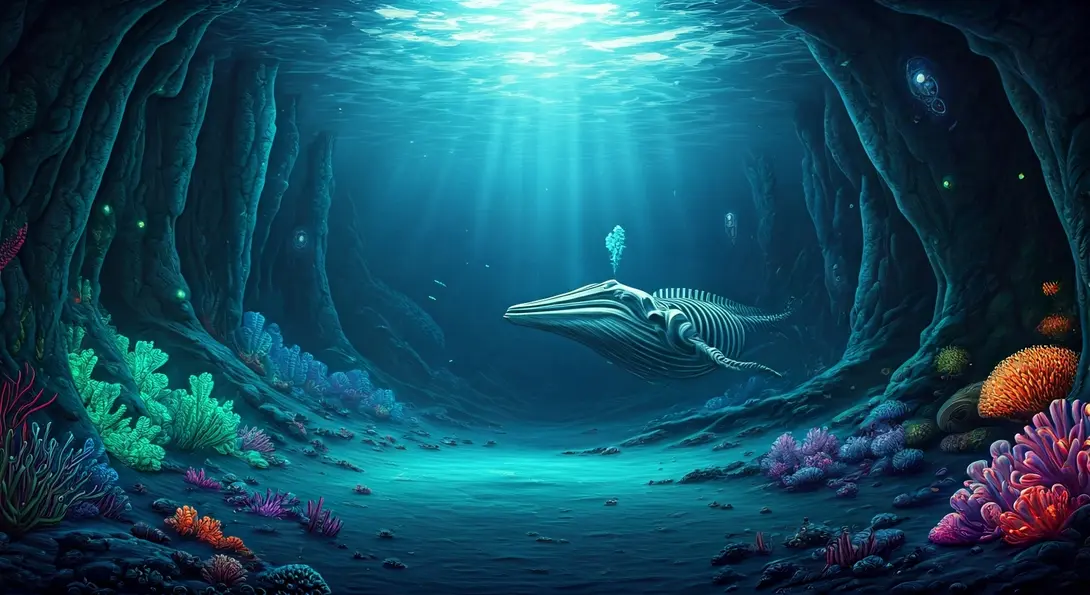
In the southeastern Indian Ocean, scientists have made a monumental discovery: a colossal “whale graveyard,” or necropolis, stretching approximately 1,200 kilometers within the Diamantina Trench. Situated at depths of up to 7,000 meters, this extraordinary site has served as a resting place for whale carcasses for at least 5.3 million years, nurturing unique deep-sea ecosystems.
Contents
A Colossal Whale Graveyard Unearthed in the Indian Ocean
The newly described whale graveyard is nestled at the bottom of the southeastern Indian Ocean, specifically within the Diamantina Trench, located between Australia and Antarctica. This extensive tectonic system of trenches and ridges forms a trough roughly 1,200 kilometers long. Here, an international team of researchers from China, Italy, and New Zealand documented an astonishing 485 bone sites, encompassing both fresh carcasses and fossilized remains of cetaceans.
During more than 30 deep-sea vehicle dives, researchers counted 476 fossilized skeletons and identified five locations where decaying whale bodies still lay. The density of remains in some areas is remarkable, reaching up to approximately 759.5 individual specimens per square kilometer. This concentration suggests that millions of whales could have found their final resting place across the entire zone. Consequently, the authors of the study published in “Nature” aptly refer to this site as a “necropolises” rather than a mere graveyard.
5.3 Million Years of History Etched in Bone
The uniqueness of this discovery isn’t solely due to its sheer scale, but also its immense age. Analysis of strontium isotopes within the bones revealed that the oldest remains date back approximately 5.3 million years, corresponding to the early Pliocene epoch. This significant timeframe indicates that whales have been regularly supplying this segment of the deep ocean with organic matter for at least several million years. A single whale fall can sustain a localized deep-sea ecosystem for decades.
Among the most valuable fossils uncovered is the skull of an extinct beaked whale, Pterocetus benguelae, precisely dated to around 5.3 million years ago. The team also described a new species, Pterocetus diamantinae, identified by its distinct anatomical features preserved in exceptionally well-preserved jawbones. This offers invaluable insights into ancient cetacean evolution.
The Diamantina Trench: A Natural Collector of Deceased Whales
The Diamantina Trench is a system of profound depressions, reaching depths of up to 7,000 meters, flanked by steep slopes and oceanic ridges. This distinctive morphology acts as a natural collector. Whales feeding and diving in this region, particularly those susceptible to exertion and rapid pressure changes, sometimes perish during deep dives. Their bodies then slide down the steep slopes and accumulate in the narrow bands of the trench floor.
Furthermore, the rate of sedimentation in this part of the ocean is exceptionally low. This crucial factor means that whale bones remain exposed for extended periods before being covered by sediments, contributing to their remarkable preservation. These whale falls create vibrant oases of life within the otherwise barren deep-sea environment. Scientists recorded dense communities of organisms, including:
- Jellyfish
- Tube worms
- Polychaetes
- Crustaceans
- Mollusks
- Brittle stars
The abundance of these organisms can locally reach thousands of individuals per square meter around a single whale fall. This phenomenon highlights how crucial these rare events are for sustaining biodiversity in the abyss, much like conservation efforts can revitalize specific ecosystems.
Frequently Asked Questions (FAQ)
A whale fall ecosystem refers to the unique deep-sea community of scavengers, decomposers, and chemosynthetic organisms that thrive on the organic matter provided by the carcass of a deceased whale that has sunk to the ocean floor. These ecosystems can last for decades, providing a rich food source in an otherwise food-scarce environment.

The Diamantina Trench’s unique geology, with its deep troughs and steep slopes, acts as a natural collection basin for whale carcasses. Combined with low sedimentation rates, this environment allows bones to remain exposed and preserved for millions of years, rather than being quickly buried and lost.
Scientists use radiometrically dating techniques, specifically analyzing the isotopes of strontium present in the whale bones. This method allows them to accurately determine the age of the remains, providing insights into the geological periods when these whales lived and died.
From the exceptionally well-preserved remains found in the Diamantina Trench, researchers identified and described a new species of beaked whale named Pterocetus diamantinae, named after the trench itself. This discovery provides crucial information about ancient cetacean diversity and evolution.
Source: EurekaAlert, Nature, NationalGeographic, Popsci. Opening photo: Gemini
About Post Author
