

iRobot Roomba Plus 575 Combo Review
-
Design & Build Quality
-
Navigation & Obstacle Avoidance
-
Vacuuming Performance (Hard Floors)
-
Mopping Capabilities
-
AutoWash Station & Automation
-
App & Connectivity
Excellent Mopping & Smart Automation, Hindered by App Glitches
The iRobot Roomba Plus 575 Combo offers impressive mopping performance with dual rotating pads and a highly effective AutoWash station that minimizes manual intervention. Its compact design and advanced navigation are significant advantages for daily cleaning. However, persistent Wi-Fi connectivity and app issues detract from the overall user experience, and carpet cleaning could be improved.
Advantages
- Compact design and low height (8.35 cm) for cleaning under furniture
- Excellent LiDAR and AI camera navigation for obstacle avoidance
- Highly effective mopping with dual rotating pads and “PerfectEdge” capability
- Multi-functional AutoWash station for automatic dustbin emptying, water refilling, mop washing (60°C), and drying
- Good vacuuming performance on hard floors
- High threshold climbing capability (up to 35 mm)
- Long battery life (up to 180 minutes)
- Commendable build quality and attractive matte finish
Disadvantages
- Persistent Wi-Fi connectivity and app control issues (“offline” status)
- Roomba Home app is less intuitive and feature-rich compared to competitors
- No “do not disturb” mode in the app
- Less effective carpet cleaning, especially for fine debris like flour
- Main brush can tangle with long hair, despite “anti-tangle” claims
- Absence of spare filters, pads, or brushes in the package
- Relatively long charging time
- Mop lifting (10mm) may not be sufficient for thick carpets; occasional sticking on carpet edges
Is This the Best Affordable iRobot on the Market? Roomba Plus 575 Combo Review
iRobot has navigated some turbulent times recently. However, its latest models clearly indicate that the manufacturer has found its stride. The Roomba Plus 575 stands out as one of the most sensible robot vacuums from the brand in years, additionally offering an attractive price point. While not without its drawbacks, it leaves a very positive impression in daily use. Here’s a comprehensive review of the Roomba Plus 575, featuring its innovative AutoWash station.Overview of the Roomba Plus 575 Combo
The reviewed model, officially known as the iRobot Roomba Plus 575 Combo + AutoWash Dock, boasts numerous impressive features and equipment. Firstly, it is notably compact, well-constructed, and elegantly attractive. It can seamlessly integrate into your living room without being an aesthetic distraction. Secondly, it incorporates a LiDAR navigation system for rapid home mapping, an AI camera for advanced obstacle detection, and an AutoWash station that automatically empties the dustbin, washes, and dries the mopping pads. The competitive price is undoubtedly a significant bonus. But is this enough for Roomba to once again become a genuine contender against rivals like Dreame, MOVA, and Roborock? For a comparison, check out our review of the Dreame X60 Ultra Robot Vacuum.Unboxing and Accessories
The Roomba arrived in a substantial package, which, besides the robot itself, contained the AutoWash station, a power cable, a spare dustbin bag, and 280 ml of StayClean cleaning fluid. It’s worth noting the absence of spare filters, pads, or brushes; these consumables will need to be purchased separately when they wear out.Design and Build Quality
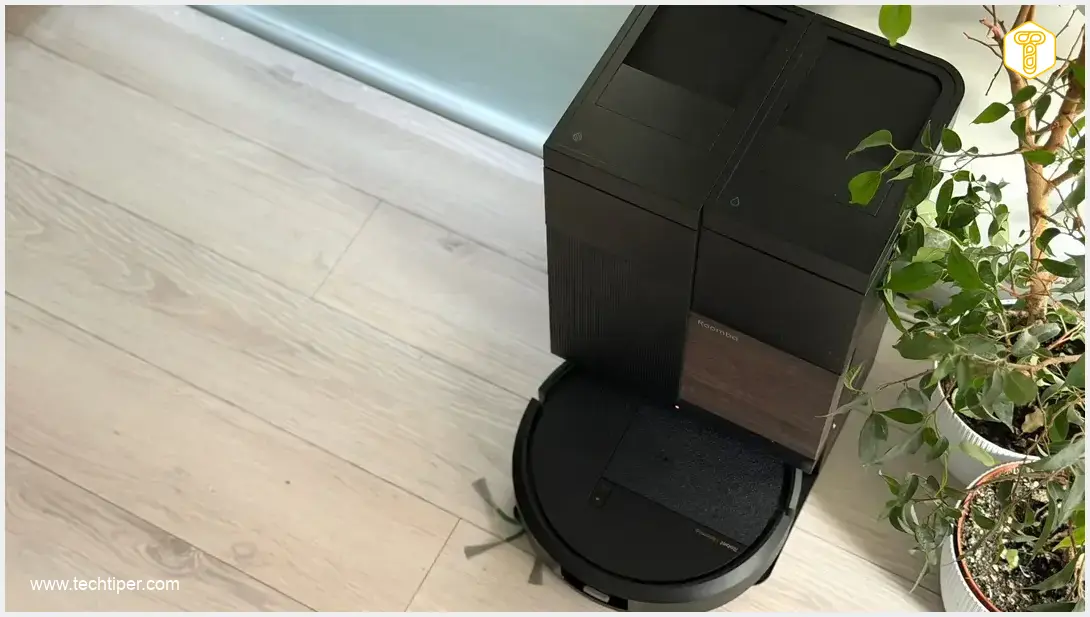
The Roomba Plus 575 Combo is distinctly smaller than many contemporary robot vacuums. The device measures approximately 29.8 × 30.3 cm and stands only 8.35 cm tall. Thanks to its integrated LiDAR module, it avoids having a tall turret. This design allows the appliance to easily fit under most modern sofas, beds, and kitchen cabinets with plinths. iRobot’s decision to move away from camera-only robots, which typically require optimal lighting, is a welcome improvement, as LiDAR proves significantly more effective. In practice, the compact chassis is one of this model’s greatest advantages. Its smaller diameter facilitates easier maneuvering between chair legs, and its low height allows it to reach areas where larger robots often leave dust and pet hair behind. The build quality is commendable for its price point. The plastics feature a matte finish, are well-fitted, and the overall device does not convey a cheap impression. The top panel is minimalist, featuring discreet physical buttons and an aesthetically pleasing finish in matte black or white, designed to mask settled dust. Beneath the robot lies an integrated two-compartment container for dust (180 ml) and liquid (80 ml). However, in daily operation, the user is largely freed from the task of emptying or refilling, thanks to the efficiency of the AutoWash station. The cleaning assembly underneath the device comprises an Anti-Tangle rubber main brush, a three-armed side brush for sweeping debris from edges and crevices, and two actively rotating mopping discs. The charging station is the central component of the entire system. It significantly contributes to daily convenience by handling the majority of service tasks. The AutoWash station measures approximately 33 × 34 × 48.5 cm. While it isn’t the smallest, it appears less imposing in a living room or hallway compared to some of the bulkier “towers” from competitors.Setup and Configuration
The setup process is quick and intuitive. The station should be positioned against a wall, ensuring adequate clearance from furniture and stairs. The robot can then be paired via Bluetooth using the Roomba Home application. While this is typically a swift process, I encountered persistent Wi-Fi connectivity challenges during my review. The Roomba struggled with my dual-band router, which broadcasts both 2.4 GHz and 5 GHz frequencies under a single network name. I consistently had to set up a separate 2.4 GHz network for the robot. Nevertheless, once the network issues were resolved, the domestic reconnaissance could begin. The initial home mapping usually takes about fifteen minutes. The device generates multi-level 3D maps with room segmentation, but these weren’t always optimal. I had to manually edit, divide, and merge sections to achieve an accurate representation of my apartment’s layout. The application allows users to create schedules, segment the home into rooms, define no-go zones, manage maps, and select operating modes. The Roomba supports four fundamental cleaning modes:- Vacuuming only
- Mopping only
- Simultaneous vacuuming and mopping
- Sequential cleaning (vacuuming first, followed by mopping)
Daily Cleaning Performance (Vacuuming)
The declared suction power of 25,000 Pa is an impressive figure, though – as always with robot vacuums – the raw number alone does not determine cleaning quality. More crucial is the synergistic operation of the main brush, side brush, navigation, and the automatic power increase on carpets. In practice, on hard floors, the Roomba Plus 575 Combo handles dust, crumbs, sand, pet hair, and typical outdoor debris very effectively. The results are highly satisfactory, particularly with regular, daily cleaning. The robot moves confidently and predictably, navigates well in densely furnished interiors, and can skillfully avoid obstacles or find an alternative route if its path to the station becomes blocked. However, its performance on carpets is less impressive. When deployed for spot cleaning, the robot was unable to fully extract flour even after two passes (in standard mode). It handled larger debris without any issues. The main brush combines rubber elements and bristles, and iRobot states that the Roomba Plus 575 features a system to reduce hair tangling. My observations, however, suggest that the brush design doesn’t perform optimally with long hair. It is a positive detail that a hair-cutting tool is included in the package, indicating that even the manufacturer anticipates some degree of entanglement. A significant advantage, however, is its mechanism for climbing thresholds, ensuring that transition strips between rooms pose no obstacle.Mopping Capabilities
This constitutes one of the strongest aspects of the Roomba 575. Instead of a mere cloth pressed against the floor, the robot employs two actively rotating DualClean pads, operating at speeds of up to 200 rotations per minute. In SmartScrub mode, it increases pressure and performs forward and backward movements to more intensively tackle stubborn stains. On laminate, stoneware, and tile surfaces, the robot effectively removes shoe marks, wet paw prints, light kitchen spills, and fresh stains. SmartScrub also assists with dried-on dirt, although it should not be expected to replace manual scrubbing for the most ingrained marks. After the initial pass, I initially thought the Roomba would leave dirty streaks on the floor. However, the robot had a different approach to removing the grime. It planned its spot cleaning in a cross-pattern. In this mode, the device cleans the same area twice, changing its direction of travel by 90 degrees. As a result, the floor was thoroughly cleaned. However, I do not recommend directing the robot at such heavy spills – unless you enjoy cleaning the undercarriage and brushes of dirty sludge afterwards. The Roomba should be considered a device for maintaining cleanliness, rather than tackling significant, fresh messes. A key advantage of the reviewed device is its “PerfectEdge” capability, allowing the right mopping arm to physically extend outwards by 30 mm. This enables it to clean surfaces right up to wall edges and under furniture. While this won’t entirely eliminate the “dead zone” near baseboards or corners – the geometry of a round robot still plays a role – it genuinely improves the precision of edge cleaning. The Roomba Plus 575 cannot retract its mops into the base during vacuuming. However, it can lift them by 10 mm to prevent soiling or wetting carpets. This is usually sufficient for short-pile carpets, but for thicker, plush carpets, it seems safer to define a no-mop zone. I also observed that carpet edges posed a challenge for the Roomba. Occasionally, when driving onto a carpet, the robot would get stuck (the pad wedged under the carpet) or fold its corner.Maintenance and Battery Life
Upon completion of cleaning, the robot returns to its base, where it automatically empties its dustbin into an AllergenLock bag, refills water, dispenses detergent, washes the mops at 60°C, and dries them with warm air. The manufacturer states up to 90 days without needing to empty the bag, though actual values will naturally depend on the floor area, number of occupants, presence of pets, and cleaning frequency. The level of automation here is on par with modern robot vacuums, though users will still periodically need to refill the clean water reservoir, empty the dirty water tank, and maintain the brushes and filters. The 5200 mAh battery is designed to provide approximately 180 minutes of operation. This is ample runtime even for larger apartments or single-family homes. In my modest 51 square meter apartment, with an effective cleaning area of about 25 square meters, it never came close to running out of power, returning to the base with only a minimal battery depletion. A weaker aspect, however, is the lengthy charging time, which spans several hours.Specifications and Pricing
Here are the specifications for the Roomba Plus 575 Combo:- Max. Suction Power: 25,000 Pa
- Mopping: 2 rotating DualClean pads, up to 200 rpm
- Connectivity: Wi-Fi 2.4 GHz
- Navigation: ClearView Pro LiDAR + PrecisionVision AI
- Battery: 5200 mAh, up to approximately 180 minutes run time
- Robot Dustbin Capacity: 180 ml
- Robot Water Tank Capacity: 80 ml
- Station Dust Bag: 2.5 L, declared replacement time up to 90 days
- Station Water Tanks: 3.6 L clean water, 3.2 L dirty water
- Other Features: Mop washing at 60°C, threshold climbing up to 35 mm, mop lifting by 10 mm upon carpet detection, standard air filter, Roomba Home app, 4 suction power levels, SmartScrub function
- Voice Communication: Google Home, Siri, and Alexa
- Dimensions: Robot: 29.8 cm diameter, 8.35 cm height; Docking station: 33 x 34 x 48.5 cm
- Weight: 2.9 kg
Conclusion and Our Opinion
Recent innovations from iRobot indicate they are finally catching up to Chinese competitors, solidifying their position as a genuine rival to robots from Dreame, Roborock, or Ecovacs. With the Roomba Plus 575, users receive a robust, nearly maintenance-free robot featuring a compact design, perfectly suited for maintaining daily cleanliness. Its strength lies not in the sheer number of features, but in the intelligent combination of solutions that make it highly effective for homes of various sizes. The device possesses immense potential, but a full recommendation is contingent upon improvements to its application. Until iRobot resolves the Wi-Fi connectivity and app control issues, it is challenging to speak of truly complete user comfort.Frequently Asked Questions (FAQ)
The Roomba Plus 575 Combo boasts a compact design, excellent maneuverability, powerful 25,000 Pa suction, effective dual rotating mop pads, advanced LiDAR and AI navigation, and a multi-functional AutoWash station that significantly reduces manual maintenance.
While it performs very well on hard floors, its carpet cleaning efficiency is less impressive, especially for fine debris like flour. It can also sometimes struggle with thicker carpet edges, occasionally getting stuck or folding them. It does, however, automatically lift its mop pads by 10mm when detecting carpets to prevent wetting.
Users have reported recurring Wi-Fi connectivity problems and app control issues, where the robot appears offline. The Roomba Home app is also considered less intuitive and feature-rich compared to some competitors. Additionally, it lacks a “do not disturb” mode and has a relatively long charging time.
The AutoWash station automates several maintenance tasks. It empties the robot’s dustbin, refills its water, dispenses detergent, and washes and dries the mopping pads at 60°C. This significantly reduces manual intervention, with the dust bag lasting up to 90 days depending on usage.
Source: Internal review. Opening photo: Jolanta Szczepaniak.
About Post Author
