
Contents
Nothing Phone (4a) Pro Review: A Truly Sensible Smartphone
Welcome to our comprehensive review of the Nothing Phone (4a) Pro, a device that, at least theoretically, stands as the manufacturer’s most powerful smartphone planned for this year. However, this doesn’t translate to an exorbitant price tag; quite the opposite. The ‘a’ in its name signifies its position as a more accessible model, offering exceptional value. Nothing has also emphasized superior build quality while retaining the unique features that have made its previous products so popular.
Disclaimer: The Nothing Phone (4a) Pro was provided to us for review by Nothing. The manufacturer had no influence over the content of this review.
Overview: Our Verdict on the Nothing Phone (4a) Pro
Nothing continues its established path, consistently striving to deliver smartphones that are unique in multiple ways, standing out not just for their design but also for their capabilities and, crucially, their excellent value proposition. The reviewed Nothing Phone (4a) Pro is no exception, boasting a superb build, powerful components, and refined software. While it doesn’t have any glaring flaws, it’s worth noting that some competitors might offer slightly more in certain areas, such as battery capacity or software support longevity.
Advantages:
- Excellent value for money
- Distinctive, unmistakable Nothing design
- Premium build quality
- Enhanced Glyph Interface
- Pleasing and vibrant display
- Consistent primary and telephoto camera performance
- Clean, efficient, and user-friendly software
Disadvantages:
- Wide-angle camera falls short compared to others
- Some competitors offer larger battery capacities
- Glyph interface is less interactive than the flagship Nothing Phone (3)
Unboxing, Specifications, and Pricing of the Nothing Phone (4a) Pro
The Nothing Phone (4a) Pro arrives in a thoughtfully designed black box. Upon removing the outer sleeve, you’re greeted by a pristine white inner carton, where each accessory is neatly organized, not cramped. Standard inclusions for the Phone (4a) Pro users are a pre-applied screen protector, a protective case, a 1-meter USB-C to USB-C cable, a SIM tray ejector tool, and essential documentation.
The included case is a rubber protector that fits snugly around all edges and offers ample thickness, ensuring good protection for the sides and front of the device. The camera island benefits from a flush surface, and there’s a repeated indentation in the bottom corner. The only minor drawback is that the case tends to accumulate dirt and fingerprints quite easily.
Pricing and Value
The Nothing Phone (4a) Pro, while positioned as a more accessible model, stands as the premium offering within Nothing’s ‘a’ series. Its pricing is remarkably reasonable. At the time of this review’s publication, it was available for approximately:
- 8 GB RAM / 128 GB Storage: 475 USD (or equivalent in local currency)
- 12 GB RAM / 256 GB Storage: 550 USD (or equivalent in local currency)
Note: Prices are approximate conversions from original regional pricing and may vary by market and retailer.
This pricing means you don’t have to pay significantly more than the standard Nothing Phone (4a) to gain a larger display within a more refined and slightly smaller chassis, along with more powerful internal components.
Detailed Technical Specifications
- Display: 6.83-inch OLED, 1.5K+ resolution (2800×1260, 20:9, 450 ppi), 93.9% screen-to-body ratio, up to 5000 nits peak brightness, 144 Hz refresh rate, 10-bit color depth (1.07 billion colors), HDR10+/Ultra HDR.
- Processor: Qualcomm Snapdragon 7 Gen 4 (4 nm lithography); CPU: 1x Cortex-720 (2.8 GHz), 3x Cortex-720 (2.4 GHz), 4x Cortex-520 (1.8 GHz); GPU: Adreno 722.
- RAM: 8 or 12 GB LPDDR5X RAM.
- Storage: 128 or 256 GB UFS 3.1.
- Cameras:
- Front: 32 Mpx (f/2.2, Samsung S5KKD1)
- Rear:
- Main: 50 Mpx (f/1.9, PDAF, OIS, Sony IMX 896)
- Telephoto: 50 Mpx (f/2.9, PDAF, OIS, periscope, 3.5x optical zoom, Samsung S5KJN5)
- Ultra-wide: 8 Mpx (f/2.2, Sony IMX 355)
- Battery: 5080 mAh, 50 W wired charging (USB PD3.0).
- Connectivity: Dual SIM (5G, 2x Nano SIM or Nano SIM + eSIM), Wi-Fi 6 (802.11ax), Bluetooth 5.4, NFC, USB-C (2.0).
- Other Features: In-display fingerprint reader, IP65 certification (dust and water splash resistant), Stereo speakers, Glyph Interface.
- Operating System: Android 16 (Nothing OS 4.1).
- Dimensions: 163.7 × 76.6 × 8 mm.
- Weight: 210 g.
- Build Materials: Front: Corning Gorilla Glass 7i; Frame: Aerospace-grade aluminum; Back: Aluminum.
- Color Options: White, Black, Pink, Blue.
Design and Build Quality of the Nothing Phone (4a) Pro
The Nothing Phone (4a) Pro distinguishes itself through its construction when compared to other models from the brand. While it retains the characteristic Nothing design, this aesthetic is predominantly focused on the camera module. The rest of the device, including the back panel, is crafted primarily from aluminum – a departure from the glass or plastic backs typically seen in previous Nothing phones. Notably, there are no plastic materials used in the Phone (4a) Pro’s construction, which significantly enhances the overall premium feel of the device.
Despite this, the front remains a standard symmetrical design. However, the reviewed Nothing Phone (4a) Pro boasts relatively slim bezels, which allow for a larger screen compared to its siblings while maintaining a slightly smaller overall footprint. It’s still a substantial smartphone in hand.
Key front-facing features include a pleasant-to-use selfie camera (though its predecessor was marginally better) and an effective in-display fingerprint reader. A discreet earpiece grille is also present, which doubles as part of the stereo speaker system.
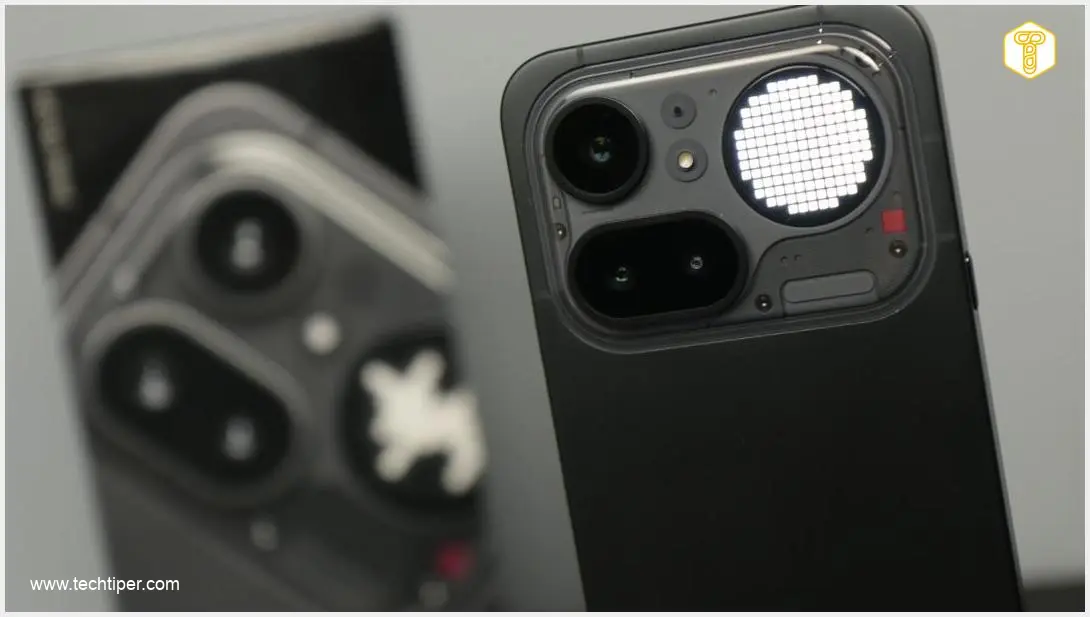
The back features a distinctive aluminum panel—a unique choice for Nothing. The prominent camera island is the first thing that catches the eye. It’s quite large, and its protruding lenses cause the device to wobble slightly when placed flat on a surface. Overall, the finish is very positive, though you should expect fingerprints to be visible after a day’s use. Thankfully, they are easy to wipe away, preserving the phone’s sleek design.
An interesting stylistic element is an indentation in the bottom corner, which is neither a functional button like on the Nothing Phone (3) nor an accessory mounting point similar to CMF models. Antenna lines subtly complete the design.
The Glyph Interface: A Backlit Display
Nothing continues to innovate with its Glyph Interface, the unique LED lighting system on the back of its smartphones. On the Phone (4a) Pro, this takes the form of a sizable, pixelated display area. While it’s even larger than the Glyph on the flagship Phone (3), it offers significantly less interactivity. You won’t find advanced functionalities like a clock, battery indicator, or compass. Instead, it provides classic notification alerts, serves as a simple flashlight, and indicates volume levels. A small red square also illuminates, but exclusively when recording videos.
Ergonomic Edges and Stereo Speakers
The sides of the Nothing Phone (4a) Pro also feature an aluminum construction, a welcome surprise given that plastic wouldn’t be unexpected at this price point. This choice significantly enhances the overall user experience, and the edges are ergonomically designed. Here’s what you’ll find on each side:
- Top: Secondary microphone.
- Bottom: Main speaker grille, USB-C port, primary microphone, SIM card tray.
- Left Side: Essential Key (customizable button).
- Right Side: Power/lock button and volume rockers.
The separation of the Essential Key from the standard buttons is a particularly appreciated design choice. The full functionality of this feature will be explored in the software section.
The stereo speaker setup on the Nothing Phone (4a) Pro is decent. While it doesn’t offer an exaggerated frequency separation or powerful bass, the sound is sufficiently loud. It’s a good system for hearing notifications, but perhaps not ideal for extended multimedia playback.
Display and Visual Quality
Nothing opted for a marginally larger display in the Phone (4a) Pro compared to the Phone (4a), while also slightly boosting the resolution to a full 1.5K. This results in a generous and noticeably expansive workspace for daily use. In terms of brightness, the phone delivers commendable performance for its class, reaching approximately 1500 nits on a sunny day and about half that indoors.
Regarding color reproduction, Nothing’s default settings tend to enhance color saturation and introduce a touch more red, particularly evident in the ‘Vivid’ color profile. If this preference isn’t to your liking, you can switch to the ‘Standard’ mode, where color inaccuracies are reduced to an acceptable level (DeltaE slightly above 2).
Another distinguishing feature of the Phone (4a) Pro, setting it apart from the Phone (4a), is its elevated refresh rate, increased from 120 Hz to 144 Hz. The software on the reviewed smartphone capably switches between 60, 90, 120, and 144 Hz modes. However, this dynamic refresh rate primarily benefits the system UI and common applications like Chrome and YouTube. Unfortunately, in gaming scenarios, the smartphone tends to lock into the lowest refresh rate setting.
Battery Life and Charging Speed
Despite featuring a slightly larger screen within a more compact body compared to the Nothing Phone (4a), the Phone (4a) Pro retains the same battery capacity. In some markets, its capacity is 5080 mAh, while other regions might offer 5400 mAh, often at the expense of NFC functionality. At a similar price point to the reviewed smartphone, it’s possible to find alternatives with significantly larger batteries.
Nothing appears to have aimed for standard battery performance. You can comfortably expect a full day of intensive use, up to two days with lighter usage, and around 5 hours of screen-on time during heavy activity. While not revolutionary, this performance is perfectly acceptable and won’t deter users.
The Nothing Phone (4a) Pro supports a maximum wired charging power of 50 W. This isn’t exceptionally fast, but it’s certainly adequate. A full charge takes approximately one hour, with the first 30 minutes delivering around 65% battery. These are reasonable speeds, though some competitors in this price bracket do offer faster charging solutions.
Camera Performance: Photos and Videos
The camera application on the Nothing Phone (4a) Pro integrates several interesting features while maintaining a straightforward user experience. It offers a comprehensive range of modes, from simple point-and-shoot options to more advanced settings, all arranged intuitively. A unique feature is its community integration, allowing users to create and share predefined camera settings, with Nothing itself offering a selection of default presets.
Video Recording Capabilities
The Nothing Phone (4a) Pro supports video recording at the following resolutions:
- 1080p at 30 and 60 frames per second (fps)
- 4K at 30 frames per second (fps)
Unfortunately, active switching between all lenses is only possible in the standard video recording settings. When shooting at 60 fps, you can record independently with the main and telephoto cameras, but you cannot switch between them mid-recording. The ultra-wide-angle lens is exclusively available at 1080p and 30 fps, and for 4K video, you are limited solely to the main camera.
A Well-Rounded Dual-Camera System
On paper, the Nothing Phone (4a) Pro appears to utilize the same camera setup as its more affordable sibling, the Phone (4a). However, closer inspection reveals key differences. These primarily stem from a modified image processor, which offers enhanced capabilities on the Pro model. Additionally, the main camera itself is distinct. The recurring issue, however, remains the ultra-wide-angle sensor, which underperforms compared to the rest of the camera array.
When it comes to ultra-wide-angle shots, it’s important to acknowledge that the phone employs an aging sensor (Sony IMX 355, 8 MP, f/2.2) that has long passed its prime. While the overall results are merely acceptable, limitations are evident across all aspects: color reproduction, contrast, and detail levels. Although one cannot expect miracles from the ultra-wide camera in the Nothing Phone (4a) Pro’s price segment, the discrepancy in quality compared to the other cameras is noticeable.
In contrast, the telephoto lens (Samsung S5KJN5, 50 MP, f/2.9) performs quite well, offering 3.5x optical zoom. The software further encourages digital zoom up to 7x; however, we advise against using this mode, as it significantly degrades the excellent base quality.
Naturally, the best photography experience comes from the main camera, which differs from the one found in the Phone (4a). For the Pro model, Nothing opted for the highly regarded Sony IMX 896 sensor (50 MP, f/1.9) instead of a Samsung unit. This popular sensor is a strong performer in many ‘affordable flagship’ smartphones and proves equally effective in the reviewed Phone (4a) Pro, with its software managing it competently across all scenarios.
For videos, the optical image stabilization (OIS) support for both the main and telephoto cameras is a significant advantage. The overall video quality is respectable, aligning well with, and in some aspects even surpassing, its price segment. As expected, there’s a noticeable drop in quality when using the ultra-wide-angle lens. Furthermore, digital zoom should be avoided, as it leads to a clear reduction in detail.
Software Experience and Performance
The Nothing OS, Nothing’s custom Android overlay, is another signature element distinguishing the brand’s smartphones. It’s not bloated; instead, it offers a unique character. Among its distinctive features is ‘Essential Space,’ an advanced note-taking application that integrates screenshots and voice recordings. Additionally, Nothing actively engages its community in software development and incorporates AI functionalities, including integration with generative AI like ChatGPT.
The Nothing Phone (4a) Pro launched with Android 16 (running Nothing OS 4.1). The manufacturer commits to 3 years of major Android updates, meaning the device will receive updates up to Android 19. While some manufacturers, notably Samsung, offer longer update policies, others provide significantly less. A definite positive is the impressive 6 years of security updates, ensuring long-term device protection.
We are very impressed with the overall performance of the Nothing Phone (4a) Pro. This smartphone exhibits ample processing power for all daily tasks. Only during exceptionally demanding processes might you notice that some operations take slightly longer. However, there are no instances of lag or any performance issues that would negatively differentiate it from competitors. On the contrary, it stands as one of the most powerful contenders in its price segment.
Conclusion: Is the Nothing Phone (4a) Pro Worth It?
Our review of the Nothing Phone (4a) Pro concludes with a strong impression that this smartphone has significant potential to become one of the most cost-effective options in its class. True to its brand identity, Nothing has delivered a device with a distinctive design and intriguing features (such as the Glyph Interface and Essential Space). These are complemented by robust processing power and an overall positive user experience, encompassing a capable camera system, an impressive display, and excellent software.
The Nothing Phone (4a) Pro presents no major, undeniable flaws. While we can point out that the ultra-wide-angle camera lags behind the other lenses in quality, and some competing models offer larger batteries or faster charging, the Phone (4a) Pro still holds its own remarkably well in the broader comparison. However, dedicated fans of the brand might have anticipated a more advanced Glyph Interface, especially considering the capabilities of older, flagship Nothing devices.
Frequently Asked Questions (FAQ)
How does the Nothing Phone (4a) Pro compare to the Nothing Phone (4a)?
The Nothing Phone (4a) Pro offers a marginally larger 1.5K+ OLED display, an elevated 144 Hz refresh rate, a more refined aluminum build, and more powerful internal components compared to the standard Nothing Phone (4a). While both share similar camera setups on paper, the Pro model features a modified image processor and a different main camera sensor (Sony IMX 896), offering enhanced capabilities.
What is the battery life and charging speed like on the Nothing Phone (4a) Pro?
The Nothing Phone (4a) Pro is equipped with a 5080 mAh battery (though some regions might have a 5400 mAh variant without NFC). It offers standard battery performance, comfortably lasting a full day with intensive use or up to two days with lighter usage. It supports 50W wired charging, which can fully charge the device in about an hour, reaching approximately 65% in the first 30 minutes. While not the fastest on the market, it’s a reasonable speed for its class.
Is the camera system on the Nothing Phone (4a) Pro suitable for all types of photography?
The Nothing Phone (4a) Pro features a capable camera system, particularly with its 50 MP main sensor (Sony IMX 896) and 50 MP telephoto lens offering 3.5x optical zoom, both of which deliver excellent results in various scenarios and support optical image stabilization for videos. However, the 8 MP ultra-wide-angle camera uses an older sensor and significantly underperforms compared to the other two, showing limitations in color, contrast, and detail. While it excels in primary and zoomed photography/videography, the ultra-wide lens is its weakest point.
Source: Internal research. Opening photo: Łukasz Pająk
About Post Author
