

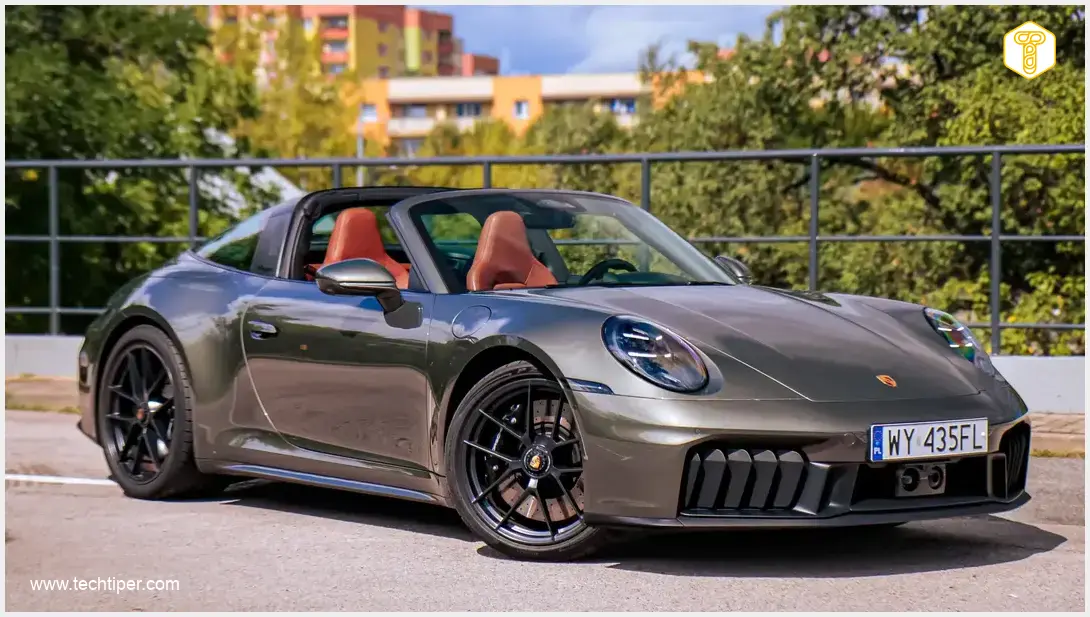
Porsche 911 Targa 4 GTS Review
-
Performance (T-Hybrid)
-
Driving Dynamics & Handling
-
Interior & Technology
-
Design & Targa Roof Experience
-
Practicality & Space
-
Value (Price & Customization)
Performance and Style with T-Hybrid Innovation
The Porsche 911 Targa 4 GTS (992.2) masterfully blends iconic Targa styling with groundbreaking T-Hybrid performance. It offers exhilarating driving dynamics, a luxurious and tech-rich interior, and surprisingly respectable fuel efficiency for its class. While practicality is limited and customization is costly, it delivers an unparalleled, sophisticated sports car experience.
Advantages
- Innovative T-Hybrid system with instant throttle response and eliminated turbo lag.
- Exceptional performance and exhilarating acceleration (0-60 mph in 3.1s).
- Superb driving dynamics, precise handling, and powerful braking.
- Luxurious, high-quality, and technologically advanced interior.
- Iconic and unique electric Targa roof experience.
- Surprisingly respectable fuel efficiency for a high-performance sports car.
- Extensive personalization options for unique ownership.
Disadvantages
- Increased weight and complexity from the Targa roof mechanism.
- Noticeable wind turbulence and cabin noise with the roof open at higher speeds.
- Very limited practicality; rear seats primarily for storage.
- High starting price and significant cost for essential options/customization.
- Lack of some modern conveniences like head-up display or passenger display.
- Potential for minor roof creaks and increased cabin noise with roof closed at speed.
Contents
Porsche 911 Targa 4 GTS Review: A Hybrid, Nearly a Cabriolet, and a Legend Preserved
We begin our review of the Porsche 911 Targa 4 GTS, an iconic sports car that, after its recent facelift, now features an innovative hybrid powertrain. However, this isn’t your typical hybrid setup; Porsche’s approach to electrification is uniquely their own. Regardless of the powertrain, the Targa body style itself is exceptional, adding to the enduring legend of the 911.
The 992.2 generation facelift introduces numerous subtle and not-so-subtle changes compared to its predecessor (see our review of the Toyota Corolla Cross GR Sport for an alternative hybrid perspective). While visual updates are minimal, the technological advancements are significant. Let’s delve into what the Porsche 911 Targa 4 GTS truly offers.
What’s New in the 992.2 Generation?
The latest iteration of the Porsche 911, designated 992.2, brings a host of enhancements, primarily beneath the surface. This facelift signals a shift towards integrating advanced technologies while preserving the classic 911 driving experience. From updated infotainment to subtle aerodynamic tweaks, Porsche meticulously refined nearly every aspect.
The T-Hybrid System Explained
The most significant innovation in the GTS models is the T-Hybrid system. Unlike conventional hybrids focused solely on fuel efficiency, Porsche’s T-Hybrid is engineered to boost performance. It combines a 3.6-liter flat-six boxer engine with an electric turbocharger (eTurbo) and an electric motor integrated into the PDK transmission. The eTurbo, powered by a 400V battery, spools up instantly, eliminating turbo lag, while the transmission-mounted motor provides additional torque at low speeds, enhancing acceleration and responsiveness. This complex system ensures that every driver input is met with immediate and exhilarating performance.
Pricing, Trims, and Options
The Porsche 911 lineup begins with the entry-level Carrera, starting at approximately $175,000 USD (based on current exchange rates from the original Polish Złoty pricing). Beyond the Coupe and Cabriolet body styles, the Targa is offered with two distinct powertrains:
- 4S (480 hp): Approximately $223,750 USD
- 4 GTS (541 hp): Approximately $248,500 USD
Notably, the Targa body is not available with the most powerful Turbo or GT variants, which aligns with its character as a sophisticated cruiser rather than an outright track car, though it certainly retains its sporting spirit.
Customizable Options
Porsche is renowned for its extensive customization options, allowing buyers to tailor their 911 to their exact preferences. The reviewed Targa 4 GTS featured several optional extras, significantly increasing its final price. Some notable additions included:

- Exclusive Manufaktur leather interior: ~$14,775 USD
- Aventurine Green Metallic paint: ~$5,075 USD
- Tinted HD-Matrix LED headlights: ~$4,025 USD
- Adaptive Sports Seats Plus (18-way adjustable): ~$3,825 USD
- Extended Exclusive Manufaktur leather trim package: ~$3,600 USD
- Night Vision Assist (thermal camera): ~$3,475 USD
- Front axle lift system: ~$3,200 USD
- Adaptive cruise control: ~$2,300 USD
- Surround View (360-degree cameras) with ParkAssist: ~$2,050 USD
- BOSE Surround Sound System: ~$2,000 USD
With these and other selections, the total price of the tested model approached $307,500 USD. This illustrates how Porsche’s personalization capabilities, while offering unparalleled exclusivity, can substantially elevate the final cost. Even at this price point, further enhancements like larger wheels, a Burmester audio system, ceramic brakes, or a sports exhaust with titanium tips could add hundreds of thousands more.
Warranty Information
The Porsche 911 comes with a standard 2-year warranty with unlimited mileage. The paint is covered for 3 years, and perforation of the body panels for 12 years. As a hybrid, the traction battery receives an 8-year or 100,000-mile (160,000 km) warranty. Porsche also offers extended warranty programs through its Approved scheme, allowing owners to add one, two, or three years of coverage, provided the vehicle passes an inspection and is no older than 14 years.
Insurance Costs
According to insurance data, insuring a 911 Targa 4 GTS for a driver with several years of experience could cost approximately $155 USD for basic liability insurance (OC) and around $4,750 USD for a comprehensive package including collision (AC).
Technical Specifications
The Porsche 911 Targa 4 GTS (992.2 generation) is a testament to sophisticated engineering. The integration of the T-Hybrid system fundamentally reshapes its performance profile. Here are some key technical details:
- Engine: 3.6-liter twin-turbocharged flat-six boxer with T-Hybrid system
- System Output: 541 hp (400 kW)
- System Torque: 610 Nm (450 lb-ft)
- Transmission: 8-speed PDK (Porsche Doppelkupplung) automatic
- Drivetrain: All-wheel drive (indicated by ‘4’)
- 0-60 mph (0-100 km/h) acceleration: 3.1 seconds
- 0-124 mph (0-200 km/h) acceleration: 11.1 seconds
- Top Speed: Approximately 190 mph (305 km/h)
- Curb Weight: Approximately 3,968 lbs (1,800 kg)
- Fuel Tank Capacity: 67 liters (17.7 gallons)
The T-Hybrid system includes a 27 hp (20 kW) electric motor powering the turbocharger (eTurbo) and a 54 hp (40 kW) electric motor (150 Nm / 111 lb-ft) integrated into the PDK transmission. This intelligent setup ensures rapid throttle response and enhanced low-end torque without simply adding weight for an electric-only range.
A Brief History of the Porsche 911
The Porsche 911, a legendary nameplate since its inception in 1964, has captivated automotive enthusiasts across its eight generations. Each iteration has evolved while maintaining the core spirit and iconic design that makes the 911 instantly recognizable. Even the controversial 996 generation is gaining appreciation with age, underscoring Porsche’s ability to craft truly enduring sports cars.
The current 8th generation, the 992, debuted in late 2018. Recognizing the need for continuous innovation, Porsche introduced the significant 992.2 facelift in May 2024. The most notable update is the T-Hybrid system in GTS models, designed to minimize turbo lag and optimize performance. Other variants also received power boosts, and more manual transmission options were introduced.
Styling changes for the 992.2 are minimal but impactful. Externally, redesigned bumpers, updated taillights, and the removal of separate daytime running lights give it a fresh yet familiar face. Inside, the traditional analog tachometer has been replaced by a large, curved digital display, a feature seen in other modern Porsche models. The classic key ignition has also made way for a conventional start button.
The Porsche 911, particularly in its Targa variant, operates in a unique segment. While numerous convertibles exist, the Targa’s distinctive roof mechanism sets it apart. Competitors might include models like the Mercedes-AMG SL/GT, Aston Martin Vantage Roadster, Ferrari Roma Spider, or even the BMW M8, but none offer the precise blend of sportiness and open-air experience quite like the Targa.
Inside the Cabin: Infotainment and Technology
The 992.2 facelift brought a significant technological refresh to the 911’s cockpit, primarily centered around its digital interfaces. While the core infotainment platform remains robust and familiar, the introduction of a new digital instrument cluster dramatically alters the driver’s view.
Central Touchscreen Display
The central touchscreen remains a 10.9-inch unit, perfectly integrated into the dashboard. Its quality is exceptionally high, offering crisp graphics and vibrant colors, reaffirming its premium status despite not being an OLED panel. Porsche prioritizes a focused driving experience, so a head-up display (HUD) or a passenger-side display is not offered in the 911.
The system is intuitive, allowing drivers to create personalized profiles that unlock various functions without subscription fees. A complimentary 10 GB monthly internet package for four years enables access to an app store with multimedia additions. The interface is logically divided, with customizable shortcuts on the left, essential icons and contextual settings on the right, and a configurable desktop with three widgets in the center. A built-in voice assistant responds to predefined commands, and an extensive digital owner’s manual, complete with video tutorials, is also included.
Climate control functions are primarily handled by physical buttons below the screen, ensuring quick access without diverting attention from the road. Some less frequently used climate features are accessible via the touchscreen. Practical features like the Smart Lift mode, which remembers and automatically raises the front axle for recurring obstacles via GPS, add to the car’s usability. The system also allows for fine-tuning of settings like heating/ventilation balance for the seats and a configurable button on the steering wheel.
With its integrated 5G module, the 911 offers constant internet access. If the data plan runs out, it can connect to external Wi-Fi networks or serve as a hotspot. The app store includes popular apps like YouTube, Vivaldi Browser, and Spotify. The Bose Surround Sound System, featured in the tested model, delivers excellent audio quality with powerful bass, making the optional Burmester system less of a necessity given the intoxicating soundtrack from the engine and exhaust.
Navigation, Android Auto, and Apple CarPlay
The built-in navigation system is competent, featuring up-to-date maps from HERE, fast routing algorithms, and Google search with satellite views. Both wireless Android Auto and Apple CarPlay are seamlessly integrated, offering excellent performance and stability. While these smartphone integrations are highly functional, Porsche does not project full navigation maps from these systems onto the digital instrument cluster, displaying only turn-by-turn directions.
Fully Digital Instrument Cluster
A significant update in the 992.2 is the fully digital, curved instrument cluster. While purists might miss the analog tachometer, this digital display dramatically increases functionality and customization. Readability is excellent, and optional colored dials are available for the virtual tachometer.
Porsche offers seven distinct views for the digital cluster, ranging from classic layouts to thematic displays. One particularly useful thematic view shows a full-screen navigation map, though, as mentioned, it doesn’t support external mapping apps. Other notable features include an optional Night Vision Assist with a thermal camera, which effectively identifies pedestrians and warns the driver. A thoughtful detail is the speedometer’s ability to show the speed of the preceding vehicle with a separate arrow, enhancing situational awareness.
Within customized themes, drivers can personalize side sections of the display, showing detailed information such as battery voltage or coolant temperature. These side sections also provide contextual information for drive modes, Sport Response activation, roof operation, lighting settings, and various warnings.
Porsche 911 Targa 4 GTS Interior: Luxury Meets Sport
The interior of the tested 911 Targa 4 GTS beautifully blends its sporting heritage with luxurious appointments. Porsche utilizes premium materials throughout, ensuring both durability for dynamic driving and opulent comfort. The extensive personalization options mean each 911 can be a unique reflection of its owner’s taste.
However, it’s important to manage expectations regarding practicality. While clever solutions exist, the 911 Targa 4 GTS is not designed for hauling luggage for a long family vacation. Its priorities clearly lie elsewhere, though resourceful owners can always find ways to make it work.
The keyless entry system, if optioned, allows the car to unlock as you approach, with customizable settings. The flush door handles pop out, revealing indentations for closing the doors. A minor oversight is the lack of automatic locking upon walking away. The front trunk (frunk) is also part of this keyless system.
Front Row Experience
Entering the 911 Targa 4 GTS immediately reminds you it’s a sports car. The GTS sits lower, requiring some agility to get in and out. The power seat sliding back partially aids entry, though the steering wheel doesn’t retract. The frameless doors open via partially electric handles. The door panels showcase exquisite craftsmanship, covered almost entirely in leather, even the small, soft-lined storage compartments. Physical switches are retained for window controls and other functions, avoiding overly complex digital interfaces.
Seating Comfort and Adjustability
The optional 18-way adaptive sports seats in the tested model provide unparalleled adjustability, surpassing the standard 14-way options. Drivers and passengers alike can fine-tune their position for optimal comfort and support, though the integrated headrests encourage good posture. The firm but comfortable cushioning ensures long journeys remain fatigue-free. Both seats offer identical electric adjustments, including extendable seat cushions, 4-way lumbar support, and adjustable side bolsters for both the seat and backrest. Heated seats are standard, with ventilation being an optional extra. While the passenger seat lacks memory functions, both benefit from a comfortable entry/exit feature that retracts the seat and loosens the side bolsters. After starting, seatbelts are automatically cinched. Near the driver’s seat, switches allow for opening the frunk and accessing the engine compartment (for oil and coolant). Unfortunately, ISOFIX mounts and massage functions are not available for the front seats.
The Steering Wheel
The steering wheel in the tested 911 features a leather-wrapped rim with stitching that matches the interior upholstery. It feels superb in hand, is heated, and is perfectly integrated with the digital instrument cluster. Two-way electric adjustment is provided, but it’s a missed opportunity that it doesn’t integrate with the comfort entry/exit function.
Buttons and rollers on the spokes are minimal but sufficient: the left controls multimedia and a customizable function, while the right manages the digital cluster. A dedicated rotary knob selects drive modes, and a red “Sport Response” button unleashes full power for 20 seconds. The stalk for cruise control is discreetly located, a common design choice in some Volkswagen Group brands. Convenient paddle shifters facilitate rapid gear changes.
The traditional ignition key has been replaced by a physical start button. The 992.2 facelift also introduces a driver attention monitoring system, which proved unintrusive during the review, rarely prompting the driver to refocus on the road.
Dashboard Design and Controls
The 911’s dashboard retains its classic Porsche character, blending traditional aesthetics with modern functionality. Color schemes are highly customizable, reinforcing its premium+ segment status. Crucially, Porsche has retained physical switches for essential functions.
A signature analog clock with a stopwatch function adorns the top of the dashboard. Below the central touchscreen, a row of physical buttons provides quick access to frequently used features such as Smart Lift, exhaust flap control, hazard lights, traction control, and suspension settings. Further down are the air vents, which offer excellent airflow, particularly important for the Targa body style.
The center console, finished in piano black, surprisingly avoids distracting reflections even with the roof open on sunny days. It houses physical controls for climate, multimedia, heated/ventilated seats, and the Targa roof mechanism. The distinctive, compact gear selector for the PDK transmission is also located here. A single cupholder is provided, which can be removed or replaced with an ashtray if the smoker’s package is chosen.
The armrest is comfortable, providing a small storage compartment with an inductive phone charger and two USB-C ports. The passenger-side glovebox is larger, and a second retractable cupholder is located nearby. A storage net is available for the passenger’s left footwell. The fuse box, visible on the driver’s side, is even upholstered in leather as an optional extra.
Above the windshield, an auto-dimming rearview mirror offers surprisingly good rear visibility through the large rear window. While maneuvering, the wide rear fenders require careful consideration, but the overall view is better than expected.
The “Rear Seats”
Technically a 4-seater according to its registration, the Porsche 911’s rear seats are best described as an afterthought. They are primarily suitable for emergency situations or as additional storage. Unlike some cars, the front seats do not automatically slide forward to facilitate rear entry. The two rear seating positions are only viable for individuals up to approximately 5 feet (1.5 meters) tall, assuming the front occupants aren’t excessively tall, as headroom is severely limited. Headrests are omitted, and the seatbacks are vertical.
The most practical uses for the rear compartment are transporting small children (ISOFIX anchors are present) or as supplementary luggage space. A single hook on the seatbacks provides a convenient spot for hanging jackets.
Lighting and the Unique Targa Roof
Porsche’s approach to lighting is exemplary. From the exterior, the 911 greets its owner with an animated sequence of headlights, taillights, and powerful puddle lights from the mirrors upon approach. Interior lights activate upon door opening, ensuring excellent visibility around and within the vehicle, including the frunk.
Inside, the primary lighting is bright and effective. The ambient lighting, while subtle, is noticeable and customizable in color, or can be set to synchronize with album artwork from played music. Brightness is also adjustable.
The highlight of the Targa 4 GTS is its unique Targa roof, a nod to a classic body style that has graced the 911 through its generations. The 992.2 Targa features the iconic wide roll bar, and its operation is fully electric. The intricate opening and closing sequence, which takes just under 20 seconds, can only be performed when stationary. The entire rear glass section tilts back, allowing the roof panel to retract or extend, with protective elements extending from the roll bar to ensure a seamless fit. This entire process is fully automated, requiring no manual locking or release. Control is via buttons on the center console or the key fob, requiring continuous depression until the operation is complete. The system will prevent operation if an obstruction is detected.
Driving with the roof open offers a unique experience, distinct from a full convertible, providing an open-air feel with increased headroom. However, above 40 mph (60 km/h), wind turbulence becomes noticeable, making it more suited for cruising than high-speed touring.
Cargo Space
As mentioned, practicality isn’t the 911’s strong suit, but Porsche has maximized available space. The primary cargo area is the frunk, which can be opened from inside, via the key fob, or by touching the area under the badge. This front compartment offers 135 liters (4.8 cubic feet) of space, sufficient for a carry-on suitcase or a few backpacks. Side compartments hold essential items like a tire repair kit and the windshield washer fluid reservoir.
The secondary cargo area is located behind the front seats, offering an additional 163 liters (5.7 cubic feet) of space. This is indeed the most sensible use for the “rear seats.” Even the area where the roof panel retracts is illuminated, hinting at its potential for minimal storage when the roof is closed.
Driving Impressions: The Targa 4 GTS on the Road
The Porsche 911 has always been a quintessential sports car, but modern generations increasingly blend this with luxurious grand touring capabilities. The result is a compelling Grand Tourer that, while not feather-light, boasts immense power and advanced technologies that profoundly influence its driving characteristics.
The 911 Targa 4 GTS seamlessly transforms from a stylish cruiser with its roof down into a potent performance machine, showcasing why the Porsche legend is so enduring. Despite its approximately 3,968-pound (1,800 kg) curb weight, increased by the Targa mechanism and additional body reinforcements, the car never feels sluggish.
Driving Dynamics and Handling
The Targa’s weight, a consequence of the roof mechanism and reinforcing structures, is surprisingly well-managed. While some road imperfections are noticeable due to the large 20- and 21-inch wheels (with center locks) and low-profile tires, the ride quality is generally excellent on most roads, far from being “jaw-rattling.” Speed bumps and curbs require caution, often necessitating the Smart Lift function.
In sportier settings, the suspension significantly stiffens, eliminating body roll and providing immense grip through corners. The steering is firm by default, offering precise maneuverability. The rear-axle steering system further enhances agility, contributing to a commendable turning circle of 35.8 feet (10.9 meters), compared to 36.7 feet (11.2 meters) in other versions. At higher speeds, the progressive steering delivers impeccable precision, especially in sport modes.
The substantial brakes, standard even without the optional ceramics, provide excellent stopping power. The firm pedal requires some getting used to but allows for precise modulation. Regeneration is nearly imperceptible, a deliberate design choice to prioritize driving feel. The braking system is precise, efficient, and ensures superb stability even when braking mid-corner. An automatically deploying rear spoiler, which also houses a third brake light, activates above 75 mph (120 km/h) or in sport modes, further enhancing stability.
T-Hybrid Performance
The T-Hybrid system in the 911 Targa 4 GTS is not merely a mild hybrid; it’s a performance enhancer. The 400V traction battery (1.9 kWh gross) powers a 27 hp (20 kW) eTurbo, which instantly spools up the turbocharger, eliminating lag. A 54 hp (40 kW), 150 Nm (111 lb-ft) electric motor integrated into the PDK gearbox provides immediate torque, aiding swift acceleration and replacing the traditional starter motor. Combined with the 3.6-liter flat-six boxer engine, the system delivers a total of 541 hp (400 kW) and 610 Nm (450 lb-ft) of torque. While these numbers might not shock in the age of electric vehicles, the high-revving nature of the boxer engine ensures an emotional and thrilling driving experience.
The all-wheel-drive (indicated by ‘4’) system contributes to exceptional acceleration. The 911 Targa 4 GTS rockets from 0 to 60 mph (0-100 km/h) in a blistering 3.1 seconds with launch control. More impressively, 0 to 124 mph (0-200 km/h) takes just 11.1 seconds. Unlike some high-performance cars, the Porsche lacks an “Eco” mode, defaulting to “Normal.” However, “Sport” and “Sport Plus” modes profoundly transform the car’s character, sharpening throttle response, holding higher revs, and delivering lightning-fast gear changes.
A “Wet” mode is available, which the car can suggest automatically on wet surfaces. This mode calms the powertrain response and emphasizes an even torque split to both axles, while also deploying the spoiler and air flaps for enhanced stability. The optional Sport Chrono package includes a track-focused module, allowing detailed tracking of lap times, g-forces, tire temperatures, and pressures.
The “Sport Response” button on the steering wheel activates a 20-second burst of maximum power and responsiveness, perfectly showcasing the instantaneous action of the eTurbo. The added mass of the Targa roof mechanism (approximately 220 pounds or 100 kg) is imperceptible in dynamic driving, thanks to the all-wheel drive’s stability and the rear-biased power delivery. The 911’s character is surprisingly composed in everyday driving. It allows for gentle throttle inputs in urban settings without feeling nervous. Only when the pedal is pressed hard does the true sports car emerge, delivering its performance instantaneously. The 8-speed PDK transmission, swift and precise, further enhances the car’s immediate response to driver commands.
As noted, open-roof driving is comfortable up to around 40 mph (60 km/h); above this speed, significant wind turbulence occurs. With the roof closed, minor creaks from the roof mechanism can be heard over bumps. There’s also some wind noise around the windows, and at higher speeds, the Targa’s reduced sound insulation compared to the Coupe means the cabin is noticeably louder due to airflow.
The exhaust system, equipped with switchable flaps, ensures the 911’s presence is felt even with the flaps closed. When open, the sound becomes deeper and more visceral, affirming the unique voice of the flat-six boxer engine. While not silent, cruising at steady speeds allows for comfortable long-distance travel, with wind noise being more prominent than the engine or exhaust.
The T-Hybrid system in the 911 Targa 4 GTS is not designed for significant regenerative braking for extended electric-only driving. While a battery charge indicator is present in the digital cluster, it primarily serves as information, as the car autonomously manages its energy levels. During dynamic driving, the battery recharges not only through wheel braking but also by harnessing exhaust gas pressure from the turbocharger.
Fuel Consumption and Range
While the T-Hybrid system primarily targets performance enhancement, it does contribute to reasonable fuel efficiency for a high-performance sports car. The start-stop system, refined by the mild-hybrid integration, operates smoothly. The 67-liter (17.7-gallon) fuel tank requires 98-octane gasoline.
During testing at approximately 68°F (20°C):
- City Driving (relaxed): Approximately 10 L/100km (23.5 MPG), yielding a range of about 460 miles (740 km).
- City Driving (peak hour/dynamic): Can range from 7 L/100km (33.6 MPG) during light traffic to over 15 L/100km (15.7 MPG) in heavy traffic. Dynamic driving can push consumption past 20 L/100km (11.8 MPG).
- Suburban Driving (constant 50 mph / 80 km/h): Approximately 6.5 L/100km (36.2 MPG), offering a range of about 640 miles (1030 km).
- Highway Driving:
- 62 mph (100 km/h): 7 L/100km (33.6 MPG), range ~590 miles (950 km)
- 75 mph (120 km/h): 7.6 L/100km (30.9 MPG), range ~547 miles (880 km)
- 81 mph (130 km/h): 7.9 L/100km (29.7 MPG), range ~522 miles (840 km)
- 87 mph (140 km/h): 8.3 L/100km (28.3 MPG), range ~497 miles (800 km)
These figures demonstrate that despite its potent performance, the 911 Targa 4 GTS can achieve surprisingly respectable fuel economy, especially during steady-state cruising, proving that hybrid technology can benefit even the most demanding sports cars without compromising their core character.
Driver Assistance Systems: Advanced Tech at a Cost
Like all Porsche models, advanced driver assistance systems (ADAS) in the 911 often come at a premium. The tested Targa 4 GTS featured a good selection, but not every available option. The interface for managing these systems is intuitive and accessible through dedicated switches.
Adaptive Cruise Control and Lane Keeping
The traffic sign recognition system is present and, while occasionally misinterpreting signs from side roads, its audible alerts are often masked by the exhaust note and the Targa’s inherent cabin noise. If desired, a steering wheel button can be configured to quickly disable speed limit warnings. While some basic ADAS features are standard, many, like adaptive cruise control, require an upgrade. The tested model had the mid-tier adaptive cruise control (without predictive functions), which performed flawlessly, quickly recognizing other vehicles and maintaining smooth acceleration without harshness. For full lane-keeping assist, Porsche’s InnoDrive system is necessary, actively guiding the car within its lane. However, based on previous 911 models before the facelift, the lane-keeping assist could be somewhat delayed and prone to disengagement, hopefully improved in the 992.2.
Lighting Technology
The 992.2 facelift brought stylistic and functional updates to the headlights. All lighting functions, including turn signals, are now integrated into a single cluster. The main lens is divided into four smaller units, delivering excellent illumination. The basic beam offers high brightness, extensive coverage, and good width, with a decent throw distance. The reviewed 911 Targa 4 GTS also featured the optional segmented HD-Matrix LED headlights. This system appears to have an increased number of individually controllable segments compared to the pre-facelift model, resulting in more precise light distribution. It effectively masks other road users while consistently illuminating overhead signs on expressways and highways. This creates a distinct “white carpet” of light that precisely defines the driving lane and widens during lane changes.
Parking Assistance and Cameras
Standard features include a rearview camera and front/rear parking sensors. An optional 360-degree Surround View system (a considerable extra cost) provides excellent image quality, aided by the car’s ample exterior lighting. While night-time detail could be improved, it significantly assists in maneuvering, making it easier to navigate tight spaces in the low and wide 911. Porsche also offers an automated parking system (paired with the 360-degree cameras). While it generally identifies suitable parking spots well, an experienced driver will likely park faster and more efficiently manually, especially when considering other urban crossovers like the Lexus LBX e-Four, which might offer similar parking aids in a different package.
Conclusion: The Evolution of a Legend
The Porsche 911 Targa 4 GTS (992.2) is an exceptional feat of engineering from Stuttgart. The introduction of the T-Hybrid technology has transformed an already incredibly fast car into one with even more immediate responses. Porsche has successfully integrated the desirable instantaneous torque characteristics of electric vehicles into the 911, all while preserving the classic flat-six engine sound and subtly improving fuel efficiency. The Targa body style remains a unique and highly desirable feature, offering a distinctive open-air experience.
However, choosing the Targa comes with trade-offs: increased weight and a slightly less quiet cabin. As is typical with Porsche, customization options come at a significant cost, and while these bespoke touches are unique, the necessity to pay extra for relatively fundamental driver assistance systems can be frustrating, especially given the initial price point of nearly $250,000 USD. Finally, it’s important to reiterate that one should not expect extensive practicality from the 911 in terms of cargo or passenger space; its brilliance lies in other areas.
Frequently Asked Questions (FAQ)
The T-Hybrid is Porsche’s performance-oriented mild-hybrid system. It combines a 3.6-liter flat-six boxer engine with an electric turbocharger (eTurbo) and an electric motor integrated into the PDK transmission. The eTurbo eliminates turbo lag, while the transmission-mounted motor boosts low-end torque, enhancing overall responsiveness and acceleration rather than focusing on electric-only driving range.
The Targa roof in the 911 Targa 4 GTS is fully electric. It features an iconic wide roll bar, and the entire rear glass section tilts back to allow the roof panel to retract or extend. The intricate process takes under 20 seconds and can only be performed when the vehicle is stationary. It’s fully automated, requiring no manual intervention once activated.
The rear seats in the 911 Targa 4 GTS are extremely limited in space and are generally not practical for adults. They are best suited for emergency situations, small children (with ISOFIX anchors), or, most commonly, as additional storage space for luggage or personal items. Headroom and legroom are severely constrained.
The Targa roof mechanism is complex, involving multiple motors, intricate linkages, and a large retracting glass section, which adds significant weight and cost compared to a fixed-roof Coupe. Additionally, the Targa body requires extra structural reinforcement to maintain chassis rigidity after removing the fixed roof, further contributing to its weight and price. While it offers a unique open-air experience, these engineering requirements explain the premium.
Source: Original article
Opening photo: Łukasz Pająk
About Post Author
