Contents
Samsung’s Next Frontier: Exploring Rollable and Slidable Smartphone Designs Through New Patents
The smartphone industry is constantly evolving, and Samsung appears to be at the forefront of the next wave of innovation. Following the success of its Galaxy Z Fold and Z Flip series, new patent filings suggest the South Korean tech giant is intensively exploring rollable and slidable smartphone designs. While these concepts are still far from becoming a finished product, the direction of development clearly indicates that devices like a “Galaxy Z Roll” or “Galaxy Z Slide” could emerge as a more compact and practical alternative to current foldable phones.
Samsung Patents Ideas for Rollable Smartphones
The latest patent application, detailed by Android Authority, reveals Samsung’s serious commitment to these dynamic display technologies. The filing outlines two distinct approaches to phones with expanding screens, even hinting at potential product names like “Z Slide” and “Z Roll.” Key features mentioned include a dedicated button to activate the expansion, support for the S Pen stylus, and a dynamic user interface that adapts as the display area expands by approximately 40–50%.
These patents emphasize sophisticated mechanisms designed to allow the screen to smoothly extend and retract while maintaining its rigidity and, crucially, eliminating the visible creases that remain a challenge for current foldable panels. The documentation details multi-link hinges and roller systems engineered to distribute tension across the display surface, maintain appropriate tension during expansion, and provide robust support for the portion of the screen extending beyond the main device body.
Two Innovative Concepts for Future Smartphones
Samsung’s patent illustrates two primary concepts for these future smartphones:
- Variant 1: The Extending Classic
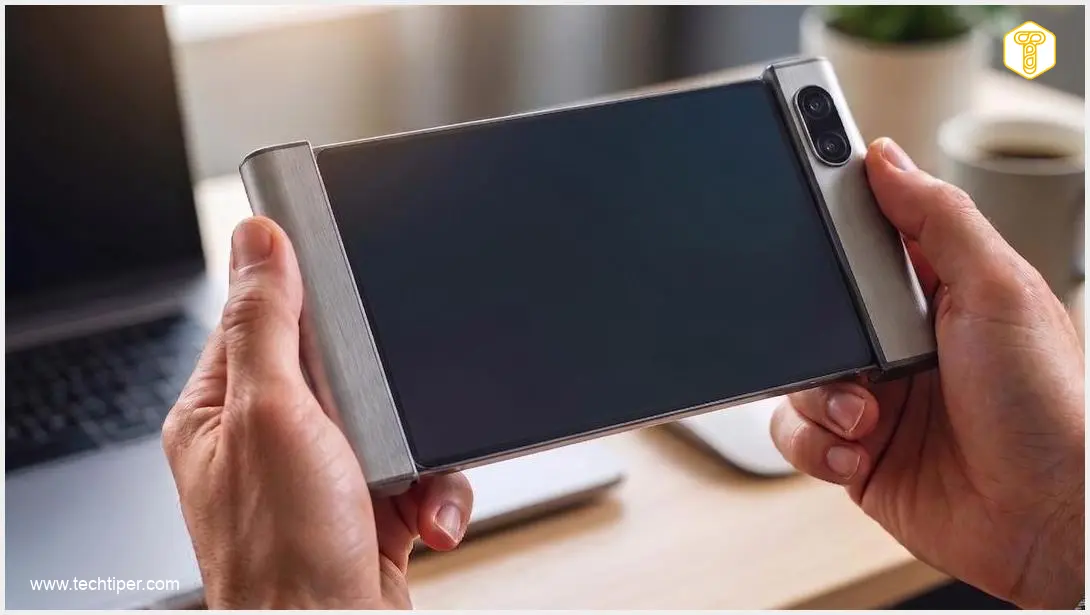
This design resembles a traditional smartphone that gains an additional segment of screen real estate when the physical casing is manually extended. Imagine a standard smartphone that can become wider on demand, offering more display without a complete fold. - Variant 2: The Radical Roll-out
The second, more innovative design features a two-part housing where the flexible display is entirely hidden when the device is in its compact mode. This approach significantly reduces the risk of screen damage. When expanded, an adaptable OLED panel elegantly rolls out from both ends of the device. The patent details a sophisticated sensor system that monitors the screen’s extension level and speed. This allows the user interface to continuously adjust and optimize content layout to the dynamically changing available workspace, ensuring a seamless user experience.
Will Rollable Phones Replace Foldables?
From a business standpoint, rollable and slidable designs represent a logical evolution for Samsung after establishing the Galaxy Z Fold and Z Flip series in the market. These new form factors offer compelling advantages: they combine the benefits of a large display with a more compact and potentially more durable body. When the screen is rolled or retracted, its delicate surface is protected within the device’s housing, reducing the risk of scratches and impacts. Furthermore, rollable devices could be significantly thinner and more convenient to carry in a pocket compared to traditional foldable phones that often have a notable hinge gap or thickness when folded.
The real question remains: will consumers, many of whom are still evaluating the practicality of existing foldable devices, be enticed by this new generation of expanding smartphones? The success of rollable technology will hinge on delivering a genuinely improved user experience and resolving any potential mechanical complexities. Samsung’s continuous innovation in flexible display technology, as seen in devices like the current Galaxy Z Fold and Z Flip, paves the way for such advancements. For those interested in how these innovations might compare with future flagships, explore topics like Samsung Galaxy S26 Ultra AI Privacy Display vs iPhone 17 Pro Max and keep an eye on developments around Samsung Galaxy S26 Launch Date and AI Unpacked 2026.
Frequently Asked Questions (FAQ)
What is the difference between rollable, slidable, and foldable smartphones?
Foldable smartphones, like Samsung’s Galaxy Z Fold and Z Flip, use a hinge to bend a flexible screen in half. Rollable and slidable smartphones, on the other hand, feature screens that expand or retract from a compact body, often by rolling or sliding out from the device’s main frame. This allows for a larger display when needed, without the creasing associated with some foldable designs or the bulk of a fully unfolded device.

What are the potential benefits of rollable/slidable phones over current foldables?
Rollable and slidable phones offer several advantages, including a potentially thinner and more pocketable design in their compact state, as the screen can be completely hidden within the body. This hidden design also offers better protection against scratches and external damage. They may also achieve a completely flat screen when expanded, avoiding the subtle creases sometimes seen on foldable displays.
When can we expect rollable or slidable Samsung phones to be released?
Currently, Samsung’s rollable and slidable phones are in the patent and concept phase. While patents indicate active research and development, there is no official timeline for their commercial release. Developing such advanced technologies from patent to a market-ready product can take several years, and not all patented designs ultimately make it to mass production.
How might the S Pen integrate with rollable or slidable displays?
The patent mentions S Pen support, suggesting that Samsung aims to maintain the stylus functionality found in its premium devices. For rollable and slidable screens, this would require the display material to be durable enough to withstand S Pen interaction and the underlying digitizer technology to function seamlessly across the expanding screen area, ensuring accurate and responsive input regardless of the display’s size.
Source: Android Authority, Wear View. Opening photo: Gemini
About Post Author