

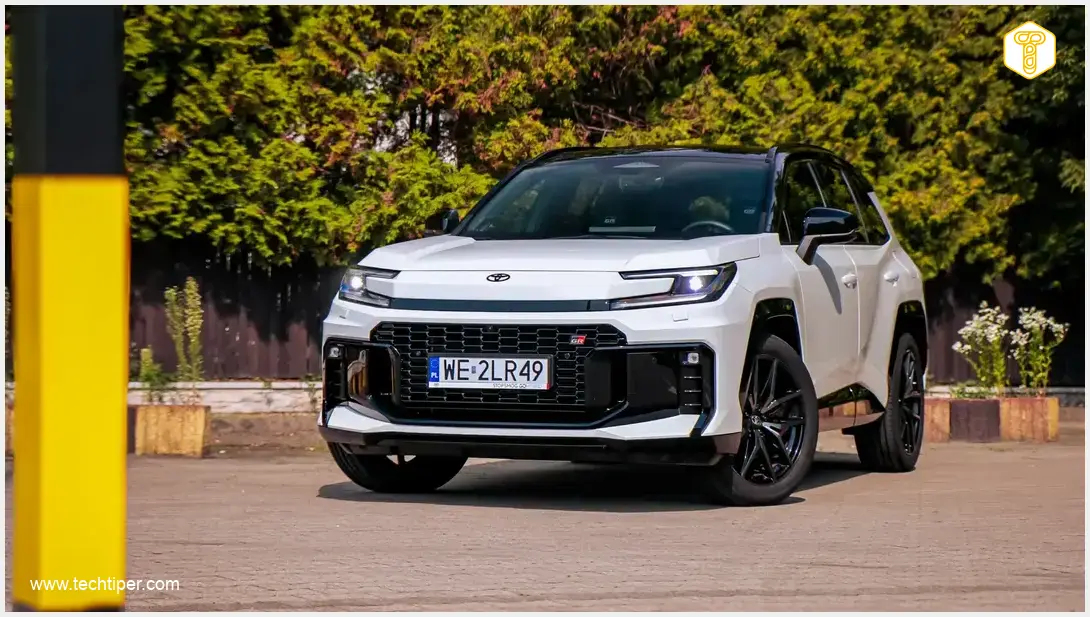
Toyota RAV4 AWD-i GR Sport (2026) Review
-
Infotainment System
-
Driving Dynamics & Comfort
-
Fuel Efficiency
-
Interior & Ergonomics
-
Driver Assistance Systems
-
Overall Value
A Thoughtful Evolution with Strong Core Strengths
The 2026 Toyota RAV4 AWD-i GR Sport (XA60) presents a significant evolution, offering a thoroughly revamped infotainment system, impressive fuel efficiency, and refined driving dynamics. While its core platform remains familiar, key updates to technology, interior design, and driver assistance systems elevate the user experience. Despite minor drawbacks like some interior plastics and trunk capacity, it maintains Toyota’s reputation for reliability and practicality, making it a compelling choice in a competitive segment.
Advantages
- Thoroughly revamped and intuitive infotainment system with seamless smartphone integration.
- Exceptional fuel efficiency, particularly in city driving conditions.
- Refined driving dynamics, high level of comfort, and predictable handling.
- Comprehensive and effective suite of driver assistance systems.
- Excellent interior ergonomics and high practicality.
Disadvantages
- Reduced power output for some hybrid variants; gap for an intermediate powertrain option.
- Interior noise levels, especially on highways, could still be improved.
- Slightly smaller nominal trunk capacity compared to the previous generation.
- Some interior plastics can be easily scratched, and certain premium features are trim-exclusive.
- Potentially slightly more expensive than some rivals with marginally less standard equipment.
Contents
Toyota RAV4 AWD-i GR Sport (2026) Review: A Successful Evolution on the Brink of Revolution
We are embarking on a comprehensive review of the 6th generation Toyota RAV4, specifically the sportier GR Sport variant. This generation, codenamed XA60, faces significant, if not record-breaking, competition, including a growing number of Chinese models. Toyota is undoubtedly aware of this, which explains the extensive list of updates and improvements making their debut, directly or indirectly, in this new RAV4. Toyota has clearly listened to consumer needs, leading to a broad evolution across almost every aspect of the vehicle. While not a radical revolution, the essence of a reliable, practical, and user-friendly Japanese product remains strong. This review will explore what this hybrid RAV4 offers in practice.Pricing and Trim Levels for the Toyota RAV4 (XA60)
Toyota’s sixth-generation RAV4 is now exclusively available in electrified versions. While there isn’t a purely electric variant (that niche is filled by the bZ4X), all powertrain options are full hybrids, including Plug-in Hybrid (PHEV) models. All-wheel-drive (AWD-i) remains an option, with prices varying across four primary trim levels. At the time of this review’s publication, the approximate pricing for the RAV4 (XA60) in key global markets is as follows (please note that actual prices may vary by region and current exchange rates):2.5 Hybrid Dynamic Force:
* **FWD (185 hp):** * Comfort: Approximately $49,900 / €45,900 * Style: Approximately $54,700 / €50,400 * Executive: Approximately $58,700 / €54,000 * **AWD-i (194 hp):** * Comfort: Approximately $52,400 / €48,200 * Style: Approximately $57,200 / €52,600 * GR Sport: Approximately $61,200 / €56,400 * Executive: Approximately $61,200 / €56,4002.5 Plug-In Hybrid:
* **FWD (272 hp):** * Comfort: Approximately $55,900 / €51,500 * Style: Approximately $60,700 / €55,900 * Executive: Approximately $64,700 / €59,600 * **AWD-i (309 hp):** * Comfort: Approximately $59,200 / €54,500 * Style: Approximately $63,900 / €58,800 * GR Sport: Approximately $68,000 / €62,600 * Executive: Approximately $68,000 / €62,600 These figures typically apply to 2027 models, with 2026 models often being slightly less expensive. Discounts may also be available, ranging from approximately $3,600 to $5,000, depending on the chosen trim and powertrain. Toyota offers a 3-year/60,000-mile (100,000 km) factory warranty for the entire RAV4, including paintwork. The hybrid system receives a 5-year/60,000-mile (100,000 km) warranty. A 12-year perforation warranty is also included, with no mileage limit. Toyota also provides an extended warranty program, Toyota Relax, covering vehicles up to 10 years old or with mileage up to 115,000 miles (185,000 km). For the traction battery, Toyota guarantees that it will maintain at least 70% of its capacity for 10 years or up to 620,000 miles (1 million km).Insurance Costs for the Toyota RAV4
Based on typical market data, basic liability insurance for the tested RAV4 model for an experienced driver could be around $180 per year. A comprehensive package, including collision and theft (AC), might cost approximately $1,900 annually. These figures are illustrative and can vary significantly based on location, driver profile, and selected coverage. Our tested Toyota RAV4 (XA60) was the Hybrid Dynamic Force variant with AWD-i in the GR Sport trim, giving it an initial price point of approximately $61,200 / €56,400. Interestingly, there was only one optional equipment item available for additional cost: a sunroof for about $750. Our review unit did not include this option. Beyond that, a wide range of accessories, such as a tow hitch or side steps, can be added. With a pearl white paint job (no extra charge), the final price of our review model, factoring in available discounts, came to around $56,700 / €52,200. While the Toyota RAV4 is generally competitive, it might be slightly more expensive than some direct rivals while offering marginally less standard equipment, a factor potential buyers should consider.Technical Specifications of the Toyota RAV4 (XA60) AWD-i GR Sport
Toyota has maintained a consistent approach to powertrains in the 6th generation RAV4, largely carrying over the same units from its predecessor. It’s worth noting that some adjustments were made to the internal combustion engine’s power output to meet evolving emission standards. The AWD-i system is distinct, with the rear wheels powered exclusively by a separate 54 hp electric motor, eliminating the need for a drive shaft. This setup contributes to entirely adequate performance on paper. The GR Sport variant, while visually enhanced, primarily offers a styling package and a modified suspension rather than a significant boost in power. Consistent with its sportier styling, the GR Sport variant of the RAV4 features slightly larger dimensions, being a few centimeters longer and wider than other versions. Interestingly, the XA60 generation has not significantly grown compared to the XA50, with identical wheelbases and most other dimensions. The exception is the height, which has increased by 8 centimeters. Conversely, the stated trunk capacity has nominally decreased, and it further diminishes if you opt for the Plug-In Hybrid version.A Brief History of the Toyota RAV4
The RAV4 has a rich history, beginning its journey as a vehicle designed with off-road capabilities in mind, even offering 3-door variants. Over time, Toyota recognized the burgeoning SUV market and strategically shifted the RAV4’s focus, a move that has proven highly successful. For a deeper dive into the fifth generation, you can refer to our Toyota Corolla Cross GR Sport review, which shares some DNA. The tested sixth-generation RAV4 (XA60) was globally unveiled in 2025. It shares the same platform as its predecessor, which explains the largely identical dimensions. Toyota explicitly states that there’s no need for the RAV4 to grow further in size. Instead, the focus was on drastically refreshing accompanying technologies, particularly the multimedia systems. The introduction of a new design language was also a key element. Given that the dimensions remain consistent, the RAV4 continues to firmly represent the C-segment SUV market. As mentioned earlier, competition in this sector is intense. Rivals include the Suzuki Across (a closely related model), the Hyundai Tucson and Kia Sportage from Korea, the Nissan Qashqai and Mazda CX-60 from Japan. A growing presence of Chinese models such as the BAIC Beijing 5, BYD Seal U, JAECOO 7, Omoda 7, and Chery Tiggo 9 also challenge the market. From other regions, we see models like the Renault Austral, VW Tiguan, Skoda Kodiaq, Ford Kuga, and even premium options like the BMW X1.The RAV4 (XA60) Infotainment System: A Toyota Revolution
One of the most significant novelties in the new RAV4, and indeed for the entire Toyota brand, is the thoroughly revamped infotainment system. Given Toyota’s typically conservative approach, this could almost be considered a revolution. In practice, it’s a highly modified platform based on systems familiar from other models, including its predecessor, but with performance maintained at an excellent level. The software is exceptionally simple to use and highly legible. The operating principles remain largely the same, so there’s no steep learning curve. However, new solutions have been introduced, the graphical interface has been refreshed, and crucially, the system now fully utilizes the large display area. All RAV4 models come with the same primary displays. The central touchscreen measures 12.9 inches, while the digital instrument cluster is a 12.3-inch panel. A Head-Up Display (HUD) can also be added, which is standard equipment for the GR Sport trim.Central Screen Offers an Enhanced User Experience
One of the changes accompanying the refreshed software is the partial requirement to connect your driver profile. Only then will all functions be unlocked, though in practice, this mainly applies to the built-in dashcam. Other options, including multimedia, remain accessible without a profile. A key innovation in the RAV4’s interface is the main, scrollable home screen featuring widgets. While the number of widgets isn’t vast, they can be customized to suit user preferences, representing the primary personalization change for the entire software. Additionally, there’s a quick settings panel. The rest remains unchanged, allowing easy navigation to key modules via the side menu. Toyota’s software still lacks a built-in owner’s manual, but this is less of a drawback now. Individual switches finally have sensible descriptions, eliminating much of the guesswork about specific functions. The voice assistant is quite comprehensive, though it still relies on predefined commands, with full capabilities often requiring a subscription. Another constantly displayed element of the interface is the climate control section. Toyota has moved away from a fully independent panel, though physical buttons remain (without rotary knobs). The visible bar allows quick adjustment of key climate functions, complemented by separate screens offering more advanced features, including basic automation. Among other comfort enhancements, the RAV4 includes the aforementioned dashcam and a digital key. Other standard features like lighting and central locking operations are managed via conventional switches. Toyota hasn’t significantly altered its connectivity options, which isn’t a complaint. Constant internet connectivity is available, and the system can connect to external Wi-Fi networks, though the RAV4 itself cannot serve as a Wi-Fi hotspot. Surprisingly, a web browser application isn’t present, even though the underlying functionality seems to exist within the software. Our review RAV4 was equipped with a 9-speaker JBL sound system; lower trims typically feature 6 speakers. The audio quality is surprisingly smooth and well-balanced. While there are no specific complaints about frequency reproduction, Toyota doesn’t aim for groundbreaking features like spatial audio.Navigation Improved, but Android Auto and Apple CarPlay Still Dominate
The navigation system has also received a significant facelift. However, it still relies on the familiar HERE maps, meaning route guidance and the underlying database are generally reliable. Numerous personalization options are available, but Toyota hasn’t introduced any unique, advanced features. Nonetheless, readability and usability have clearly improved. Toyota has made a noticeable effort to better integrate Android Auto and Apple CarPlay. Both platforms operate smoothly and wirelessly, and are now more deeply intertwined with the car’s system, especially with the digital instrument cluster. Apple smartphone users might find a slight advantage in the RAV4, as the side section with shortcuts can be retained. With Google’s solution, a specific workaround is often needed to return to the main system.Digital Instrument Cluster and HUD Receive a Significant Upgrade
In many Toyota models, including the previous RAV4, the digital instrument cluster was responsible for managing many of the car’s systems. Toyota has now migrated most of these settings to the more convenient central screen and significantly refreshed the digital gauges themselves. More themes and functionalities are available, yet the design remains intuitive for existing users. Toyota offers a variety of layouts rather than just color schemes for the themes. You can choose a single dial, dual dials, a map view, driver assistance system overview, fuel consumption graph, or a minimalist variant. Each option has its unique character and proves useful in specific scenarios. Without overusing the term ‘revolution’ in this review, Toyota deserves significant praise for allowing full navigation display from both Android Auto and Apple CarPlay on the digital instrument cluster. Regardless of whether you use Google Maps, Waze, or Apple Maps, the full navigation program will be shown directly on the digital gauges. Further personalization options include a scrollable widget section on the left. The sheer number of widgets is impressive, and you can limit them only to the items that truly interest you. This includes various forms of the trip computer, navigation prompts, multimedia information, and driver assistance systems. Separately, a menu with (thankfully) limited settings awaits. This is where you adjust the digital instrument cluster (and HUD), though options for the tailgate, for instance, also remain. Conveniently, this functionality is duplicated from the central display. The Head-Up Display has also seen improvements, offering three themes that dictate the amount of information presented on the windshield. A fair amount of data can be displayed, including a tachometer or an energy use indicator. Despite this, everything remains perfectly legible and uncluttered.Toyota RAV4 (XA60) Interior: Refreshed with Uncompromised Ergonomics
Toyota has consistently prioritized practicality over flashy materials in its interiors, and this philosophy remains unchanged in the tested RAV4. The cabin primarily features plastics, but they are of good quality and well-fitted. However, some surfaces can scratch relatively easily. Despite this, Toyota has incorporated soft-touch materials in certain areas. Crucially, the outstanding practicality and overall ergonomics remain, setting a high standard. The keyless entry system in the 6th generation RAV4 operates via the front door handles and the tailgate. As you approach the car, exterior lights in the mirrors illuminate, but you must grasp one of the handles to unlock the central locking. Locking is done by touching visible indentations. For the tailgate, you can also lock the entire car immediately, even without fully closing the lid.The Front Row Delivers SUV Comfort
Opening the RAV4’s doors reveals that they fully cover the sills, preventing soiled pant legs in adverse weather conditions. The hinges operate smoothly and offer a wide range of motion. The door handles are conventional, reflecting Toyota’s practical and straightforward design approach. Moving down the door panel, you’ll find pleasant-to-touch materials with a generously sized, soft-padded insert. Harder plastics become more prevalent further down and to the sides, but they are well-assembled. The elevated control cluster for windows and mirrors is very comfortable, and Toyota has cleverly integrated a convenient grip with a simple storage compartment. The main storage compartment can easily accommodate large bottles.Comfortable Seating
The seats in the tested Toyota RAV4 differentiate the GR Sport version with unique materials—a combination of synthetic leather and suede. The contouring itself is identical to what you’d find in other variants. These are simply good, comfortable seats that provide adequate support and remain comfortable on longer journeys. Both front seats offer electric adjustment, though the passenger seat lacks lumbar support adjustment. Memory functions, even for the driver’s seat, are notably absent. Interestingly, despite the GR Sport being pricier than the Style trim, it foregoes ventilation, a feature found in the more affordable RAV4 models. However, three-stage heating is included.Steering Wheel: A Model of Ergonomics
Another GR logo adorns the RAV4’s steering wheel, featuring a perforated leather rim with red stitching. Subtle contours for grip enhance the driving experience. Overall, it’s a comfortable and functional steering wheel. The rim is heated, and manual, two-way adjustment is available. Physical buttons and switches on the spokes contribute to excellent usability. Toyota has refreshed the layout, opting for clearly separated panels that are quick to learn. The left side controls multimedia and the digital instrument cluster, while the right side manages driver assistance systems. Paddle shifters behind the spokes allow for simulated gear changes. A driver attention monitoring system is located on the steering column. It reacts relatively quickly if you take your eyes off the road and is consistently accurate. Nearby, two essential buttons control the tailgate and the fuel filler flap.Dashboard: Practical, if a Bit Over-engineered
The 6th generation RAV4’s interior has gained more character. Toyota clearly aimed for a more engaging dashboard design while maintaining maximum practicality. Modern solutions have been integrated without compromising ergonomics. The materials used are generally decent, though some areas could benefit from softer touches. Visible heating wires in the windshield are also present. At the top of the dashboard, a sizable opening for the head-up display projector is immediately noticeable. Speaker grilles are also present, complemented by additional tweeters on the A-pillars. A simple shelf is even provided for the front passenger. Below the central display, you’ll find physical buttons for key climate settings and a rotary knob for audio volume. Below the air vents, another panel with physical buttons is located, though it’s somewhat over-engineered. It features four different types of switches for… selecting driving modes. These are positioned to the side, which taller drivers might find uncomfortable for their right knee. The leather insert doesn’t help as it’s too low. On the other hand, this design has allowed for a convenient storage compartment for two smartphones. This typically includes one inductive charger, with a second added in the Executive trim. A narrower storage space for small items is located on the level below, where two USB-C ports and additional physical buttons are found. Moving between the front seats, the European RAV4 features a comfortable, straightforward selector instead of the larger e-CVT gear lever. Two large cup holders with a removable divider are nearby. The armrest is not adjustable but opens from both sides and offers ample storage. Inside, there’s another USB-C port and a 12V socket. Furthermore, the lid can be flipped to create an additional shelf with dividers. Meanwhile, the glove compartment in front of the passenger is of an acceptable size. Sunglasses can be stored in a compartment near the headliner. Interestingly, interior lighting is now managed via touch-sensitive buttons. Further back, an auto-dimming rearview mirror provides good visibility.The Second Row: Designed for Long Journeys
Stepping into the rear seats, you’ll notice that the door panel is still well-finished, though there are slightly more hard plastics, and the storage compartment is smaller but still large enough for a bottle. The wide opening of the hinges allows for comfortable entry and exit. There is ample space in the second row of the RAV4, so even taller passengers should travel comfortably. Our only minor critique is the headrests, which lack adjustability and can only be removed, not extended. The ability to recline the seatbacks in two positions remains. The armrest with open cup holders is carried over from the predecessor. Other conveniences include seatback pockets, hooks, central air vents, two USB-C ports, and Isofix anchors (without covers). In the top-tier Executive trim, heated outboard seats are also added to this list.Minimal Lighting and Optional Sunroof
One aspect that might slightly disappoint in the new RAV4 is the interior lighting. While Toyota includes numerous light sources, they are notably dim. The relatively strong projectors in the mirrors, which activate upon approaching the car, are a positive exception. Otherwise, the interior can feel quite dark. The system also mentions ambient lighting, but its effect is barely noticeable. For more daylight, a power-operated sunroof is available for approximately $750. Its shade, however, is manual. The Executive trim offers the option of a full panoramic glass roof.RAV4 Trunk: More Than Meets the Eye
The RAV4’s tailgate can be opened in several ways, including a foot-kick sensor under the bumper. It requires a bit of practice, as Toyota’s response isn’t always instantaneous. Toyota has retained the dual button above the license plate, where the secondary button instantly locks the central locking. The same can be done after raising the tailgate, where two buttons await. The RAV4’s tailgate lifts quite high (and its opening height can be adjusted), which, combined with a relatively low loading sill, makes it easy to load groceries and luggage into the trunk. Its shape is generally practical. The base trunk capacity of the 6th generation RAV4 is 514 liters, which is theoretically about 65 liters less than its predecessor. While this seems like a significant reduction, Toyota compensates by offering more usable space when loading luggage up to the roof, thanks to the vertical tailgate, providing 749 liters—a slight increase over the previous model. For the Plug-In Hybrid, expect a reduction of around 70 liters. The rear seatbacks (60:40 split, no ski pass-through) can be adjusted to different angles, aiding in cargo organization. When folded, they create a nearly flat floor and expand capacity to almost 1,800 liters, noticeably more than in the 5th generation. Naturally, some of this volume includes underfloor storage, which can be set at two levels. The JBL subwoofer also takes up some space here. The cargo cover is well-finished and can be neatly stored in a dedicated compartment under the floor. In the trunk of the tested vehicle, you’ll find two hooks, a 12V socket, tie-down loops for securing nets, and a thoughtfully designed right wheel arch area. The RAV4 is also designed for roof rack mounting and a tow hitch. With the latter, it can tow a trailer weighing up to 800 kg (1,760 lbs) or 2 tons (4,400 lbs), depending on whether the all-wheel-drive variant is chosen.Driving Impressions: The RAV4 Delivers Exactly What Toyota Customers Expect
When considering the driving experience of a Toyota, “sporty emotions” rarely come to mind. While there are exceptions like the GR models (e.g., Toyota Corolla Cross GR Sport), the tested Toyota RAV4 GR Sport primarily signifies visual enhancements with a subtle performance bonus. More on that shortly, but first, understand that this review unit is exceptionally comfortable and confident on the road. The steering system is very well-balanced, offering pleasant resistance while remaining light for maneuvering. Parking or navigating tight city streets is effortless in the RAV4. The turning circle is just over 11 meters (36 feet), which is commendable. At higher speeds, the system tightens, gaining precision. The aforementioned bonus in the GR Sport is its modified suspension. Consequently, the RAV4 feels marginally stiffer, but to an extent that most drivers likely won’t perceive. Thus, I can confidently assess the tested Toyota as a stable and appropriately firm SUV in all conditions, one that nonetheless prioritizes comfort and effectively absorbs road imperfections.RAV4 Driving Dynamics Maintain a High Standard
Under the hood of all Toyota RAV4 (XA60) models, you’ll find the same 2.5-liter naturally aspirated gasoline engine producing 143 hp (221/227 Nm). This is a proven, non-turbocharged engine that offers predictable performance. The overall system output depends on the electric motors, all working in conjunction with a continuously variable e-CVT transmission. In the Hybrid Dynamic Force variant, the front axle motor generates 136 hp, while the Plug-in Hybrid boasts 204 hp. Adding the AWD-i system introduces an additional 54 hp (121 Nm) electric motor that exclusively powers the rear axle (without a mechanical connection to the front). Thus, our tested self-charging hybrid with 4×4 produces a combined 194 hp. On paper, the reviewed RAV4 AWD-i accelerates from 0 to 100 km/h (0-62 mph) in 7.7 seconds, which is entirely sufficient for the vast majority of daily driving scenarios. I was able to verify this figure in real-world measurements. Toyota has experimented a bit with driving modes and their selection methods, but essentially, they are divided into two categories. The standard modes include Eco, Normal, Sport, and Custom, each with obvious implications. For off-road conditions, there are Snow and Trail modes, available thanks to the AWD-i system, which sends more power to the rear axle. It’s commendable that Toyota is increasingly embracing individual settings, though naturally limited to basic options. For instance, you can personalize throttle response and the default stiffness of the steering system. The differences between modes are not drastic but are noticeable over time. In practice, the tested 6th generation Toyota RAV4 feels marginally more composed on the road compared to its predecessor, though these are subtle changes. It remains an SUV that primarily offers predictable handling, a characteristic for which Toyota is well-known. Whether you’re driving to the local grocery store or embarking on a long road trip, the RAV4 won’t fatigue you and will reliably get you to your destination. One persistent criticism directed at Toyota has been interior noise, especially in conjunction with the CVT transmission. While this was more noticeable in the fifth-generation RAV4, the sixth generation shows clear improvements. However, there’s still room for refinement. During calm driving, engine noise is generally not an issue. You can hear when the internal combustion engine engages, but it’s not overly intrusive. In city driving, it’s notably quiet. The average sound insulation becomes apparent primarily on highways at higher speeds, and surprisingly, it’s not directly from the engine. Rather, wheel arches and windows contribute more to the noise. Therefore, while Toyota has made significant strides, it seems there’s still a deliberate margin for its premium counterpart, such as the Lexus LBX e-Four. Naturally, during dynamic driving, particularly aggressive acceleration, the constant engine sound is unavoidable, but the tested car wasn’t designed for such scenarios. Therefore, the presence of paddle shifters behind the steering wheel should be seen as a novelty, as simulating gears in an e-CVT largely defeats its purpose. The ultimate goal is comfortable travel, and in this regard, the RAV4 is faultless. Performance is good, though the significantly more powerful Plug-In Hybrid naturally offers more. As is typical for Toyota, a regenerative braking system is on board but not overtly adjustable. While you can’t directly control the braking force, engaging cruise control without setting a specific speed allows the software to automatically decelerate based on radar data when it detects other road users ahead. This process is smooth, though it doesn’t provide a full stop.Fuel Consumption and Range of the Toyota RAV4 AWD-i (XA60)
Regardless of the powertrain, the 6th generation RAV4 features a 55-liter (approximately 14.5 US gallons) fuel tank, which is fairly standard. However, as a hybrid, it also benefits from a traction battery, particularly noticeable in urban driving. Optimal weather conditions, with temperatures around 25 degrees Celsius (77°F), also aided performance during our test. The tested Toyota RAV4 can be exceptionally fuel-efficient in city driving. By judiciously managing the accelerator and keeping the energy use indicator in the Eco sector, you’ll be very pleased with the results. I consistently completed routes (both short and long) with fuel consumption as low as 3.8 L/100 km (approximately 61.9 MPG US or 74.3 MPG UK), translating to a range of about 1,440 km (895 miles). When not in a hurry and road conditions permit, I occasionally achieved results as low as 2.9 L/100 km (approximately 81.1 MPG US or 97.4 MPG UK). Naturally, maximizing electric-only driving is key to these figures, meaning it won’t be the most dynamic experience. If you constantly use the internal combustion engine, you can easily reach 8 L/100 km (approximately 29.4 MPG US or 35.3 MPG UK). In suburban driving, with an average speed of around 80 km/h (50 mph), electric motors alone are insufficient, but fuel consumption around 4.5 L/100 km (approximately 52.3 MPG US or 62.8 MPG UK) is still very satisfying, offering a range of about 1,200 km (745 miles). On highways, expect the following readings from the trip computer: * 100 km/h (62 mph): 5.6 L/100 km (approximately 42 MPG US or 50.4 MPG UK); range: ~980 km (609 miles) * 120 km/h (75 mph): 6.7 L/100 km (approximately 35.1 MPG US or 42.2 MPG UK); range: ~820 km (510 miles) * 130 km/h (81 mph): 7.3 L/100 km (approximately 32.2 MPG US or 38.7 MPG UK); range: ~750 km (466 miles) * 140 km/h (87 mph): 8 L/100 km (approximately 29.4 MPG US or 35.3 MPG UK); range: ~680 km (423 miles) Overall, it’s no surprise that the hybrid Toyota RAV4 can achieve low fuel consumption. This is one of the key reasons why buyers often choose this model over its competitors.Driver Assistance Systems: Toyota’s Proven Style, Now More Intuitive
One of the most significant improvements in Toyota’s software, from our perspective, is the detailed descriptions for driver assistance systems. In the new RAV4, you no longer have to guess what individual abbreviations mean, and more switches have been added. Everything is now conveniently managed via the central screen, rather than the digital instrument cluster, a commendable step forward by Toyota. Partially unchanged is the traffic sign recognition system, which will provide audible warnings not only when exceeding the speed limit but also when a change in the limit is detected. The RAV4 occasionally reads signs from side roads, so the characteristic beeping can be hard to ignore. Fortunately, it can be quickly muted, as a dedicated button is almost always visible on the central screen. Regardless of the trim level, the tested Toyota RAV4 offers identically sized mirrors, which are large enough to provide excellent visibility. Standard features include a blind-spot monitoring system with two levels of indicator brightness. Additionally, cross-traffic alerts are provided for both front and rear, and this information is even displayed on the head-up display. Toyota also doesn’t skimp on cruise control; all 6th generation RAV4s come equipped with the most advanced adaptive cruise control system. We appreciate that Toyota allows for further personalization, such as adjusting acceleration behavior. The system’s responses are flawless and efficient. Moreover, it’s a predictive variant, meaning it can incorporate data from the navigation system, among other factors. Naturally, a lane-keeping assist system is also present, and its performance is commendable. The Toyota quickly recognizes lane markings and maintains position even through higher-speed and sharper turns. What’s more, the RAV4 can perform automatic lane changes, and it feels like one of the best systems on the market – providing clear assistance without abrupt movements or uncertainty. During night driving, the quality of the Toyota RAV4’s headlights is impressive. While Toyota doesn’t necessarily push boundaries in this area, the basic low beam mode performs exceptionally well. The light spread, brightness, and beam fill were all aspects we had no complaints about. The only minor quibble might be a slightly longer range. Additionally, fog lights are available, but they do not serve as active cornering lights. The presence of headlight washers is a welcome feature. The only missing element in the RAV4’s headlights is matrix LED technology, which Toyota reserves exclusively for the top-tier Executive model. Nevertheless, the tested model can automatically switch between high and low beam modes (without individual segments), though it could do so a bit faster. Lower RAV4 trims do not include a 360-degree camera system, but a rearview camera is standard. In the Style trim, additional cameras are optional, while they are standard on the GR Sport and Executive models. Toyota has not introduced any revolutionary changes in this area, so the image quality provided is fundamental. While brightness is acceptable, the level of detail could be improved. However, the useful visualizations (even with folded mirrors) are appreciated, along with the option for automatic activation when, for example, approaching an intersection (controlled at low speeds). This means they no longer solely rely on parking sensor activation (which are front/rear only). Just as 360-degree cameras are not available on all trims, the same applies to the automatic parking system, which is reserved exclusively for the top Executive model.Toyota RAV4 (XA60) AWD-i GR Sport Review: Conclusion and Our Opinion
We conclude our review of the 6th generation Toyota RAV4, a vehicle that truly borders on revolutionary. While the platform and many mechanical solutions largely remain unchanged from its predecessor, the newly designed interior, coupled with updated driver assistance systems and multimedia, clearly elevates the RAV4 to a higher level. Throughout, we were impressed by its fuel efficiency and overall driving characteristics. It’s a minor drawback that Toyota has reduced the power output of some of its hybrids. While dynamic performance remains good, there’s a gap for an intermediate powertrain option between the standard hybrid and the significantly more powerful Plug-In Hybrid. Similarly, while we appreciate the improved noise insulation, we still believe it could be better. Finally, it’s worth remembering that the RAV4 (XA60) has a smaller trunk capacity than its predecessor.Frequently Asked Questions (FAQ)
The 6th generation RAV4 features a significantly refreshed infotainment system, updated driver assistance technologies, and a redesigned interior. While the underlying platform and some mechanical components are carried over, these updates collectively enhance the user experience, connectivity, and safety.
The Toyota RAV4 AWD-i is exceptionally fuel-efficient in city driving. During tests, it achieved figures as low as 3.8 L/100 km (approximately 61.9 MPG US or 74.3 MPG UK), and under ideal conditions, even 2.9 L/100 km (approximately 81.1 MPG US or 97.4 MPG UK), allowing for an extended range thanks to its hybrid system.
The revamped infotainment system includes a 12.9-inch central touchscreen and a 12.3-inch digital instrument cluster. It offers a customizable widget-based home screen, improved navigation, and seamless wireless integration with Android Auto and Apple CarPlay. A significant enhancement is the ability to display full navigation from both smartphone platforms directly on the digital instrument cluster.
The GR Sport trim primarily offers visual enhancements and a sportier styling package. It also includes a modified, slightly stiffer suspension, which contributes to a more composed ride, though the performance boost over other trims is minimal.
The Toyota RAV4 AWD-i can tow a trailer weighing up to 2 tons (4,400 lbs), while FWD variants have a capacity of 800 kg (1,760 lbs). This capacity is a strong point for users needing to haul moderate loads.
Source: Original article. Photography by Łukasz Pająk
Opening photo: Łukasz Pająk

About Post Author
