

Contents
Embrace the Future: Why Now is the Perfect Time to Upgrade to Wi-Fi 7
The cost of electronic devices is currently experiencing significant fluctuations, partly driven by the increasing prices of computer memory components. For those considering an upgrade to their home network with a new Wi-Fi 7 router, this period might represent a fleeting opportunity to acquire cutting-edge technology at a relatively accessible price point. To help you navigate this transition, we’ve identified four compelling Wi-Fi 7 router models that offer excellent performance across various budgets.
Why Invest in Wi-Fi 7, and Why Now?
Wi-Fi 7, officially known as 802.11be or Extremely High Throughput (EHT), represents the latest evolution in wireless data transmission standards. Debuting between late 2023 and early 2024, it offers a dramatic leap forward in performance and efficiency compared to its predecessors. The advancements are substantial:
- Blazing Speed: Wi-Fi 7 is more than four times faster than Wi-Fi 6, boasting theoretical data transfer rates of up to 46 gigabits per second (Gbps).
- Expanded Spectrum: It operates across three frequency bands (2.4 GHz, 5 GHz, and 6 GHz), providing more bandwidth and less interference.
- Wider Channels: The standard introduces twice as wide channels in the 6 GHz band, maximizing data throughput.
- Multi-Link Operation (MLO): Wi-Fi 7 enables devices to communicate simultaneously across multiple channels and bands, optimizing speed and reliability.
What do these technical improvements mean for your daily digital life? Expect lightning-fast download and upload speeds, allowing for instantaneous transfers of very large files. Enjoy seamless 4K and even 8K video streaming without buffering. Online gaming benefits immensely from a radical reduction in latency and lag, providing a smoother, more responsive experience. Furthermore, Wi-Fi 7 significantly enhances the handling of multiple connected devices in a smart home environment, ensuring consistent performance for everyone and everything.
Many modern smartphones, laptops, and other smart devices are already compatible with Wi-Fi 7, making it an excellent time to integrate this advanced wireless technology into your home network. You might even find ways to repurpose older devices, for instance, by learning how to turn an old phone into a Wi-Fi hotspot extender to maximize your network’s reach.
There’s another compelling reason to consider upgrading your network sooner rather than later. The consumer electronics market is currently experiencing significant price volatility and supply chain challenges. Computers, smartphones, and gaming consoles have already seen price increases. It’s highly probable that a domino effect will soon impact router prices, driving them upwards as well.
Therefore, if you’re looking to revolutionize your home network and simultaneously safeguard against potential price hikes, now is the time to act. But which Wi-Fi 7 router should you choose? Using ASUS as an example, we present four models spanning various price points and feature sets.
Featured Wi-Fi 7 Router Models
1. ASUS RT-BE55 BE3600: Budget-Friendly Performance
The ASUS RT-BE55 BE3600 offers an accessible entry point into the world of Wi-Fi 7 for every household. This compact black router, featuring four prominent vertical antennas, delivers data transfer speeds of up to 3600 Mbps across its 2.4 GHz and 5 GHz bands. It’s an ideal choice for those taking their first step towards more stable streaming and gaming experiences.
The RT-BE55 BE3600 emphasizes flexibility, supporting multiple operating modes:
- Router Mode: Standard wireless network management.
- Access Point (AP) Mode: Connects wired devices to your Wi-Fi network.
- Bridge Mode: Facilitates data transfer between ports without typical routing functions.
This router incorporates MU-MIMO (Multi-User, Multiple-Input, Multiple-Output) technology, enabling it to communicate with multiple devices simultaneously without performance degradation. It includes a 2.5 Gbps WAN port for high-speed internet connections and four gigabit LAN RJ45 ports for wired devices. A WPS button simplifies connecting new devices. Setting up this versatile and discreet router is straightforward, thanks to a dedicated mobile application and the manufacturer’s web interface. The package typically includes an RJ-45 cable, power adapter, and a quick installation guide. Expect to find this model priced approximately between $75 and $100 USD, offering excellent value for unlocking Wi-Fi 7 capabilities.

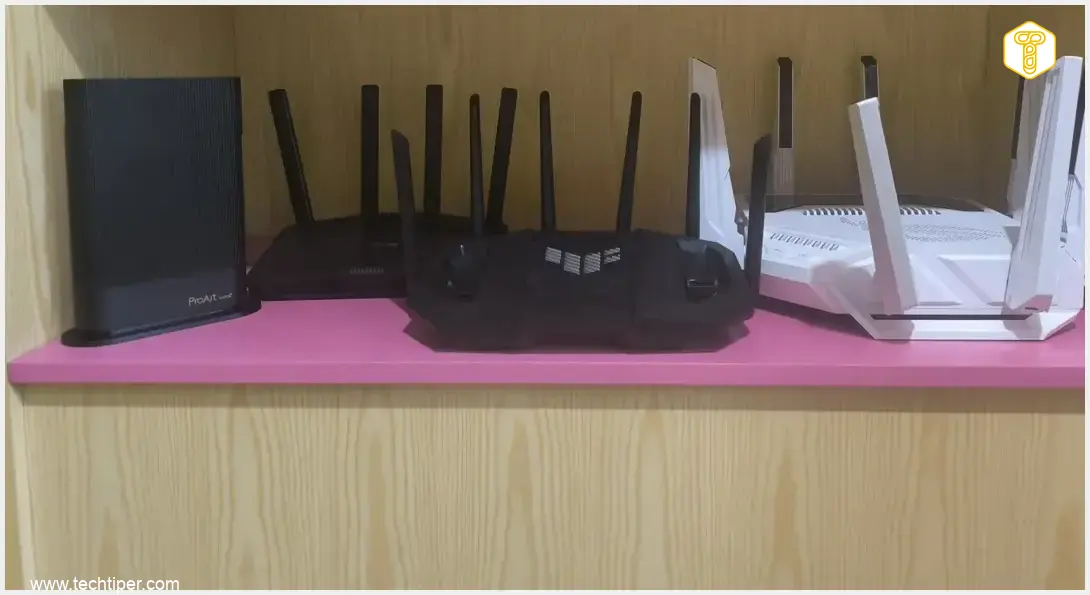
2. ASUS ProArt PRT-BE5000: Stylish Stability for Creative Pros
The ASUS ProArt PRT-BE5000 perfectly blends stable Wi-Fi 7 performance with a stylish aesthetic. Encased in a sleek, column-shaped black housing, this router is equipped with five internal antennas and leverages Beamforming technology to direct Wi-Fi signals precisely to connected devices, ensuring optimal reception. It offers data transfer speeds of up to 5000 Mbps.
Operating in Dual-Band mode (2.4 GHz and 5 GHz simultaneously), the ASUS ProArt PRT-BE5000 provides robust signal transmission and reception. Connectivity options include one 2.5G RJ-45 WAN input, one 2.5G LAN port, and three 10/100/1000G LAN ports, catering to various wired networking needs. A WPS button on the rear allows for quick, password-free device pairing, making it perfect for seamless 4K video streaming. Beyond its primary routing function, it can also operate in Mesh mode, expanding network coverage for larger homes. This feature highlights how far wireless technology has come, moving away from the need for physical connections, a trend reflecting the decline of the HDMI era as wireless 4K transmissions become preferred.
Measuring 131mm in height and 38mm in width, this elegant router is designed to fit unobtrusively into various home environments. Its base is detachable, allowing for wall mounting to save space. The retail package typically contains an RJ-45 cable, power adapter, and a quick installation guide accessible via a dedicated application. This model generally retails for around $150 USD.
3. ASUS TUF Gaming BE9400: Serious Gaming Performance
For dedicated gamers seeking a robust and feature-rich networking solution, the ASUS TUF Gaming BE9400 offers an advanced gateway to high-performance online experiences. This next-generation router supports Wi-Fi 7 across three bands (2.4 GHz, 5 GHz, and 6 GHz) utilizing Tri-Band technology, delivering combined maximum speeds of up to 9400 Mbps.
The ASUS TUF Gaming BE9400 is equipped with six external antennas for superior signal strength and coverage. In addition to standard Router, Access Point, and Bridge modes, it also features a Repeater mode. This allows the router to receive a signal from another router, amplify it, and retransmit it, extending your network’s reach.
All its ports—one WAN and three LAN—offer 2.5 Gbps throughput, ensuring high-speed wired connections. One of the LAN inputs is specifically optimized for gaming devices, providing a dedicated high-priority connection. The router also includes a USB 3.2 Gen 1 port for connecting peripherals like modems or printers.
Additional gaming-centric features include Quality of Service (QoS), which prioritizes network traffic for selected devices, parental controls, a VPN server for secure private network connections, and support for external 4G/LTE modems. For wireless security, it uses WPA3 and WPA2 standards with PSK (Pre-Shared Key) for home use and Enterprise protocols for office environments. With its modern design and compact form factor, this powerful router provides an exceptional gaming and streaming experience, typically priced between $150 and $200 USD.
4. ASUS ROG Rapture GT-BE19000AI: Uncompromising AI-Powered Gaming Dominance
The ASUS ROG Rapture GT-BE19000AI is an immensely powerful wireless router designed for gamers who demand absolutely no compromises during intense gaming sessions. As one of the world’s first AI-powered routers featuring an AI core, it is a tri-band model (2.4 GHz, 5 GHz, and 6 GHz) that fully embraces the Wi-Fi 7 standard. It delivers astounding speeds of up to 19,000 Mbps and incredibly stable connections crucial for demanding online games.
Gamers will particularly appreciate the ROG Rapture GT-BE19000AI for its ability to boost and prioritize game data packets at every stage, from the player’s PC or console all the way to the game server. Its artificial intelligence engine supports a three-level game acceleration system, transforming virtual gameplay into an unparalleled experience. The router boasts numerous RJ-45 ports: two 2.5 Gigabit LAN/WAN ports, four 2.5 Gigabit LAN ports, and two 10 Gigabit LAN ports, offering extensive high-speed wired connectivity. It also includes one USB 3.1 Gen 1 connector and supports external 4G/LTE modems.
Equipped with eight external antennas and an array of advanced security features (WPA3, WPA2, MAC address filtering), this router’s futuristic black and white design integrates seamlessly with high-performance gaming setups. This “tech-spider” desktop unit, with its robust build and chimney-like structure, extends its reach throughout your entire home and beyond, ensuring comprehensive Wi-Fi 7 coverage in every corner of your gaming kingdom. Be prepared for a premium investment, as this model typically ranges from $625 to $875 USD.
Frequently Asked Questions (FAQ)
Wi-Fi 7 (802.11be, or Extremely High Throughput) is the latest wireless standard, offering significantly faster speeds (up to 46 Gbps), lower latency, and better efficiency compared to Wi-Fi 6. Key advancements include operation on three frequency bands (2.4, 5, and 6 GHz), wider 6 GHz channels, and Multi-Link Operation (MLO) for simultaneous communication across multiple bands, leading to a much more robust and responsive network, especially with many devices.
Investing in a Wi-Fi 7 router now is strategic for two main reasons: future-proofing and market conditions. Wi-Fi 7 offers unparalleled speeds and stability for current and future devices. Additionally, the broader electronics market is experiencing price increases and supply chain issues, suggesting that router prices are likely to rise soon. Upgrading now can help you secure advanced technology at potentially lower costs before widespread price adjustments.
When selecting a Wi-Fi 7 router, consider your budget, home size, and specific usage needs. For basic use and smaller homes, a dual-band model with speeds around 3600-5000 Mbps might suffice. For larger homes, creative professionals, or moderate gamers, look for models with Mesh capabilities, Beamforming, and higher speeds (e.g., 5000-9400 Mbps). Dedicated gamers or those with extensive smart home ecosystems should prioritize tri-band routers with advanced QoS, multiple high-speed LAN ports, and AI-powered optimizations for the best performance (e.g., 9400-19000 Mbps). Also, check for features like MU-MIMO and robust security protocols.
Yes, Wi-Fi 7 routers are backward compatible with older Wi-Fi standards like Wi-Fi 6E, Wi-Fi 6, Wi-Fi 5 (802.11ac), and even older versions. This means your current devices—smartphones, laptops, smart home gadgets—will still be able to connect to a Wi-Fi 7 router. However, to fully experience the benefits of Wi-Fi 7, such as its ultra-fast speeds and low latency, you will need devices that also support the Wi-Fi 7 standard. Older devices will connect at their maximum supported Wi-Fi standard.
Source: Self-developed, ASUS. Opening photo: Android.com.pl (Removed)
About Post Author
