

Contents
The Fall of Vibe Coding: Why Core Programming Skills Are More Valuable Than Ever
Just a year ago, the era of classic software engineering seemed to be drawing to a close. AI-powered tools like Cursor, Bolt.new, and Replit Agent promised the ultimate democratization of software development. The narrative was clear: anyone who could describe an idea in a few sentences could launch a working application over the weekend. “Vibe coding” quickly became the symbol of this new epoch.
Today, however, search trends tell a different story. The phrase “vibe coding is dead” is rising just as rapidly as the trend initially emerged. So, what went wrong, and why is the tech industry shifting its focus back to traditional software engineering?
Why the Vibe Coding Idea Burned Out
For an entire year, everyone wanted to be a developer, and vibe coding seemingly made that possible. The concept was simple and incredibly tempting: instead of writing code line by line, a user merely describes their intent and the desired outcome in natural language, leaving the AI to handle the complex implementation.
It appeared as though the high barrier to entry in the technology sector had completely vanished. At its peak, the global market for AI programming tools reached a staggering valuation of $8.5 billion, with the vast majority of developers testing or actively utilizing vibe coding practices.
The Rise of “AI Slop”
Despite the hype, it quickly became apparent that the reality did not match the promise. Instead of fostering a golden age of original, unique applications, the market was flooded with what industry experts now call “AI slop.”
- Lack of Originality: The result of vibe coding is often technically functional applications that fail to stand out, generated from the exact same underlying templates.
- The “Copy of a Copy” Effect: Products became indistinguishable from one another. Users quickly learned to recognize this repetitive, cookie-cutter pattern.
- Oversaturation: Vibe coding simply worked too well for everyone all at once, generating a vast sea of identical digital products.
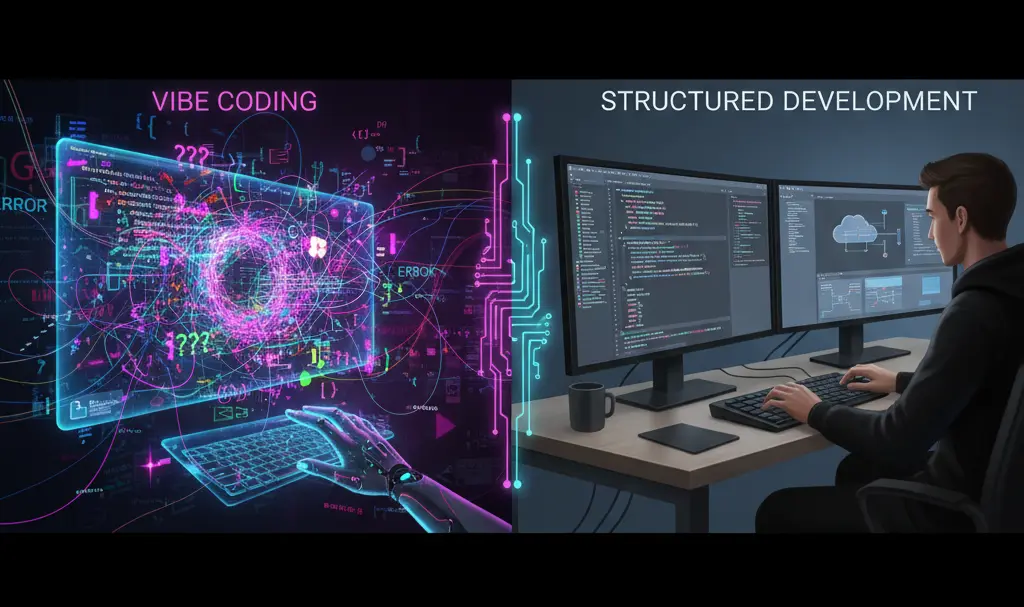
Vibe Coding: A Revolution with an Expiration Date
Today, discussions in tech circles have pivoted from democratization to urgent warnings about technical debt, severe security vulnerabilities, and a skyrocketing demand for professionals who can actually comprehend the code AI generates.
The bold claims that completely inexperienced individuals could safely deploy and maintain software have proven false. Rather than closing the skills gap, collaborating with artificial intelligence has actually widened it, heavily rewarding those who already possess strong, fundamental engineering skills.
As we look toward the future of technology, such as the innovations expected at CES 2026 with the rise of Agentic AI, it is clear that AI tools are meant to augment, not replace, human intelligence. Vibe coding democratized basic software creation in the same way smartphones democratized photography. However, just because someone holds a smartphone does not make them a professional photographer.
The Market Quietly Returns to Real Engineers
Recent studies confirm that “prompting” is simply another abstraction layer of programming. To vibe code effectively and safely, you still need to understand software architecture. An experienced engineer armed with an AI assistant becomes exponentially more productive, whereas an inexperienced user quickly generates code they cannot maintain.

Research analyzing GitHub Copilot usage showed a massive 55% productivity increase among developers using AI support. However, this boost strictly stacks on top of pre-existing coding skills.
The Hidden Costs of AI Code
Organizations that attempted to replace their junior developers with prompts quickly learned a harsh lesson: the initial savings during the creation phase translated into drastically higher maintenance and repair costs.
- Development Hell: Experienced engineers are now speaking out about the nightmares of trying to maintain messy, AI-generated codebases.
- Increased Bug Rates: A recent extensive industry analysis by CodeRabbit, reviewing hundreds of open pull requests, revealed that AI-assisted code contained approximately 1.7 times more critical issues than human-written code.
- Security Risks: The same study highlighted a sharp increase in security vulnerabilities and 75% more misconfigurations in AI-generated software.
Because of these compounding issues, companies are quietly hiring real developers to clean up the mess left behind by rapid vibe coding deployments. Events like the Codaro Coding Challenge are already redefining hackathons in the AI era by emphasizing human problem-solving alongside AI assistance, rather than pure automation.
Ultimately, the market is pivoting away from blind AI generation. Companies are now heavily investing in professionals with practical programming experience—individuals who know how to architect a solution, debug complex systems, and fix problems, rather than just prompting a machine to generate them.
Frequently Asked Questions (FAQ)
What exactly is “vibe coding” and why is it considered dead?
Vibe coding refers to the practice of building software purely by writing natural language prompts for AI tools (like Cursor or Bolt), rather than writing traditional code. It is facing a massive decline because it often leads to unmaintainable code, high technical debt, and generic applications lacking security and structural integrity.
Will AI eventually replace traditional software engineers?
Current industry trends indicate the opposite. While AI makes developers much more productive, it requires a deep understanding of software engineering to guide the AI, review its output, and maintain security. Companies are actually increasing their demand for skilled engineers who can fix the complex errors generated by AI.
How can developers safely use AI coding tools without creating technical debt?
Developers should treat AI as a highly capable assistant rather than a replacement for architectural thinking. Safe integration requires rigorous code reviews, automated testing, understanding every line of code the AI suggests, and never deploying unverified AI output into a production environment.
Source: Medium, DevstockAcademy, Wikipedia, X, PJA, Stackoverflow & Opening photo: Gemini
About Post Author
