

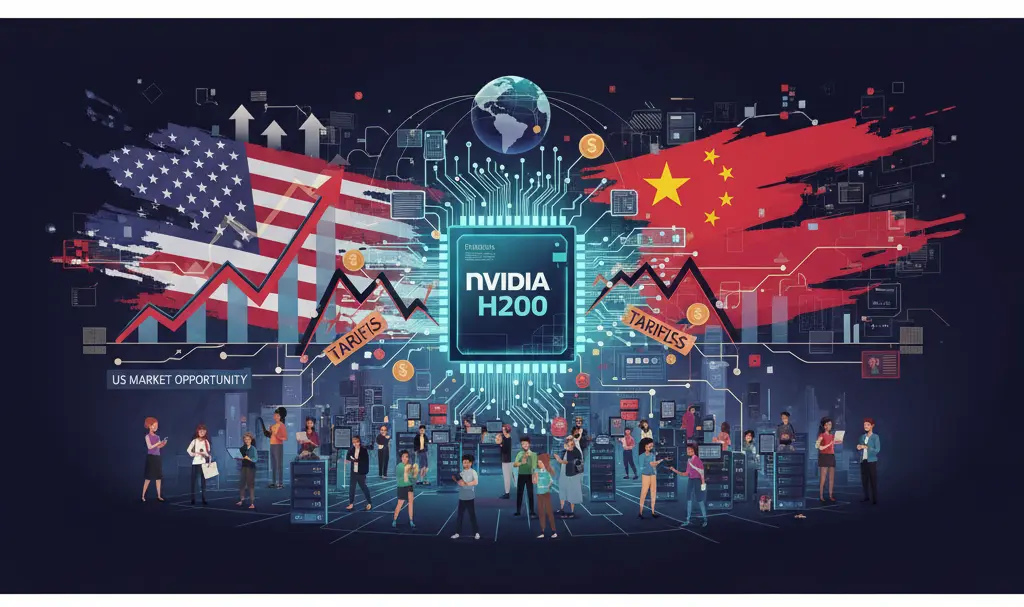
The long-standing technology conflict between the United States and China, which has significantly impacted trade relations for companies like NVIDIA, appears to be reaching a pivotal moment. While a return to the highly sought-after Chinese market is on the horizon for the graphics processing unit (GPU) giant, it comes with substantial costs and complex dynamics.

Contents

A Potential End to the Tech Standoff
NVIDIA has reportedly received an official license from the U.S. public administration to distribute a limited quantity of its older-generation H200 chips to China. This marks a significant development, as such trade was previously prohibited, with the U.S. citing national security concerns as the primary reason for the restrictions.
China’s Domestic Push Amidst Restrictions
During the period of heightened tensions and trade restrictions, China proactively focused on bolstering its domestic chip production. Companies like Huawei stepped up, aiming to develop competitive alternatives that could rival NVIDIA’s offerings. This strategic push was designed to reduce reliance on foreign technology and ensure self-sufficiency in critical areas.
NVIDIA’s Return: Opportunities and Obstacles
The situation has now shifted dramatically, with Jensen Huang’s company poised to re-enter the crucial Asian market. Despite the “green light” from U.S. authorities, questions remain about China’s reception of NVIDIA. However, all indications suggest there’s little cause for concern.
According to Bloomberg, the Chinese administration has instructed local sales platforms, such as Alibaba, to prepare for the delivery of H200 chips, signaling China’s readiness for NVIDIA’s return.
Significant Costs and Tariffs for NVIDIA
While the license opens doors, it is not without financial burdens for NVIDIA. The agreement is reportedly contingent on several conditions:
- Mandatory U.S. Inspections: NVIDIA must undergo inspections within the United States.
- 25% Tariff: The company is obligated to pay a 25% tariff on the value of the shipments. This substantial duty will significantly impact the profitability of these transactions.
A Timely Decision to Avert Major Losses
The U.S. administration’s decision may have shielded NVIDIA from immense financial setbacks. As early as May of last year, NVIDIA’s founder and CEO, Jensen Huang, predicted that a continued ban on trade with China could result in losses of up to $8 billion for the company in the first quarter of 2026 alone. This highlights the critical importance of the Chinese market for NVIDIA’s global revenue and growth.
Huang also emphasized that solutions from competitors like Huawei should not be underestimated, noting that their chips offer capabilities quite similar to NVIDIA’s H200. This competitive landscape underscores the ongoing need for innovation and market agility for NVIDIA.
Frequently Asked Questions (FAQ)
Why was NVIDIA’s trade with China restricted?
Trade of advanced chips like those from NVIDIA was restricted by the U.S. government due to national security concerns, aiming to limit China’s access to cutting-edge technology.
Which NVIDIA chips are now allowed for sale in China?
NVIDIA has received a license to sell a limited number of its older-generation H200 chips to China.
What are the financial implications for NVIDIA?
NVIDIA will incur significant costs, including mandatory inspections within the U.S. and a 25% tariff on the value of its chip shipments to China.
How has China responded to the previous trade restrictions?
During the ban, China focused heavily on boosting its domestic chip production, with companies like Huawei developing their own competitive chips to reduce reliance on foreign technology.
Could this decision prevent significant losses for NVIDIA?
Yes, NVIDIA CEO Jensen Huang had previously projected potential losses of up to $8 billion in Q1 2026 if the ban continued, suggesting this decision could help mitigate such financial impact.
Source: Bloomberg. Opening photo: Generated by Gemini.
About Post Author
