

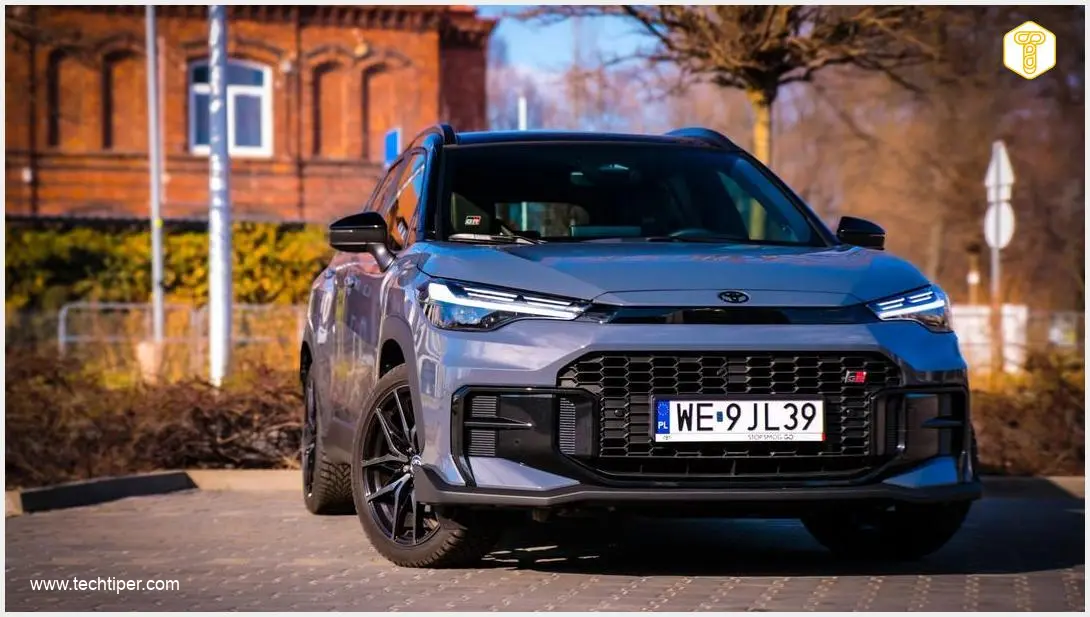
Toyota Corolla Cross GR Sport Review
-
Interior Quality & Finish
-
Sound Insulation
-
Infotainment & Connectivity
-
Driving Comfort & Ride
-
Fuel Economy
-
Driver Assistance Systems
Refined Comfort, Excellent Efficiency, Room for Interior Improvement
The facelifted Toyota Corolla Cross GR Sport offers a comfortable ride, intuitive infotainment with wireless connectivity, and outstanding fuel economy. While interior quality and sound insulation have seen improvements, they still leave some room for enhancement. The GR Sport trim adds style without transforming its comfortable driving dynamics.
Advantages
- Improved interior finish and ergonomics
- Excellent fuel economy from the hybrid powertrain
- Comfortable ride quality and suspension
- User-friendly infotainment with wireless Android Auto/Apple CarPlay
- Reliable and effective driver assistance systems
- Practicality and ease of use in daily life
Disadvantages
- Still noticeable use of hard plastics, especially in the rear
- Sound insulation, while improved, could be better
- GR Sport is primarily a styling package, not a performance upgrade
- CVT can lead to engine noise during strong acceleration
- Speed limit warning system is often inaccurate and obtrusive
- Limited advanced features (e.g., 360 camera, adaptive lights) in GR Sport trim
Contents

Toyota Corolla Cross GR Sport Test: A Facelift Responding to Customer Needs
Here’s our comprehensive review of the Toyota Corolla Cross GR Sport, representing the refreshed model of the compact crossover that clearly benefited from a facelift. While not the oldest vehicle in Toyota’s Japanese lineup, the manufacturer received clear feedback from around the world on areas needing improvement. I can already reveal that the interior finish and sound insulation are better. So, what else has changed? Let’s find out in this in-depth review of the Toyota Corolla Cross in its GR Sport edition.
Pricing and Trim Levels
Toyota has expanded the number of Corolla Cross variants with this facelift, introducing the GR Sport version we’re testing. The engine lineup remains unchanged in terms of available options. The pricing is as follows (in local currency units):
- 1.8 (140 HP):
- Comfort: 145,900
- Style: 157,900
- 2.0 (180 HP, FWD):
- Comfort: 154,900
- Style: 166,900
- GR Sport: 178,900
- Executive: 181,900
- 2.0 (180 HP, i-AWD):
- Style: 176,900
- GR Sport: 188,900
- Executive: 191,900
At the time of publication, Toyota offered special promotional prices, allowing savings of up to nearly 10,000 currency units. Nevertheless, even without the discount, these prices remain similar to those before the facelift. You can explore the differences in equipment through detailed specifications available from the manufacturer.
Warranty and Insurance Costs
The Corolla Cross comes with a factory warranty of up to 3 years or 100,000 kilometers. Paintwork is covered for 3 years without mileage limits, and body perforation for 12 years. The hybrid powertrain components (including the traction battery) have a 5-year/100,000-kilometer warranty. Additionally, Toyota Relax packages can extend coverage up to 10 years or 185,000 kilometers.
According to local insurance data, comprehensive insurance for the tested Corolla Cross for an experienced driver could be around 4,500 currency units annually, with basic liability starting from approximately 580 currency units. We encourage checking current local rates for precise figures.
The tested Toyota Corolla Cross is a GR Sport variant with front-wheel drive (FWD), starting at 178,900 currency units. This configuration was enhanced with the optional VIP package (7,000 currency units), which includes an upgraded JBL sound system, a panoramic roof, and a more advanced infotainment system. Pearl or metallic paint finishes do not require an extra charge, and all GR Sport versions include a black roof. Aside from the VIP package, few other options are available to expand the Corolla Cross’s equipment. Thus, the final price for the tested model is 185,900 currency units. Additional accessories like a tow bar, various trim elements, and transport solutions (roof racks, etc.) can be selected.
Technical Specifications
The facelifted Toyota Corolla Cross did not bring fundamental changes to the available powertrains. However, the top-tier hybrid with a 2.0-liter gasoline engine now produces slightly less power—180 HP instead of 197 HP—a change primarily driven by emissions regulations. Nevertheless, performance remains very similar, at least on paper. It’s worth remembering that the i-AWD system adds an electric motor to the rear axle, albeit with limited power (40 HP). This also impacts boot capacity.
Key characteristics for the GR Sport version include a lowered suspension (by 10 mm), redesigned bumpers, sporty interior accents, and an exclusive Sport driving mode. Beyond these, the facelift does not introduce additional modifications to the bodywork or powertrain.
Brief History of the Toyota Corolla Cross
The Corolla Cross debuted in many markets in late 2022, effectively completing Toyota’s crossover and SUV lineup. As its name suggests, it’s a raised Corolla, one of the world’s most popular cars. It’s surprising that Toyota waited so long to introduce a crossover version of this model.
Even more surprising to some might be Toyota’s decision to implement a significant facelift—by company standards—in 2025, just five years after its global debut. This update largely responds to frequent feedback regarding the interior quality of the Corolla Cross. The GR Sport version, a stylistic nod to Toyota’s performance models, was introduced alongside this update. The rejuvenation treatment included redesigning the front and rear of the car, along with subtle interior design adjustments.
The Toyota Corolla Cross competes in the compact crossover/SUV C-segment. Its closest rivals include models such as the Hyundai Kona, Mazda CX-30, Honda HR-V, Nissan Qashqai, Skoda Karoq, Seat Ateca, Opel Grandland, and Peugeot 3008. The list of competitors is extensive, as this is a highly popular market segment globally. For a deeper dive into how this car stacks up against other versatile compacts, you might be interested in a comparison like driving the new Opel Astra and its 64-year-old great-grandfather.
Infotainment System
Toyota approaches infotainment systems with a focus on minimal distraction, a philosophy that holds merit. The Corolla Cross doesn’t offer extravagant features but rather essential solutions within an ergonomic interface. This means there’s no need to meticulously study the software or search for hidden options, though some elements could benefit from better explanations. This is particularly true for the driver-assistance systems, which, along with many other settings, are managed through the digital instrument cluster. Nevertheless, the system’s simplicity, efficiency, and ease of use are highly appreciated in the long run.
Most Corolla Cross versions feature the standard Smart Connect system, which is somewhat limited compared to the Smart Connect+ (available in higher trims or packages), especially concerning navigation features (offline maps, advanced options). All variants feature the same display panels: a 12.3-inch digital instrument cluster and a 10.5-inch central touchscreen. An optional JBL sound system is also available for enhanced audio.
Central Screen – User-Friendly Operation
Toyota doesn’t require users to log in to a personal profile to access full system functionality, although doing so enables remote control via a smartphone app. Nevertheless, you can immediately begin exploring the system upon entering the tested Corolla Cross.
As mentioned, the Toyota platform’s interface is straightforward, primarily relying on a side menu for quick access to specific modules. There’s no widget-filled dashboard, and personalization options are limited to light/dark themes. Occasionally, fonts appear slightly squeezed but remain legible.
The Corolla Cross includes a basic voice assistant whose functions are limited to core vehicle controls. There is no built-in owner’s manual to explain the meaning of various icons or shortcuts.
Comfort-related functions are also minimal on the central screen. Almost all climate control operations are handled via a separate, convenient panel with physical buttons. The central screen only features two such switches. Other options relate to lighting and central locking, again, basic settings.
In terms of connectivity, Toyota is a bit more daring with the Corolla Cross, offering Wi-Fi (without hotspot functionality) and a web browser. While regular use is unlikely, it’s available if needed. Furthermore, Toyota continues to support wired media connections (USB) and Miracast.
The tested facelifted Corolla Cross was equipped with the optional JBL sound system, comprising nine (instead of six) speakers. The overall audio quality is satisfactory—a conventional setup that allows for listening to music, audiobooks, and podcasts without significant drawbacks, but also without exceptional performance.
Navigation, Android Auto, and Apple CarPlay
The navigation system in our review unit is the advanced version (Smart Connect+), offering additional features. Generally, it’s a very simple tool for route planning that performs as expected.
Despite relatively old map markers, the databases seem to cover all new roads. Additional features, such as speed camera alerts, are present, though we did note some omissions.
Naturally, wireless support for Android Auto and Apple CarPlay is included—a new feature, as pre-facelift models required a cable for Google-powered smartphones. The performance of both solutions is very good. CarPlay has a slight edge, allowing the side shortcuts section to remain visible within the main system. For those considering other premium urban crossovers with advanced connectivity, a look at the Lexus LBX e-Four review might provide interesting insights.
Digital Instrument Cluster – Significant Importance
The digital instrument cluster plays a crucial role in managing the most important modules of the Corolla Cross. In a Toyota, this is where you control driver-assistance systems and even the power tailgate. Its primary function—displaying essential driving information—is executed through clear visualizations.
Toyota offers a considerable number of customization options for this display. You can choose from four visual themes for the dials, which can also be independently adjusted in terms of quantity and arrangement. Furthermore, you can select between a classic tachometer or an energy usage indicator, ensuring something for everyone.
Another extensive set of personalization options appears in the form of widgets. You can assign these to three predefined layouts and quickly switch between them. The two side sections offer identical sets of widgets, including various trip computer displays, multimedia information, driver-assistance systems, navigation, and more. The central section can again show driver-assistance systems, the map, and also serves as the settings area for managing the Corolla Cross’s most critical options.
Interestingly, the tested vehicle, unlike some other Toyotas, does not conveniently indicate when brake lights are active, which would be useful when actively using recuperation.
Interior After Facelift – Recognizable Only by True Fans
The interior modernization of the Toyota Corolla Cross is subtle. The manufacturer has made minor improvements to the materials, incorporating more soft-touch elements, though they don’t dominate. Nevertheless, this is a step in the right direction. The GR Sport variant adds its own visual touches and upholstery type. The ergonomics, however, remain excellent.
Toyota offers a keyless entry system with sensors in the front door handles. Simply grasp a handle to unlock the central locking or touch the indentations to lock it. The Corolla Cross’s tailgate is also integrated into this system; while gesture-opening isn’t available, additional buttons on both the exterior and interior allow for full central locking control.
First Row – Crossover Comfort
Opening the front doors, which completely cover the sill, reveals easy access to the first row. The ‘Cross’ designation clearly enhances ingress and egress comfort compared to a traditional compact, undoubtedly a key factor encouraging buyers towards this larger, pricier Toyota.
The door panel has seen no major changes, featuring soft-touch materials without being overly plush. The layout of elements is convenient, though more illuminated buttons would be welcome. The storage bin, while hard, is spacious enough for a large bottle.
Seats – Sporty in Name Only
As the tested Corolla Cross is a GR Sport variant, it features ‘sporty’ seats. These have more pronounced bolstering, improving lateral support. A definite plus is that the headrest is not integrated, despite its appearance. I also appreciate the upholstery, which combines eco-leather on the sides with central Alcantara (Ultrasuede). Coupled with appropriate cushioning, these seats ensure comfortable journeys.
Adjustments are primarily manual, with the exception of 2-way lumbar support, which is only available for the driver’s seat. The front passenger cannot adjust seat height. Both seats feature 2-stage heating. It would be beneficial if Toyota also included Isofix anchor points in the front passenger seat.
Steering Wheel – Still Ergonomic
Another distinguishing feature of the GR Sport are the paddle shifters, the emblem on the steering wheel, and the red stitching on the rim. The overall design remains unchanged, providing a comfortable interface for the driver. Toyota didn’t try to reinvent the wheel here; everything is present and ergonomic. The heated steering wheel rim, primarily on the sides, is a welcome feature. Adjustment is manual and 2-way.
I genuinely appreciate Toyota’s steadfast commitment to physical buttons for controls, as they are intuitive and simply convenient. The left section manages the digital instrument cluster, the right controls the cruise control, and the lower sections handle multimedia. Differentiating between the various switches is entirely possible without taking your eyes off the road.
As if physical buttons weren’t enough, more are located around the steering wheel, controlling lighting, the boot, and, of course, engine start/stop.
Dashboard – Subtle but Positive Changes
The most significant changes inside the facelifted Toyota Corolla Cross are found between the front seats. The upper dashboard design remains identical, maintaining a consistent look with most other current Toyota models. Build quality is good, though hard plastics and piano black elements are still present. However, durability and ergonomics are highly commendable.
At the very top of the dashboard, along with the A-pillars, you’ll spot the JBL sound system speakers. Naturally, your gaze will quickly land on the protruding screen, beneath which are physical buttons for volume control. Below that is the perfectly convenient climate control panel.
A minor revolution concerns the area below, where you’ll find a wireless charging pad and a larger storage compartment, easily accommodating two smartphones without them sliding around during driving. Further down, there are buttons for traction control and driving modes. The Corolla Cross still uses a substantial gear selector with simulated gear changes. Unfortunately, the surrounding area is covered in piano black, which is prone to scratches. A USB-C port and electronic parking brake switches are also located here.
Moving to the area between the seats, Toyota has now placed classic switches for seat heating. There are also two cup holders, one of which can be partially covered by extending the armrest. The armrest itself is length-adjustable, and opening it reveals a modest storage compartment with a 12V socket.
The final, average-sized storage compartment is located in front of the passenger. Near the headliner, you’ll find an auto-dimming rearview mirror (with an on/off switch) and a complete panel for controlling lighting and the sunroof. Again, Toyota’s commitment to physical buttons throughout is appreciated.
Second Row – Primarily Space
The first and second rows of the Toyota Corolla Cross differ primarily in lighting and materials. The rear is darker due to fewer light sources, and hard plastics dominate—a characteristic unchanged by the facelift. However, convenient cup holders are still present in the doors, though larger storage compartments are absent.
The rear bench comfortably accommodates passengers up to 1.85 meters (approximately 6 feet 1 inch) tall. Taller individuals will fit, but headroom may become tight, partly due to the panoramic roof. In such cases, utilizing the adjustable seatback recline angle is definitely recommended. Additionally, there’s an armrest with more open cup holders and central air vents with two USB-C ports.
Other amenities from Toyota include hooks and a single pocket on the passenger seatback. Isofix anchor points, hidden behind fully removable covers, complete the setup.
Lighting – Basic, Sunroof – Comprehensive
Toyota has never aimed for elaborate ambient lighting, and the facelifted Corolla Cross is no exception. Externally, only the lamps and headlights provide illumination; no additional sources appear when opening the doors. Inside, you’ll find basic lighting, now fully LED but not exceptionally powerful.
For ambient lighting, you’d need to look at the top-tier Executive trim. The reviewed model only features white strips in the front doors, which are not controllable.
However, the Toyota Corolla Cross allows for the installation of a large panoramic sunroof. It requires an extra payment (VIP package in GR Sport) but introduces significant light into the darker interior. If it’s too bright, the glass surface (interrupted by a reinforcing bar) can be covered by an electrically operated blind, which is somewhat noisy during operation. However, there’s no option to open or tilt the sunroof.
Boot – Potentially Spacious
The Corolla Cross, typical of a crossover/SUV, offers a sizable loading aperture and a relatively high boot sill. The tailgate is, of course, power-operated, and its opening height can be adjusted. Additionally, buttons on the tailgate allow for full control of the central locking.
Boot capacity varies significantly depending on the equipment and chosen powertrain. The most space is available with the least powerful engine (1.8, 140 HP), offering 473 liters (approximately 16.7 cubic feet). For 2.0-liter engines, this drops to 425 liters (approximately 15 cubic feet), and with i-AWD, it’s 390 liters (approximately 13.8 cubic feet). The JBL sound system further reduces capacity by 10 liters.
Thus, the photos show a 415-liter (approximately 14.6 cubic feet) boot in its standard configuration. Folding down the rear seatbacks (40:60 split, no pass-through) provides approximately 1,300 liters (approximately 45.9 cubic feet), with a noticeable step. The Corolla Cross is not a record-breaker in these measurements.
Under the floor, you’ll find molded inserts for small items and mandatory equipment. Toyota has also provided a shelf near the right wheel arch, mesh hooks, and two general-purpose hooks. The spaces on the sides of the floor remain useful, as does the ability to adjust the recline angle of the rear seatbacks. A 12V socket is still absent.
Driving Impressions – Maintaining Standards
The facelifted Toyota Corolla Cross introduces the GR Sport variant, which is primarily a visual package enhanced by a lowered suspension (by 10 mm). In practice, it remains a vehicle focused on maximizing ride comfort. Don’t expect a sporty driving experience in any aspect, which, frankly, is a positive attribute for this reviewed car.
Comfort is evident in the light steering system, designed for maximum maneuverability. The turning circle is acceptable (around 11 meters or 36 feet). At higher speeds, precision is adequate, and overall, the steering feels so natural that its specific characteristics hardly demand attention.
The suspension, which is lowered and somewhat stiffened, contributes to more confident cornering in dynamic situations. However, comfortable ride quality remains paramount, with excellent absorption of road imperfections. The Corolla Cross prioritizes comfortable travel regardless of the version.
Driving Dynamics – GR Sport is a Styling Package
Toyota was somewhat compelled to reduce the power of the top-tier Corolla Cross, so the 2.0-liter internal combustion engine now produces 133 HP (down from 150 HP). The electric motor’s output remains unchanged on paper (112 HP), resulting in a total system output of 180 HP (down from 197 HP). Power is transmitted to the front wheels via an e-CVT continuously variable transmission.
An optional i-AWD variant is available, adding a 40 HP electric motor to the rear axle. While it minimally improves performance, its primary role is to assist when the front axle loses traction during acceleration. This also results in increased weight (and fuel consumption) and a reduced boot capacity.
The tested facelifted Corolla Cross, with front-wheel drive, theoretically accelerates from 0 to 100 km/h (0-62 mph) in 7.7 seconds—only 0.1 seconds slower than the older, more powerful version, which is commendable. In practice, expect times around 8 seconds (+/- 0.2 seconds), a figure perfectly sufficient for this vehicle class.
One distinguishing feature of the GR Sport version is an additional driving mode, now called Sport (previously Power), accompanying Eco and Normal modes. The differences between these options are limited to throttle response and the frequency of the internal combustion engine engaging. Regardless, you can force the Corolla Cross to drive purely on electric power (EV mode) under specific conditions, primarily when the traction battery is sufficiently charged. Such electric-only travel typically lasts for only a few kilometers.
As you now know, the GR Sport doesn’t transform the reviewed Toyota into a sports car. Therefore, the Corolla Cross consistently encourages a calm driving style, excelling in this role. Whether driving in the city or on the highway, comfortable sensations dominate. It’s an excellent car for drivers who don’t seek extreme thrills from every journey but rather reliability and predictability.
One of the biggest complaints about the pre-facelift Corolla Cross was road noise. With this modernization, Toyota has improved sound insulation in some areas, but there’s still room for further enhancement. The overall level of various sounds is acceptable. Toyota could further benefit from additional sound-deadening mats in the doors, wheel arches, and around the engine.
Of course, during calm driving, when the electric motor takes center stage, the experience is very good. However, dynamic driving or strong acceleration combined with the continuously variable transmission means it will get loud. It’s brief (depending on the maneuver) and one can get accustomed to this characteristic.
Finally, always remember to activate the adaptive cruise control. You don’t need to set a specific speed, as in passive mode, it functions as a recuperation system. The tested Toyota uses sensor data to maximize energy recovery. This operates very smoothly and reliably, and most importantly, positively influences fuel consumption.
Fuel Economy and Range – A Significant Advantage
The hybrid Corolla Cross, regardless of the version, has a 43-liter fuel tank. This is an acceptable, though not record-breaking, capacity for this class. During the following measurements, ambient temperatures ranged from 5 to 10 degrees Celsius.
Initial city drives revealed that Toyota might have subtly optimized the powertrain’s efficiency. While the internal combustion engine’s power decreased, I had the impression that the Corolla Cross now relies more on electric driving. Thus, during calm evening drives, I easily achieved fuel consumption as low as 3.5 l/100 km (approximately 67 MPG US).
Naturally, this result requires specific conditions and should be considered the lower end. Typically, my city journeys concluded with figures around a very low 4 l/100 km (approximately 58.8 MPG US), offering a range of around 1,070 km (approximately 665 miles). The upper end of the scale was about 7 l/100 km (approximately 33.6 MPG US), but this required actively avoiding electric-only driving.
The advantages of Toyota’s hybrid system extend to suburban driving, where the tested Corolla Cross, at a constant speed of approximately 80 km/h (approximately 50 mph), consumed just 3.7 l/100 km (approximately 63.5 MPG US), yielding a range of around 1,160 km (approximately 721 miles). I believe this could be even lower in warmer temperatures.
On expressways, expect the following trip computer readings:
- 100 km/h (62 mph): 5.3 l/100 km (44.3 MPG US) – Range: ~810 km (503 miles)
- 120 km/h (75 mph): 6.3 l/100 km (37.3 MPG US) – Range: ~680 km (423 miles)
- 130 km/h (81 mph): 6.9 l/100 km (34.1 MPG US) – Range: ~620 km (385 miles)
- 140 km/h (87 mph): 7.4 l/100 km (31.8 MPG US) – Range: ~580 km (360 miles)
Undoubtedly, Toyota is renowned for its fuel-efficient hybrids, and the Corolla Cross is an excellent example. Naturally, the faster you drive, the less significant the electric motor’s contribution becomes, with the internal combustion engine taking precedence. This is important to remember, especially on longer journeys. Furthermore, Toyota maintains a significant speedometer discrepancy (140 km/h indicated -> 132 km/h on GPS).
Driver Assistance Systems – Still Unobtrusive
Toyota takes a subtle approach to presenting its implemented driver assistance systems. They are managed through the digital instrument cluster, requiring a moment to decipher the meaning of various acronyms and pictograms. Nevertheless, the tested Corolla Cross offers all essential features and a good number of customization options, particularly for the cruise control.
The speed limit warning system is hard to ignore while driving. The beeping is loud, and it takes some time to get used to the sound. Unfortunately, the Corolla Cross frequently reads signs from side roads, and the option to disable this feature isn’t quick to access.
The mirrors in the reviewed car are adequately sized, providing good visibility during maneuvers. Their functionality is enhanced by blind-spot monitoring and rear cross-traffic alert. Everything operates as expected.
The adaptive cruise control in the facelifted Corolla Cross accurately recognizes all road changes. However, it’s not particularly quick when accelerating. Similarly, deceleration occurs with ample anticipation. This aspect further emphasizes the calm nature of the Toyota, even in the GR Sport version.
I highly rate the lane-keeping assist system. Toyota has put significant effort into ensuring its implementation avoids any unsettling behavior. It provides fully active support, engaging in almost all conditions and consistently recognizing road markings without issue.
The headlights of the facelifted Corolla Cross have been redesigned, but their quality remains consistently high. The basic beam pattern is very effective across all parameters. During night drives, you’ll appreciate its range, spread, brightness, and fill. In this regard, Toyota deserves praise.
Interestingly, the GR Sport version is, in some ways, the most limited when it comes to additional lighting functionality. Notably, it lacks front fog lights. Furthermore, adaptive headlights (Matrix LED) and a decorative light strip on the front are exclusively available in the top-tier Executive trim. The tested model only featured automatic high beams, but their reactions were relatively slow.
The Corolla Cross GR Sport also does not include a 360-degree camera system, which is reserved for the most expensive trim level. However, a single rear camera is present. The quality of the displayed image is satisfactory, with Toyota introducing no significant changes in this regard. You can choose between two display formats, and hazard detection should not be an issue.
Summary and Our Opinion
This concludes our review of the facelifted Toyota Corolla Cross GR Sport. The ‘GR Sport’ aspect should primarily be seen as a styling package that indeed adds character to the vehicle’s exterior, while the car itself remains very comfortable and convenient in its essence. This perfectly complements the excellent powertrain, which offers ample dynamics and, most importantly, superb fuel economy. At the same time, the Corolla Cross continues to be a practical vehicle that strives to simplify, or at least not complicate, daily life at every turn.
Regarding drawbacks, the mediocre sound insulation and somewhat plastic interior remain. It’s fair to say that Toyota has made visible and tangible improvements, but they are still not quite sufficient. If the materials used were better and more soundproofing was added in the doors, the Corolla Cross would undoubtedly gain universal appeal, especially since there are no other significant, unadaptable flaws to be found.
Frequently Asked Questions (FAQ)
What are the main improvements in the facelifted Toyota Corolla Cross?
The facelifted Toyota Corolla Cross features improved interior finish and sound insulation, subtle design adjustments to the front and rear, and an updated infotainment system with wireless Android Auto and Apple CarPlay.
Is the GR Sport version of the Corolla Cross genuinely sporty in its driving dynamics?
No, the GR Sport version of the Toyota Corolla Cross is primarily a styling package. While it includes a lowered suspension (by 10 mm) and a ‘Sport’ driving mode, the car remains focused on maximizing comfort and smooth driving rather than delivering a true sports car experience.
How efficient is the hybrid powertrain in the facelifted Corolla Cross?
The hybrid powertrain is a significant advantage, offering excellent fuel economy. In city driving, it can achieve as low as 3.5 l/100 km (approximately 67 MPG US), while on suburban roads, it averages around 3.7 l/100 km (approximately 63.5 MPG US). Even on highways at 130 km/h (81 mph), it maintains a respectable 6.9 l/100 km (approximately 34.1 MPG US).
Has Toyota addressed the interior quality and noise levels in the facelifted Corolla Cross?
Toyota has made visible and tangible improvements to both interior materials (more soft-touch elements) and sound insulation. While these are steps in the right direction, the review suggests there is still room for further enhancement, particularly regarding plastic elements in the second row and overall noise reduction during dynamic acceleration.
What are the key connectivity features of the Toyota Corolla Cross’s infotainment system?
The Corolla Cross features a 12.3-inch digital instrument cluster and a 10.5-inch central touchscreen. It offers wireless Android Auto and Apple CarPlay, USB-C ports, and a straightforward, ergonomic interface focusing on essential functions. Higher trims may include enhanced navigation and an optional JBL sound system.
Source: Self-prepared material. The car for the test period was provided free of charge by Toyota. The manufacturer had no influence on the content of the material.
Opening photo: Lukasz Pajak / Android community portal
About Post Author
