Contents

What the New EU Battery Regulations Truly Mean for Smartphone Users
There has been a significant amount of misunderstanding surrounding the European Union’s new battery regulations, particularly regarding how they will affect major smartphone manufacturers like Samsung. While many consumers anticipate a nostalgic return to the smartphone designs of the early 2010s, the actual implications of this legislation are much more nuanced.

Understanding the EU Battery Mandate
The interpretation of the new EU regulations for smartphone batteries is often exaggerated in mainstream headlines. Contrary to popular belief, the law does not force manufacturers to regress to decade-old designs where users could instantly pop off a plastic back cover and swap out a dead battery in seconds.
The core of the legislation revolves around how the EU defines a “portable battery.” This category encompasses the vast majority of batteries used in consumer electronics, provided they are not designed for heavy industrial or automotive use. Consequently, while the regulations absolutely apply to smartphones, they are not as creatively restrictive as initial reports suggested.
For a broader perspective on the industry’s response to these upcoming rules, you can explore our detailed breakdown of the EU removable batteries mandate and tech giants’ readiness.
The True Definition of “Easily Replaceable”
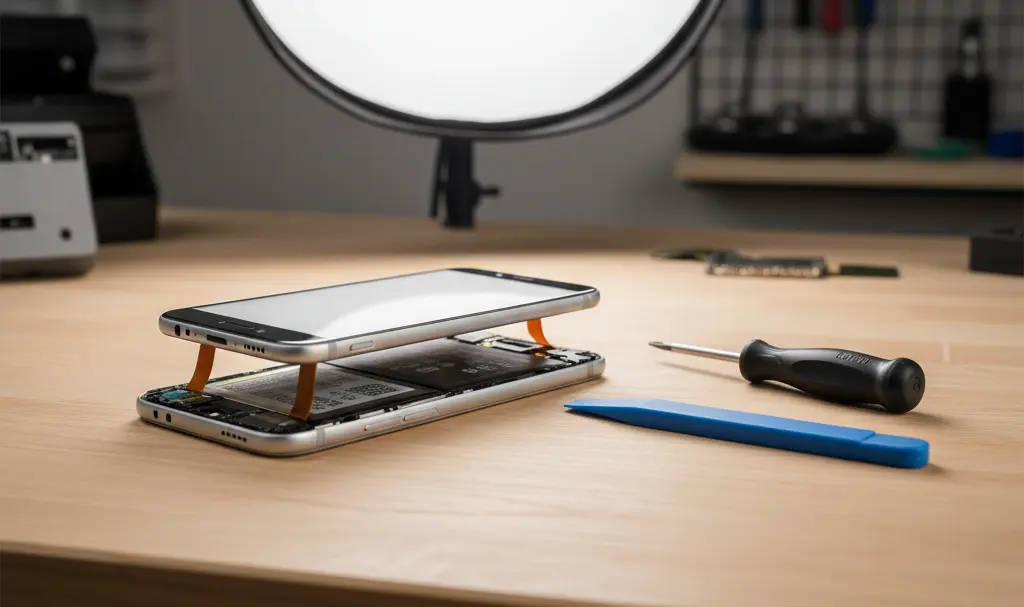
The most critical aspect of the new legislation is the definition of “easily replaceable.” According to the mandate, a battery must be removable using commonly available household tools, without requiring specialized, proprietary equipment or the application of heat to melt industrial adhesives.
This requirement, in itself, does not dictate a return to snap-on back panels that can be pried open with a fingernail. Instead, it targets the excessive use of strong glues and complex internal routing that currently makes battery replacement a daunting task for the average user.
Samsung Galaxy in 2027: Evolution Over Revolution
In practical terms, this means Samsung and other industry leaders will likely not need to completely overhaul their smartphone architectures. Many modern devices are already adopting repair-friendly solutions. We are seeing a steady shift away from permanent adhesives in favor of pull-tabs and stretch-release adhesives that make extracting a depleted cell much safer and easier.
Given the intense focus on device longevity—especially when issues arise, such as reports that the Galaxy S26 Ultra battery lags behind the average—simplifying the replacement process will be a major win for consumers who want to extend the lifespan of their premium devices.
What Changes Can Consumers Actually Expect?
As we approach the 2027 enforcement deadline, future devices will undoubtedly become much more repair-friendly. This aligns perfectly with the growing global “right to repair” movement. Consumers can expect:
- Standardized Fasteners: A shift towards standard screws (like Phillips or Torx) rather than proprietary screws.
- Pull-Tab Adhesives: Wider adoption of battery pull-tabs that eliminate the need for heat guns and prying tools.
- Better Documentation: Comprehensive, publicly accessible repair manuals provided directly by the manufacturer.
- Accessible Toolkits: The potential inclusion of basic replacement tools directly from the manufacturer or authorized third-party sellers.
Simultaneously, a complete reversion to tool-less, zero-effort removable batteries is highly unlikely for flagship devices. The exception might be specialized, rugged smartphone series designed specifically for harsh field conditions where immediate hot-swapping is a necessity.
The Verdict: A Win for Sustainability
Instead of a drastic design revolution, the smartphone market is heading toward a gradual, sustainable improvement in device repairability. Samsung is not stepping back in time to resurrect outdated blueprints; rather, the company will refine its modern engineering to ensure that replacing a battery is a straightforward, accessible process for everyone.
Frequently Asked Questions (FAQ)
Will the new EU battery regulations compromise the water and dust resistance (IP rating) of smartphones?
No, manufacturers are not required to sacrifice durability. Engineers are already developing new gasket designs and reversible seals that allow devices to remain highly water-resistant (IP68) while still complying with the easy-access requirements of the new EU laws.
Do these EU rules mean I can hot-swap my smartphone battery on the go without any tools?
It is highly unlikely for standard consumer smartphones. The mandate specifies that batteries must be replaceable with “commercially available tools” (like a standard screwdriver or a suction cup). It does not mandate tool-less, snap-off back covers like those seen on older feature phones.
If the mandate is from the European Union, will smartphones in other global markets also see these changes?
Yes, it is highly probable. Because designing and manufacturing entirely different hardware architectures for different regions is incredibly expensive, major brands like Samsung and Apple are expected to apply these repairability improvements globally to streamline their supply chains.
Source: SamMobile & Opening photo: Gemini
About Post Author