

Contents
The Expanding Dark Spot on Mars: Unveiling a 50-Year Geological Mystery
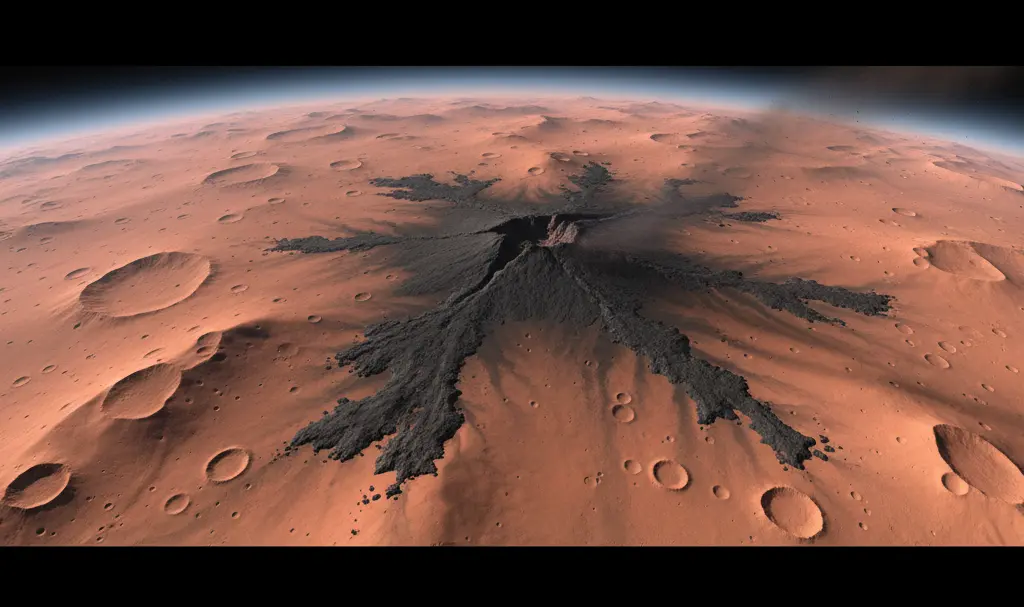
When comparing photographs of Mars taken nearly half a century ago with those captured today, a striking and somewhat unsettling change becomes apparent. A distinct, dark region on the surface has noticeably expanded over the decades. Today, planetary scientists are pointing to two highly plausible causes that shed new light on the surface activity of the Red Planet.
A Growing Dark Mark Over Five Decades
A fascinating comparison of archival imagery taken by NASA’s Viking 1 and 2 missions in 1976 with the latest high-resolution images from the European Space Agency’s (ESA) Mars Express orbiter in 2024 highlights just how dynamic the Martian landscape can be. The exact same geographic region, observed 50 years apart, is now covered by a significantly larger dark patch.
Space exploration experts emphasize that this visual discrepancy is not the result of instrumental errors, camera calibration issues, or differences in image resolution. The geological change is very real and easily visible even to an untrained eye. The recent photographic evidence shared by the ESA clearly illustrates a landscape undergoing an active, ongoing transformation.
While dramatic cosmic events in the universe—such as when astronomers witness a planetary collision—instantly reshape celestial bodies, the shifting surface of Mars represents a much more gradual, yet equally fascinating, planetary evolution.
What Exactly Is the Dark Material?
According to geologists and planetary researchers, this spreading dark “shadow” is composed of ancient volcanic deposits and coarse sand rich in heavy minerals, primarily olivine and pyroxene. The specific chemical composition of these minerals is responsible for their characteristic, almost pitch-black appearance. This creates a stark and beautiful contrast against the fine, iron-oxide-rich red dust that covers the vast majority of the planet.
Wind and Volcanoes: The Two Leading Hypotheses
Mars has long been recognized as a world with a highly active volcanic past. It is home to Olympus Mons, the single largest shield volcano discovered in the entire Solar System. While astronomers do not currently observe any active volcanic eruptions on the surface, researchers do not rule out the possibility that underground magmatic processes may have occurred in the planet’s relatively recent geological past.
However, ancient volcanism alone does not completely explain why this dark mineral material has spread so rapidly across the surface over just the last few decades. To explain this phenomenon, planetary scientists propose two primary hypotheses:
- Wind-Driven Deposition: The first theory suggests that fine particles of dark volcanic dust are actively being transported by powerful Martian winds. Global and localized dust storms on Mars are notorious for carrying surface materials across vast distances, effectively depositing this dark mineral sand over new areas.
- Wind-Driven Erosion (Exhumation): The second, inverse hypothesis suggests that the dark deposits were always there. Instead of moving the dark sand, intense Martian winds have scoured away the lighter top layer of bright red dust that previously concealed it, exposing the underlying volcanic bedrock to orbiting cameras.
The continuous monitoring of Mars relies on advanced orbiting satellites and international cooperation. Much like the collaborative efforts seen in Poland’s Artemis II mission contribution to the space industry, uncovering the mysteries of our neighboring planet requires persistent, multi-generational scientific dedication.
Frequently Asked Questions (FAQ)
Why does the surface of Mars change color over time?

Surface color variations, known as albedo changes, are primarily driven by Mars’ intense wind activity and massive dust storms. Strong winds redistribute the fine, highly reflective red iron-oxide dust, which can either blanket darker regions or be stripped away to reveal heavier, dark volcanic rock underneath.
Are there still active volcanoes on Mars today?
Currently, there is no direct evidence of active surface eruptions on Mars. However, recent orbital data and seismic readings from missions like NASA’s InSight lander suggest that localized volcanic and magmatic activity might still be occurring deep beneath the Martian crust, particularly in regions like Elysium Planitia.
How do olivine and pyroxene end up on the Martian surface?
Olivine and pyroxene are common silicate minerals formed from cooling magma. On Mars, these minerals were brought to the surface through ancient volcanic eruptions and extensive lava flows. Over billions of years, meteor impacts and wind erosion have broken these rocks down into the dark, coarse sand seen today.
Source: Merkur.de | Opening photo: Gemini
About Post Author
