

Contents
Unraveling the Mystery of the Golden Orb Found at the Bottom of the Ocean
The depths of our oceans harbor countless secrets, and humanity has only just begun to scratch the surface of these marine mysteries. A perfect example of this is a strange, golden orb discovered on the floor of the Pacific Ocean. For an extended period, the origins of this enigmatic object baffled researchers. Recently, however, scientists achieved a breakthrough, and the truth behind the golden dome is nothing short of fascinating.
An Unexpected Discovery in the Gulf of Alaska
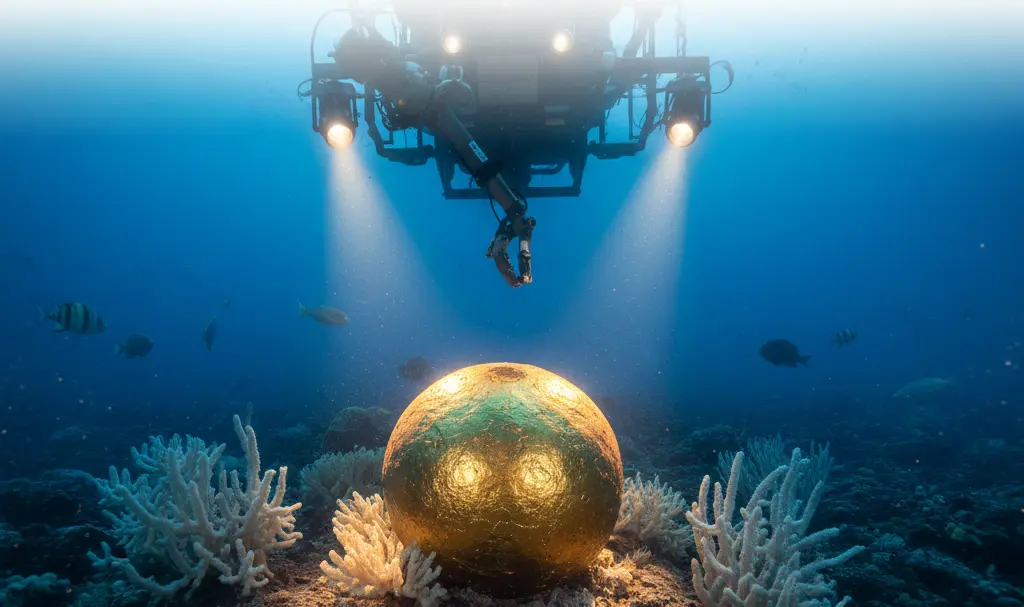
To understand the significance of this breakthrough, we must look back at a groundbreaking deep-sea expedition. During a deep-water survey conducted by NOAA Ocean Exploration, researchers operating a remotely operated vehicle (ROV) in the waters of the Gulf of Alaska stumbled upon a highly unusual object resting on the Pacific seafloor: a perfectly shaped, shimmering golden orb.
The object, measuring approximately 4 inches (10 centimeters) in diameter, instantly captured the attention of marine biologists. Its shiny, almost metallic-looking exterior stood out starkly against the stark white sea sponges scattered around it. Recognizing the rarity of the find, the research team carefully extracted the delicate specimen from the ocean floor and transported it to a laboratory for further analysis.
The allure of deep-sea anomalies often rivals the intrigue of human history lost at sea. Much like a treasure hunter unraveling a shipwreck gold mystery, scientists rely on careful extraction, patience, and cutting-edge technology to piece together the origins of these deep-ocean treasures.
What is the Golden Orb? The Scientific Verdict
Once brought to the surface, the specimen was sent to researchers associated with the National Museum of Natural History in Washington, D.C. The investigation required specialized expertise in marine morphology and genetics.
- Structural Analysis: Scientists first examined the physical properties of the dome, noting a distinctive hole in its side, which initially led to theories that it might be an egg casing for an unknown marine species.
- DNA Sequencing: To get a definitive answer, the team extracted genetic material from the fragile specimen to sequence its DNA.
After nearly two years of rigorous testing and analysis, scientists finally shared their verdict with the world. The mysterious golden orb was not an alien egg or a lost artifact. Instead, it was identified as a biological mass—specifically, an agglomeration of dead cell remains that had compacted and formed over many years at the base of a deep-sea marine anemone attached to the rocky ocean floor.
A Subterranean Ocean: Mysteries Below the Earth’s Crust
William Mowitt, acting director of NOAA Ocean Exploration, noted that advancements in modern technology—particularly in deep-sea ROVs and genetic sequencing—are allowing us to decode the ocean’s deepest secrets. Yet, he emphasized that we are still in the early days of deep-sea discovery.
Just as researchers continuously refine our understanding of surface waters—often requiring us to rethink past models, as seen when analyzing sea-level rise studies and coastal threat maps—the Earth hides even more massive bodies of water entirely out of sight.
The vast oceans we see on maps represent only a fraction of the water our planet holds. Deep beneath the Earth’s crust lies a monumental subterranean ocean:

- Unprecedented Scale: This hidden reservoir is theorized to contain more water than all of the Earth’s surface oceans combined.
- Extreme Depth: The waters are trapped within the transition zone of the Earth’s mantle, sitting at a staggering depth of 255 to 410 miles (410 to 660 kilometers) below the surface.
- Unique State of Matter: Rather than sloshing around like a traditional sea, this water is locked inside the crystal structure of a blue mineral known as ringwoodite.
Frequently Asked Questions (FAQ)
What exactly was the golden orb discovered in the Gulf of Alaska?
After extensive DNA testing and morphological analysis, scientists determined that the mysterious golden orb is a compacted mass of dead biological cells. These cells accumulated over many years at the base of a marine anemone that was attached to deep-sea rocks.
How do marine biologists identify unknown deep-sea objects?
Researchers use a combination of visual examinations, morphological studies, and advanced genetic testing. By extracting and sequencing DNA from a specimen, scientists can match its genetic markers to known families of marine life, allowing them to categorize even the most unusual biological anomalies.
Where is the Earth’s hidden subterranean ocean located?
The massive underground reservoir of water is trapped deep within the Earth’s mantle transition zone. It is located approximately 255 to 410 miles (410 to 660 kilometers) below the Earth’s crust, bound within the molecular structure of a mineral called ringwoodite.
Source: Știri de Ultima Oră, Yahoo. Opening photo: Gemini
About Post Author
