

Contents
The Future of Automotive Lighting: Huawei’s Color Projector Headlights
The automotive industry is undergoing a massive technological shift, and headlights are no longer just for illuminating the road ahead. Chinese technology giant Huawei recently unveiled the latest generation of its proprietary XPixel technology. While smart headlights are becoming increasingly common, Huawei has pushed the boundaries of innovation by enabling vehicle headlights to project full-color movies.
Initially, this groundbreaking cinematic feature will be rolled out exclusively to a select group of premium electric vehicle manufacturers, but it signals a major leap forward for automotive smart tech.
No Projector? Your Car Headlights Can Do the Job
During a recent automotive conference at a dealership in Beijing, Huawei demonstrated the immense capabilities of its next-generation XPixel system. When the technology first debuted a few years ago, its primary focus was on advanced driver assistance systems (ADAS) and road safety.
The earlier iterations of the system were designed to communicate with the driver and the environment by:
- Projecting precise driving paths and lane-change trajectories directly onto the asphalt.
- Illuminating animated pedestrian crosswalks to signal that it is safe to cross in front of the vehicle.
- Displaying interactive floor games, such as traditional hopscotch, to showcase the precision of the light matrix.
The rapid pace of Chinese EV development is evident across the entire industry. Just as Exlantix unveils ES and ET models packed with intelligent cabin features, Huawei’s partners are leveraging XPixel to transform the vehicle’s exterior into a fully interactive digital interface.
Color Movie Projection: A New Era of Automotive Entertainment
The latest iteration of the XPixel system introduces a feature entirely unrelated to traffic safety or navigation: high-definition entertainment. Utilizing advanced micro-LED technology and complex light-control algorithms, the new headlights act as digital projectors.
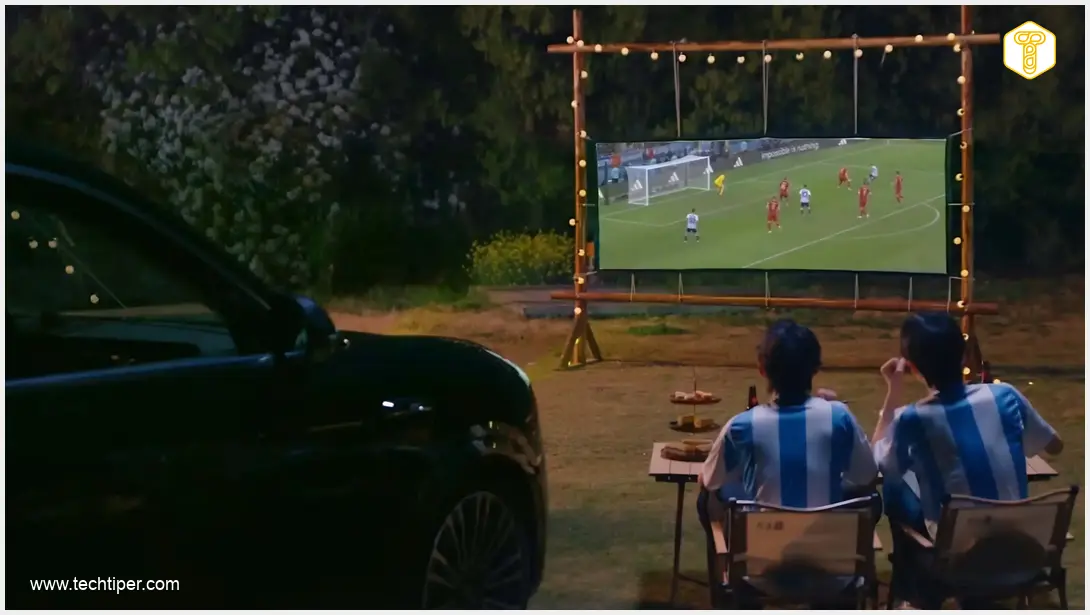
Drivers can park their vehicles in front of a blank wall, garage door, or projector screen, and use their car headlights to project vibrant, full-color movies. This effectively turns the vehicle into a mobile drive-in cinema, ideal for camping trips or outdoor gatherings.
At launch, this advanced functionality will be exclusive to a tight-knit circle of premium electric vehicles produced in China. The initial lineup of models equipped with the new XPixel cinematic headlights includes:
- Aito M9
- Qijing GT7
- Luxeed V9 MPV
The Regulatory Divide: Global Markets vs. US Standards
These advanced matrix headlights highlight exactly how far automotive lighting technology has progressed globally. However, it also draws a stark contrast with the slower adoption rates seen in the United States.

For decades, automakers in the US were severely restricted by outdated Federal Motor Vehicle Safety Standards (FMVSS). These regulations, which mandated strict high-beam and low-beam definitions, essentially banned the use of Adaptive Driving Beam (ADB) systems and smart matrix headlights. It wasn’t until early 2022 that federal regulators finally updated the rules to permit adaptive headlights on American roads.
Because the American market was effectively stalled by these regulatory roadblocks, overseas manufacturers gained a significant head start in lighting research and development. Coupled with other regional breakthroughs, such as MG electric cars introducing semi-solid-state batteries, the competitive gap in smart automotive engineering continues to widen.
Looking ahead, it will be fascinating to see how international markets respond to this rapid influx of high-tech automotive innovation, especially considering the complex trade dynamics surrounding imported electric vehicles.
Frequently Asked Questions (FAQ)
How does the Huawei XPixel headlight technology project color movies?
Huawei’s XPixel technology utilizes highly advanced micro-LED units combined with precise digital matrix lighting algorithms. This allows the system to control millions of individual light pixels independently. Operating much like a high-definition digital projector, the headlights can render vibrant color images and full-motion video content onto flat exterior surfaces.
Are projecting headlights legal to use on public roads?
The safety-focused features of smart adaptive headlights—such as projecting lane guidelines or pedestrian crosswalks—are becoming legal and standardized in many global markets. However, the entertainment functions, including movie projection, are strictly designed for stationary use. Safety protocols prevent drivers from broadcasting movies while the vehicle is in motion or on public roads.
Why is the United States lagging behind in adaptive headlight technology?
The implementation of adaptive driving beam (ADB) and smart matrix headlights was blocked in the United States for decades due to older Federal Motor Vehicle Safety Standards (FMVSS). The National Highway Traffic Safety Administration (NHTSA) only updated these regulations in 2022 to allow advanced matrix lighting, giving international competitors a significant head start in research and development.
Source: InsideEVs. Opening photo: Huawei press materials
About Post Author
