

Contents
Big Tech Earnings: How Google is Winning the AI Cloud Race
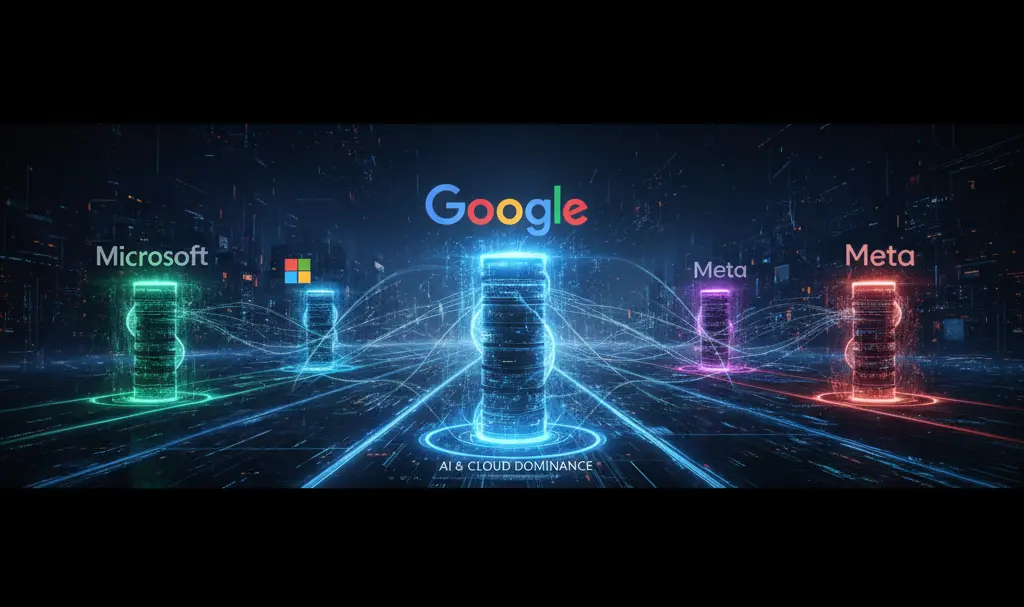
Late April brings the highly anticipated release of the latest financial reports from Big Tech corporations. A straightforward conclusion emerges from the complex data and earnings summaries: Google currently possesses the clearest and most sustainable vision for the future of artificial intelligence. Unsurprisingly, the companies controlling internet cloud infrastructure hold the most influence in the rapidly evolving AI landscape.
Google Successfully Justifies Its AI Investments
Today’s analysts and investors are scrutinizing artificial intelligence expenditures with an increasingly critical eye. Following the initial round of published Q1 2026 earnings reports, Google clearly stands out from the competition with highly impressive metrics.
Most notably, the Mountain View-based tech giant successfully monetized its cloud division beyond expectations:
- Revenue Surge: Google Cloud generated $20 billion, comfortably exceeding the forecasted $18.4 billion.
- Future Demand: The volume of planned cloud contracts (the backlog) doubled compared to the previous Q4 2025 report.
- Market Reaction: Alphabet (Google’s parent company) saw its stock price surge by 6.6% in late trading.
Google continues to aggressively develop its Gemini models, recently introducing features like advanced file generation. Excitement is also building for the upcoming Google I/O 2026 conference scheduled for May 19, which promises a significant wave of software innovations.
Meta Struggles to Keep Pace in the AI Ecosystem
Like its competitors, Meta is forced to increase capital expenditures due to rising hardware component costs and a deep commitment to AI technology. However, as Meta attempts to pivot—highlighted by recent discussions around Meta AI board advisors and Zuckerberg’s innovation strategies—the company is failing to deliver the same return on investment as Google.
According to Bloomberg Intelligence, the Meta AI assistant has yet to capture consumer interest. A global usage report from StatCounter for March 2026 confirms this massive disparity in the AI application market:
- ChatGPT: Dominates globally with a 78.16% market share.
- Google Gemini: Holds second place at 8.65%.
- Perplexity: Follows closely at 7.07%.
Notably, the Meta AI app fails to even register on the chart due to negligible user interest. Furthermore, Mark Zuckerberg’s enterprise lacks the proprietary public cloud infrastructure that provides a massive competitive advantage to Microsoft and Amazon. While Zuckerberg tried to reassure stakeholders during the quarterly earnings call by stating they “see the direction we need to head,” the market remained largely unconvinced.
Cloud Computing Drives Growth, But Expenses Worry Investors
Following its earnings announcement, Meta’s stock dropped over 6% in after-hours trading. The sole silver lining was that AI implementations slightly improved the efficiency of ad targeting on their core social media platforms.
Meanwhile, Amazon Web Services (AWS) saw its cloud revenue jump by 28% compared to Q1 2025, heavily bolstered by strategic partnerships and investments in AI research firms OpenAI and Anthropic.

Microsoft reported even stronger cloud performance, with revenues climbing 40% year-over-year compared to the same period last year. Despite this massive growth, the company’s stock fell by 2.6%. The reason mirrors Meta’s situation: AI-related expenses significantly exceeded analyst forecasts. As Microsoft shifts its strategy, it is clear that the initial honeymoon phase of unrestricted AI spending has ended. Investors are now demanding immediate, tangible profitability.
Frequently Asked Questions (FAQ)
Why are investors scrutinizing Big Tech AI spending so heavily right now?
Investors are demanding a tangible return on investment (ROI) from the billions of dollars poured into AI development. While cloud providers like Google are demonstrating immediate revenue bumps by selling AI integration services to other businesses, companies spending heavily on AI without a clear short-term path to profitability are facing severe market skepticism and stock price drops.
How does owning cloud infrastructure give companies like Google and Microsoft an advantage in AI?
Training and operating large language models require massive amounts of computing power and server space. Google, Amazon, and Microsoft own their own vast cloud networks (Google Cloud, AWS, Azure), which not only lowers their internal development costs but also allows them to generate immense revenue by renting out this AI computing power to other businesses. Companies like Meta, which lack public cloud services, cannot offset their AI hardware costs in the same way.
Source: Bloomberg / StatCounter. Opening photo: Gemini.
About Post Author
