

Contents
The Truth About Idle Power Consumption: Do Plugged-In Chargers Waste Electricity?
Very few of us actually bother to unplug our chargers from the wall after every single use. For most people, chargers become a permanent fixture of their room’s decor. However, a common question often arises: do these chargers consume electricity while sitting completely idle? We decided to put this to the test using a straightforward methodology.
Idle Chargers vs. The Wattmeter: Our Testing Methodology
To be absolutely certain about the power draw, we tested four different power adapters. Each adapter supports a different maximum power output: 5W, 45W, 67W, and 125W, respectively. We plugged each one individually into an active extension cord via a digital wattmeter to record the precise results.
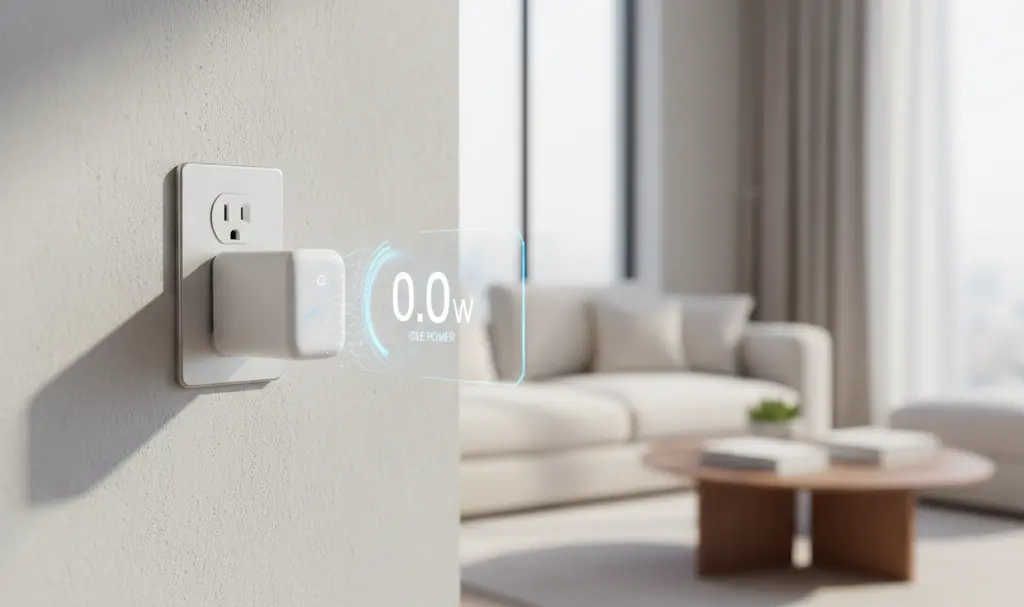
The outcome was quite surprising for anyone who believes in “vampire power.” The digital wattmeter registered absolutely no power consumption for any of the chargers while they were in an idle state. Even when we plugged three high-power charging bricks in simultaneously, the meter only registered the tiny amount of electricity required to power the LED indicator light on the extension cord itself.
Consider this myth officially busted. You can stop worrying about leaving your charger plugged into the wall. But this begs the question: why does an active, plugged-in electronic device draw virtually zero power?
Why an Idle Charger Barely Consumes Any Electricity
The answer lies in strict global manufacturing standards. Manufacturers of external power supplies are bound by stringent eco-design regulations designed to combat energy waste on a massive scale. For example, international efficiency standards dictate that any modern external power supply sold in major markets cannot draw more than 0.21W in standby mode.
For standard chargers with an output below 49W, the limit is even lower—capped at a maximum of just 0.10W. These regulations force tech companies to design highly efficient power management systems.
- Efficiency Level VI: If you inspect your charger closely, you will likely spot a small Roman numeral six (VI) enclosed in a circle. This is the international Energy Star Compliance Level VI certification.
- What it means: Established in 2016, this symbol guarantees that the device’s idle power consumption is less than 0.100W.
- Smart detection: Modern chargers do not actively push power when empty. Only a few microscopic internal components remain active, cyclically checking whether a phone or laptop has been connected so the device can instantly wake from standby mode.
Whether you are dealing with a standard phone brick or advanced adapters—like those discussed in our analysis of the Samsung Galaxy S26 Ultra charger compatibility issue—the idle power limits remain incredibly strict to ensure energy efficiency.
The Real-World Cost of Leaving Your Charger Plugged In
It is important to note that consumer-grade wattmeters often fail to register extremely low electrical values. This explains why our testing equipment consistently showed 0.0W instead of a fraction of a watt. But even if we assume the maximum legally allowed power draw of 0.10W, the financial impact is virtually non-existent.
If you leave a Level VI certified charger plugged in 24 hours a day, 365 days a year, it will consume less than 1 kilowatt-hour (kWh) of electricity annually. In practical terms, leaving your charger continuously plugged in for an entire year costs only a few cents.

The technology sector is continually shifting toward greener, more sustainable practices. Just as the EU removable batteries mandate and tech giants’ readiness aims to reduce electronic waste and improve device longevity, stringent standby power limits ensure that the billions of chargers plugged in around the world do not place an unnecessary burden on the global energy grid.
Conclusion
An unplugged device attached to a plugged-in charger puts the charging brick into an idle, “no-load” state. While a minute fraction of electricity is used to detect a connection, it is too small to impact your electricity bill or harm the environment. You can confidently leave your chargers in the outlet without any guilt.
Frequently Asked Questions (FAQ)
Does a high-wattage fast charger (e.g., 125W) draw more idle power than a standard 5W charger?
No, not significantly. Regardless of their maximum output capabilities, all modern chargers must comply with strict international energy efficiency standards (like Level VI). This ensures that even the most powerful laptop or smartphone fast chargers draw less than 0.21W—and often less than 0.10W—when sitting idle.
Can leaving a charger continuously plugged in degrade its internal components over time?
While the wear is incredibly minimal, internal components like capacitors and switching circuits are technically active while checking for a device connection. Modern chargers are specifically engineered to withstand being plugged in 24/7 for years, but unplugging them could theoretically provide a marginal increase to their total lifespan and protect them from unexpected home power surges.
Is the combined “vampire draw” from multiple household chargers enough to impact my monthly electric bill?
No. Even if you have ten modern chargers plugged into wall outlets simultaneously 24 hours a day, their combined idle power consumption would likely amount to less than 10 kWh over an entire year. The total financial cost would equate to just a few cents or a couple of dollars annually, which is negligible on a standard household utility bill.
Source: Gemini & Opening photo: Gemini
About Post Author
