

Contents
Uncovering the Sunken Ruins of the Lighthouse of Alexandria
An extraordinary archaeological discovery has been made at the bottom of the Mediterranean Sea. Researchers have located and retrieved mysterious monumental stones that are believed to be the ancient remnants of a world-famous lighthouse built hundreds of years before the Common Era. While the existence of these ruins has been known for decades, it is only recently that modern technology has allowed for the safe extraction and digital reconstruction of the site.
A Sunken Wonder of the Ancient World
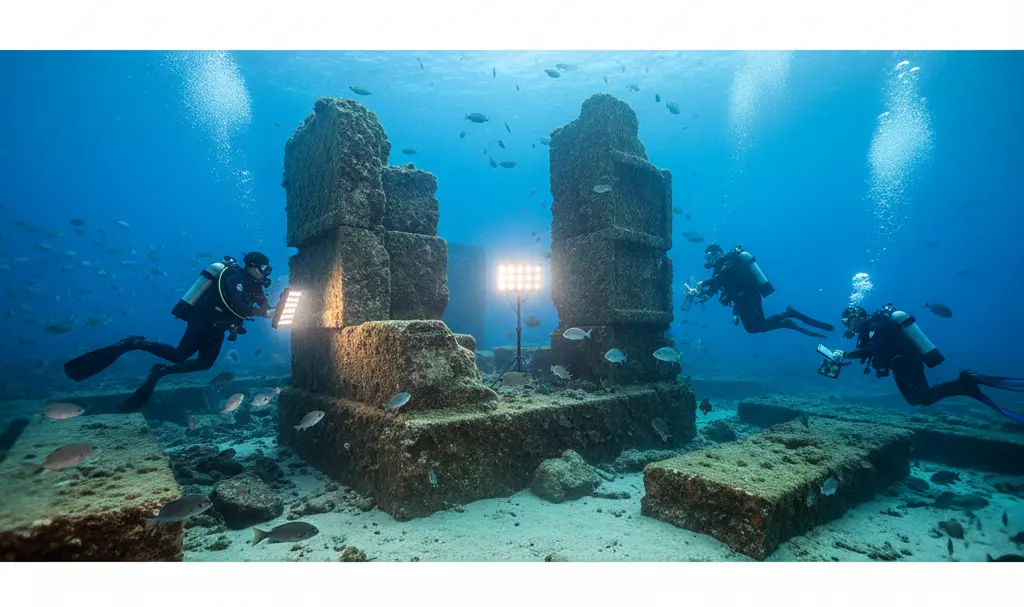
A dedicated team of scientists, led by marine archaeologist Isabelle Hairy from the French National Centre for Scientific Research (CNRS), achieved a major breakthrough off the coast of Alexandria, Egypt. They successfully recovered massive, block-shaped stones from the Mediterranean seabed.
Upon extraction, researchers quickly recognized the historical significance of these massive rocks. They served as the foundational structure for one of the Seven Wonders of the Ancient World: the Lighthouse of Alexandria. Experts believe these blocks functioned as the thresholds, lintels, paving slabs, and door jambs positioned at the grand entrance of the legendary structure.
The logistics of retrieving such artifacts are immense, often capturing the world’s imagination, much like when a treasure hunter released a shipwreck gold mystery. The complexities of deep-water excavation require incredible precision and patience.
Project PHAROS: Reconstructing History
The scale of the Alexandrian ruins is staggering. Each of the recovered stone blocks weighs between 70 and 80 metric tons (approximately 154,000 to 176,000 pounds). Although the underwater location of these ruins was first identified in 1968, the sheer weight of the artifacts and the limitations of 20th-century diving technology meant that extraction had to wait for decades.
Today, the recovery is part of an international initiative known as Project PHAROS. The project utilizes cutting-edge documentation methods to preserve history without causing further damage to the artifacts.
- Photogrammetry Mapping: Every retrieved fragment undergoes detailed photogrammetry, a process that captures exact physical dimensions through multiple high-resolution photographs.
- Digital Preservation: These measurements are used to generate highly accurate, 3D digital twins of the ancient stones.
- Virtual Reconstruction: The ultimate goal is to create a complete virtual reconstruction of the ancient lighthouse.
Historically, the Lighthouse of Alexandria was constructed in the 3rd century BCE, designed by the brilliant Greek architect Sostratus of Cnidus. Standing as a beacon of maritime engineering, the majestic tower guided ships safely into harbor for centuries before being severely damaged and ultimately destroyed by a series of massive earthquakes, culminating in a devastating tremor in 1303 CE.
Unexpected Deep-Sea Discoveries: The Mysterious Golden Orb
The depths of the world’s oceans frequently yield unexpected and bizarre objects. While some expeditions uncover man-made historical marvels, others reveal strange biological anomalies. For instance, deep-sea explorers navigating the Pacific Ocean previously stumbled upon a mysterious, smooth “golden orb” resting on the seabed.
For years, the golden object underwent rigorous scientific testing, including structural analysis and DNA sequencing, to determine its origin. The meticulous study of such biological puzzles requires years of dedication, similar to how researchers must carefully analyze ancient biological remains in an Oviraptor dinosaur nest incubation experiment.

When the comprehensive research findings were eventually published, they revealed a fascinating, albeit natural, explanation. The mysterious golden orb was not alien or metallic; it was an organic clump of dead cells that had formed over many years at the base of a marine sea anemone.
Frequently Asked Questions (FAQ)
Why did it take decades to extract the stones of the Lighthouse of Alexandria?
Although the ruins were first discovered in 1968, the massive weight of the stone blocks—ranging from 70 to 80 metric tons—made underwater recovery extremely dangerous and logistically difficult. It required the development of modern heavy-lifting equipment and advanced preservation techniques like photogrammetry to safely retrieve and study the artifacts.
What is Project PHAROS?
Project PHAROS is an ongoing marine archaeology initiative focused on documenting the recovered structural fragments of the Lighthouse of Alexandria. The project uses advanced photogrammetry to map the stones and create highly accurate 3D digital models, paving the way for a full virtual reconstruction of the ancient wonder.
How was the Lighthouse of Alexandria destroyed?
Built in the 3rd century BCE, the Lighthouse of Alexandria survived for centuries as an engineering marvel. However, it suffered severe structural damage from a series of powerful earthquakes over hundreds of years, with the final, catastrophic blow occurring during an earthquake in 1303 CE.
Source: The Daily Galaxy & Opening photo: Gemini
About Post Author
