

Contents
The Dawn of Starship V3: SpaceX Pushes the Boundaries of Space Exploration
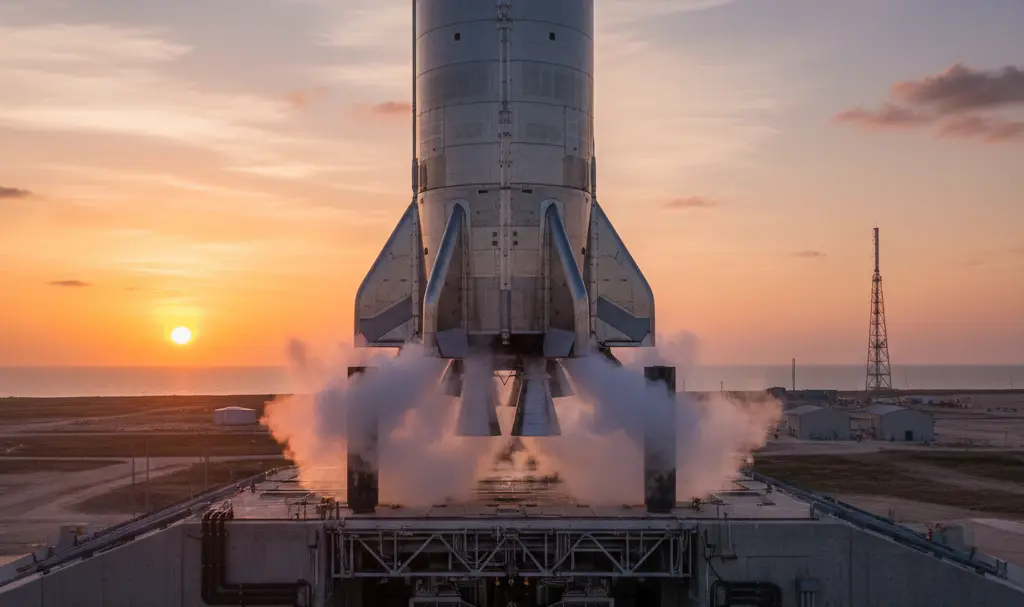
SpaceX is officially gearing up for the inaugural flight of Starship V3, the next generation of the largest and most powerful rocket in human history. This monumental spacecraft is not only taller than its predecessors, but it is also engineered to unlock a new era of ambitious space missions. From pioneering orbital refueling to facilitating crewed lunar landings, Starship V3 represents a massive leap forward for the aerospace industry.
Building the Tallest Rocket in History
SpaceX has continuously shattered its own engineering records, and the Starship system is no exception. The newest iteration of the vehicle stands at an awe-inspiring 124 meters (approximately 407 feet) tall, securing its title as the highest rocket ever constructed. For context, this towers over the historic 110-meter Saturn V rocket that took Apollo astronauts to the Moon.
The fully integrated flight stack has already been positioned on the new orbital launch mount at Starbase in Texas. This region is rapidly expanding as a central hub for Elon Musk’s advanced technological ventures, encompassing everything from aerospace engineering to semiconductor factories and AI space robotics.
Key Technological Upgrades in Starship V3
The Starship program is built upon an agile philosophy of rapid prototyping, testing, and continuous iteration. With Starship V3, SpaceX has introduced several critical modifications designed to enhance performance and reliability:
- Upgraded Raptor Engines: The newest generation of Raptor engines has been fine-tuned to deliver superior efficiency and significantly higher thrust.
- Unprecedented Power: At liftoff, the new Starship configuration is expected to generate approximately 18 million pounds of thrust (around 80 Meganewtons). This is roughly a 10% increase in power compared to the previous generation of the Super Heavy booster.
- Optimized Hot Staging: The “hot staging” system—where the upper stage engines ignite just before separating from the booster—has been refined to ensure a smoother and more reliable stage separation in the vacuum of space.
- Redesigned Grid Fins: The grid fins, which are essential aerodynamic control surfaces, have been completely redesigned to improve the booster’s precision during its descent back through the Earth’s atmosphere.
SpaceX is no longer solely focused on getting the rocket into space and returning it safely. The company is actively transitioning toward the practical, operational use of Starship for complex orbital missions.
Advancing the NASA Artemis Program and Orbital Refueling
The new generation of the rocket is slated to play a vital role in Elon Musk’s overarching vision for multi-planetary life, as well as NASA’s Artemis program. The Artemis initiative, which is bolstered by international contributions to the space industry, aims to establish a sustainable human presence on the Moon.
One of the most critical objectives for Starship V3 is demonstrating and maturing orbital refueling technology. Because Starship requires a massive amount of propellant to break free of Earth’s gravity, its tanks are nearly empty by the time it reaches Low Earth Orbit (LEO). To reach deep space destinations like the Moon or Mars, “tanker” Starships will need to rendezvous with the primary spacecraft in orbit to transfer cryogenic propellants. Without this infrastructure, long-duration, high-payload missions beyond Earth’s orbit would be impossible.
What to Expect from the Upcoming Test Flight
The impending test flight will mark the very first launch from the newly constructed pad at Starbase. According to mission profiles, the rocket will aim to complete a controlled splashdown in the Indian Ocean roughly one hour after liftoff.
Looking toward the future, SpaceX intends to push the envelope of reusability even further. While the company already plans to catch the Super Heavy booster using the mechanical “chopstick” arms of the launch tower (affectionately dubbed “Mechzilla”), their ultimate goal is to apply this same revolutionary catch mechanism to the upper stage Starship vehicle as well.

Frequently Asked Questions (FAQ)
Why is orbital refueling crucial for Starship’s lunar missions?
Because of its massive size and payload capacity, Starship burns the majority of its fuel just reaching Low Earth Orbit (LEO). To possess the necessary Delta-V (change in velocity) to travel to the Moon, land, and potentially return, the spacecraft must be refilled with cryogenic propellants while in orbit by specialized “tanker” variants of Starship.
How does the thrust of Starship V3 compare to historic rockets?
Starship V3 is designed to generate approximately 18 million pounds of thrust (80 Meganewtons) at liftoff. This makes it more than twice as powerful as the historic Saturn V rocket used during the Apollo missions, which generated roughly 7.5 million pounds of thrust.
What is “hot staging” in rocket launches?
Hot staging is a separation technique where the engines of a rocket’s upper stage ignite while still attached to the first stage (booster), just moments before the two separate. This method prevents a loss of momentum during stage separation and increases the vehicle’s overall payload-to-orbit efficiency.
Source: Ars Technica, independent research.
Opening photo: Gemini
About Post Author
