

Contents
The Security of Face Unlock: Can a Photo Fool Your Smartphone?
PINs, fingerprints, and pattern locks have long been standard methods for securing our smartphones. However, biometric authentication, particularly face unlock, has rapidly grown in popularity. The convenience is undeniable – a quick glance is all it takes to access your device. But how secure is this method, especially when compared to its predecessors? We conducted an experiment to find out if a simple photo could bypass smartphone face recognition.
Our Experiment: Testing Face Unlock with Printed Photos
To put smartphone face unlock to the test, we deliberately chose a device that utilizes an older generation of facial recognition technology, one that does not incorporate advanced infrared dot sensors for precise 3D mapping. For this purpose, we used a One Plus Nord 3 5G, a model released in July 2023. While relatively recent, this phone relies on a less complex system compared to the cutting-edge 3D biometric solutions found in many flagship devices today.
Methodology: Attempting to Fool the System
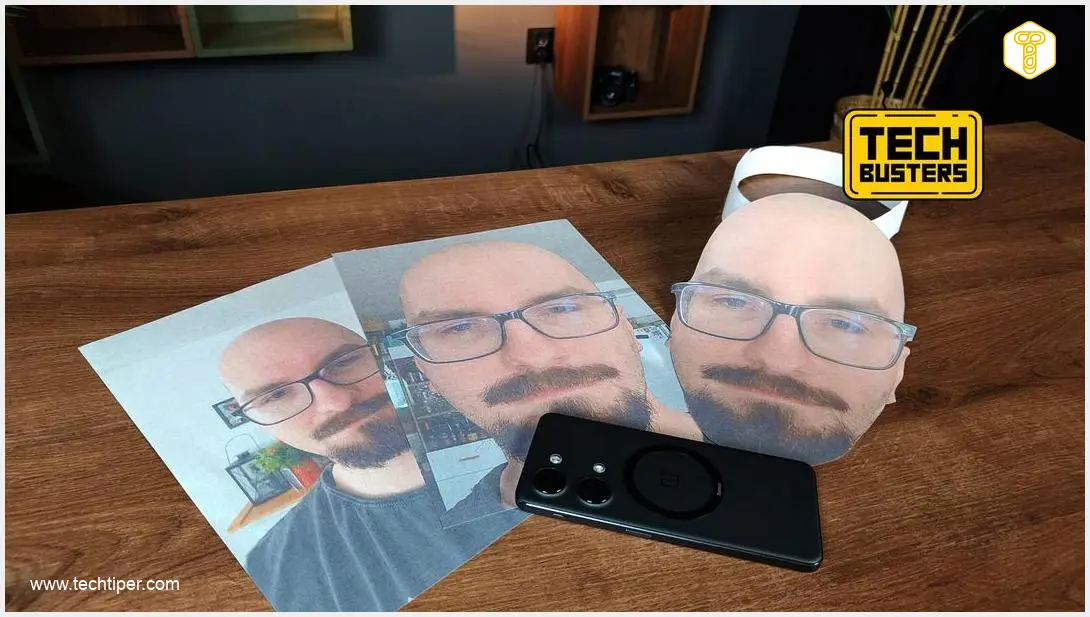
Our editor took several clear photographs of himself and printed them in high resolution. We then presented these printed photos to the One Plus Nord 3 5G, aiming to trick its face unlock system into believing it was the actual owner. We varied the lighting conditions during our attempts to simulate different real-world scenarios. We even escalated our test by creating a “mask” – cutting out the face from a printed photograph and holding it over our own face, much like a rudimentary disguise.
The Results: An Unexpected Level of Security
Despite our concerted efforts and using a theoretically less advanced face unlock system, we were unable to unlock the smartphone even once. Each attempt resulted in a clear “face recognition error” message. This outcome was rather surprising, especially considering we had specifically chosen an older technological solution compared to the highly sophisticated systems integrated into the latest Android and iOS smartphones.
Our findings indicate that breaching a face-secured smartphone might be more challenging than common perception suggests. This prompts the question: how exactly does this technology work, even in its less advanced forms, to prevent such straightforward bypass attempts?
Understanding How Face Unlock Works Without Infrared Sensors
The success of our experiment, or rather the failure to bypass the security, highlights the underlying sophistication of even basic facial recognition systems. Using the example of the One Plus Nord 3 5G, which primarily relies on its front-facing camera, we can understand the key principles at play:
- Live Image Analysis: The front camera continuously feeds a live video stream to the device’s processor. The system doesn’t just look for a static image; it analyzes a dynamic input.
- Key Feature Measurement: The software assesses various facial parameters, such as the precise distance between the eyes, the length from the nose to the upper lip, and other unique geometric proportions, comparing them against the pre-registered facial template.
- Depth and “3D” Cues: Even without dedicated infrared sensors, the system can attempt to infer depth or “three-dimensionality” from the camera feed. This can involve analyzing subtle shadows, light reflections, and minute movements that differentiate a real face from a flat image.
- Light Source Detection: A crucial capability is the system’s ability to distinguish between an object that emits light (like a digital photo on another screen) and one that reflects it (like a real human face). Printed photos, being reflective, are often detected as such.
- Environmental Object Recognition: The system may also be programmed to detect common flat, rectangular objects in the frame, such as sheets of paper, photographs, or other smartphones displaying images. If such elements are detected in the prominent position where a face should be, it can trigger a security alert.
It’s important to note that specific algorithms and criteria used by manufacturers are proprietary. This secrecy is a deliberate security measure, preventing potential attackers from knowing all the “rules” to bypass the system.
The Evolution of Face Unlock Security
Even with an older smartphone model, the security of face unlock technology is constantly being enhanced through software updates. These updates often refine the recognition algorithms, making them more resilient to spoofing attempts. Furthermore, device operating systems often incorporate additional security layers:
- Attempt Limits: As observed in our test, the phone’s operating system (OxygenOS in this instance) will often disable face unlock after a few failed attempts and require an alternative verification method, such as a PIN or password. This acts as a crucial indicator that an unauthorized individual might be trying to access the device.
- Continuous Improvement: All major smartphone manufacturers invest heavily in improving biometric security. If their systems were easily compromised, it would quickly become public knowledge, severely impacting their reputation and user trust.
While face unlock offers convenience, it’s always recommended to use it in conjunction with other strong authentication methods like a complex PIN or strong password, especially for highly sensitive data. For more information on digital security, you might find our articles on how to prevent smartphone listening and protect your microphone privacy and whether antivirus software is still necessary in 2026 insightful.

Frequently Asked Questions (FAQ)
Is face unlock truly secure on all smartphones?
The security of face unlock varies significantly between devices. Advanced systems, like Apple’s Face ID or Google’s Pixel Face Unlock, use dedicated infrared sensors to create a 3D map of your face, making them highly secure against photo or even 3D mask spoofing. Simpler, camera-based systems (often found on budget or older phones) are generally less secure but, as our experiment showed, are still surprisingly resistant to basic photo-based bypass attempts. For maximum security, always combine face unlock with a strong PIN or password.
Can a very realistic 3D printed mask unlock a smartphone?
While our experiment focused on printed 2D photos, advanced 3D printed masks have historically been able to fool some less sophisticated camera-based face unlock systems. However, modern face unlock technologies, especially those employing infrared dot projectors (like Face ID), are designed to detect depth and liveness, making them extremely difficult to bypass with even highly detailed 3D masks. Manufacturers constantly refine these systems to counter new spoofing methods.
Source: Self-authored research. Opening photo: Krzysztof Rojek.
About Post Author
