

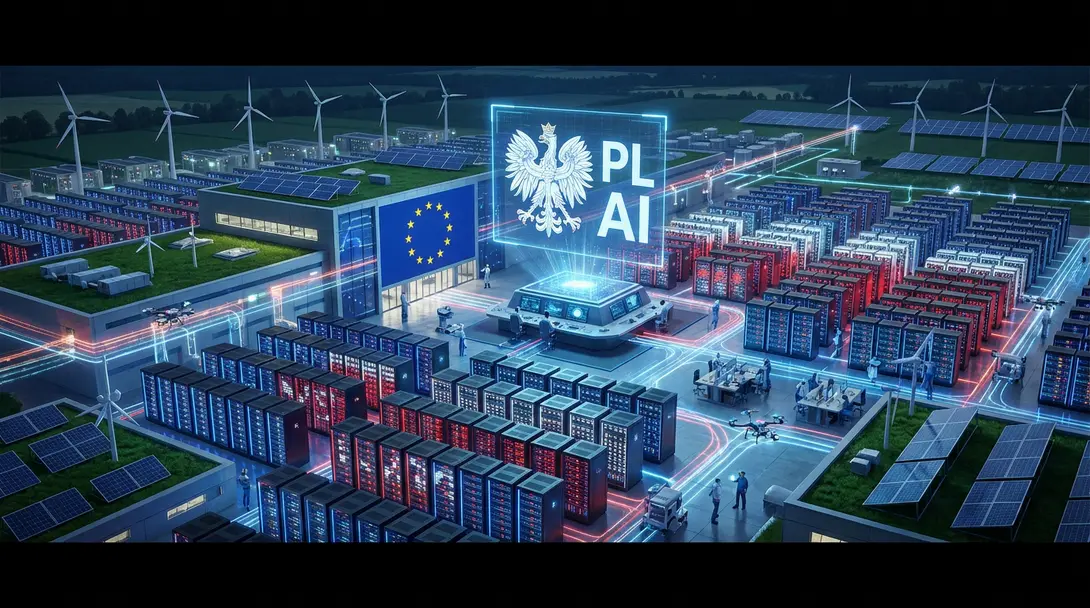
Poland is significantly advancing its plans to establish an AI Gigafactory within its borders. On July 14, 2026, the Polish government approved an investment of 400 billion Polish Zloty (equivalent to tens of billions of US dollars) for the project. Further cementing this commitment, Dariusz Standerski, the Deputy Minister of Digital Affairs, recently signed a crucial agreement, propelling the initiative forward.
Contents
Poland Advances Towards AI Gigafactory with Major Investment and EU Collaboration
The development of an AI Gigafactory in Poland represents a strategic move to bolster the nation’s technological infrastructure and computational capabilities. This facility is envisioned to be a cornerstone for AI innovation, research, and application across various sectors.
The Road to a Polish AI Gigafactory: Project Status and European Partnership
Current Progress and International Cooperation
Deputy Minister Dariusz Standerski, acting on behalf of Poland, formalized an agreement with the European Union. This partnership is part of a joint procurement process for establishing AI gigafactories across the continent, signaling a collaborative approach to developing Europe’s AI capabilities. This collaborative framework is essential for ensuring standardized infrastructure and shared benefits across member states, aligning with broader EU strategies for technological sovereignty. To learn more about Poland’s role in shaping EU AI policy, read about Poland’s New AI Commission and the EU AI Act.
Ambitious Timeline and Upcoming Tender
The Ministry of Digital Affairs has set an ambitious target for the AI Gigafactory to commence operations in Poland by 2028. To achieve this, a tender process is expected to be announced shortly, inviting interested companies to submit their proposals within a 15-week window. This competitive bidding phase will be critical in selecting the most capable partners for the project’s realization.
Competitive Landscape: Poland’s Bid for a Medium-Scale AI Hub
The realization of Poland’s AI Gigafactory is not without a competitive element. EuroHPC JU, the European Union’s joint undertaking responsible for high-performance computing, plans to establish a total of seven such factories across Europe: four medium-scale and three large-scale facilities. Deputy Minister Standerski noted in an interview with Rzeczpospolita that there are currently around seven applications, with the potential for an eighth or ninth. Poland’s significant investment of 400 billion Polish Zloty is earmarked for a medium-scale variant of the gigafactory, indicating a strategic focus on a substantial yet achievable project within the broader European context.
Commercial Viability and Strategic Investment
Strong Industry Engagement
Despite the competitive environment, there is considerable interest from the private sector. Deputy Minister Standerski expressed confidence in industry engagement, citing that approximately 200 companies participated in a recent informational meeting. This strong interest underscores the market demand for advanced AI computing resources and the potential for public-private partnerships.
Strategic Capacity Allocation
A key aspect of the project’s funding and operation involves a clear strategy for the allocation of computing power:
- Poland will purchase 17% of the gigafactory’s computing capacity.
- The European Union will also acquire 17% of the capacity.
- The remaining two-thirds of the computing power will be made commercially available by a private consortium, allowing businesses and researchers to access cutting-edge AI infrastructure.
Poland has committed to purchasing its allocated share for a period of five years, ensuring a stable foundation for the factory’s initial operations. This model ensures both public access and commercial viability. The demand for advanced computing hardware is continuously evolving, as seen in recent industry news regarding OpenAI’s AI Hardware Device Launch Delay to 2027.
Strategic Location Selection: Balancing Opportunity and Sustainability
The Ministry of Digital Affairs will not dictate the final location for the AI Gigafactory. Instead, the decision will be data-driven, based on the analysis of tender offers. Currently, ten preliminary locations have been identified. This approach ensures that the chosen site offers the best conditions for infrastructure, connectivity, and, importantly, sustainable energy supply.

Why an AI Gigafactory? Benefits for Poland’s Digital Future
Poland’s primary motivation for pursuing an AI Gigafactory is to gain more affordable and reliable access to artificial intelligence capabilities. This infrastructure will provide:
- Cost-Effective Access: Computing power will be available at a lower cost than market rates, making advanced AI more accessible for public and private entities.
- Innovation Hub: The facility will enable the creation and training of very large-scale AI models, fostering breakthroughs in various fields.
- Public Sector Empowerment: State-owned companies and large public institutions can leverage the gigafactory to train specialized models. For example, AI could be used for forecasting resource availability, optimizing complex production chains, or enhancing public services.
“It will be reliable power, available cheaper than on the market, allowing us to create and train very large-scale models,” Standerski told Rzeczpospolita. “If, for example, companies with state treasury involvement or large public institutions need a model to forecast resource availability or optimize an entire production chain, the gigafactory will be able to train and test such a model so that it is ready for implementation.”
Addressing Environmental Impact and Future Challenges
Sustainable Energy Solutions
A significant concern surrounding such a large-scale facility is its energy consumption, which could be comparable to that of a medium-sized city. However, Deputy Minister Standerski reassured stakeholders that each of the ten proposed locations was selected with the potential for powering the AI Gigafactory entirely through renewable energy sources. This commitment aligns with existing EU environmental regulations, which aim to mitigate the ecological footprint of large data centers.
Long-Term Sustainability and Funding Questions
While the initial five-year commitment from Poland and the EU provides a strong start, questions remain about the project’s long-term sustainability. After the mandatory purchase period, will Poland continue to benefit from preferential terms for this EU-funded factory? Or will future access incur higher costs, potentially passed on to citizens through taxes? These are crucial questions that stakeholders hope will be addressed as the project develops, ensuring the gigafactory remains a long-term asset for the nation.
Frequently Asked Questions (FAQ)
The AI Gigafactory project is a major initiative by the Polish government, backed by significant investment, to establish a large-scale artificial intelligence computing facility. It aims to provide advanced computational power for AI development, research, and commercial applications, in collaboration with the European Union.
The Polish government approved 400 billion Polish Zloty for the project on July 14, 2026. The Ministry of Digital Affairs plans for the AI Gigafactory to become operational by 2028, with a tender process for interested companies expected to be announced soon, followed by a 15-week application period.
Upon activation, Poland will purchase 17% of the capacity, and the European Union will also acquire 17%. The remaining two-thirds of the computing power will be made commercially available by a private consortium. Poland has committed to purchasing its share for five years.
The gigafactory is expected to provide reliable and more affordable access to high-performance AI computing power than market rates. This will enable the creation and training of large-scale AI models, fostering innovation, and supporting public sector applications such as resource forecasting and production optimization for state-owned enterprises.
After Poland’s initial five-year commitment to purchase computing capacity, there are questions regarding whether the country will continue to receive preferential terms for this EU-funded facility. Concerns include the potential for increased costs, which might be borne by citizens through taxes, and ensuring sustained access to the factory’s resources on favorable terms.
Source: Rzeczpospolita & Opening photo: Ministry of Digital Affairs / X
About Post Author
