

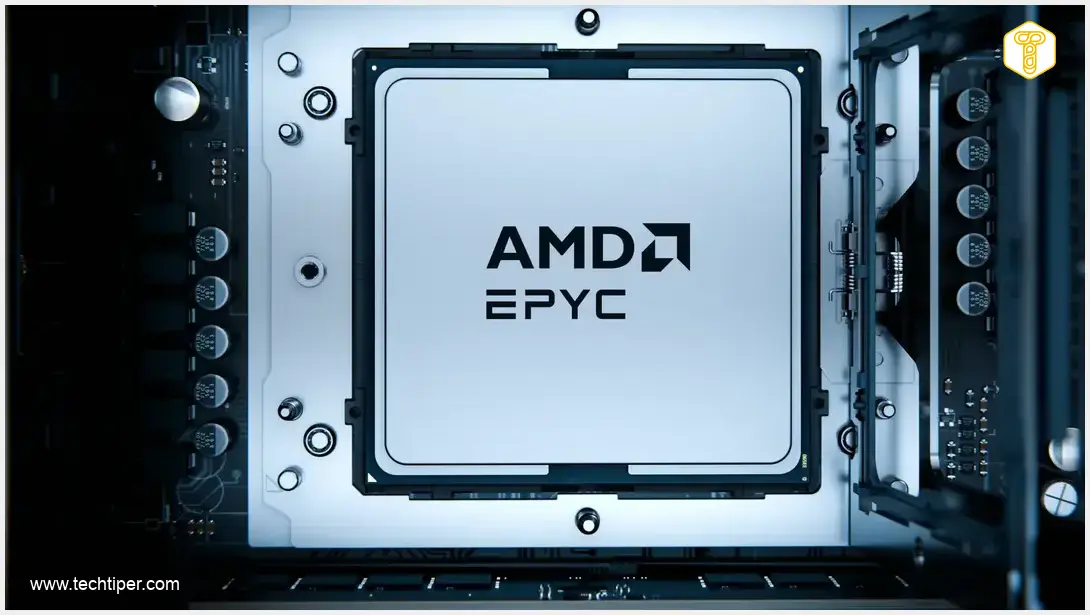
AMD made a series of significant announcements at its Advancing AI 2026 conference in San Francisco. Among the most impactful reveals was the introduction of the AMD EPYC 9006 series, the company’s newest family of server processors. The flagship chip in this new lineup boasts an impressive 256 cores, setting a new benchmark for computational power. Beyond server CPUs, AMD also signaled its strategic expansion into the realm of “physical” artificial intelligence.
Contents
AMD EPYC 9006: Venice Architecture Battles for Data Centers
Nearly two years after the debut of the AMD EPYC 9005 processors, the manufacturer has unveiled its highly anticipated sixth-generation units. Codenamed “Venice,” these cutting-edge processors are meticulously engineered to meet the escalating demands across various high-performance computing sectors. They are particularly vital for the rapidly evolving field of AI agents, sophisticated cloud computing operations, and other High-Performance Computing (HPC) workloads.
Architectural Innovations and Enhanced Connectivity
The core of the new architecture is built upon a combination of standard Zen 6 cores and highly dense Zen 6c cores. The Zen 6c variant is specifically optimized for superior power efficiency and space utilization, crucial factors in modern data centers. These processors also usher in support for next-generation connectivity standards:
- PCIe Gen 6: This doubles the bus bandwidth to an astounding 64 Gbps per lane compared to the previous generation, enabling faster data transfer within the server.
- CXL 3.1: A critical interface that allows for low-latency sharing and expansion of operational memory, significantly enhancing memory-bound workloads.
Unparalleled Performance and Security
Enhanced security mechanisms are also a cornerstone of the EPYC 9006 series, incorporating hardware-accelerated post-quantum cryptography (PQC) to protect against future threats. According to AMD’s published data, the EPYC 9006 series offers a substantial performance advantage over its competitors.
- The Venice generation is projected to deliver up to 3.3 times higher performance in server applications compared to NVIDIA Vera 88C. (See also: NVIDIA AI: A Trillion-Dollar Shift Towards Inference)
- Against the Intel Xeon 6960P, the new EPYC processors are expected to achieve up to 1.8 times more tokens per second for frontier AI models.
AMD EPYC 9006 Series Overview
The comprehensive list of the new AMD EPYC 9006 processors and their primary applications is as follows:
- EPYC 9006 SP7: Up to 256 cores / 512 threads or 96 cores (up to 5.0 GHz) – Ideal for high-density AI nodes, offering extreme parallel processing capabilities.
- EPYC 9006 SP8: From 8 to 128 cores – Suited for diverse enterprise server environments, balancing performance and efficiency.
- EPYC 9006X SP7: Up to 96 cores – Designed specifically for technical computing (HPC) workloads requiring robust single-thread performance.
- EPYC 9006 LP: Up to 72 cores – Optimized for AI host nodes in server racks, focusing on efficiency and integration.
AMD Helios Servers: Powering AI Innovation
These powerful new EPYC processors will be integrated into AMD Helios servers, which represent a complete, rack-scale infrastructure solution. Helios servers are purpose-built for the rigorous demands of training and inferencing the largest artificial intelligence models, making them particularly effective for AI agent applications. Dr. Lisa Su, CEO of AMD, confirmed that Helios servers will be deployed by Anthropic, one of the world’s foremost AI service providers, underscoring their critical role in the AI ecosystem.
Next-Generation Acceleration with Instinct MI455X
Beyond the AMD EPYC 9006 processors, Helios servers will also leverage next-generation AMD Instinct MI455X graphics accelerators. These accelerators are based on the advanced CDNA 5 microarchitecture. Each MI455X chip comes equipped with an impressive 432 GB of HBM4 memory, delivering an astonishing bandwidth of up to 19.6 TB/s, crucial for high-throughput AI workloads.
Helios Rack System Architecture
A single Helios rack system is designed to house 72 MI455X accelerators, interconnected by the high-speed UALink (Ultra Accelerator Link) bus. This configuration provides a cumulative bandwidth of 260 TB/s, facilitating seamless data flow between accelerators. The centralized network architecture is built around the Pensando DPU (Data Processing Unit), which offers several key advantages:
- Hardware-level environmental isolation, ensuring secure and dedicated resources.
- High scalability, allowing for flexible expansion to meet growing demands.
- A secure infrastructure tailored for cloud service providers, promoting trust and reliability.
The design also incorporates Salina DPU and Vulcano AI NICs, further enhancing networking capabilities and AI-specific processing. (Considering this complex system, challenges might arise, similar to concerns discussed in AI Server Deletion Experiment: The Nuclear Option)

The Dawn of “Physical” Artificial Intelligence
AMD has officially announced its significant commitment to the development of “physical” artificial intelligence. This initiative focuses on intelligent devices that interact with the physical world, such as humanoid robots and advanced robotic arms, all powered by sophisticated AI. To enable these applications, AMD is introducing specialized hardware.
Ryzen AI Embedded X100 for Edge AI
The Ryzen AI Embedded X100 processor is highlighted as an ideal solution for these physical AI applications. This highly integrated chip combines several powerful components:
- The efficient Zen 5 processor architecture.
- RDNA 3.5 graphics for visual processing.
- A dedicated Neural Processing Unit (NPU) specifically designed for efficient, on-device neural network processing, minimizing reliance on cloud resources.
AMD Kria AI Module for Industrial Automation
Further strengthening AMD’s portfolio for autonomous industrial machines is the AMD Kria AI module. This compact System-on-Module (SoM) integrates a processor, memory, and logic circuits onto a single board, providing a complete solution for embedded AI. To accelerate development, AMD also offers a comprehensive Kria development platform, built on open software standards. This suite is designed to:
- Streamline the design process for developers.
- Significantly reduce the time from prototype to mass production for robotic edge devices.
Frequently Asked Questions (FAQ)
Zen 6c cores are a variant of the Zen 6 architecture specifically optimized for superior power efficiency and higher density within a given silicon area. This optimization makes them particularly suitable for data center environments where space and power consumption are critical factors, allowing AMD to pack more processing power into a smaller footprint while managing energy usage effectively.
The EPYC 9006 series, codenamed “Venice,” tackles these demands with its high core counts (up to 256 cores), Zen 6 architecture, and support for advanced technologies like PCIe Gen 6 and CXL 3.1. These features provide massive parallel processing capabilities, high bandwidth, and low-latency memory expansion, all of which are crucial for the intensive computational and data-access requirements of modern AI and High-Performance Computing workloads.
AMD Helios servers are complete, rack-scale integrated infrastructures designed specifically for training and inferencing large AI models. They are unique because they combine the new AMD EPYC 9006 processors with next-generation AMD Instinct MI455X accelerators, interconnected by the high-speed UALink bus, all managed by a Pensando DPU-based centralized network architecture. This integrated approach ensures extreme performance, scalability, and security for critical AI deployments by leading providers like Anthropic.
“Physical AI” refers to artificial intelligence that powers devices interacting directly with the physical world, such as humanoid robots and robotic arms. AMD supports this vision with hardware like the Ryzen AI Embedded X100 processor, which integrates Zen 5 CPUs, RDNA 3.5 graphics, and a dedicated NPU for on-device neural network processing. Additionally, the compact AMD Kria AI module and its development platform provide robust solutions for autonomous industrial machines and edge AI deployments.
Source: AMD, proprietary elaboration.
Opening photo: AMD / press materials
About Post Author
