

Contents

The Atlantic Ocean Current System Is Collapsing Faster Than Anticipated
New climate research published in the journal Science Advances has revealed that a crucial ocean current system in the Atlantic is weakening much faster than previously assumed. Climatologists spotted the first warning signs of crossing a critical tipping point as early as 2021. If this system truly collapses, the global consequences could be catastrophic.

What is AMOC and Why Is It Crucial for the Global Climate?
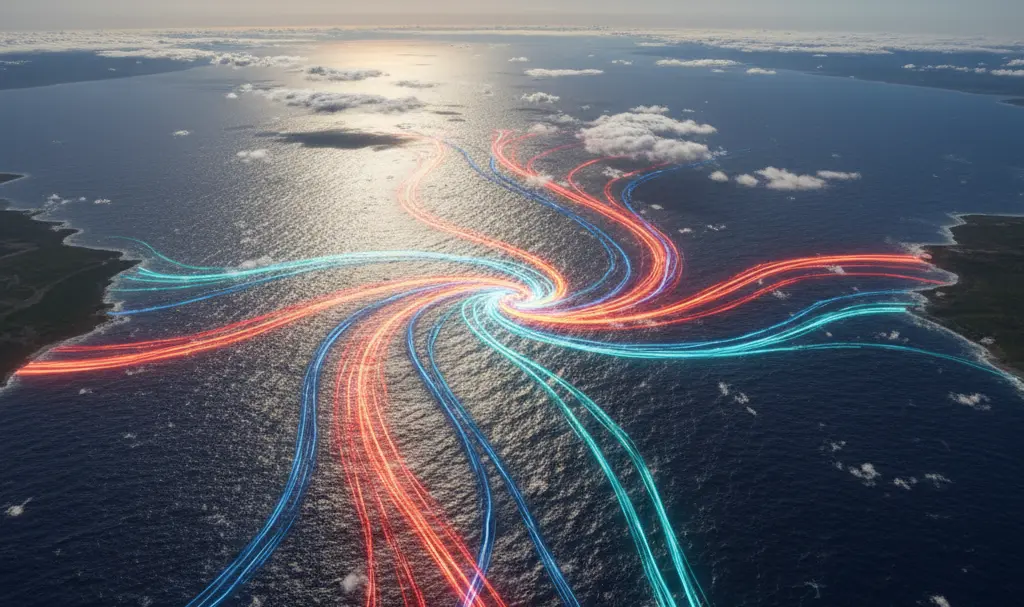
The Atlantic Meridional Overturning Circulation (AMOC) is one of the most important ocean current systems in the world, responsible for maintaining the delicate balance of our global climate. It functions as a massive conveyor belt that transports warm water from the tropics toward the north. Because of this process, regions in higher latitudes, such as Europe and the Arctic, enjoy a much milder climate.
Simultaneously, the AMOC absorbs vast quantities of carbon dioxide into the ocean depths, removing it from the atmosphere—a critical natural mechanism that complements terrestrial carbon-capture efforts like large-scale desert greening projects.
Scientists explain the mechanism behind the AMOC system as follows:
- The current transports warm, salty water to the North Atlantic via surface currents.
- During winter, these waters release their heat into the atmosphere, causing them to cool down significantly.
- As the water cools, it becomes denser and heavier, sinking to the ocean floor.
- These newly formed cold water masses are then pushed back south via deep-sea currents.
The profound impact of this current is clearly visible when comparing cities at similar latitudes. For instance, in Calgary, Canada, winter temperatures regularly plummet below -4°F (-20°C). Meanwhile, in London, England, winters remain notably mild—a direct result of the AMOC warming Western Europe.
Recent Studies Confirm the Worst-Case Scenarios
A research team led by Valentin Portmann from the Inria Centre de recherche Bordeaux Sud-Ouest in France applied an innovative analytical method known as ridge regression—a technique previously rarely used in climate science. Their findings were alarming: the most pessimistic predictions among previous climate models are the ones most accurately reflecting real-world observations.
Groundbreaking research recently indicates an expected AMOC slowdown of 43% to 58% by the year 2100, carrying a 90% probability that the weakening will reach at least 50%. What is even more concerning is that the projected decline is 60% steeper than the average estimates provided by the majority of previous climate models. This strongly suggests that earlier forecasts severely underestimated the gravity of the situation.
Real-World Ocean Observations Validate the Trend
Parallel to the French study, scientists from the University of Miami analyzed real-world data collected from four measurement stations deployed along the western edge of the North Atlantic. These stations have been rigorously tracking temperature, salinity, and current speeds since 2004.
Their analysis confirmed a definitive weakening of the AMOC across all four monitored latitudes over the past two decades. Cumulatively, the data documents a 10% weakening of the AMOC between 2004 and 2023. Although these specific observations cover only the western boundary of the Atlantic, researchers treat this area as a bellwether that provides the earliest signals of changes occurring throughout the entire circulation system.
Shane Elipot, an oceanographer at the University of Miami and co-author of the report, emphasized that the models aligning with these observations also predict that the AMOC is hurtling toward a tipping point. Once crossed, the current could completely shut down. Scientists now fear that the threshold for irreversible circulatory arrest could be breached as early as the middle of this century.
What Would an AMOC Collapse Mean for the World?
A potential collapse of the AMOC would trigger cascading extreme weather events worldwide. The primary consequences would include:
- Extreme European Winters: Western Europe would experience drastically colder, freezing winters.
- Severe Summer Droughts: Precipitation patterns would shift, leading to severe summer droughts across Europe.
- Significant Sea Level Rise: Coastal regions along the Atlantic could see water levels rise by 20 to 40 inches (50–100 cm).
- Ice Sheet Expansion: Research from Utrecht University suggests sea ice could extend far southward, potentially reaching parts of the British Isles, Scandinavia, and the Netherlands.
The expansion of ice cover would inherently act as a cooling amplifier, since ice reflects far more solar energy back into space than the dark surface of the ocean.
However, the devastating effects would not be confined to European countries. The AMOC is a key driver of the Indian monsoon system. Its collapse would result in prolonged droughts across vast areas of Africa and disrupt agriculture for billions of people. Furthermore, it would trigger an accelerated sea-level rise along the U.S. East Coast, compounding existing coastal vulnerabilities frequently highlighted in recent sea-level rise threat assessments.
Frequently Asked Questions (FAQ)
What exactly happens if the AMOC reaches its tipping point?
If the AMOC reaches its tipping point, the entire circulation system could abruptly and irreversibly collapse. This would drastically reduce the transport of warm tropical water to the North Atlantic, causing sudden, extreme cooling in Northern Europe and North America, while simultaneously disrupting tropical monsoon systems that billions of people rely on for survival and agriculture.
Can humanity reverse the weakening of the Atlantic Meridional Overturning Circulation?
Currently, there is no direct technological intervention capable of restarting or manually accelerating global ocean currents. The only viable mitigation strategy is to drastically reduce global greenhouse gas emissions to slow down planetary warming. This is crucial because melting freshwater from ice sheets is the primary driver disrupting the AMOC’s delicate salinity and density balance.
Source: Guardian, Science in Poland, Pulsar, CNN, Independent, NASA, Skeptical Science. Opening photo: Gemini
About Post Author
