

Contents

Humanoid Robots Outpace Humans: The Beijing Half Marathon Milestone
If anyone still harbored doubts about the sheer speed at which China is advancing in bipedal robotics, recent events in Beijing have put those questions to rest. In 2025, humanoids competing in the local half marathon barely managed to drag themselves across the finish line, with the fastest machine taking a grueling 2 hours and 40 minutes. Just one year later, a bipedal robot not only won the race but absolutely shattered the human world record for the 13.1-mile (21-kilometer) distance.

The Robot That Outran Humanity
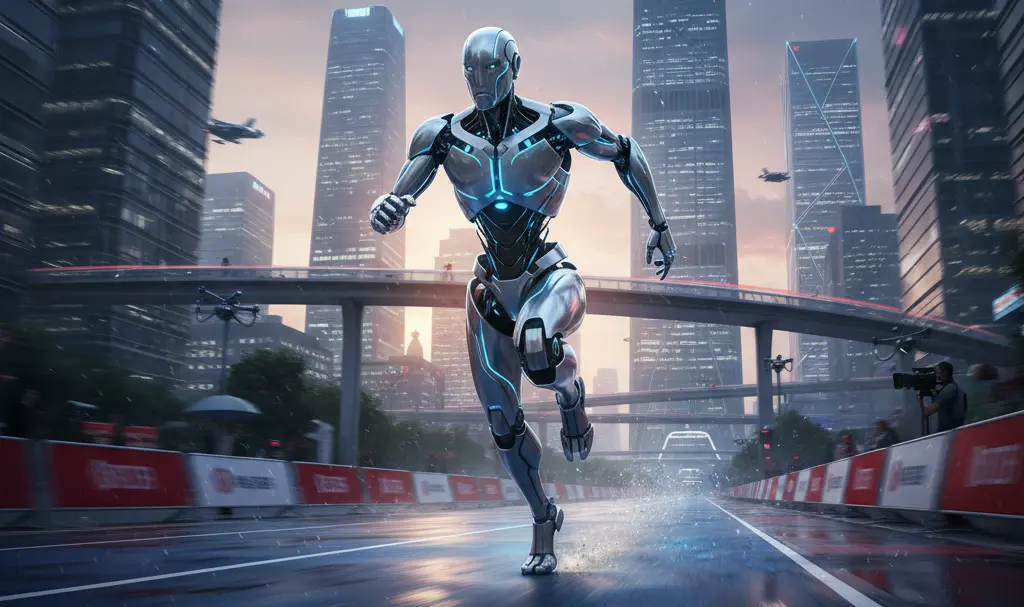
Beijing recently hosted its second-ever mixed half marathon, where human runners and humanoid robots competed simultaneously on the same course, albeit in separated lanes. The undisputed star of the event was Lightning—a bipedal running robot developed by smartphone giant Honor (a company with ties to Huawei). Lightning completed the grueling course in an astonishing 50 minutes and 26 seconds. To put this into perspective, it beat the official human world record (held by Jacob Kiplimo at 57:20) by nearly seven minutes.
Interestingly, the race featured a specialized scoring system that rewarded full autonomy. Due to this rule, the completely autonomous version of Lightning was officially crowned the winner, even though its remote-controlled “twin” actually crossed the finish line faster with a blistering time of 48:19.
A Mind-Blowing Technological Leap
The contrast between the inaugural 2025 event and the 2026 race highlights an unprecedented acceleration in technological progress:
- 2025: The fastest robot, Tiangong Ultra, took 2 hours and 40 minutes to finish. Most machines failed to complete the race entirely, and those that did were almost two hours slower than top human athletes.
- 2026: Nearly half of the competing robots finished the challenging course fully autonomously, without any remote control. Not only did they keep pace with humans, but they decisively outperformed them.
However, it is worth noting that this robotic victory was not entirely independent. During the race, the machines required hot-swapped battery replacements to maintain their blistering pace. Furthermore, the autonomous winner, Lightning, suffered a spectacular crash into a barricade just meters before the finish line and had to be physically picked up by a team of human engineers. Other machines experienced even rougher starts, with some falling over dramatically mere seconds after the starting gun fired.
A Brutal, Real-World Testing Ground
Organizers did not design this event merely as a PR stunt; it was engineered as a massive, real-world testing ground. The half marathon snaked through the Yizhuang industrial and technological district of Beijing. The course deliberately featured over a dozen different surface types and challenges:
- Flat, high-speed asphalt stretches
- Steep inclines and complex downhill slopes
- Sharp turns and narrow bottlenecks
- Uneven terrain mimicking an unpredictable urban jungle
The primary goal was to see how advanced sensor arrays, AI-driven control systems, and balance mechanisms perform in chaotic, real-world conditions. Much like the engineering required to perfect agile landings and advanced balance mechanisms, navigating a complex marathon course demands exceptional real-time processing that simply cannot be fully simulated in a sterile laboratory.
While a few robots stumbled on corners or ricocheted off barriers, the most advanced models ran with shocking fluidity. Some reached sprinting speeds of roughly 15.5 mph (25 km/h), perfectly mimicking the biomechanical sprinting styles seen on human athletic tracks.
Why is China Pushing Bipedal Humanoids?
For Beijing, this marathon is a strategic demonstration of power. It serves as a core pillar of China’s strategy to dominate the global humanoid robot sector, an industry projected to be a massive engine for future economic growth. According to recent research data, by 2025, over 80 percent of the approximately 16,000 globally deployed humanoid robots were operating in China, leaving Western competitors holding only a fraction of the global market share.
While international rivals scale their efforts—such as recent investments in child-sized robots for household applications—China is heavily leaning into industrial and commercial deployment. Tech companies are aggressively gathering telemetry data from motion sensors attached to human factory workers. This vast reservoir of human movement data is used to train AI models on complex behavioral patterns.
The more real-world data these algorithms consume—whether from a factory floor or a punishing 13.1-mile marathon—the faster the machines learn to navigate our world. This rapid accumulation of experiential data is dramatically shrinking the timeline from laboratory prototypes to mass, global deployment.
Frequently Asked Questions (FAQ)
How was the humanoid robot able to beat the human marathon world record?
The robot, named ‘Lightning’, utilized advanced bipedal mechanics and high-torque motors capable of sustaining sprinting speeds of up to 15.5 mph (25 km/h). Unlike humans who experience muscular fatigue, the robot maintained a consistent, mathematically optimized pace, though it did require battery swaps during the race to sustain its energy levels.
Did the robots run the half marathon completely unassisted?
No. While the AI navigation and movement control were fully autonomous for the winning category, the hardware still required human intervention. Engineers had to swap out the robots’ batteries mid-race, and in some cases, physically lift the machines back up when they lost their balance and crashed.
Why are tech companies testing robots in marathons instead of laboratories?
Laboratories offer controlled, predictable environments. A marathon course through an urban district provides unpredictable lighting, diverse surface textures, varied inclines, and physical bottlenecks. This exposes the AI’s real-time sensory processing to chaotic, real-world variables, which is crucial for developing robots that can safely operate in actual cities and factories.
Source: Reuters, RP, X, RTHK, Global Times
Opening photo: Gemini
About Post Author
