

Contents
Ancient Discovery: A 2,400-Year-Old Shipwreck Uncovered During Wind Farm Surveys Off Italy’s Coast
Off the picturesque coast of Calabria, Italy, a routine photogrammetric survey of the seabed for a planned offshore wind farm yielded an unexpected and extraordinary discovery. Marine archaeologists uncovered the remarkably preserved wreck of an ancient Greek merchant ship, dating back approximately 2,400 years. This significant find, laden with hundreds of amphorae – clay vessels used for transporting goods like wine and olive oil – offers a fascinating glimpse into ancient Mediterranean trade and maritime history.
An Underwater Surprise off Calabria
The shipwreck was precisely located off the coast of Monasterace, situated on the Ionian Sea coastline of the Calabria region, near the ancient city of Kaulon. This remarkable discovery occurred during photogrammetric surveys conducted in 2023 for Acciona Energía’s planned offshore wind farm project. While the surveys took place in 2023, Italian authorities only recently made the information public, allowing for careful documentation and planning.
Dating back to the 4th–5th century BCE, the vessel’s position and impressive state of preservation strongly suggest it was a Greek merchant ship that sank with its full cargo of ceramic containers still largely intact. The depth of the discovery, approximately 730 meters (about 2,400 feet) in the Ionian Sea and roughly 22 kilometers (about 14 miles) from Monasterace on Calabria’s eastern coast, likely contributed to its excellent preservation.
The Spanish energy company, Acciona Energía, collaborated closely with the Italian Ministry of Culture and local conservation authorities. This partnership was crucial in identifying the archaeological site and integrating it into the initial investment planning. Ultimately, the wind farm project was redesigned to ensure that the turbine installations would completely bypass the wreck area, protecting this invaluable historical treasure. Such careful planning demonstrates a growing commitment to cultural heritage preservation even amidst significant infrastructure development. For more insights into sustainable energy advancements, explore The Renewable Energy Revolution: Future Global Power.
Amphorae from Magna Graecia and Sicily
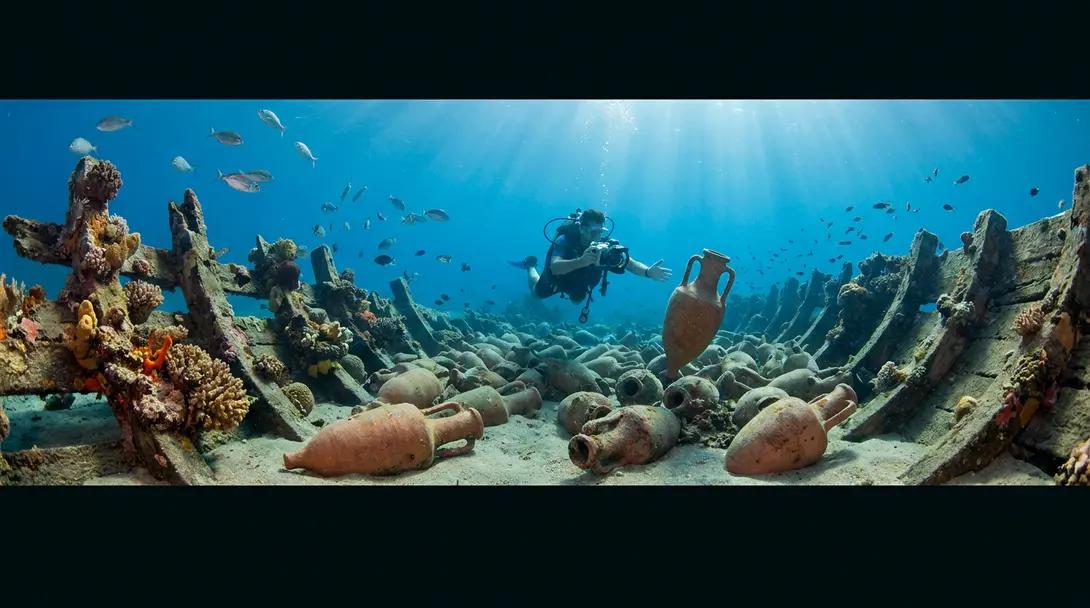
Over 300 amphorae were identified on board the ancient vessel. These distinctive clay jars were widely used across the Mediterranean Basin for transporting various commodities, including wine, olive oil, grains, and other foodstuffs. Their presence in such numbers on the wreck provides direct evidence of extensive ancient trade networks.
Analysis of the ceramic types indicates that the amphorae originated from various production centers within Magna Graecia – the Greek colonies established in Southern Italy – and Sicily. This diversity in the cargo’s origin confirms the existence of a dense and sophisticated regional trade network that connected different Hellenic settlements across the central Mediterranean. These trade routes were vital for the economic prosperity and cultural exchange of the ancient world.
Photogrammetric surveys, which use multiple overlapping photographs to create precise 3D models, revealed that the cargo now forms two distinct clusters of amphorae, separated by approximately 10 meters (about 33 feet). Researchers hypothesize that this separation could be a result of the sinking process itself, perhaps due to the ship breaking apart, or subsequent disturbances to the seabed over millennia.
While remarkably preserved, researchers note that the wreck is not entirely untouched. Modern trawl fishing activities have likely disturbed the site, potentially damaging the wreck structure and scattering some of its precious cargo. This highlights the ongoing challenges of protecting underwater cultural heritage from contemporary human activity.
The Italian Ministry of Culture has announced plans for detailed documentation of the site, including high-resolution photogrammetric models. They also intend to recover the most vulnerable artifacts to ensure the preservation of the site for future research and potential museum exhibitions. Italian cultural authorities consider this discovery one of the most significant contemporary archaeological finds in the Mediterranean Sea, offering unprecedented insights into a pivotal era of maritime history. Such discoveries continue to shape our understanding of ancient civilizations and their technological prowess. For a look at future innovations, consider CES 2026 Tech Trends.

Frequently Asked Questions (FAQ)
The seabed survey was a routine photogrammetric assessment conducted to identify a suitable location for a planned offshore wind farm by Acciona Energía off the coast of Calabria, Italy. The discovery of the ancient shipwreck was an unexpected outcome of this environmental impact study.
The shipwreck dates back approximately 2,400 years, to the 4th–5th century BCE. It is believed to be a Greek merchant ship, evidenced by its cargo of hundreds of amphorae and its typical trade route location.
Upon discovery, the wind farm project was redesigned to ensure that the planned turbine installations would completely avoid the wreck site. Additionally, the Italian Ministry of Culture plans detailed documentation, high-resolution photogrammetric modeling, and the recovery of the most endangered artifacts to preserve the site for future study and potential museum exhibits.
The analysis of over 300 amphorae found on board, which originated from various production centers in Magna Graecia (Greek colonies in Southern Italy) and Sicily, confirms the existence of a dense and sophisticated regional trade network. This indicates active economic and cultural exchange between different Hellenic settlements across the central Mediterranean during that period.
Source: Antena 3 CNN, Arkeonews, WebWire, Acciona, GreekReporter, TheCoolDown, DiverNet. Opening photo: Okinawa World Diving / Pexels.com
About Post Author
