

Contents
Blue Origin’s New Glenn Rocket Grounded: An Unforeseen Setback for Space Ambitions
A recent, powerful explosion involving Blue Origin’s New Glenn rocket has put a significant pause on Jeff Bezos’s ambitious space exploration plans. This incident at Cape Canaveral has caused extensive damage to crucial ground infrastructure, necessitating a complete re-evaluation and rescheduling of future launch timelines.
Catastrophic Explosion Destroys Launch Infrastructure
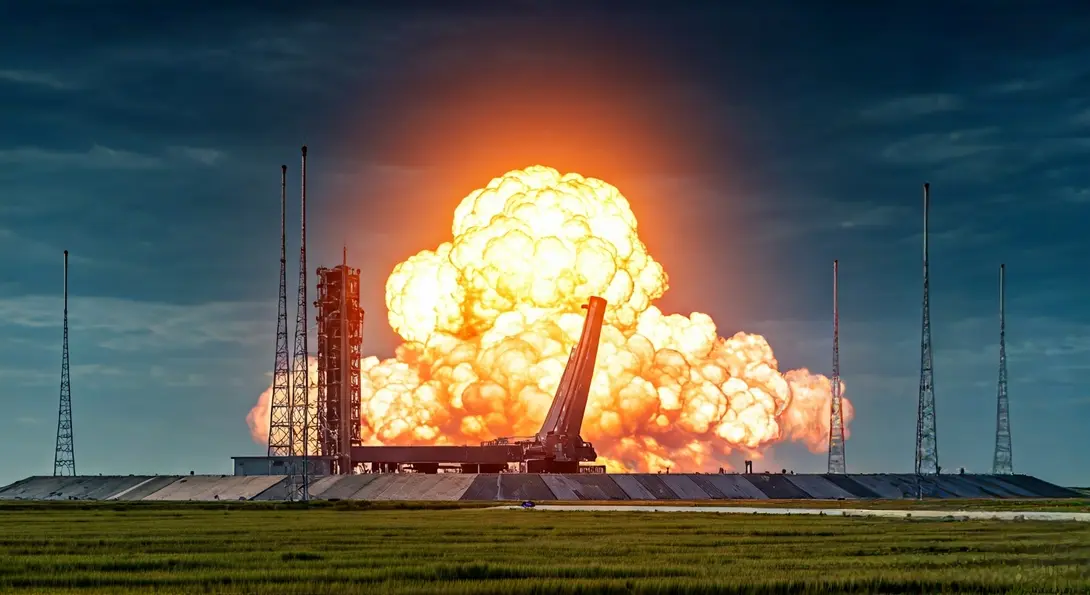
The catastrophic event occurred during a static fire test of the New Glenn rocket’s first-stage BE-4 engines. For reasons yet to be fully explained, the rocket experienced an explosion, erupting into a colossal fireball and generating a destructive shockwave across the launch site. This type of test, where engines are fired while the rocket remains secured to the launchpad, is a critical step to ensure operational readiness and safety before an actual flight.
Fortunately, no personnel at Cape Canaveral Space Force Station were injured during the anomaly, and no commercial payload was onboard the rocket at the time of the incident. Following the event, a thorough assessment revealed the true extent of the damage:
- The primary issue centers on the condition of Launch Complex 36, Blue Origin’s dedicated New Glenn launch facility.
- The force of the blast devastated the power tower, essential for supplying energy to the rocket and launch systems.
- The lightning tower, critical for protecting the vehicle and pad from electrical strikes, was also severely damaged.
- The complex’s transporter and erector system, responsible for moving and vertically integrating the massive rocket, sustained significant destruction.
The loss of this infrastructure at Launch Complex 36 represents a major blow to Blue Origin, as it is their sole operational launch site for the New Glenn rocket.
Costly Repercussions and Delayed Missions
Space industry experts estimate that rebuilding the damaged launch complex will take a minimum of six months, with a realistic return to flight operations potentially extending even further. This incident introduces drastic delays for several high-profile projects:
- Amazon’s Project Kuiper: A critical mission to deploy telecommunications satellites for Amazon’s Project Kuiper constellation was originally slated for a June launch. This crucial deployment, aimed at providing global broadband internet, will now face substantial delays.
- NASA’s Artemis Program: Blue Origin’s New Glenn heavy-lift rocket is a key component of NASA’s ambitious Artemis lunar program, which aims to return humans to the Moon. The grounding of New Glenn creates uncertainty and potential delays for these vital missions. Learn more about international contributions to lunar exploration, such as Poland’s role in the Artemis II mission.
- Mars Missions: The New Glenn was also anticipated to play a role in future Martian exploration endeavors, which will now be impacted by the extended downtime.
Unlike some competitors, such as SpaceX, which has multiple operational launch pads and vehicle variations, Blue Origin currently lacks an alternative launch facility for New Glenn. This absence of redundancy presents immense logistical and financial challenges for the company. The coming months will undoubtedly involve extensive and costly repairs, impacting Blue Origin’s financial outlook and project timelines. For insights into other major players in the space industry and their technological advancements, consider exploring developments like Elon Musk’s Terafab semiconductor factory in Texas, integrating AI and space robotics.
Frequently Asked Questions (FAQ)
What is the New Glenn rocket?
The New Glenn is a heavy-lift orbital launch vehicle under development by Blue Origin, Jeff Bezos’s aerospace company. It is designed to launch large payloads, including satellites and potentially human crews, to Earth orbit and beyond. It features a reusable first stage, similar to Blue Origin’s suborbital New Shepard rocket.

What was the likely cause of the New Glenn explosion?
The exact cause of the explosion during the static fire test remains under official investigation by Blue Origin and relevant authorities. Initial reports indicate it occurred during the firing of the BE-4 engines on the first stage, but further details are pending the outcome of the investigation.
How will this incident impact Blue Origin’s competitive position in the space industry?
This significant delay in New Glenn’s development and operational readiness poses a considerable challenge to Blue Origin’s competitive standing, especially against companies with more established heavy-lift capabilities and launch redundancy. The prolonged grounding could allow competitors to capture contracts and further solidify their market positions in the commercial launch and government space sectors.
Source: Reuters, Internal Research. Opening photo: Gemini
About Post Author
