

Contents
DIY Electric Motor: Separating Fact from Fiction
The idea of constructing an electric motor might sound like a project reserved for advanced engineering labs. Yet, countless online videos demonstrate people building functional electric motors using nothing more than common household items. This begs the question: are these seemingly simple DIY projects genuinely possible, or just clever hoaxes? We decided to put this popular claim to the test to uncover the truth.
The Allure of Homemade Electric Motors
From social media feeds to educational platforms, demonstrations of rudimentary electric motors have captivated audiences worldwide. These projects typically involve basic components and promise a fascinating glimpse into the principles of electricity and magnetism. Our objective was to meticulously follow these DIY guides, conduct our own experiments, and provide a clear, evidence-based answer to whether a functional electric motor can indeed be assembled at home.
Essential Components for a Basic Electric Motor
To replicate the common online tutorials for a homemade electric motor, you’ll typically need just a few accessible items:
- Battery: A standard battery (even a small AAA, though a larger one can make construction easier due to its size) provides the necessary power.
- Magnet: Any small permanent magnet will work.
- Copper Wire: Insulated copper wire is crucial for conducting electricity and forming the motor’s coil.
- Paper Clips (Optional): These can be useful for creating stable connections between the copper wire and the battery terminals.
- Screw (Optional): Sometimes used to extend the structure or serve as a core for an electromagnet.
Our Hands-On Experiments: Putting the Theory to the Test
Our team conducted a series of experiments, incrementally increasing the complexity to thoroughly test the concept of a homemade electric motor:
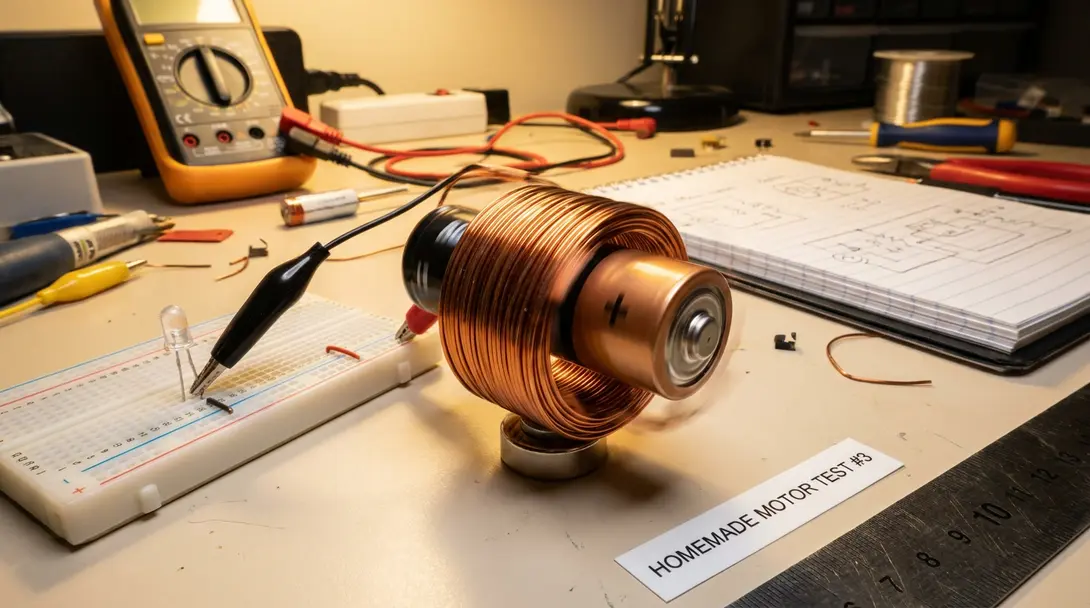
- Simple Loop Motor: We began by connecting magnets to a battery and then formed a heart-shaped loop with copper wire, positioning it to interact with the magnetic field.
- Electromagnet Test: Next, we coiled copper wire around a screw and applied power from the battery. This test focused on creating an electromagnet rather than sustained rotation.
- Propeller Motor: For our most elaborate setup, we placed a small propeller between two magnets, integrated a screw and battery, and then connected the circuit with copper wire, aiming for visible rotational movement.
The results were compelling. Tests number one and three successfully demonstrated movement of the copper wire and the propeller, respectively. In test number two, while it didn’t produce continuous motion, it clearly created a rapidly heating electromagnet, confirming the principle of current-induced magnetism. These outcomes allowed us to confirm the viability of creating a simple electric motor at home. But what scientific principles underpin this fascinating phenomenon?
The Fundamental Principle: Electromagnetism in Action
The operation of these simple electric motors relies on a foundational discovery made by Danish physicist Hans Christian Ørsted in 1820. Ørsted observed that an electric current flowing through a conductor creates a magnetic field around it. This groundbreaking insight established the crucial link between electricity and magnetism, a concept known as electromagnetism.
In our DIY motors, when electric current from the battery passes through the copper wire, the wire itself becomes a temporary electromagnet. This newly generated magnetic field then interacts with the field of the permanent magnet(s) in the setup. If the interacting magnetic poles are oriented to repel each other (e.g., North pole encountering another North pole), this repulsive force can induce movement or rotation in the wire or propeller.
The battery is indispensable in this process. Without the electrical current it provides, the copper wire would not generate a magnetic field and therefore would not repel the permanent magnets, preventing any motion. This interaction of magnetic fields is the core reason why the simple electric motor works.
Beyond the Basics: Exploring Other Tech Myths
Our investigation into the homemade electric motor is just one example of our commitment to debunking or confirming popular technological myths. We’ve explored many other intriguing claims, such as whether cleaning RAM truly speeds up a phone, if a photograph can unlock a smartphone, or if thermal imaging can genuinely see through walls. We’ve also delved into more unusual topics like the ranking of technology gadgets that sound like a joke but are real, and even complex topics like how AI bypasses security passwords and viruses in an experimental setting.

Frequently Asked Questions (FAQ)
Generally, building these simple motors is considered safe for educational purposes, especially with low-voltage batteries (like AAA or AA). However, always ensure adult supervision for children, avoid short circuits, and be aware that components like copper wire can heat up, especially if used to create an electromagnet. Disconnect power if any part becomes excessively hot.
While these homemade motors are not practical for industrial use, they are incredibly valuable as educational tools. They brilliantly demonstrate the fundamental principles of electromagnetism, energy conversion, and basic circuit design, making abstract scientific concepts tangible and understandable for students and hobbyists.
The heating of the copper wire is due to electrical resistance. As current flows through the wire, electrons collide with atoms in the conductor, converting some of the electrical energy into heat. This is a common phenomenon in electrical circuits and is more noticeable when higher currents flow or the wire is thin and offers more resistance.
Simple DIY motors demonstrate the basic principle of electromagnetic interaction for motion, often producing intermittent or uncontrolled rotation. Industrial electric motors, however, are highly engineered machines designed for continuous, efficient, and controlled operation. They use complex coil windings, commutators, brushes, armatures, and advanced magnetic materials to generate significant, sustained torque and precise speed control for a wide array of applications, from home appliances to electric vehicles.
Source: Our own research.
Opening photo: Krzysztof Rojek
About Post Author
