

OpenAI Codex Micro Developer Keyboard Review
-
Workflow Enhancement
-
Design & Build Quality
-
Intuitive Controls
-
AI Status Feedback (RGB)
-
Connectivity & Compatibility
-
Value for Niche Users
OpenAI Codex Micro: A Niche, Powerful AI Developer Tool
The OpenAI Codex Micro is a purpose-built hardware controller designed to significantly enhance the workflow of developers using OpenAI’s Codex AI agent. With its robust build, intuitive controls, and dynamic AI status feedback via RGB lighting, it offers a tangible improvement in efficiency for its targeted niche. While its $230 price point and specialized function make it less suitable for the average user, it represents a compelling glimpse into the future of AI-integrated hardware for professional applications.
Advantages
- Streamlines and enhances developer workflow with Codex AI.
- Intuitive controls (joystick, rotary knob, dedicated buttons) for frequent actions.
- Dynamic RGB backlighting provides immediate visual feedback on AI status.
- Robust housing and durable materials (polycarbonate, aluminum, PBT/PC keycaps).
- Flexible connectivity (Bluetooth, USB-C) and broad OS compatibility (Windows, macOS).
- Enhances interaction with ChatGPT applications and the specialized Codex tool.
Disadvantages
- High price point ($230) for a supplementary device.
- Niche target audience (primarily developers heavily utilizing Codex AI).
- Not a standalone AI device or a replacement for a standard keyboard/computer.
- Initial production run quickly sold out, indicating limited immediate availability.
- Not the advanced consumer-oriented hardware expected from the Jony Ive collaboration.
Contents
OpenAI Steps Beyond Software with Codex Micro Developer Keyboard
OpenAI, a leader in artificial intelligence, is increasingly expanding its reach beyond software applications on computers and smartphones. Their first foray into dedicated hardware isn’t an AI personal assistant or a smartphone competitor, but a compact keyboard designed specifically for developers: the Codex Micro. Priced at $230, this innovative device was created in collaboration with the company Work Louder, and its initial production run quickly sold out, demonstrating significant interest from the developer community.
Introducing the Codex Micro: OpenAI’s New Hardware Endeavor
It’s crucial to distinguish the Codex Micro from a more secretive and ambitious project that OpenAI is reportedly developing with Jony Ive, Apple’s former chief design officer. The Codex Micro is primarily a physical control panel engineered to streamline and enhance the workflow when interacting with OpenAI’s programming agent, Codex.
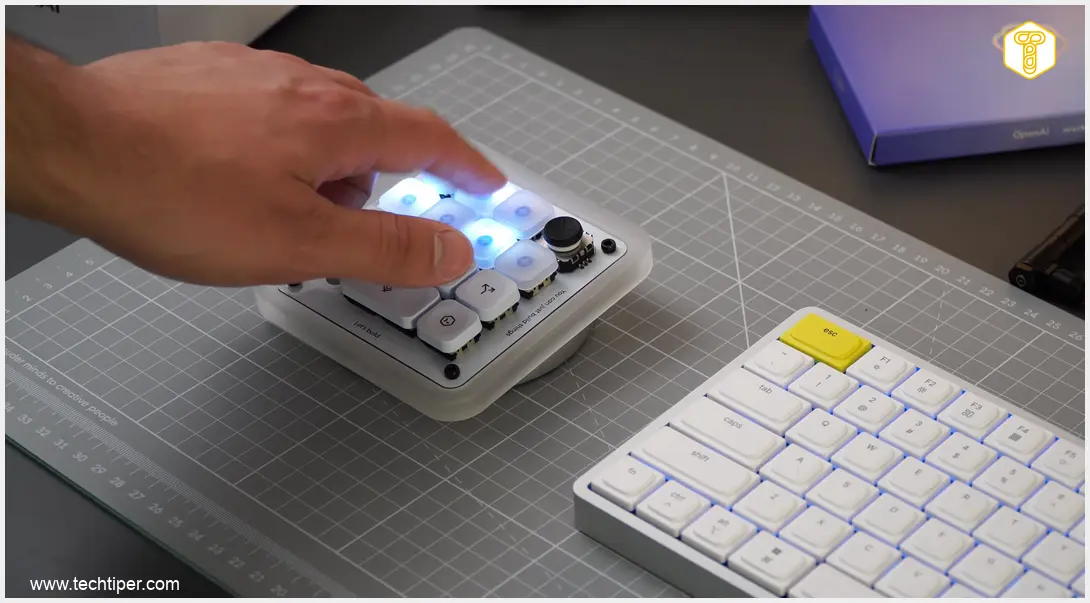
The device’s robust housing features 13 mechanical switches, a sensitive touchpad, a precise joystick, and a versatile rotary knob. Connectivity is flexible, offering both Bluetooth wireless and USB-C wired options, ensuring compatibility with both Windows and macOS operating systems. A notable feature is its RGB backlighting, which serves more than just an aesthetic purpose. The colors dynamically indicate the current status of the Codex AI agents, providing immediate visual feedback to the user.
This intelligent lighting system allows developers to quickly ascertain the AI agent’s activity without needing to switch between different application windows. Users can tell at a glance whether the agent is analyzing a task, executing a command, awaiting a decision, or has completed its work. This functionality is particularly beneficial for developers who are simultaneously managing multiple conversations and projects within the Codex environment.
Intuitive Controls: Joystick for Tasks, Knob for AI “Thinking”
Each component of the Codex Micro is thoughtfully designed to facilitate the most frequent actions performed when working with the Codex agent:
- Joystick: Tilting the joystick can instantly trigger predefined processes. These might include common developer tasks such as checking for changes in code, searching for bugs, or initiating code refactoring – the process of restructuring existing computer code without altering its external behavior.
- Dedicated Buttons: Separate buttons provide quick access to crucial interactions, allowing users to accept or reject an agent’s suggestion, start a new conversation, or activate voice communication with the AI.
- Rotary Knob: This intuitive control is used to adjust the AI model’s “reasoning” level. For simpler tasks, users can select a faster processing mode. Conversely, for more complex problems, they can increase the amount of computational effort the AI dedicates to finding an optimal solution, ensuring thoroughness where needed.
The Codex Micro also comes with a set of additional keycaps featuring icons that correspond to various functions. The manufacturer provides 32 custom symbols and 11 single-color keycaps for personalization. The device’s robust construction includes a polycarbonate and aluminum chassis, complemented by durable PBT and PC keycaps.
More Than Just a Keyboard: Enhancing AI Interaction
It’s important to understand that the Codex Micro is not intended to replace a standard keyboard, a computer, or a smartphone. Nor does it function as an independent AI assistant. Instead, it serves as a supplementary controller, meticulously crafted to shorten the pathway to accessing and utilizing features available within the ChatGPT application and the specialized Codex tool.

The Codex agent itself is primarily designed for software development tasks. Its capabilities include creating functions, correcting errors, refactoring code segments, and reviewing code changes made by human developers. OpenAI is continually evolving Codex as a versatile tool that operates seamlessly within the ChatGPT application, various code editors, and the terminal.
In a significant update, Codex was integrated into the new ChatGPT applications for Windows and macOS in July. This unified program now intelligently combines the classic chat interface, advanced tools for executing complex tasks, and a dedicated environment for developers. For more insights into how AI is integrated across different platforms, you might be interested in ChatGPT, Apple CarPlay, Android Auto, and Gemini Integration.
Ultimately, the Codex Micro makes the most sense for individuals who routinely interact with AI agents for a significant portion of their workday. For the average ChatGPT user, it would likely remain a relatively expensive and less essential accessory. Curious about other AI developments? Read about Why OpenAI Shut Down Sora: The Truth (Less Sensational).
What About the Hardware Project with Jony Ive?
The launch of this compact developer keyboard does not signify that OpenAI has abandoned its plans for more advanced consumer-oriented hardware. For several years, the company has been collaborating with Jony Ive and his design studio, LoveFrom. In 2025, the io Products team joined OpenAI with the express purpose of jointly developing innovative products that seamlessly merge artificial intelligence, software, and industrial design.
At the time, OpenAI indicated that this collaboration had already yielded concrete project concepts. However, the tech giant has not yet officially revealed what this device might look like, what functions it will offer, or when it will be released to the market. Jony Ive and LoveFrom have maintained their independence but have taken on a pivotal role in shaping OpenAI’s product design philosophy.
Therefore, the Codex Micro is not the long-awaited smartphone successor or the primary outcome of the high-profile collaboration with Jony Ive. It is a considerably more modest product, developed with Work Louder, specifically tailored for a niche group of developers.
Nevertheless, this keyboard offers a compelling glimpse into the potential trajectory of the AI hardware market. Instead of merely confining more functionalities within software applications, manufacturers are beginning to introduce physical buttons, controls, and dials to interact with AI. True consumer-grade hardware from the creators of ChatGPT, however, still awaits its debut.
Frequently Asked Questions (FAQ)
The OpenAI Codex Micro is a specialized hardware controller, a compact keyboard designed for developers to interact more efficiently with OpenAI’s AI programming agent, Codex. It features mechanical switches, a touchpad, joystick, and a rotary knob to streamline coding tasks and AI interactions.
The Codex Micro is priced at $230. The initial batch, a collaboration with Work Louder, quickly sold out. Information on future availability would typically be found on the Work Louder or OpenAI official websites.
Key features include 13 mechanical switches, a touchpad, a joystick for triggering tasks, a rotary knob for adjusting AI reasoning levels, and RGB backlighting that indicates the AI agent’s status. It connects via Bluetooth or USB-C and is compatible with Windows and macOS.
No, the Codex Micro is not a standalone AI device, nor does it replace a computer or a standard keyboard. It is a supplementary controller designed to enhance interaction with the existing ChatGPT application and the Codex AI agent, making functions more accessible.
The Codex Micro is a niche developer tool, already released. The project with Jony Ive and his studio LoveFrom is a much more ambitious and secretive initiative focused on developing advanced consumer-oriented hardware that blends AI, software, and design, with no public details or release date yet.
Source: OpenAI. Opening photo: Work Louder
About Post Author
