

Contents

The Decades-Long Search for a Mother: How AI Connected the Dots
For most of his life, Avtar Singh was haunted by an unanswered question: who was his biological mother, and what became of her after her marriage to his father ended? All he knew was her name, Savinder, and a few fragmented details about his family’s connections to India, Africa, and the United Kingdom. After years of fruitless searching through conventional channels, a simple question posed to an artificial intelligence (AI) chatbot, ChatGPT, led to an extraordinary breakthrough.

A Childhood Shrouded in Mystery
Avtar’s remarkable story was first brought to light by The Guardian. Born in India, he was raised by his grandparents until the age of nine, when he moved to Canada to live with his father and his new family. It was only many years later that he learned the woman he had known as his mother was not his biological parent. His birth mother, he discovered, had reportedly returned to Africa following her divorce. However, his family remained tight-lipped, unwilling to divulge further details about her or her whereabouts.
Traditional Search Methods Fall Short
Driven by an innate desire to understand his roots, Avtar embarked on a determined quest for information. He scoured digital platforms like Google and Facebook, delving into British archives, but his efforts yielded no significant leads. He even considered reaching out to television programs specializing in reuniting lost relatives, a testament to his persistent hope.
Despite his openness to various avenues, Avtar had reservations about using commercial DNA testing services. His concerns stemmed from the potential implications for genetic data privacy and how such sensitive information might be stored and utilized by companies.
For more insights into integrating AI into daily life, explore how AI is being used in various contexts, from entertainment systems to critical healthcare applications. Discover more about AI integration in everyday tech.
The Unexpected Aid of Artificial Intelligence
The turning point arrived on May 8th, during a trip through France. In a moment of intuition, Avtar decided to input the sparse details he possessed into ChatGPT. He typed in his mother’s name, Savinder Kaur, her approximate age, and added that she might have lived in India, Africa, and the United Kingdom. The chatbot’s response was almost immediate and astonishingly precise: it presented an article about a woman named Savinder Kaur Nagi, born in Kenya to an Indian Sikh family.
Avtar approached this AI-generated lead with a healthy dose of skepticism, well aware that large language models can sometimes produce inaccurate or fabricated information. However, this time, the system had done more than just generate text; it had referenced an existing, legitimate article. The piece was a heartfelt tribute written by Nicci Dhamu, Savinder’s daughter, published following her mother’s passing in 2024. It beautifully chronicled Savinder’s life, her passions, and her enduring connections to India.
The most compelling clue within the article was a photograph of a tailoring course diploma from Dhariwal, a town near Amritsar. This document dated back to a period shortly after Avtar’s birth and was from a location deeply connected to his family’s history. Armed with this potent piece of evidence, Avtar cautiously reached out to Nicci, the author of the article, inquiring about a potential familial connection.
The role of AI in processing and presenting complex information is rapidly expanding, from helping individuals uncover personal histories to assisting medical professionals. Learn about AI’s impact in healthcare, including generating ER discharge summaries.
An Emotional Reunion: The Confirmation of “Titu”
Unbeknownst to Avtar, Nicci had always been aware that her mother had been married before and had a son who was taken from her as a young child following the divorce. The family only knew his childhood nickname: Titu. Savinder had never forgotten him; towards the end of her life, as she battled dementia, she would often cry out in Punjabi, repeating, “my child.”
During their very first phone conversation, Nicci posed a direct question to Avtar: “Are you Titu?” This intimate detail, known only to the immediate family, served as the ultimate confirmation. The two instantly recognized their connection, negating the need for any DNA testing. Just a few days later, Avtar flew to London, where he had an emotional reunion with his half-sister Nicci, his half-brother, and an uncle who vividly remembered him as a small boy.
Technology’s Role: Skepticism Amidst Success
While this story had a profoundly happy ending, Avtar Singh maintains a cautious perspective on technology. He believes that ChatGPT didn’t “understand” his family history in a human sense but rather efficiently connected the clues he provided with publicly available information on the internet. He remains critical of how technology companies collect and process private data, emphasizing the importance of digital privacy even as he acknowledges the invaluable role AI played in his personal journey.
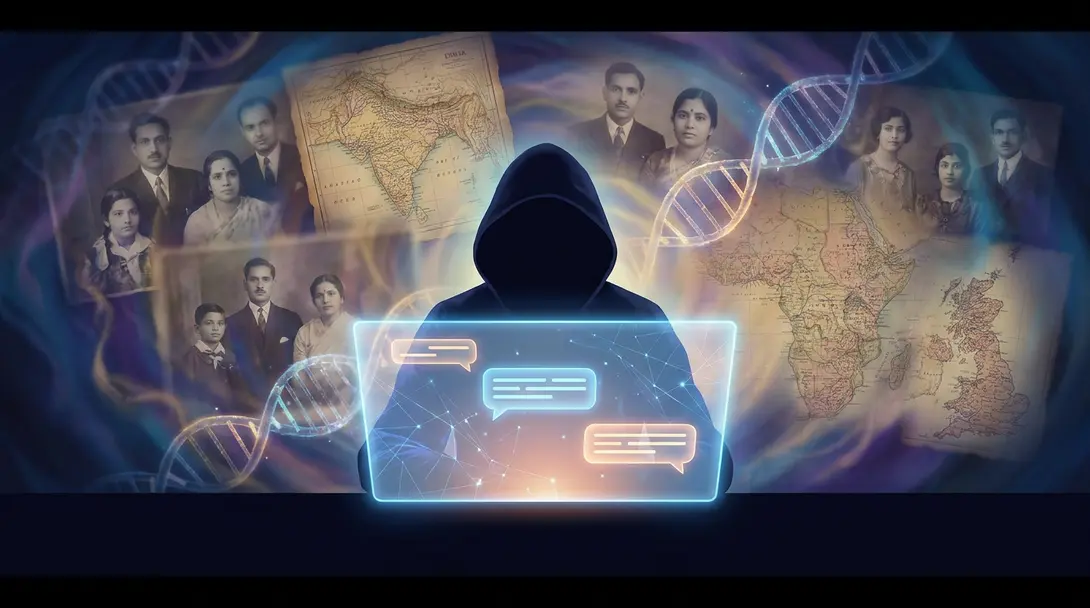
Source: The Guardian. Opening photo: Gemini
Frequently Asked Questions (FAQ)
Avtar provided ChatGPT with his biological mother’s name (Savinder Kaur), approximate age, and possible locations (India, Africa, UK). ChatGPT then identified an existing online article about Savinder Kaur Nagi, which was a memorial written by her daughter. This article contained crucial family details and a photo of a diploma that confirmed the familial connection, leading Avtar to reach out directly to the author.
Avtar Singh was hesitant to use commercial DNA testing services due to concerns about how his genetic data might be stored, managed, and potentially used by these companies. This highlights a common ethical consideration regarding personal data privacy in the age of advanced technology.
While AI tools can be incredibly effective at processing vast amounts of information and connecting seemingly disparate data points, as demonstrated in Avtar’s story, it’s crucial to approach their output with a critical eye. AI models can sometimes generate inaccuracies or “hallucinate” information. In this case, ChatGPT succeeded because it pointed to an existing, verifiable source (the memorial article). For sensitive personal research, AI should be used as a starting point for discovery, with all information cross-referenced and verified through traditional human methods.
Avtar’s skepticism, despite the successful outcome, reflects a common understanding that while AI can perform powerful information retrieval and synthesis, it doesn’t “understand” context or human emotion in the same way a person does. His view that ChatGPT merely “connected dots” rather than truly comprehending his family’s history underscores the distinction between algorithmic efficiency and human intuition or empathy. It also highlights ongoing concerns about data privacy and the ethical implications of technological advancement.
About Post Author
