

Contents
Beyond the Barbarian Invasions: How Ancient DNA Rewrites the End of the Roman Empire
For decades, history books have depicted the fall of the Western Roman Empire as a sudden, violent catastrophe triggered by relentless barbarian invasions. This narrative of a rapid collapse of one of the world’s greatest civilizations has dominated our understanding of late antiquity. However, groundbreaking paleogenetic research is now painting a completely different—and much calmer—picture of these historical events.
The power of modern scientific analysis to unearth historical truths is profound. Whether researchers are examining ancient fossils to uncover an Oviraptor dinosaur nest incubation experiment or sequencing human DNA to understand societal shifts, modern methodology continuously rewrites our understanding of the past. In this case, the transition from antiquity to the Middle Ages is now understood to be a highly gradual process built primarily on the peaceful integration of diverse communities.
The Paleogenetic Revolution in Historical Research
To uncover the reality of life during the empire’s decline, scientists utilized advanced paleogenetic techniques—extracting and analyzing ancient DNA from archaeological remains. The study focused on the daily lives of ordinary people inhabiting the region of modern-day southern Germany between the 4th and 7th centuries CE.
The research team successfully analyzed the genetic material from the remains of more than 250 individuals. By comparing this data with thousands of ancient human genomes from various parts of Europe, they reconstructed the complex social transformations that occurred as Roman imperial authority weakened.
Key Findings on Early Migration Patterns
- Earlier Timelines: Migrations of populations from Northern Europe began much earlier than historians previously assumed.
- Gradual Arrival: These initial migrations were not massive, overwhelming invasions, but rather small-scale, localized movements.
- Initial Segregation: Northern newcomers initially lived alongside established Romanized communities while maintaining distinct social and genetic boundaries.
From Segregation to Complete Assimilation
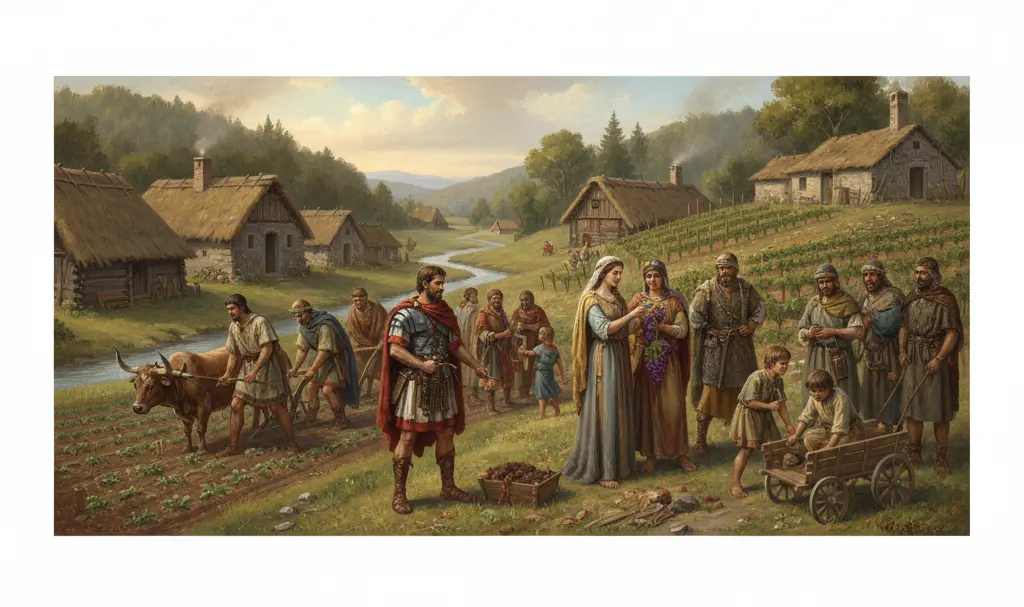
Initially, the northern migrants functioned alongside Roman-cultured communities but kept to themselves. They primarily worked in agriculture and lived under specific social constraints, including strict limitations on intermarriage. However, over generations, these rigid boundaries began to blur.
Particularly fascinating is the analysis of burial goods and grave structures. The data shows that by approximately 470 CE, the cultural and material differences between inhabitants of Roman descent and those of Northern European origin had virtually disappeared.
Just as advanced technologies often prompt us to reassess long-held scientific assumptions—much like recent corrections found in sea-level rise studies and coastal threat maps—paleogenetics is reshaping our understanding of human history. Researchers conclude that instead of a violent conquest, the region experienced a steady, gradual process of assimilation. This peaceful blending laid the demographic and cultural foundation for modern Central European populations.
Reconstructing Daily Life 1,500 Years Ago
The study went beyond macro-level migration patterns, delivering exceptionally detailed insights into the daily routines and social structures of post-Roman Europe. By tracking genetic markers, scientists could determine whether a specific individual grew up in the exact location they were buried or if they had migrated from another region.
The resulting data thoroughly debunked the theory of a massive, singular wave of Germanic migration designed to conquer and entirely replace the local population. Instead, a new social fabric was being woven.

The Birth of the Modern European Family
As the Roman state apparatus dissolved, new familial structures began to dominate. Researchers noted the emergence of family models that closely resemble those known from later centuries of European history.
- Nuclear Families Over Clans: Society shifted away from large, complex clan structures. Instead, small, independent family farms based on the immediate relationship between parents and children became the cornerstone of the economy.
- The Influence of Early Christianity: The spread of Christian values profoundly impacted social behavior. Monogamy became the strict standard, and marriages between close relatives—common in some ancient cultures—became incredibly rare.
- The Role of Grandparents: Reconstructed ancient family trees revealed that many children grew up with their grandparents present. This multi-generational involvement likely had significant social, educational, and emotional value in shaping the youth of early medieval society.
Ultimately, this genomic research proves that the birth of medieval Europe was not the result of a single, dramatic, apocalyptic event. Rather, it was a long, complex, and relatively peaceful process of blending cultures, families, and communities into a new societal order.
Frequently Asked Questions (FAQ)
How does paleogenetics challenge the traditional “barbarian invasion” narrative of Rome’s fall?
Paleogenetics analyzes ancient DNA to trace migration and ancestry over time. Recent genomic data from 4th to 7th century CE burial sites shows that instead of sudden, violent demographic replacements by northern invaders, populations integrated slowly over generations. Migrants lived alongside locals, eventually blending into a single, unified culture.
What specific evidence shows that Roman and Northern European cultures peacefully assimilated?
Researchers examined burial goods, grave styles, and genetic markers of over 250 individuals in southern Germany. They found that while earlier graves showed distinct genetic and cultural segregation between Romans and Northern Europeans, by 470 CE, those material and cultural differences in the burials had almost completely disappeared, indicating full social integration.
How did family structures change during the transition from the Roman Empire to the Middle Ages?
The genetic mapping of ancient family trees revealed a shift away from large, extended clan networks toward small, nuclear family farms. Influenced by early Christianity, monogamy became standard, and marriages between close relatives became very rare. The data also shows a high presence of grandparents involved in child-rearing during this era.
Source: Wired. Opening photo: Gemini.
About Post Author
