

Contents
Local AI Revolution: AMD Ryzen AI Max+ 395 Drives Autonomous Robotics
Artificial intelligence is rapidly moving beyond the confines of distant data centers and into the physical world around us. Today, compact computers powered by processors like the AMD Ryzen AI Max+ 395 are capable of independently analyzing images, understanding spoken commands, and precisely controlling machine movements. This represents a significant breakthrough, fundamentally altering how modern robotics are designed and deployed.
The Dawn of On-Device AI: AMD Ryzen AI Max+ 395
Historically, complex AI computations have demanded immense computational resources, often reliant on powerful cloud-based servers. However, a recent experiment leveraging AMD Ryzen AI technology demonstrates a pivotal shift: not every robotic application requires extensive server-grade processors, such as those in the AMD EPYC 9006 series, to achieve sophisticated learning and interaction. This innovation ushers in a new era where AI capabilities are localized, offering numerous advantages.
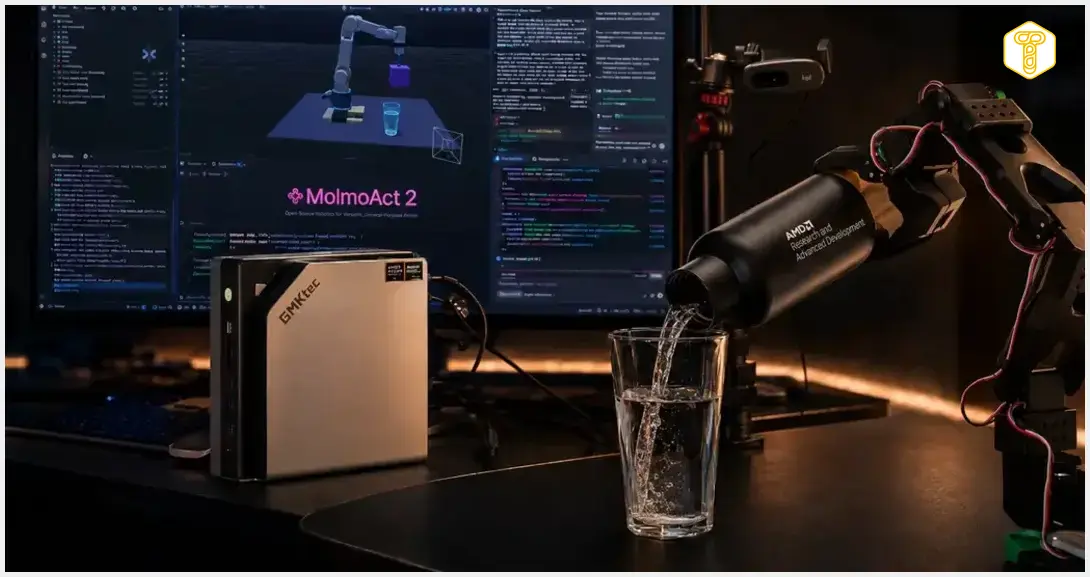
AMD showcased a test setup utilizing a MiniPC equipped with the AMD Ryzen AI Max+ 395 processor. This compact yet powerful system is designed to execute intricate AI models directly on the device. The integrated algorithms seamlessly combine advanced image analysis, natural language processing (NLP), and precise mechanical control. This local processing capability is a cornerstone for the next generation of intelligent devices, paralleling the advancements seen in modern AI-powered laptops that bring complex AI tasks to everyday computing.
Unleashing Autonomous Capabilities Without the Cloud
This innovative system empowers machines to perform a wide array of intelligent tasks:
- Object Recognition: Accurately identifying and categorizing objects within their environment.
- Natural Language Understanding: Interpreting commands given in plain, human language, allowing for intuitive interaction.
- Autonomous Movement Planning: Independently strategizing and executing sequences of movements for robotic arms or other mechanical components.
Crucially, all computational processes, including complex environmental simulations, are conducted directly on the device. This eliminates the need to transmit sensitive operational data to external cloud services, significantly enhancing data privacy and reducing potential latency. Such an architecture dramatically lowers the entry barrier for academic institutions, innovative startups, and smaller research teams, transforming a small computer into a fully capable development environment for physical AI.
The Backbone of Local AI: AMD ROCm Platform
A key enabler in this project is the open-source AMD ROCm programming platform. ROCm (Radeon Open Compute) provides the software tools necessary to efficiently optimize and run advanced vision-language models directly on AMD’s integrated graphics processing units (GPUs) and Neural Processing Units (NPUs). This platform offers developers the flexibility and power needed to harness the full potential of AMD hardware for AI applications, fostering innovation and rapid deployment of intelligent systems.
The Anatomy of an Autonomous Robot: From Brain to Brawn
An autonomous robot functions much like a sophisticated digital organism, where each integrated circuit plays a distinct and vital role in its overall intelligence and responsiveness. This modular design is critical for creating highly agile and responsive robotic systems:
- The Brain (CPU, GPU, NPU with Kria AI): These units collectively serve as the robot’s central processing hub, responsible for analyzing sensory data, making decisions, and planning complex movements. Kria AI solutions further enhance these capabilities, optimizing AI inference and machine learning tasks.
- The Spine (Versal chips): Acting as the communication backbone, AMD Versal adaptive compute acceleration platforms ensure rapid and efficient data exchange between all the robot’s components, crucial for real-time responsiveness.
- The Muscles (Zynq chips): AMD Zynq adaptive SoCs are typically responsible for controlling the precise movements of joints and grippers, translating high-level commands into physical actions.
- The Senses (Spartan units): Spartan field-programmable gate arrays (FPGAs) are often employed to receive and process signals from various sensors, providing the robot with critical information about its immediate environment.
This specialized distribution of tasks allows the machine to react seamlessly and intelligently to its surroundings, enabling truly autonomous operation.
Why Local AI Matters for the Future of Robotics
The transition to on-device AI, exemplified by the AMD Ryzen AI Max+ 395, marks a pivotal moment for robotics. It promises:

- Enhanced Efficiency: Reduced reliance on constant cloud connectivity and the associated bandwidth.
- Improved Privacy and Security: Sensitive data remains on the device, minimizing exposure risks.
- Lower Latency: Real-time decision-making is possible without network delays, crucial for dynamic environments.
- Greater Accessibility: Powerful AI development tools become available to a broader range of innovators.
As AI continues to evolve, localized processing will be fundamental to creating more intelligent, robust, and independent robotic systems that can operate effectively in diverse real-world scenarios.
Frequently Asked Questions (FAQ)
The primary advantage of local AI in robotics is the ability to process data and make decisions directly on the device, without needing constant cloud connectivity. This results in lower latency, enhanced data privacy, increased reliability in environments with poor network access, and reduced operational costs associated with cloud services.
AMD’s ROCm (Radeon Open Compute) platform is an open-source programming environment that allows developers to optimize and run complex AI models efficiently on AMD’s integrated GPUs and NPUs. It provides the necessary software tools and libraries to fully leverage the hardware capabilities for on-device AI, accelerating development and deployment.
This on-device AI approach particularly benefits academic institutions, research startups, small to medium-sized development teams, and industries requiring high data privacy or operating in remote locations. It lowers the barrier to entry for advanced robotics development by providing a complete AI environment within a compact, affordable hardware package.
The distributed architecture, where specialized chips (like CPU/GPU/NPU for brain functions, Versal for communication, Zynq for control, and Spartan for sensors) handle specific tasks, allows robots to operate more efficiently and robustly. This modularity ensures optimal performance for each function, enhances real-time responsiveness, and makes the system more resilient and easier to scale or upgrade.
Source: AMD, Original Research. Opening photo: AMD / Press Materials
About Post Author
