Contents
Pushing the Limits: Galaxy S26 Ultra’s Horizon Lock Tested to the Extreme
The recent launch of Samsung’s latest flagship smartphones, the Galaxy S26 series, has captivated tech enthusiasts worldwide. Among its many impressive features, the video stabilization, particularly the “horizon lock” function, has garnered significant viral attention. This innovative technology promises to keep your video horizon perfectly level, regardless of how you move your phone.
Understanding Horizon Lock: A Game-Changer for Mobile Videography
The Samsung Galaxy S26 Ultra’s horizon lock is truly remarkable in its execution. Imagine rotating your phone, tilting it through wide angles, or even flipping it 180 degrees – yet your video footage maintains a perfectly stable, level horizon, as if it were shot using a professional gimbal. This feature highlights the rapid evolution of smartphones into powerful content creation tools, often exceeding expectations.
Traditional optical image stabilization (OIS) and electronic image stabilization (EIS) work by counteracting minor shakes and jitters. However, horizon lock takes this a step further by actively compensating for much larger rotational movements, effectively “locking” the horizon within the frame. This capability is invaluable for dynamic shots, action sequences, or simply ensuring smooth, professional-looking videos even when handheld.
The Extreme Test: Galaxy S26 Ultra Meets the Power Drill
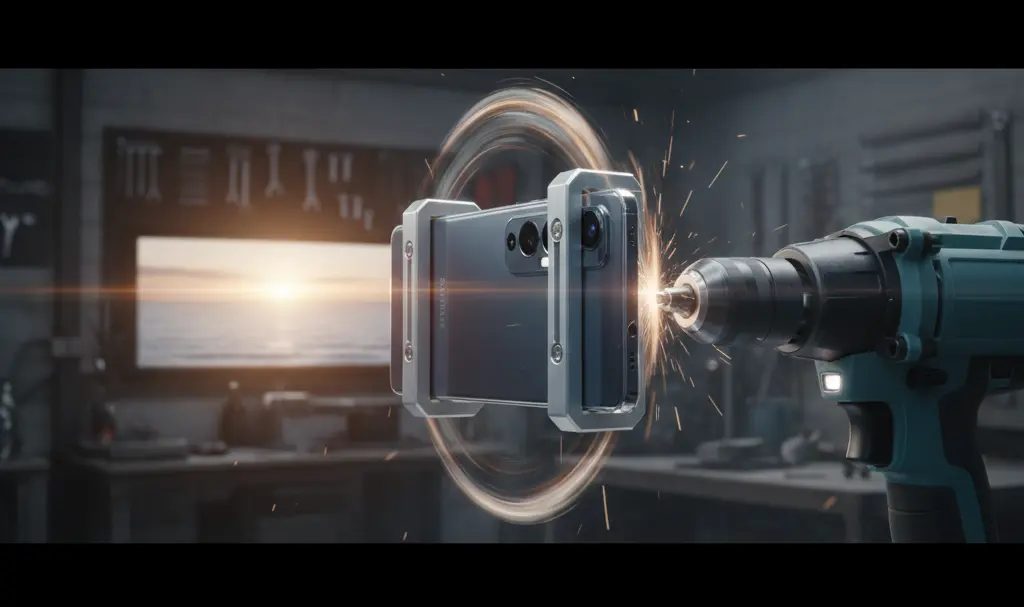
While the internet is flooded with polished demonstrations of the S26 Ultra’s stabilization, I decided to venture into a less elegant, yet more revealing, test scenario – one designed to probe the absolute limits of this technology. My plan was straightforward:
- Take the Galaxy S26 Ultra.
- Activate its horizon lock feature.
- Subject the smartphone to rapid, dynamic rotational motion using a power drill.
Does it sound absurd? Perhaps. But the goal wasn’t to simulate real-world usage. Instead, it was to understand the breaking point of this advanced stabilization system. When does it “give up”?
Why an Extreme Test Matters
It’s true that no one would typically spin their phone like a propeller to record a video. In everyday situations, movements are far less extreme – a casual walk, a run, or simple handheld shots. For these common scenarios, the S26 Ultra’s stabilization performs with effortless grace.
However, the purpose of this experiment was specific: to discover the threshold at which the stabilization system fails. Driven by pure journalistic curiosity, I aimed to observe precisely how much abuse the stabilization could endure before declaring “defeat.”
The Results: Beyond Expectations
Without giving away too many spoilers, I can confidently say that the outcomes were significantly better than I had initially anticipated. The S26 Ultra’s ability to maintain a stable horizon, even under the intense rotational forces of a power drill, was genuinely impressive and demonstrated a robustness that truly pushes the boundaries of smartphone video technology.
Frequently Asked Questions (FAQ)
What is “Horizon Lock” in smartphone cameras?
Horizon Lock is an advanced video stabilization feature that keeps the recorded horizon perfectly level, even when the phone is significantly tilted, rotated, or moved. It compensates for large angular changes, making footage appear as if it was shot with a professional stabilizing gimbal.
How does smartphone video stabilization generally work?
Smartphone video stabilization typically combines Optical Image Stabilization (OIS), where physical lens elements move to counteract shake, and Electronic Image Stabilization (EIS), which uses software analysis of video frames to correct for movement. Horizon Lock is an enhancement of these technologies, utilizing more sophisticated sensors and algorithms to handle extreme rotational movements.
Is the “power drill test” practical for everyday users?
No, the power drill test is not practical for everyday use. It’s an extreme, unconventional method designed solely to push the technological limits of the phone’s stabilization system and understand its capabilities under severe stress, rather than simulating typical user scenarios.
What makes the Galaxy S26 Ultra’s stabilization stand out?
The Galaxy S26 Ultra’s stabilization, particularly its horizon lock, stands out due to its ability to handle drastic phone movements—including complete 180-degree rotations—while maintaining a perfectly level horizon. This level of performance approaches that of dedicated camera gimbals, offering exceptional smoothness for mobile content creators.
Source: Self-developed content. Opening photo: Gemini
About Post Author