

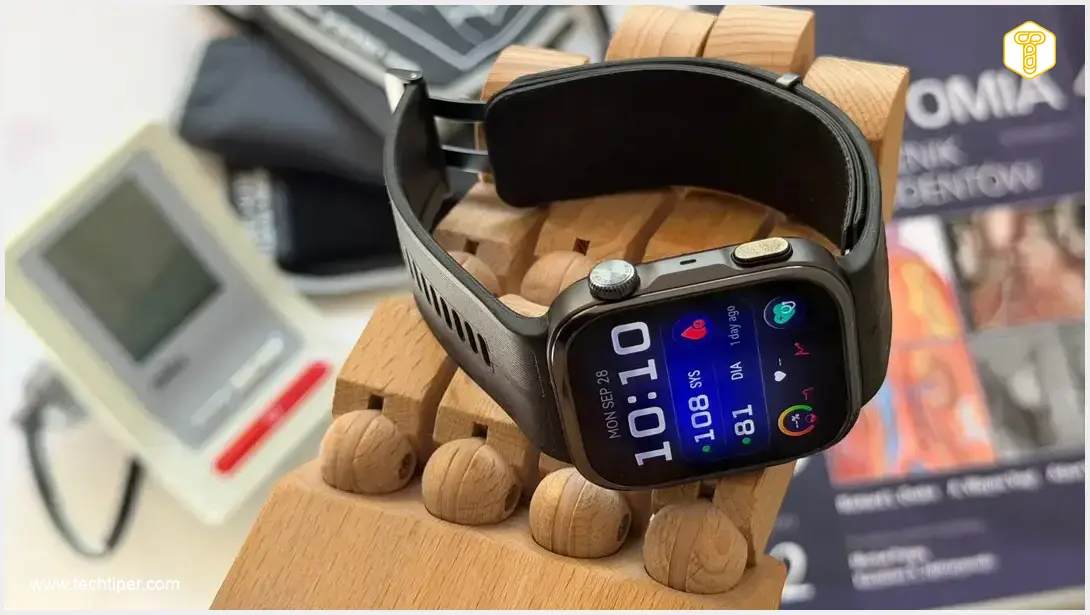
HUAWEI WATCH D3 Review
-
24-Hour Blood Pressure Monitoring
-
Comfort & Design
-
Ease of Use
-
Other Health Features
-
Battery Life (Regular Use)
-
Value for Money
HUAWEI WATCH D3: Advanced 24-Hour Blood Pressure Monitoring & Smart Health Companion
The HUAWEI WATCH D3 delivers a groundbreaking approach to cardiovascular health with certified 24-hour ambulatory blood pressure monitoring, seamlessly integrated into a comfortable and discreet smartwatch design. Its comprehensive data, combined with additional health features like ECG, makes it an invaluable tool for proactive health management, though it does not replace professional medical advice.
Advantages
- Certified 24-hour Ambulatory Blood Pressure Monitoring (ABPM), including during sleep.
- Provides accurate and detailed blood pressure insights over a full day.
- Discreet and comfortable design, even during automatic measurements and sleep.
- Seamless integration with the HUAWEI Health app for data analysis.
- Includes additional valuable health features such as ECG and on-demand blood pressure measurements.
- Good battery life (up to 6 days) in regular smartwatch mode.
- Positioned at a competitive price point, offering good value.
Disadvantages
- Cannot replace professional medical diagnosis, treatment, or advice.
- Requires correct strap size selection for optimal performance.
- User needs to remain still during measurements for accuracy.
- Continuous 24-hour ABPM consumes more battery than typical daily use.
Contents
HUAWEI WATCH D3: Revolutionizing 24-Hour Blood Pressure Monitoring
High blood pressure, or hypertension, is a widespread health concern, often affecting a significant portion of the adult population globally. What makes it particularly dangerous is its often asymptomatic nature, meaning many individuals are unaware they have it until it leads to more severe complications. Regular blood pressure monitoring is crucial for early detection and management, yet traditional, stationary measurements can be inconvenient and difficult to incorporate into daily life. This article explores the HUAWEI WATCH D3, a cutting-edge smartwatch offering certified 24-hour ambulatory blood pressure monitoring (ABPM), including during sleep. I spent a full day testing this innovative device to understand its real-world performance and what insights it can provide into one’s health.
Disclaimer: This is a medical device. Use it according to the instructions for use or label.
The Silent Threat: Why Heart Conditions Often Go Unnoticed
Heart diseases, especially high blood pressure, frequently exhibit no noticeable symptoms for extended periods. This silent progression makes conditions like hypertension particularly insidious. For instance, statistics from various health organizations show that millions of adults worldwide live with undiagnosed or poorly managed high blood pressure. Many are unaware because elevated blood pressure typically doesn’t cause pain or clear symptoms. This underscores the critical importance of proactive monitoring rather than waiting for the body to signal a problem.
The Limitations of Single Blood Pressure Readings
Blood pressure is not a static value; it fluctuates throughout the day based on various factors. It tends to rise with stress, after consuming caffeine, during physical exertion, and typically decreases at night during sleep. A single measurement, therefore, captures only a snapshot in time, which might not be representative of a person’s overall blood pressure profile.
- “White Coat Syndrome”: For some individuals, the act of visiting a doctor can elevate blood pressure readings, even if their home readings are normal. This phenomenon is known as “white coat hypertension.”
- “Masked Hypertension”: Conversely, some people may have normal readings in a clinical setting but elevated blood pressure at home or during 24-hour monitoring. This is referred to as “masked hypertension” and carries similar risks to sustained hypertension.
These scenarios highlight why relying solely on a few measurements per year or opportunistic checks during other medical appointments is insufficient. A more comprehensive approach is often needed to accurately assess cardiovascular health.
What is Ambulatory Blood Pressure Monitoring (ABPM)?
Ambulatory Blood Pressure Monitoring (ABPM), often referred to as a “blood pressure holter,” involves a series of automatic blood pressure measurements taken over a 24-hour period. These measurements are performed while the individual goes about their normal daily activities and also during sleep. Medical guidelines typically recommend measurements every 15-30 minutes. For the results to be reliable, at least 70% of the readings must be successful, including a minimum of 20 readings during the day and 7 during the night. The data collected provides a comprehensive picture, allowing healthcare professionals to evaluate how blood pressure behaves in a patient’s real-life environment.
It’s important to remember that while advanced, the HUAWEI WATCH D3 cannot replace a doctor’s visit or prescribed medical tests. However, it empowers users to perform 24-hour blood pressure monitoring conveniently without disrupting their daily routines. It’s worn like a regular watch, yet discreetly integrates a small air cuff within its strap. This cuff inflates mechanically during each measurement, providing accurate readings.

The blood pressure measurement function of the HUAWEI WATCH D3 is certified as a medical device (CE 0197 marking), indicating its adherence to European health, safety, and environmental protection standards. The watch provides systolic and diastolic blood pressure readings, along with heart rate, all of which are seamlessly transmitted to the HUAWEI Health app on a smartphone.
My 24-Hour Experience with the HUAWEI WATCH D3
To conduct ABPM with the HUAWEI WATCH D3, the first step is to select the correct strap size (M or L) based on wrist circumference. Fully charging the battery before starting the test is also advisable, as continuous 24-hour monitoring consumes more power than typical daily use. Once prepared, the 24-hour monitoring mode is easily activated through the watch’s menu.
With the 24-hour mode activated, the watch autonomously managed the measurement schedule, allowing me to carry on with my day. Each measurement followed a consistent pattern: the cuff in the strap would inflate, creating a noticeable but not uncomfortable pressure on my wrist, and after a few dozen seconds, the air would release. For accurate readings, it’s recommended to pause and keep the arm still during the measurement. Despite automatic readings occurring in various settings – in a store, on public transport, or during a walk – the HUAWEI WATCH D3 operates discreetly enough that those around me were unaware I was undergoing ABPM directly from my wrist. This subtle operation is a significant advantage for real-world usability.
One of my primary curiosities was how sleeping would be affected by a watch that inflates periodically for measurements. Surprisingly, this presented no issue whatsoever. The nocturnal measurements did not wake me, and the watch proved unobtrusive during sleep. This improved comfort is partly due to the WATCH D3’s streamlined and optimized design compared to its predecessors. For those interested in optimizing their daily health monitoring routines, devices like the Huawei Band 10 offer excellent complementary features for activity tracking and general wellness.
Insights from My Blood Pressure Report
After 24 hours, the HUAWEI Health app presented a comprehensive summary of my all-day blood pressure monitoring. Instead of a single number, I received a detailed overview of my blood pressure fluctuations, revealing how my readings changed in response to my activities throughout the day. The application also calculated average readings. My daytime average was 120/82 mmHg, while my nighttime average was 102/67 mmHg. It’s crucial to reiterate that interpreting these results is the role of a healthcare professional, not self-diagnosis.
Out of personal interest, I researched what specialists look for in such reports. One key aspect is the extent to which blood pressure drops at night compared to daytime readings. According to medical resources, a typical nocturnal drop should be between 10-20%. My results showed a drop of 15-18%, falling within this healthy range. Furthermore, based on the guidelines from the European Society of Cardiology, both my average readings fell into the “elevated blood pressure” category, primarily due to the diastolic pressure. This type of detailed data provides a much more nuanced understanding of cardiovascular health than occasional spot checks. For comprehensive health management, integrating various health monitoring tools can be highly beneficial, and products like the Huawei Band 10 can serve as excellent companions for activity and sleep tracking.
The most significant takeaway for me was that this report is far more than just an interesting novelty to glance at over coffee. It provides a rich dataset that can offer profound insights into one’s body. The manufacturer explicitly states that this information is for informational purposes only and should not be used as a basis for diagnosis or treatment, emphasizing the need for professional medical consultation.
Beyond ABPM: Other Features of the HUAWEI WATCH D3
While 24-hour ABPM is the HUAWEI WATCH D3’s standout feature, it also functions as a versatile everyday smartwatch. In regular mode, blood pressure measurements can be taken on demand, wherever you are – before leaving home in the morning, at work, or while traveling. Without continuous 24-hour monitoring, the watch’s battery can last up to 6 days on a single charge.
Cardiovascular health involves more than just blood pressure. The HUAWEI WATCH D3 also includes an ECG (electrocardiogram) electrode on its side. By simply holding a finger on it for 30 seconds, the watch performs a single-channel ECG recording and generates a report. This can highlight readings that deviate from general norms, prompting users to seek medical advice if necessary. Active individuals will also appreciate the ability to measure blood pressure before and after workouts, as the watch can provide guidance on whether to moderate their physical exertion for the day.
The HUAWEI WATCH D3 effectively supports regular blood pressure monitoring, all while maintaining the elegant appearance of a sophisticated smartwatch rather than a bulky medical device. It is positioned at a competitive price point, often with promotional offers available for a limited period. Is it a worthwhile investment? Absolutely, especially if conscious health management and cardiovascular disease prevention are your priorities.
Disclaimer: This is a medical device. Use it according to the instructions for use or label.
Frequently Asked Questions (FAQ)
ABPM involves taking automatic blood pressure measurements over a 24-hour period, both during daily activities and sleep. It’s crucial because blood pressure fluctuates throughout the day, and single readings can be misleading. ABPM provides a comprehensive picture of your blood pressure profile, helping doctors diagnose conditions like “white coat syndrome” or “masked hypertension” more accurately than traditional office visits.
The HUAWEI WATCH D3 integrates a small air cuff within its strap. During a measurement, this cuff inflates mechanically, similar to a traditional blood pressure monitor, to provide accurate systolic and diastolic readings, along with heart rate. These readings are then sent to the HUAWEI Health app.
No, the HUAWEI WATCH D3 is a medical device designed to assist with monitoring and providing informational data. It cannot replace professional medical diagnosis, treatment, or the advice of a qualified healthcare provider. Always consult your doctor for any health concerns or before making medical decisions.
Beyond its certified 24-hour ABPM, the HUAWEI WATCH D3 includes an ECG function for single-channel electrocardiogram recordings. It also supports on-demand blood pressure measurements, heart rate tracking, and can provide insights for managing physical exertion before and after workouts.
Yes, the HUAWEI WATCH D3 is designed for comfortable daily wear. Its discreet operation, even during automatic ABPM measurements, ensures it doesn’t draw undue attention. The optimized design also allows for comfortable wear during sleep, with nocturnal measurements being unobtrusive.
Source: Author’s own research, HUAWEI. Opening photo: Jolanta Szczepaniak
About Post Author
