

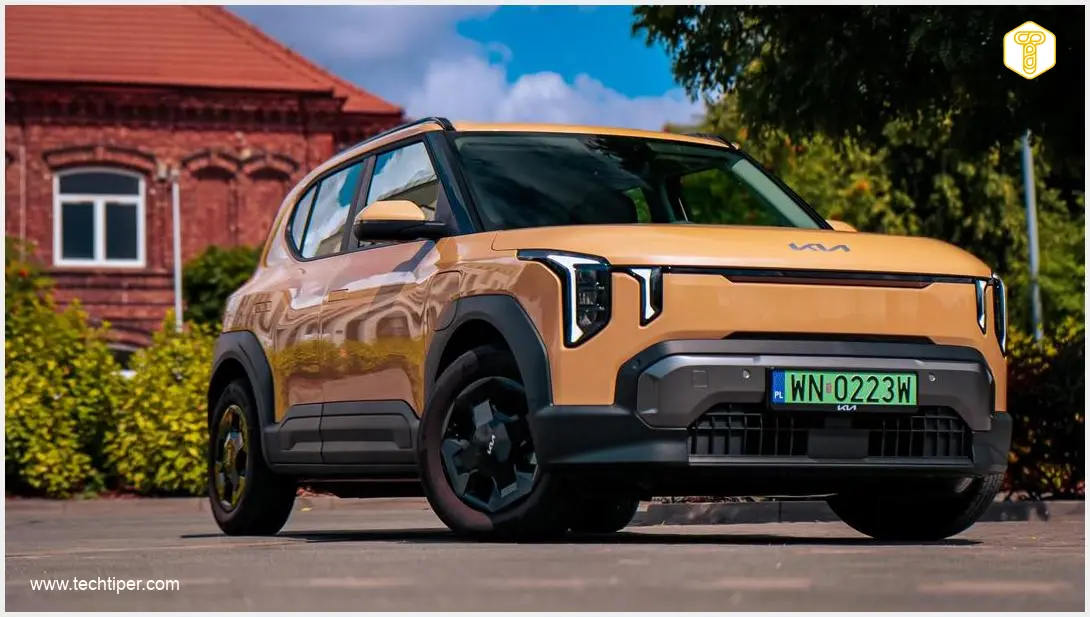
Kia EV2 Review
-
Practicality & Interior Space
-
Technology & Infotainment
-
Driving Dynamics & Comfort
-
Energy Consumption & Range
-
Charging Capabilities
-
Value for Money
Kia EV2: A Smart and Practical Electric City Car
The Kia EV2 delivers a compelling package of modern technology, practicality, and comfort at a reasonable price. While its highway range isn’t exceptional and some features require careful selection or subscriptions, its impressive charging capabilities, intuitive infotainment, and comfortable ride make it a smart choice for an electric city car and beyond.
Advantages
- Competitive pricing with advanced technology.
- Highly practical and spacious interior for its class.
- Comfortable ride and excellent urban maneuverability.
- Advanced, user-friendly infotainment with physical controls.
- Strong charging capabilities, including optional 22 kW AC and V2L.
- Impressive city energy efficiency and comprehensive ADAS.
Disadvantages
- Highway range limited by battery size.
- Traffic sign recognition system is error-prone.
- Some desirable features and multimedia functions require extra cost or subscriptions.
- Interior uses hard plastics, and some details show cost-saving measures.
- Steering precision can be less engaging at higher speeds.
- Manual door handles and tailgate on most trims.
Contents
Kia EV2 Review: A Practical and Modern Electric City Car
We begin our review of the Kia EV2, the smallest electric car from the Korean automaker, which can confidently be described as a fully-fledged vehicle. This isn’t always a given when considering other brands (e.g., the Dacia Spring), where compromises are often apparent at every turn. In the case of the EV2, a reasonable price point is paired with cutting-edge technology, making it a compelling option in the electric vehicle market.
However, Kia isn’t a miracle worker, and some cost-saving measures are inevitable. Yet, these are largely understandable given the vehicle’s positioning. We can reveal that the EV2 offers a substantial and reliable package, suitable for more than just trips to the grocery store. The key lies in thoroughly exploring the configurator to find the right setup. Let’s delve into the advantages and potential drawbacks of the Kia EV2.
Pricing and Trim Levels of the Kia EV2
The Kia EV2 is positioned as the brand’s most affordable electric model, though Kia has hinted at a future EV1. Currently, the EV2 starts from approximately 25,000 USD (based on a starting price of 99,900 Polish Zloty). While this entry-level variant offers significant value, many buyers will likely opt for higher trims. Here’s a breakdown of the full pricing structure at the time of this review, covering two powertrain options and four trim levels:
- 42.2 kWh (146 horsepower):
- Light: Approximately 25,000 USD (99,900 PLN)
- Air: Approximately 28,700 USD (114,900 PLN)
- Earth: Approximately 30,600 USD (122,400 PLN)
- 61 kWh (135 horsepower):
- Light: Scheduled for release in the second half of 2026
- Air: Approximately 33,700 USD (134,900 PLN)
- Earth: Approximately 35,600 USD (142,400 PLN)
- GT Line: Approximately 39,200 USD (156,900 PLN)
These prices include an automatic discount of approximately 4,000 USD (16,300 PLN). It’s notable that the larger battery variant comes with a slightly less powerful motor, which could further influence the potential range. The specific features of each trim level vary considerably.
Warranty Coverage
The EV2 maintains Kia’s excellent standard warranty: 7 years or 93,000 miles (150,000 kilometers). The paintwork is covered for 5 years (also 93,000 miles), while anti-perforation warranty lasts for 12 years. Crucially, the traction battery comes with a separate warranty of 8 years or 99,000 miles (160,000 kilometers).
Insurance Costs
For a driver with several years of experience, the basic third-party liability (OC) insurance for the EV2 could be around 137 USD (550 PLN). A comprehensive package including collision (AC) might cost approximately 750 USD (3,000 PLN).
Our Test Model Configuration
The EV2 tested for this review was a reasonably configured model, not the absolute top-of-the-line. It featured the Earth trim level with the smaller 42.2 kWh battery, starting at approximately 30,600 USD (122,400 PLN). Additional options included:

- Vanilla Blossom paint: Approximately 700 USD (2,800 PLN)
- Heat pump: Approximately 1,000 USD (4,000 PLN)
This brought the final price to approximately 32,300 USD (129,200 PLN), which remains a sensible price for a 4-meter (13.1-foot) electric vehicle. However, it’s important to note that even at this price, not all of Kia’s available technologies for the EV2 were included.
Technical Specifications: Understanding the Kia EV2
When selecting your Kia EV2, you’ll face a choice: either an extra 62 miles (100 km) of range or shave 1 second off the 0-62 mph (0-100 km/h) acceleration. The manufacturer’s data suggests that heavier steel wheels might lead to faster acceleration, which could be correlated with richer equipment levels and higher overall vehicle mass.
The EV2’s technical parameters are generally well-balanced. The tested vehicle never felt lacking in any significant way. It’s not a sports car, but it certainly won’t be an obstacle on the road. Most parameters are perfectly adequate for a relatively small electric car.
Dimensions and Practicality
The EV2’s dimensions are also very practical. It’s a roughly 4-meter (13.1-foot) long car designed from the ground up as an EV, and this is evident in every aspect of its space utilization. Despite a seemingly small number of engine versions and trim lines, the EV2 can differ significantly in terms of practicality.
For instance, you can opt for a 4-seater variant, which provides a more spacious trunk. Even wheel size plays a potentially noticeable role, affecting turning radius and acceleration. Therefore, it’s crucial to verify what each specific package, or lack thereof, entails.
The Genesis of the Kia EV2
At the time of this review, the EV2 is one of Kia’s newest electric vehicles, having been unveiled alongside the EV4 and PV5 in 2025, with production starting in early 2026. As mentioned, it is the smallest model in the brand’s portfolio, serving as a counterpart to the Hyundai Inster but positioned a segment higher.
While a compact vehicle, its styling clearly echoes the larger Kia EV9. Kia also spared no expense on technology, and the EV2 incorporates solutions found in much more expensive models. However, the extent of these features ultimately depends on how much you add in the configurator.
The EV2 is built on Hyundai’s E-GMP platform but utilizes a 400V architecture, a common choice for vehicles of this size. Nevertheless, features like 22 kW AC charging highlight Kia’s modern approach to EVs. Many competitors overlook this aspect, and such technological advancements across various domains can be a significant differentiator.
Competitive Landscape
The Kia EV2 enters the B-segment as an electric crossover, a market already well-populated by rivals. Competitors include the Renault 4 E-Tech/5 E-Tech, Fiat 600e, VW ID. Polo, MINI Aceman, BYD Dolphin Surf, or the MG4. Each of these stands out with its own unique styling, meaning personal taste plays a significant role in the purchasing decision, alongside pricing. (For more on competitors, check out our review of MG Electric Cars and the MG4.)
Infotainment System: Unrestricted Connectivity in the EV2
One area where Kia demonstrably made no compromises with the EV2 is its operating system. It features the same software found in much more expensive models, and it hasn’t been stripped down. This brings both positive innovations (more multimedia and secondary apps) and some negatives (subscriptions).
The overall ergonomics and abundance of physical switches, a rarity among competitors, remain unchanged. All of this is underpinned by excellent performance. Unfortunately, we couldn’t test all functions, as the reviewed EV2 unit lacked internet connectivity. However, based on our experience with other Kia models (e.g., the Kia K4), we know that most of these features are noteworthy.
Regardless of the trim level, the EV2’s interior features three displays. Two 12.3-inch screens serve as the central display and digital instrument cluster. A smaller, 5.3-inch touchscreen, nestled between the larger ones, is dedicated to quick climate control settings.
Central Display Features
Kia encourages users to log into their Connect driver account, though it’s not strictly necessary to appreciate the EV2’s software. However, without it, you lose access to some multimedia functions. Logging in is beneficial for managing the car via a smartphone and activating features like pet care mode (remote climate control).
The EV2’s system interface relies on draggable desktops with shortcuts, some of which also function as widgets. These can be customized to your preferences, and their accent colors can be linked to driving modes. A separate quick-settings bar is always accessible at the top, and a side panel enriches the experience. This panel is available in most applications and can display additional information such as navigation, weather, or energy consumption.
Kia has long opted not to include a built-in owner’s manual, instead providing a QR code for access to the latest documentation, which is convenient in its own way. The voice assistant, while basic, responds to simple commands.
Climate control in the EV2 is managed via a dedicated touchscreen panel and physical switches, though options can also be displayed on the central screen. It offers trip planning with specific interior temperatures and windshield defrosting. Settings also include toggles for automating features like heated seats or recirculation.
Among other interesting features, alongside standard options for central locking, windows, and lights, there’s a transport mode. Its purpose is to limit the operation of assistance systems when carrying cargo, preventing them from being overly sensitive. We appreciate the array of customizable shortcut keys that can be assigned various tasks.
The EV2 can connect to the internet and even provide a Wi-Fi hotspot. However, Kia doesn’t allow the car to use external networks independently, and with the unavailable subscription in our test model, we couldn’t fully test all multimedia features. There’s a surprising number, including games and even YouTube, but these require an active subscription.
Kia offers three audio system configurations for the EV2. The entry-level Light model has four speakers, the mid-range Air has six, and the top-tier Earth and GT-Line models feature eight speakers with Harman Kardon branding. Our test model included the latter.
While one shouldn’t expect audiophile quality from affordable cars, we were generally satisfied with the sound during music and podcast playback. The frequency bands are clear, accurately reproduced, and bass notes don’t cause interior trim resonance.
Navigation, Android Auto, and Apple CarPlay
The built-in navigation system is available in all EV2 versions except the base Light model. The system is user-friendly and effective, offering additional customization options. Map usage and route planning are seamless, with Google providing support for point-of-interest searches.
Naturally, Kia has integrated charging station information (with near real-time updates), route planning that accounts for charging stops, and automatic battery preconditioning for optimal charging. The system also offers speed camera warnings, but due to internet connectivity issues, we couldn’t verify their accuracy. (For enhanced EV route planning, consider Android Auto EV Route Planning with Google Maps.)
Wireless Android Auto and Apple CarPlay are available in every EV2. Both platforms operate flawlessly and integrate with the digital instrument cluster for navigation prompts.
Digital Instrument Cluster
Kia’s electric models, including the EV2, feature digital instrument clusters that prioritize modern design over traditional dials. They focus primarily on numerical readouts, though temperature gauges are present. The display is highly legible and allows for basic personalization.
Three themes are available, which can be permanently linked to selected driving modes or set to a single preferred theme. Differences primarily involve the layout of the gauges and the dominant color scheme. After each EV2 shutdown, a convenient trip summary is displayed, including information on planned charging or parking climate control.
Between the main readouts, various forms of the trip computer, navigation data, or assistance system information can be displayed. Contextual additions appear in the right-hand section, showing settings for lights, wipers, or parking sensor views.
With richer equipment, the digital instrument cluster can offer even more. Combined with the 360-degree camera system, you get a view from the side cameras when activating the turn signal.
Kia EV2 Interior: Surprising Comfort and Practicality
Considering the EV2 is Kia’s most affordable EV, one shouldn’t expect a lavish interior finish. However, the design itself is certainly appealing and includes several thoughtful touches. Most importantly, the interior is highly practical and designed for convenient everyday use.
While hard plastics dominate, the materials used are pleasant to the touch. Unfortunately, some areas already showed signs of scratching from previous use. Yet, Kia has managed to incorporate fabric inserts in places, adding charm. We also have no complaints about the fit and finish.
Keyless Entry and Door Handles
The EV2 features a simple keyless entry system. As you approach the car, the mirrors unfold, recognizing your presence. However, you still need to press the visible indentations on the front door handles to unlock the central locking. The same applies to locking the car.
The tailgate, though not power-operated, can also be opened without first unlocking the central locking. In the highest trim levels, a digital key option is available, allowing you to use your smartphone as a key.
First Row Experience
Before entering the EV2, you’ll need to get accustomed to the door handles. Only the highest trim levels (Business Line package or GT-Line version) feature automatically retracting and extending handles. The tested model required pressing them in first, then grasping – something that simply takes getting used to. Entry and exit are otherwise straightforward, thanks to the raised body and door sills that are almost fully covered by the doors themselves.
The door panel is mostly plastic but includes fabric inserts that extend from the dashboard. The armrest gives slightly under pressure. Thoughtful details like “have a nice day” greetings on the door handle add to its charm. From a practical standpoint, we have no complaints; Kia has designed the EV2’s storage, such as the door pockets, to accommodate even tall bottles.
An interesting equipment note is that in the entry-level trims, only the driver’s window has automatic one-touch operation. All windows are electric, but only from the Earth trim upwards does the passenger window also feature automatic operation.
Seats
Depending on the trim, the Kia EV2’s seats can be enhanced with electric adjustment (for the driver, including lumbar support). However, our test model featured manually adjustable seats, which were still comfortable. They provide sufficient lateral support and are firm enough to prevent fatigue on longer journeys. We particularly appreciate the headrests, which offer two-way adjustment in all versions, except the GT-Line.
Only the highest trim offers ventilation. Our Earth trim test model included 3-stage heating and height adjustment for the passenger seat, which isn’t standard in cheaper models.
Steering Wheel
The main interface for the driver in the tested EV2 is a familiar and well-regarded Kia standard. The leather-wrapped and heated steering wheel (2-stage, from Earth trim) feels good in hand, although it partially obscures the additional climate control screen. The two-way adjustment range is ample.
The controls are very convenient, relying on physical buttons and switches. The left side manages the digital instrument cluster and cruise control, while the right controls multimedia. A separate button selects driving modes.
Paddles behind the steering wheel are used to adjust the regenerative braking system. Single clicks adjust braking force, while holding the left paddle activates i-Pedal (one-pedal driving), and holding the right paddle activates automatic regeneration. We’ll discuss both implementations further in the driving experience section.
Independently, behind the steering wheel, there’s also a gear selector stalk, on which Kia has placed an additional button for starting and stopping the car. This is another example of a convenient, space-saving solution on the dashboard. Similarly, the parking brake button is located near the driver’s left knee.
Dashboard: Ergonomics Throughout
The tested Kia EV2 is another model from the manufacturer that reintroduces physical switches, significantly enhancing practicality. The dashboard is relatively simple and very easy to use, complemented by good build quality. Harder plastics are softened by fabric inserts, adding to its appeal. The overall fit and finish are impressive.
Immediately noticeable is the trio of displays integrated into a single panel. The additional panel for climate control might not be the most convenient while driving, but fortunately, it doesn’t have to be used exclusively. It can serve as a constantly visible overview of current settings.
Below the central screen, there’s a row of physical buttons for multimedia control. Further down, beneath the air vents and volume knob, are convenient switches for the climate control (dual-zone from Air trim). These allow adjustment of temperature, airflow direction, and operating mode.
Moving lower, we find three quick USB-C ports. The EV2 is exceptionally generous with USB-C ports throughout the car. There’s also a 12V socket neatly integrated with a convenient cover. For additional power, there’s an inductive charger, which is rubberized and slightly raised, keeping smartphones securely in place.
Between the front seats, there’s a single, fixed cupholder. Further back, you can create an additional cupholder or completely remove the movable partition (with three mounting positions) to create a reasonably sized storage compartment for small items.
Next to the raised and comfortable, though non-adjustable, armrest are buttons to activate the camera or Auto Hold function. There’s also a slot that comfortably holds a smartphone. Lifting the armrest reveals two compartments that can also hold a fair amount of smaller and larger items.
A glove compartment is present in front of the passenger, offering decent space. Near the headliner, there’s a panel for controlling the lighting and an auto-dimming rearview mirror. Interestingly, Kia has hidden a camera with sensors inside the mirror housing, which monitors driver attention levels. Rear visibility is acceptable. We appreciate that the sun visors are extendable, allowing full coverage of the side windows.
Second Row: Not Just for Kids
The rear doors provide convenient access to the second row, though you’ll still need to get used to the door handles. Once inside, you’ll find the door panels primarily feature harder plastics, though they remain pleasant to the touch. The design allows even a larger bottle to fit in the storage compartment, which isn’t huge itself.
One of the cost-saving measures Kia implemented in the second row is the absence of automatic one-touch windows. You have to hold the switch to fully open or close them.
Sitting in the back, you’ll discover that the Kia EV2 isn’t as small as it seems, and taller individuals (up to approximately 6 feet 3 inches or 1.9 meters) can comfortably travel, albeit snugly. Nevertheless, let’s not pretend it’s a true 5-seater; for this reason, the 4-seater homologation option is very appealing, especially concerning trunk space.
In the second row, the front seatbacks play a crucial role, as they are contoured to serve as coat hangers or simply facilitate entry and exit. Additionally, you’ll find more USB-C ports on their sides.
Regarding other amenities, Kia included central climate control vents, though the ISOFIX anchor points lack covers. You won’t find a rear armrest or cupholders. Interestingly, a seatback pocket is only present on the passenger side.
Lighting: Simply Adequate
The number of light sources in the EV2 also depends on your chosen configuration. The base Earth variant (without the Business Line package) offers minimal lighting solutions. Opting for additional packages introduces welcome lights, logo projection from the mirrors, and expanded ambient lighting.
Our test model didn’t feature many external lighting effects. However, the illuminated charging port is a nice touch. Inside, both rows are equipped with adequately bright, basic cool-white LED dome lights.
A panoramic roof is an option exclusively available in the highest GT-Line trim.
EV2 Storage: A Manifestation of Practicality
The tested Kia EV2, like many electric vehicles, offers two storage compartments, though there are specific details to note. The capacity of the main trunk varies significantly depending on whether you choose the 5-seater or the optional 4-seater version.
Focusing on the main trunk, there’s no power-operated tailgate, but it’s relatively lightweight, and the manufacturer has included a convenient handle for closing. The loading opening is wide, typical for a hatchback, and the sill is at a comfortable height.
Our reviewed vehicle’s trunk offers 362 liters (12.8 cubic feet) of space for bags, suitcases, or groceries. This is a respectable figure. Removing the parcel shelf allows for additional cargo above its line. The maximum capacity is 1,201 liters (42.4 cubic feet) when the rear seatbacks are folded down (60:40 split, without a ski pass-through).
If you opt for the 4-seater version, you immediately gain a sliding rear bench, which means the basic trunk capacity ranges from 321 to 403 liters (11.3 to 14.2 cubic feet), while the maximum capacity remains unchanged. This is a very practical solution, allowing seamless adjustment of space for passengers, which, as you know, is quite good even in the 5-seater EV2.
In our test model, the trunk offers amenities such as cargo net hooks and a false floor, beneath which smaller items can be stored around the Harman Kardon subwoofer. Another clever feature is the removable side hooks that double as hangers. The only missing element for complete convenience is a 12V socket.
The EV2’s secondary storage compartment, the “frunk” (front trunk) located under the hood, has a capacity of 15 liters (0.5 cubic feet). However, it’s not available in the Air and Light versions. This space is ideal for less frequently used mandatory equipment, primarily charging cables. Another option for carrying luggage is a tow hitch, which can be added to all versions except Light. It allows towing a trailer weighing up to 750 kg (1,650 lbs).
Driving Impressions: More Than Just a City Car
While small cars are typically associated with urban driving, the EV2 isn’t so compact that it’s confined solely to the city jungle. It excels at maneuvering in parking lots but handles longer journeys at higher speeds without issue. Its characteristic ride is distinctly comfortable, almost sedan-like in its plushness. Let’s get into the specifics.
The first thing you’ll notice after driving the Kia EV2 for a few miles is its very light steering. This is excellent for maneuvering, and it contributes to an outstanding turning circle, which depends on wheel size (16-inch: approximately 32.8 feet / 10 meters; 18- and 19-inch: approximately 33.8 feet / 10.3 meters). It’s not a progressive steering system, so precision suffers slightly at higher speeds, but for relaxed driving, no one should complain.
The suspension also prioritizes comfort. The damping system handles both small and large potholes with ease, effectively minimizing impacts within the cabin. It’s worth noting that the Kia EV2 isn’t excessively heavy for an electric car (around 1,600 kilograms / 3,500 pounds), and the 16-inch wheels with taller tires also absorb a significant amount of impact.
Naturally, taking corners faster will result in some body roll, but it remains within reasonable limits. The battery cells are mounted low, contributing to stability. Despite the EV2 being marketed as a crossover, its ground clearance is sufficient for tackling larger obstacles, including curbs.
Driving Dynamics of the Kia EV2
The tested Kia EV2 is certainly not a sports car, but its electric powertrain ensures more than acceptable dynamics. The front wheels propel the vehicle, and the motor on this axle can generate either 146 or 135 horsepower, depending on whether you choose the smaller or larger battery, respectively. The torque remains the same at 250 Nm (184 lb-ft) in both cases.
Our test model was the more powerful EV2, which officially accelerates from 0-62 mph (0-100 km/h) in 8.5 seconds (steel wheels) or 8.7 seconds (alloy wheels). In practice, we consistently achieved 8.3 seconds during our measurements, indicating Kia provides conservative figures.
Kia has equipped the EV2 with four driving modes: Eco, Normal, Sport, and Snow, designed for slippery surfaces. In Snow mode, torque delivery is significantly softened to reduce wheel slip on the driven axle.
For the standard modes, the biggest difference is, as always, throttle response. Steering and suspension behavior remain unchanged. We primarily used Eco mode, which provided ample driving dynamics while significantly lowering energy consumption.
The tested Kia EV2 performs exceptionally well in urban driving, where its lightness and comfort are most appreciated. Combined with the dynamics of the electric powertrain, it allows for efficient movement. Parking, traffic jams, and narrow streets are easily navigated, and when needed, it can pick up speed to get the kids from school or run errands.
We were also positively surprised that the EV2 handles longer trips on highways without any perceived issues. Motorways and expressways pose no challenge, though it’s worth noting that Kia has limited the top speed to approximately 102 mph (165 km/h). Regardless of conditions, overtaking is not a concern. Moreover, maintaining a steady speed is accompanied by commendable cabin quietness.
Kia deserves significant praise for its comprehensive approach to the regenerative braking system, which noticeably impacts electricity consumption. Three power levels can be selected using the paddles. Holding the left paddle activates i-Pedal (one-pedal driving), minimizing the need to use the brake pedal. The EV2 can even come to a complete stop using this feature.
It’s easy to adapt to this driving style, which is by far the most efficient. The right paddle activates automatic mode, where radars and navigation data suggest how strongly regeneration should operate, depending on traffic ahead or approaching intersections/sharp turns.
Energy Consumption, Range, and Charging: EV2’s Strengths
The tested Kia EV2 houses a battery with a net capacity of 41 kWh (42.2 kWh gross) under its floor. While not a huge capacity, as you’ll soon see, it performs admirably. It’s a shame that Kia charges extra for the heat pump, which was present in our review unit. The following measurements were taken at an ambient temperature of approximately 59 degrees Fahrenheit (15 degrees Celsius).
Real-World Energy Consumption and Range
In the city, the EV2 performs exceptionally well. Our initial drives showed that the Kia has low power demands. After familiarizing ourselves with the car’s characteristics and learning to effectively utilize regeneration, we easily achieved energy consumption figures of 10.5 kWh/100 km (approximately 5.9 miles/kWh), translating to a range of about 242 miles (390 km). The lowest result we achieved was 9.5 kWh/100 km, and the highest was 17 kWh/100 km.
Outside the city, you can still expect pleasing readings from the trip computer. At a steady speed of approximately 50 mph (80 km/h), the Kia consumes around 13 kWh/100 km (approximately 4.8 miles/kWh), providing a range of about 192 miles (310 km). On highways, the EV2’s energy demands are as follows:
- 62 mph (100 km/h): 14.2 kWh/100 km (range: ~174 miles / 280 km)
- 75 mph (120 km/h): 16.7 kWh/100 km (range: ~149 miles / 240 km)
- 81 mph (130 km/h): 18.5 kWh/100 km (range: ~136 miles / 220 km)
- 87 mph (140 km/h): 21.8 kWh/100 km (range: ~112 miles / 180 km)
These results are encouraging, but naturally, the EV2’s range isn’t exceptionally long due to its battery size. This is the primary potential drawback if you plan to take the EV2 on long trips, especially in winter conditions.
Charging Capabilities
The 400V architecture allows the EV2 to charge at a maximum power of around 115 kW (CCS, DC), making it compatible with most newer fast-charging stations on intercity routes. While not an exceptionally high figure, approximately 30 minutes is enough to achieve 10-80% battery capacity. We appreciate the ability to precondition the battery beforehand to optimize charging speed.
For home or hotel charging, the standard is 11 kW (Type 2, AC), which translates to a full 0-100% recharge in just under 4.5 hours. However, Kia offers an option in the configurator that unlocks 22 kW AC charging, nearly halving that time to just over 2 hours. This solution is highly commendable, as it’s rarely found even in much more expensive electric vehicles.
Overall, the configurator offers many options for charging and energy delivery. Besides the aforementioned heat pump and increased AC power, a V2L (Vehicle-to-Load) package is available, allowing the exterior charging port to act as a 230V (3.6 kW) outlet using an adapter. This can power most household electrical appliances. Furthermore, it’s even possible to charge another car (V2D – Vehicle-to-Device).
Advanced Driver-Assistance Systems (ADAS) in the EV2
Even though we’re dealing with Kia’s most affordable electric car, and a version that isn’t the most feature-rich, the EV2 still incorporates good, sometimes surprising, solutions. These are logically organized within the system, accompanied by clear descriptions and a range of useful, relatively uncommon switches.
Traffic Sign Recognition
However, we must start with a feature that could be better implemented: the traffic sign recognition system. It frequently makes mistakes, often focusing on signs from side roads. This triggers audible alerts, which might be tolerable individually, as they can be muted by holding the volume-down button on the steering wheel. The problem is that these alerts also trigger unnecessarily when new speed limits are detected.
Mirrors and Blind Spot Monitoring
The mirrors, however, are excellent. They are adequately sized and provide more than decent visibility. The EV2 also includes a blind-spot monitoring system, which extends to rear cross-traffic detection. While automatic dimming features are not expected in this class, automatic tilting mirrors would have been a welcome addition.
Adaptive Cruise Control and Lane Keeping Assist
The biggest surprise in the EV2 for us is that even the most affordable version offers the most comprehensive cruise control system. It’s adaptive, predictive, and includes a Stop&Go function. This likely stems from the overall integration of the advanced regenerative braking system, but credit to Kia. The system performs exceptionally well. Additionally, the multitude of settings related to the cruise control itself is appreciated.
To top it off, there’s a lane-keeping assist system. In the entry-level EV2, it’s a basic version, while from the second trim level (Air) onwards, it’s comprehensive. It can be activated at any time (independently of cruise control) to effectively keep the car in its lane, while also checking for threats from the side.
Lighting Systems
When it comes to headlights, there isn’t as much excitement, but full LED lights are standard across all trims. The quality of the light beam is perfectly adequate. In the city, you won’t have complaints due to its wide spread, but on night drives outside urban areas, some might wish for greater range and brightness. Nevertheless, these are appropriate headlights for this class.
The only enhancement Kia offers in the EV2’s lighting is an automatic high beam switching function. This also works adequately, though occasionally we did inadvertently dazzle oncoming drivers.
Rearview Camera and Parking Aids
Finally, a rearview camera is standard in every version of the Kia EV2. Only the highest trims offer a 360-degree system with additional functions (e.g., automatic braking upon obstacle detection or blind-spot view in the digital instrument cluster). Moreover, options include a remote parking system and side parking sensors. However, let’s focus on what was present in our test model.
The image quality is good. During the day, readability is excellent, while at night, brightness might sometimes be a bit low. However, this is a minor nitpick, as we never failed to notice an obstacle behind the car. It’s also great that Kia didn’t limit itself to a single view, providing three perspectives from one camera.
Conclusion: Kia EV2 – A Smart Choice
Our review of the Kia EV2 reveals a highly pleasant electric vehicle. Kia has clearly understood the needs of potential buyers of relatively small electric cars. For a reasonably competitive price, you get a host of successful technologies, but more importantly, a practically designed interior paired with a powertrain that offers an excellent balance of dynamics and energy efficiency.
Where are the drawbacks? As always, it’s crucial to meticulously verify what precisely is included in each specific trim level, as nuances might not be immediately apparent. These are often minor details but can impact the overall daily driving experience. Furthermore, despite its efficiency, the range offered won’t be exceptional due to the battery size, meaning the EV2 might not be ideal for very long journeys.
Frequently Asked Questions (FAQ)
In urban driving, the Kia EV2 with a 41 kWh net battery can achieve approximately 242 miles (390 km) on a single charge. On highways, at 75 mph (120 km/h), the range is closer to 149 miles (240 km). The overall range depends heavily on driving conditions and speed.
The EV2 supports DC fast charging up to 115 kW, allowing for a 10-80% charge in roughly 30 minutes. Uniquely for its class, it also offers an optional 22 kW AC charging capability, significantly reducing home charging times to just over 2 hours for a full charge, which is better than many more expensive EVs.
Choosing the optional 4-seater configuration provides a sliding rear bench seat, offering more versatile cargo space. The basic trunk capacity ranges from 321 to 403 liters (11.3 to 14.2 cubic feet) depending on the seat position, compared to 362 liters (12.8 cubic feet) for the 5-seater. Both maintain a maximum capacity of 1,201 liters (42.4 cubic feet) with seats folded.
While the EV2 offers an advanced infotainment system with many features, some multimedia functions, including certain games and apps like YouTube, require an active subscription. Additionally, some hardware features like the heat pump or 22 kW AC charging are optional extras that add to the purchase price.
Source: Developed in-house.
Opening photo: Lukasz Pajak
About Post Author
