
Contents
Nissan Primastar Combi L2 Review: The Ultimate Practical Passenger Van
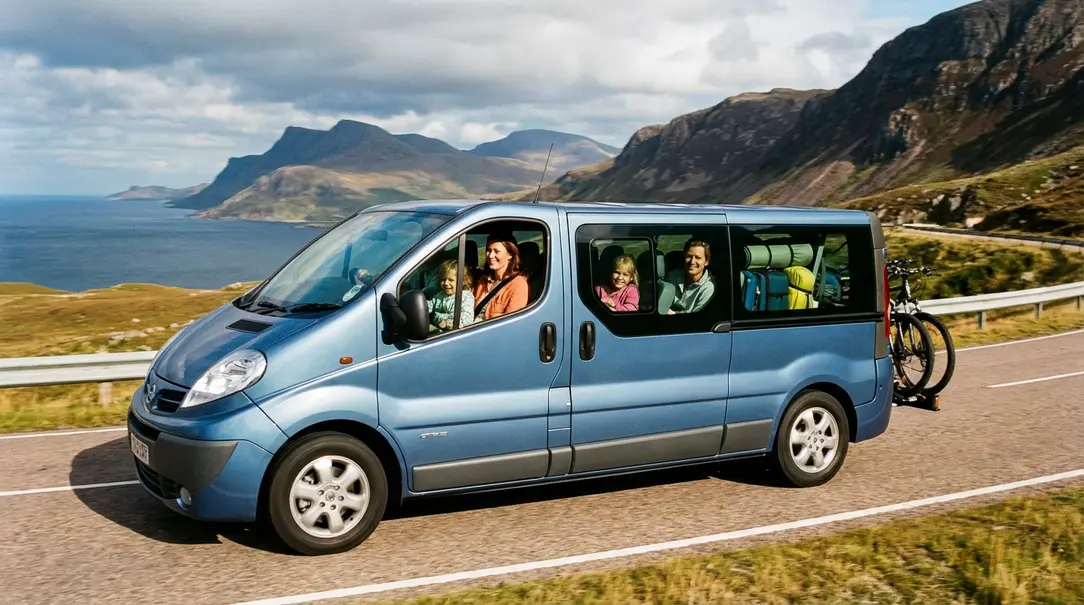
We’re diving into a review of the Nissan Primastar Combi, specifically the extended L2 version. This is a passenger van designed for ultimate practicality, capable of accommodating numerous passengers and an abundance of luggage. While its lineage is somewhat complex, it ultimately offers a tried-and-tested design that, in practice, doesn’t feel intimidating despite its size. This model also boasts a technologically straightforward design, which presents both advantages and disadvantages. Join us as we explore the full spectrum of what the Nissan Primastar has to offer.
At a Glance: Pros & Cons
Advantages:
- Excellent value for money relative to its size
- Overall simplicity of its construction
- Immense interior space
- Surprisingly good audio system
- Superb powertrain in terms of refinement and driving pleasure
- Impressively low fuel consumption
Disadvantages:
- Multimedia system feels outdated
- Interior retains a distinct “converted cargo van” feel
- Average cabin noise insulation
- Limited driver assistance systems, notably lacking adaptive cruise control
Our Verdict: Nissan Primastar Combi
The Nissan Primastar is a prime example of how the market still offers relatively simple designs that excel at fulfilling essential travel needs. It provides abundant space for passengers and their luggage, paired with a refined powertrain that works seamlessly with its efficient gearbox. However, its attractive price point stems from its commercial vehicle origins, which translates into mediocre noise insulation and a scarcity of modern amenities.
Pricing and Trim Levels
The Nissan Primastar is available in various configurations, starting with the choice between a cargo van (Van, with crew cab option) or a passenger model (Combi). You then select the body length (Combi and Van) and height (Van only), before finally choosing from different powertrains and trim levels.
This review focuses on the passenger-oriented Primastar Combi, which is offered in the following variations (please note, availability can change as the model approaches its end of production cycle):
L1 (Short Wheelbase):
- Business: dCi110 (110 HP, 6-speed manual): Currently sold out. dCi150 (150 HP, 9-speed automatic): Currently sold out.
- Business Plus: dCi150 (150 HP, 9-speed automatic): Approximately $43,700 USD.
L2 (Long Wheelbase):
- Business: dCi110 (110 HP, 6-speed manual): Currently sold out. dCi150 (150 HP, 9-speed automatic): Currently sold out.
- Business Plus: dCi150 (150 HP, 9-speed automatic): Approximately $44,300 USD.
- Tekna: dCi170 (170 HP, 9-speed automatic): Approximately $48,000 USD.
These figures represent estimated retail prices. As you can see, many configurations (for what would have been the 2026 model year) are already sold out at the time of this review. This is partly due to the current generation of the Primastar nearing the end of its lifecycle, a topic we’ll elaborate on shortly. Nissan may also offer initial discounts, often around $1,500 USD.
Nissan provides a 5-year/100,000-mile warranty on the entire vehicle. The paintwork is protected for the same period with unlimited mileage, along with roadside assistance and genuine parts. Furthermore, the body panels come with a 12-year perforation warranty. Additional service packages (up to 125,000 or 155,000 miles) are also available for purchase.
The reviewed Nissan Primastar is the extended Combi (L2) variant with the top-tier Tekna trim, which has an approximate starting price of $48,000 USD. Configuration options are limited, but you can add metallic paint for around $650 USD, or swap the standard tailgate for divided barn doors (which also removes the left-side sliding door) for a reduction of approximately $1,250 USD. The tested model, without the barn door option but with metallic paint, brought its final price to just under $48,750 USD.
Estimated Insurance Costs
Based on industry data for similar vehicles, insuring a Nissan Primastar for a driver with several years of experience could cost approximately $1,000 to $2,000 USD annually for comprehensive coverage, though rates vary significantly by location and driver profile.
Technical Specifications (Nissan Primastar L2 Combi)
Under the hood, the Nissan Primastar features a single 2.0-liter, 4-cylinder diesel engine available in different power outputs, ranging from 110 HP to 170 HP. This engine can be paired with either a 6-speed manual transmission or a 9-speed automatic. The tested model, being the top-tier variant, offers respectable performance for a vehicle of its size and purpose.
Naturally, the dimensions and available space are the most crucial characteristics of the Primastar. Thanks to the extended L2 version, the rear axle and body are shifted an additional 15.7 inches (40 centimeters), bringing the total length to almost 18 feet (5.5 meters). For the Van (cargo) variant, this translates to 236 cubic feet (6.7 cubic meters) of cargo volume.
A Brief History of the Nissan Primastar
The segment of commercial vehicles, often adapted into passenger versions, frequently features numerous badge-engineered models. This is precisely the case with the Nissan Primastar, which debuted in 2002, replacing the proprietary Vanette. The first Primastar shared its platform with the second-generation Renault Trafic and the Opel Vivaro.
In 2016, Nissan decided to rename it the NV300, but it remained a counterpart to the third-generation Renault Trafic, along with the Opel Vivaro and Fiat Talento. However, the latter two brands later pursued their own designs, leaving the alliance in 2020.
In 2021, the Nissan Primastar name returned, marking a facelift of the NV300 and a name change. Thus, the vehicle we’re reviewing is essentially an updated Renault Trafic. This particular Renault model is already slated for replacement, and a new generation is expected, likely bringing with it a new Primastar. This explains the limited availability of certain Nissan versions at the time of this review’s publication.
The Nissan Primastar’s classification is straightforward: it’s a large commercial vehicle (D/E segment) available in various forms. Its closest competitor is naturally the Renault Trafic, although manufacturers strive to differentiate the two models slightly through equipment. When looking for rivals outside this family, the choice largely depends on the desired size. Nevertheless, competitors also offer many variants, including the Citroën Jumpy (SpaceTourer M or XL), the identical Peugeot Traveller, Opel Vivaro, Toyota ProAce Verso, as well as the Volkswagen Transporter and Ford Tourneo Custom. For more premium options, there’s the Mercedes-Benz V-Class, and to some extent, the Hyundai Staria could also be considered a contender.
Infotainment System: Functional Simplicity
As you may know, the Nissan Primastar extensively utilizes Renault technology, particularly its multimedia and software systems. Consequently, the interior of our test vehicle features screens and systems familiar from other Renault models (such as the Clio or various Dacias). One could even say the Primastar offers a more extensive software version than the Alpine A110 GTS.
In practice, it’s clear that this isn’t the newest solution, and at times, it could offer higher performance. On the other hand, it provides basic personalization options and a clear interface that can be easily mastered within minutes.
The base Primastar (Business) trim comes with classic analog gauges paired with a 3.5-inch onboard computer screen. Only higher trims feature a 7-inch digital instrument cluster. For the central display, an 8-inch panel is always standard, and from the Business Plus trim upwards, it includes navigation.
Central Display: Intuitive Yet Basic
On paper, the Nissan system offers all the necessities, starting with a personal profile that aggregates your settings. There are also plenty of personalization options, especially considering this is a nearly 10-year-old design inherently built for simplicity. The operation and overall user experience are indeed simple, so no one should struggle to find specific settings.
This personalization primarily involves the main dashboard, which can comprise multiple screens and various widgets. Switching between menus is done via dedicated touch buttons located on the left side of the display itself.
These buttons allow access to settings, the app list, or volume adjustments, among other things. You won’t find a built-in user manual or an advanced voice assistant worth using within this system.
The Nissan system is partially integrated with the comfort modules of the Primastar. The available settings mainly focus on the central locking system, some lighting, and wipers. The air conditioning itself is controlled via an independent, classic, and physical panel with rotary knobs.
However, there’s more to explore regarding connectivity and audio. The Nissan Primastar is a constantly connected vehicle (thanks to a built-in LTE module), which is necessary for system and map updates. Naturally, Bluetooth and Wi-Fi (for Android Auto/Apple CarPlay) are also available, and interestingly, you can even connect external storage devices to play music or view photos.
The entry-level Primastar trims feature a 4-speaker sound system, while from the Business Plus trim upwards, two additional speakers are included. I honestly didn’t expect anything particularly positive from such an audio system in a bus-type body. However, I was pleasantly surprised, as the sound quality is slightly above average. There’s no excessive booming, noticeable echoes, or crackling. Instead, you get decent band separation and even some discernible low tones.
Navigation and Smartphone Integration
Opting for a higher Primastar trim level gives you a navigation system that isn’t available in the base variant. This program can be described as adequate. The map database is reasonably up-to-date, though I did find some minor streets that were missing. Route calculation is also acceptable, though the overall process could be faster. It does offer Google search support and numerous settings for general operation.
I won’t delve deeper into the built-in navigation, as regardless of the variant, wireless Android Auto and Apple CarPlay are available, offering superior navigation solutions. Both platforms connected seamlessly and wirelessly with the test Primastar. It’s worth noting, however, that at this point, the resolution of the display subtly reveals its age compared to what we might consider standard today.
Digital Instrument Cluster: Small but Clear
Technologically, the tested Nissan harks back to an era before the widespread dominance of digital instrument clusters. Consequently, the basic Primastar variant features analog gauges. Higher trims, however, offer a relatively modest 7-inch, yet clear, digital screen with digital equivalents.
Don’t expect elaborate digital facsimiles of traditional dials in Nissan’s visualizations. You have a choice of three themes, primarily focused on displaying speed, with an optional simple economizer, tachometer, or a view of driver assistance system operation.
Beyond the themes, you can decide what additional information is displayed in the right section. Here, the choice is significantly broader, including a simple trip computer, further forms of the economizer, DPF filter status, and navigation cues.
Regardless, the screen consistently presents contextual information related to secondary features. The overall display is practically always clear, and you never feel overwhelmed by the presented elements. The aim is simplicity without complex functions, and that’s precisely what it delivers.
Interior: A World of Space and Practicality
Although the tested Primastar is the Combi passenger version, it is fundamentally based on a commercial vehicle, meaning the interior is designed for durability and practicality. Don’t expect soft-touch materials; relatively hard plastics dominate, but they are thankfully very well-fitted. Nissan (in conjunction with Renault) has also made an effort to utilize the entire space intelligently.
Even though the Primastar leans towards Spartan compared to classic minivans or passenger cars, it doesn’t lack a keyless entry system. It operates in the classic French style: no sensors in the door handles. The Nissan automatically unlocks as you approach and locks as you walk a few steps away. Of course, you can still use the buttons on the remote control independently.
All locks are part of the keyless access system, including the enormous tailgate. However, it’s not electrically operated, though the gas struts do a decent job. The biggest challenge is pressing the button and lifting the large tailgate, but once it starts, it opens smoothly.
First Row: Stepping Up to the Command Center
Upon opening the Nissan Primastar’s door, you’re greeted by a significant step, which you climb to enter the vehicle. Taller passengers might miss an additional grab handle, common in SUVs or pickups. Nevertheless, the doors open wide, almost completely covering the sill, so there’s no complaint there.
The large door panel is a segmented plastic molding, but it’s sensibly designed. At the top, you’ll find a comfortable grip for closing the door, along with an armrest and a control panel for windows and mirrors. Below, there’s a narrow compartment (e.g., for a smartphone), and at the very bottom, a large space with dividers for bigger items, including bottles. However, from the driver’s seat, reaching this lower compartment easily while driving might be challenging.
Seats: Basic Comfort for Long Journeys
At first glance, the Nissan Primastar’s seats appear quite basic: a relatively short seat cushion, limited contouring, and standard 6-way adjustment plus lumbar support. Yet, after longer journeys, I felt no fatigue that could be attributed to an uncomfortable driving position. Much of this is due to the perfectly balanced padding, which is neither too soft nor too firm.
Amenities include single-stage heating, which takes a moment to become noticeable. Additionally, there are independent and adjustable armrests. It’s a pity Nissan didn’t incorporate more between the seats than just the physical handbrake lever (e.g., additional storage compartments or organizers). Naturally, the 9-seater variant features a double bench instead of the right-hand seat.
Steering Wheel: Car-like Feel
Despite the Primastar being a full-fledged van, behind the wheel, it feels like a passenger car. Both its design and placement are directly lifted from much smaller vehicles, so there’s no horizontally positioned steering wheel effect. In the tested vehicle, the steering wheel is manually adjustable in two directions, and it took a moment to align it with the pedals. Another point to note is the unfortunate absence of heating, although the steering wheel itself feels good in hand.
I also highly rate the physical buttons on the two spokes. They are large, well-placed, and easy to operate. The left side controls cruise control and the speed limiter, while the right side manages the digital instrument cluster, phone, and voice assistant. Multimedia controls are handled via a separate stalk located near the right knee, a classic Renault solution. The paddle shifters, which enable manual gear changes, look somewhat amusing; I don’t anticipate anyone needing to use this feature regularly.
To the left of the steering wheel, you’ll find a small storage compartment for odds and ends. Above it are buttons that adjust screen brightness and light levels, and activate a personalized mode for the driver assistance systems.
Dashboard: Maximizing Simplicity and Storage
The gray and black interior of the Primastar is, of course, a classic feature of vans derived from commercial vehicles. Nevertheless, it shows an attempt at differentiation through various embossments and textures. The entire dashboard is made of plastics, but they are well-fitted and, importantly, designed with ergonomics in mind. However, a few areas could be improved.
Excellent practicality is evident at the very top of the dashboard. Here, you’ll find cup holders (a bit of a stretch to reach) and two storage compartments. One (smaller) is integrated into the digital instrument cluster’s cover, and the other (larger, with USB-A ports) is located behind the central screen.
The display separates the ventilation system and is flanked by touch buttons and a USB-A port. Below it, you’ll find physical buttons for controlling features such as central locking and driving modes.
Below the screen, three rotary knobs control the air conditioning system. Yes, the controls are manual, and what’s worse, it takes a considerable amount of time for the cabin to warm up. Initially, the engine needs to warm up, and then it takes an equal amount of time to heat the cabin. Thus, the overall system’s efficiency could be better organized. On either side of this panel, you’ll find a switch and a 12V socket.
Further down, there’s the gear selector lever and a shallow storage compartment with an inductive charging pad. Smartphones need to be inserted sideways, so larger models (especially with cases) might have trouble fitting. It’s a shame that no additional storage or a more accessible slide-out cup holder was included nearby, as the space below remains underutilized.
The glove compartment in front of the passenger slides out, although from the outside, one might expect it to be deeper. Meanwhile, near the headliner, you’ll find the eCall system button, lighting controls, and seatbelt warning indicators (for the first row only). An auto-dimming rearview mirror and large sun visors are also present, but only the passenger-side visor includes a mirror (without illumination).
Second Row: Ample Room for All
The sliding doors on both sides of the Primastar open and close effortlessly and smoothly; I didn’t feel the lack of electric motors to do the work – not in this price class. The doors also feature sliding windows. While stepping in, the side step is somewhat appreciated, but the grab handle on the B-pillar is fully beneficial.
In the second row, passengers nearly 6.5 feet tall can travel comfortably. While headroom is abundant, legroom might become a concern if tall passengers or the driver are also in front. The bench seat’s contouring is perfectly acceptable, and the independent armrests are quite comfortable, despite being relatively narrow.
Nissan thoughtfully provided independent ventilation for the second row, routed through both the roof and the floor. Additionally, a second climate zone is included, although this primarily consists of a heat exchanger, exclusive to the top-tier Tekna trim. Other features in the Primastar include Isofix anchor points on the outer seats and interior lighting. There are also seatback pockets and simple organizers under the front seats. Unfortunately, I found no means to connect to power to charge a smartphone.
Third Row: Full-Fledged Seating
Accessing the third row of the Nissan Primastar is exclusively from the right side, as that’s where the second-row seat can fold. Specifically, its backrest folds, providing ample space to comfortably sit on the rearmost bench. Once seated, you’ll find that both the second and third rows offer virtually the same amount of space. The bench seats themselves are also nearly identical.
Thus, armrests are available, but you won’t find additional Isofix anchor points. Nissan also included an extra grab handle, air vent, and lighting. The only thing missing for complete convenience again was USB ports, although from the third row, you can reach the 12V socket in the cargo area.
Interior Lighting: Functional Minimalism
The Primastar doesn’t try to be flashy with its lighting. Consequently, you won’t find any additional external lights to illuminate the path to the vehicle. You can only independently activate the headlights and taillights via the remote control. Inside, there are a few lighting points, but they rely on warm, average-power halogen bulbs. Fortunately, they reach every row.
Cargo Area: A Cavernous Space
The reviewed Primastar is equipped with a pair of sliding side doors and a top-hinged tailgate, characteristic of the Tekna version. The tailgate can be swapped for 180-degree barn doors, but this option removes the left-side sliding door to the second row (reducing the price by approximately $1,250 USD). It’s worth considering, as the tailgate is simply enormous and requires a bit more effort to open, aside from the space it needs. Regardless, you get a huge loading aperture with a very low sill.
Let’s agree that nobody should lack cargo space in the tested Nissan Primastar. Even when traveling with 8 people, you can still carry a significant amount of luggage, as the extended version offers up to 63.6 cubic feet (1,800 liters) of space when loaded to the roof. With all rear rows folded and removed, this value increases to an astonishing 236.6 cubic feet (6,700 liters). There’s also an intermediate option where the second bench can be folded without being removed.
Amenities primarily include tie-down points for nets and other transport solutions; don’t look for classic hooks. Additionally, there’s a single cubby for small items and a 12V socket. A positive feature is the divided shelves, which can be configured in two ways to separate luggage.
Driving Experience: Easy and Comfortable
To begin this chapter of the Nissan Primastar review, let’s establish that while it’s a passenger vehicle, it’s built on a commercial van chassis, so it inherits many characteristics. However, this doesn’t mean you need special training to operate or drive it. Simply expect a bit more ruggedness and the fact that the driving experience improves slightly with more passengers or luggage on board. Overall, the ride is very soft and, in its own way, comfortable.
Suspension and Steering: Built for Comfort
Naturally, this change is most noticeable in the suspension system. When driving empty, you’ll feel the rear bounce twice, for instance, over speed bumps. Of course, this isn’t on the level of pickups with leaf springs on the rear axle, as it uses a torsion beam setup. Nevertheless, once loaded, the entire system stiffens and gains more composure. From a conventional perspective, the Primastar is distinctly soft, which translates to pleasant damping, and no one should consider dynamic driving.
The steering system is similarly very light, making it excellent for maneuvering. However, you’ll need to turn the wheel quite a bit, as the over 18-foot (5.4-meter) Primastar requires a substantial amount of space to turn around (nearly 46 feet or 14 meters). Fortunately, the body’s shape allows you to quickly gauge its extremities. At higher speeds, you can count on acceptable precision.
Driving Dynamics: Smooth and Steady
Regardless of the chosen version, the Nissan Primastar houses a 2.0-liter diesel engine under the hood that powers the front wheels. Differences pertain to the generated power and torque, with the weakest variant offering 110 HP (300 Nm) and the most powerful, tested here, providing 170 HP (380 Nm). This is paired with either a 6-speed manual or a 9-speed automatic transmission. For the top-tier engine, only the automatic is available.
On paper, the most powerful Primastar reaches 60 mph (100 km/h) in 12.5 seconds, so it’s certainly not a sports car, but it’s far from sluggish. Especially since in practice, I regularly managed to get below 13 seconds, even in rainy and wintry conditions.
Nissan has equipped the tested Primastar with a single button that activates Eco mode. Besides the appearance of a corresponding icon in the corner of the digital instrument cluster, the most noticeable difference concerns the gearbox’s operation. It shifts into coasting mode much more frequently when you lift off the accelerator, and I also had the impression that the start-stop system engaged more quickly. Beyond that, I didn’t perceive any distinct change in power delivery or throttle response.
The overall driving experience in the Primastar straddles the line between a passenger car and a commercial van. The impressions are mostly positive, as you sit very high, benefit from decent visibility, though you won’t be able to enter every parking garage. This, however, is due to its dimensions rather than other limitations.
On the other hand, at higher speeds (above 75 mph or 120 km/h), the cabin’s sound insulation is noticeably minimal, resulting in a loud interior. Nevertheless, highway speeds don’t cause any additional negative emotions. Driving in both city and highway environments presents no significant problems. You can load your large family or multiple generations on board and embark on long journeys. It offers a calm, stress-free ride, yet you won’t hesitate to efficiently overtake trucks. After several hundred miles, you shouldn’t feel excessively fatigued, provided you maintain sensible speeds in consideration of the aforementioned noise levels.
Nevertheless, I most appreciate the Primastar’s gearbox performance. While 9 speeds might seem excessive on paper, it’s a key advantage for smooth acceleration of a ~2.2-ton van. The smoothness of operation deserves high praise, and it practically never makes a mistake, extracting the maximum possible dynamics from the diesel engine, which incidentally offers excellent refinement. Therefore, one way or another, the transmission significantly contributes to the overall pleasant driving experience.
Fuel Economy and Range: A Diesel for Long Hauls
Frequent stops are not an issue when traveling in the Primastar, as the Nissan can hold up to 21 gallons (80 liters) of diesel fuel. Next to the fuel filler, there’s also an AdBlue inlet (for a 6.3-gallon or 24-liter tank). There’s no traction battery, so among the electronic enhancements, only a start-stop system is available. The following fuel consumption measurements were taken when outdoor temperatures were around 32°F (0°C).
City driving in the Primastar is possible, but it’s not the natural habitat for this Nissan. In heavy traffic or when navigating tight spaces, the onboard computer can show up to 10 liters/100 km (23.5 MPG), resulting in a range of approximately 500 miles. However, if traffic is light and you can maintain a smooth flow, you shouldn’t have trouble achieving 5 liters/100 km (47 MPG).
My typical urban journeys usually resulted in 6.5 liters/100 km (36 MPG), offering a range of about 770 miles. However, it’s important to remember that the diesel engine takes a long time to warm up and quickly loses temperature when idling. Therefore, for short distances (under 3 miles), it’s hard to get below 12 liters/100 km (19.6 MPG).
The Primastar is most enjoyable to drive on suburban roads at speeds around 50 mph (80 km/h). In such conditions, the Nissan rewards with very sensible fuel consumption, not exceeding 5 liters/100 km (47 MPG), providing a range of approximately 1,000 miles. On highways, the tested vehicle requires the following diesel consumption:
- 60 mph (100 km/h): 5.6 liters/100 km (42 MPG, ~880 miles range)
- 75 mph (120 km/h): 7.1 liters/100 km (33 MPG, ~690 miles range)
- 80 mph (130 km/h): 7.7 liters/100 km (30.5 MPG, ~640 miles range)
- 87 mph (140 km/h): 8.7 liters/100 km (27 MPG, ~560 miles range)
You can add 5-7% to these results when driving with a full complement of passengers. These are genuinely good results, considering the Primastar’s shape, mass, and payload capacity. Long journeys are definitely feasible, and it’s advisable not to exceed 75 mph (120 km/h) – both for sensible fuel consumption and the aforementioned cabin noise.
Driver Assistance Systems: Essential Basics
The tested Nissan comes with several features designed to assist the driver, though it’s fair to say that advanced driver assistance isn’t the highest priority in the Primastar. Consequently, you primarily get fundamental functions. Nevertheless, they are well-organized and clearly laid out, with a personalized mode that allows you to activate all your preferred settings with a single switch upon starting the car.
Speed Limit Warning
The “My Safety Perso” mode proves useful for the speed limit warning system. The Nissan generally recognizes road signs correctly, but it does make occasional mistakes. As a result, you’ll hear a distinctive beeping sound that is hard to ignore while driving.
Visibility and Blind Spot Monitoring
The mirrors are generously sized and significantly improve visibility around the large body. This is a major advantage of the Primastar, complemented by the blind spot monitoring system. However, don’t look for options related to rear cross-traffic alert or additional spherical mirrors.
Cruise Control and Lane Assist
Expect only classic cruise control in the Primastar. It maintains a set speed without keeping a distance from the vehicle ahead. Consequently, there’s no lane-keeping assist, but there is a system that warns if you’re drifting over lane markings.
Headlights and Fog Lights
Regardless of the trim, the Primastar is equipped with the same headlights, which cast a decent beam of light across all ranges. There’s nothing here that goes beyond standard solutions in terms of brightness, fill, range, or spread, but I had no complaints about the overall quality during night driving.
Amenities include front fog lights with a cornering function. Only the Tekna version offers an automatic high beam mode (without segmentation), but in this particular case, the driver’s own reflexes are often better to avoid dazzling other road users.
Parking Aids: Crucial for a Large Vehicle
Finally, a reversing camera and parking sensors are available, though you won’t find them in the basic Primastar trim. I can’t emphasize enough that for a vehicle of this enormous size, these additions are crucial. The cheapest model only features rear parking sensors.
However, the side sensors are particularly helpful during maneuvering. Meanwhile, the image quality from the high-mounted camera is theoretically only acceptable, but it fully allows you to orient yourself to what’s behind the vehicle, provided it doesn’t get dirty, which is easy, and then visibility is quickly lost due to the limited resolution.
Final Thoughts: Nissan Primastar Combi L2
We’ve concluded our review of the extended, passenger version of the Nissan Primastar. While it’s slowly bidding farewell to the market, it proves that a great balance of size and value can still be achieved. The enormous space is a key advantage of this model, coupled with a genuinely excellent powertrain. The entire system operates smoothly and refinedly, achieving minimal fuel consumption. Add in its fundamental technologies, and you’re ready to hit the road.
This journey is best suited for suburban roads rather than highways, to avoid complaints about interior noise. In such conditions, you’ll also less acutely feel the absence of features like adaptive cruise control or other conveniences found in passenger cars. Finally, remember that while the extended version can navigate cities, tight streets and parking lots are best avoided.
Frequently Asked Questions (FAQ)
Q: Is the Nissan Primastar Combi good for large families?
A: Yes, the Nissan Primastar Combi, especially the L2 long-wheelbase version, is an excellent choice for large families due to its immense interior space for passengers and abundant cargo capacity.
Q: What are the main differences between the L1 and L2 versions?
A: The L2 (long wheelbase) version adds approximately 15.7 inches (40 cm) to the vehicle’s length compared to the L1 (short wheelbase), primarily increasing cargo space and offering more legroom in the rear rows.
Q: Does the Nissan Primastar Combi have Apple CarPlay or Android Auto?
A: Yes, higher trim levels of the Nissan Primastar Combi include wireless Apple CarPlay and Android Auto, allowing seamless smartphone integration for navigation, music, and communication.
Q: What is the fuel economy like on the Nissan Primastar Combi?
A: The Nissan Primastar Combi, equipped with its 2.0-liter diesel engine, offers impressive fuel economy for its size. Expect around 30-45 MPG on highways and suburban roads, though city driving and short trips will yield lower figures.
Q: Is the Nissan Primastar Combi easy to park?
A: While the Primastar’s light steering aids maneuvering, its large dimensions (nearly 18 feet long with a 46-foot turning radius for the L2 version) can make parking challenging. Higher trims with a reversing camera and parking sensors are highly recommended.
About Post Author
