

Nothing Ear (3a) Review
-
Design & Build Quality
-
Comfort & Ergonomics
-
Connectivity & App
-
Microphone Performance
-
Active Noise Cancellation
-
Sound Quality
Nothing Ear (3a): Stylish, Affordable, and Feature-Rich

The Nothing Ear (3a) offers a compelling package with its distinctive design, comfortable fit, and excellent companion app. While providing competent ANC, clear microphone performance, and customizable sound, its battery life is only acceptable, and the AI call recording feature requires a subscription after an initial period. It’s a strong contender for its price point.

Advantages
- Stylish and distinctive design with transparent elements
- Durable build quality and excellent finish
- Comfortable and secure fit with good ergonomics
- Intuitive squeeze controls
- Excellent connectivity with LDAC, multi-device, Google Fast Pair, Microsoft Swift Pair
- Exceptional Nothing X companion app with extensive customization
- Good microphone performance, clear calls in noisy conditions
- Competent Active Noise Cancellation (ANC) for low-frequencies
- Effective transparent mode
- Generous bass, customizable sound profile via comprehensive equalizer
- IP54 splash and dust resistance
- Affordable price point
Disadvantages
- Limited accessories (no USB-C cable included)
- AI call recording and transcription feature requires subscription after 90 days
- Full availability of AI features and legal considerations for call recording vary by region
- Battery life is acceptable but not record-breaking
- No wireless charging
- Bass can sometimes overshadow treble frequencies (though adjustable)
- ANC relies partly on passive isolation for optimal performance
Contents
Nothing Ear (3a) Review: A Stylish and Affordable Contender
We’re excited to begin our review of the Nothing Ear (3a), the newest in-ear headphones from a brand that consistently aims to stand out. For those unfamiliar with Nothing’s product naming convention, the “a” in the name signifies a more budget-friendly offering within the third generation of their audio accessories. Naturally, this comes with certain trade-offs, but the company has still found room for some unique innovations. Let’s delve into what the Nothing Ear (3a) truly delivers in real-world use.
Unboxing and What’s Included
The Nothing Ear (3a) arrives in minimalist packaging, a hallmark of the Nothing brand, often requiring you to partially tear the box to access its contents. Inside, you’ll find a surprisingly limited set of accessories. Beyond the essential paperwork, the package includes only three pairs of additional silicone ear tips in various sizes. Notably, there’s no USB-C charging cable provided, which is a common omission in this price segment but worth noting for first-time buyers.
Pricing and Availability
As mentioned, the Ear (3a) is positioned as a more affordable alternative. At the time of this review, it was priced around $110 / €100. This makes it significantly cheaper than the flagship Ear (3) model. However, knowing Nothing’s track record, it’s always a good idea to keep an eye on retailers for potential promotions and discounts.
Technical Specifications for Nothing Ear (3a):
- Type: In-ear, wireless headphones
- Drivers: 12mm, custom-designed, with a frequency response of 20 Hz – 40 kHz, 95 dB dynamics, 32 Ohm impedance, and Hi-Res Audio support.
- Microphones: 3x MEM (per earbud) with Active Noise Cancellation (ANC)
- Connectivity: Bluetooth (SBC, AAC, LDAC codecs), multi-device connectivity (up to 2 devices simultaneously), Google Fast Pair, Microsoft Swift Pair. (Note: The spec sheet mentions “Bluetooth 6.0,” which is not a recognized standard. It likely refers to the latest Bluetooth iteration supported by the device, such as Bluetooth 5.3 or newer.)
- Battery: Case capacity: 500 mAh; Earbud capacity: 55 mAh. Total playback time up to 38 hours. USB-C charging.
- Other Features: IP54 certification (splash and dust resistant), AI-powered call recording capability.
- Color Options: White, Black, Yellow, Pink
- Weight: 4.53 g (each earbud), approximately 50 g (with case)
Design and Build Quality
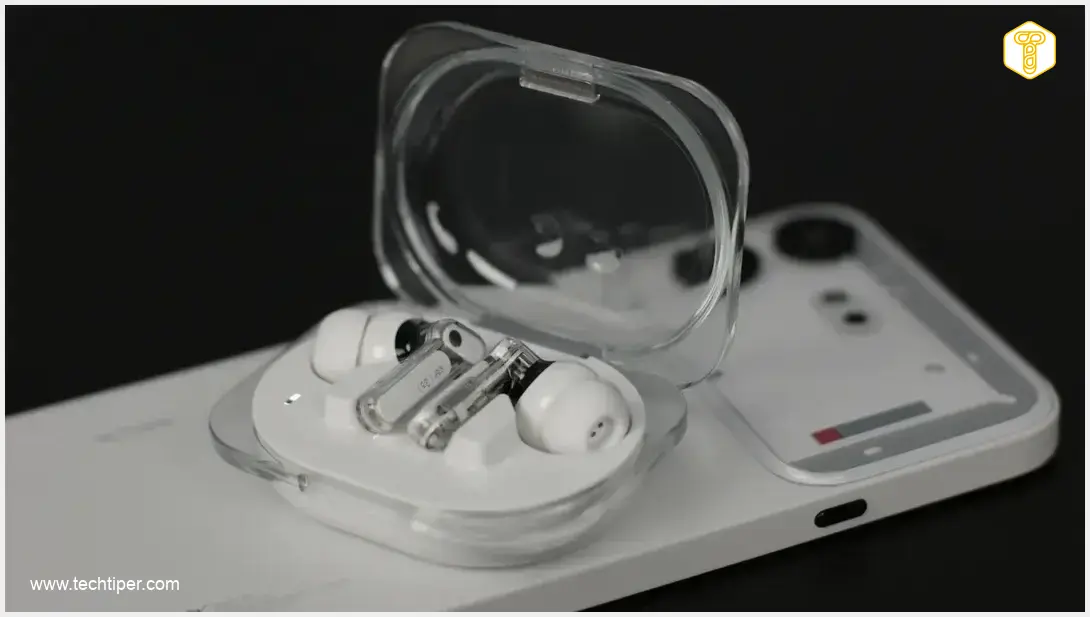
Nothing consistently offers the Ear (3a) in various color options, each designed to highlight the headphones’ unique aesthetic. For our review, we received the understated white variant. True to Nothing’s signature style, transparent elements are present, though the overall construction relies on durable plastics.
We have no complaints regarding the overall quality and fit of the individual components. The finish is excellent, resisting visible smudges, although long-term use might introduce minor scratches. It’s important to remember that the design boasts an IP54 rating, making it resistant to splashes and dust, but it is not fully waterproof.
The Charging Case
The charging case for the Ear (3a) features a distinctive rounded shape, complemented by flat, protruding edges that add character. A thoughtful cutout in the lower section makes opening and closing the case effortless, contributing to a comfortable user experience. Additionally, its flat bottom ensures stability when placed on surfaces.
The case is minimalistic, primarily featuring a USB-C port for charging. Subtle, regulatory markings are discreetly placed on the underside. The lid is adorned with a transparent sticker, designed to prevent scratches on the main casing material. Upon opening, you’ll find three LED indicators showing the charging status and battery level, alongside a convenient pairing button.
Earbud Ergonomics and Controls
Removing the earbuds from their case is straightforward. Their design is classic Nothing, with controls intuitively integrated into the stems – simply squeeze them to manage playback and calls. This method is both comfortable and reliably registered by the software.
Overall, the fit is exceptionally comfortable. The Ear (3a) earbuds stay securely in place thanks to their contoured shape and the selection of appropriately sized silicone ear tips. A wear detection sensor is also included, automatically pausing or resuming music when the earbuds are inserted or removed.
Connectivity and User Experience
The Nothing Ear (3a) connects via Bluetooth, supporting key codecs like SBC, AAC, and the high-fidelity LDAC. It also features quick pairing options such as Google Fast Pair and Microsoft Swift Pair. Impressively, these headphones don’t force a choice between features; LDAC works seamlessly even with multi-device connectivity and low-latency mode activated. For a broader perspective on earbud connectivity, you might find insights into different solutions, like the Samsung Galaxy Buds Hearapy app, helpful.
The Nothing X App
As with most wireless headphones, the first step is to connect them to your smartphone, ideally with the Nothing X app (available for free on Google Play Store and Apple App Store). This application is exceptionally well-designed, offering a clear interface and all essential functionalities. Its thoughtful translation makes Nothing X one of the best companion apps in the market for this type of device.
The app’s interface is notably user-friendly, providing clear explanations for each function. Beyond extensive customization options for controls, a versatile equalizer, and various ANC settings, a new feature has been introduced: call recording.
AI Features: Call Recording and Transcription
This new mode allows users to record calls (up to two hours) or create short “audio snapshots” (up to one minute), which can be reviewed later with added comments. The feature also includes AI-powered call transcription. However, this functionality is only free for the first 90 days and comes with a strict monthly limit (two hours). After this period, a subscription is required. Consequently, many users seeking this solution might revert to free alternatives. Furthermore, the full availability of call recording and transcription features is limited in some regions, and users should be mindful of local legal considerations regarding call recording. For more on Nothing’s ecosystem and software, a review like the Nothing Phone 4a Pro review might offer additional context.
Audio Performance: Microphones, ANC, and Sound Quality
Microphone Performance
In practice, the microphones on the Nothing Ear (3a) deliver a positive experience. They effectively capture your voice with minimal distortion. They also handle background noise competently; our test calls confirmed that conversations remained clear, even during walks on rainy and windy days.
Active Noise Cancellation (ANC)
The active noise cancellation is generally competent. However, the passive noise isolation, achieved by selecting the correct in-ear tips for a good seal, plays a significant role in reducing ambient sounds. The ANC itself effectively diminishes most irritating low-frequency noises, though higher-frequency sounds may still be audible. Most users will likely be satisfied with this level of performance, and the transparent mode also works remarkably well.
Sound Profile
Nothing emphasizes improved low-frequency reproduction in the Ear (3a), and this is immediately apparent. There’s a generous amount of bass, which can sometimes overshadow the treble frequencies. For some listeners, this might be the first aspect they adjust using the equalizer. The app’s extensive equalizer capabilities, including community-driven preset options, are genuinely commendable.
By appropriately balancing the different frequency bands, users can quickly and easily customize a sound curve that perfectly matches their preferences. Nevertheless, even the default settings are likely to be more than satisfactory for fans of popular music. Within this price category, any distortion across the various tones remains well within acceptable limits.
Battery Life and Charging
Nothing provides specific battery life figures for the Ear (3a), which, understandably, depend on whether ANC and the LDAC codec are active. The manufacturer’s declared battery times are as follows:
- Without ANC: Up to 6 hours
- With ANC: Up to 4.5 hours
- The charging case provides approximately 3 full recharges for the earbuds.
These figures reflect real-world usage with the high-quality LDAC codec. If you opt for AAC without ANC, you could theoretically achieve up to 10 hours of music playback. Overall, these are acceptable results, though they are certainly not record-breaking in this segment.
The charging case relies solely on USB-C for power; Nothing has opted against wireless charging, primarily to keep costs down and differentiate these from their higher-end models. A full charge for the case takes approximately 1 hour and 15 minutes, while the earbuds themselves require about 45 minutes in the case. Impressively, just five minutes of charging can provide an hour of playback.
Conclusion: Our Verdict on the Nothing Ear (3a)
Our review of the Nothing Ear (3a) concludes that these are successful headphones offering intriguing features. As is often the case with Nothing, the design and user comfort (supported by an excellent companion app) are paramount. The sound quality, microphone performance, and active noise cancellation are also commendable, though there remains some room for refinement.
However, we would not recommend the Nothing Ear (3a) primarily for its call recording feature. While interesting, it eventually requires a subscription, and its full availability remains inconsistent across regions. Furthermore, users should also consider that the battery life, while acceptable, is not outstanding compared to some competitors.
Frequently Asked Questions (FAQ)
The Nothing Ear (3a) offers a unique design, comfortable fit, and solid audio performance for its affordable price point (around $110 / €100). While it has some compromises like average battery life and subscription-based AI features, its overall value, especially considering the robust app and sound customization, makes it a compelling option in its segment.
The Active Noise Cancellation (ANC) on the Nothing Ear (3a) is generally competent, effectively reducing lower-frequency ambient noises. However, its strength lies more in passive noise isolation achieved through a good ear tip seal. While it might not match flagship ANC performance, it’s satisfactory for most users, and its transparent mode is quite effective.
The AI-powered call recording and transcription features are free for the first 90 days with a monthly usage limit. After this initial period, a subscription is required to continue using them. Additionally, the full functionality and availability of these features may vary by region, so users should check local legal guidelines regarding call recording.
Source: Self-developed. Opening photo: Lukasz Pajak
About Post Author
