

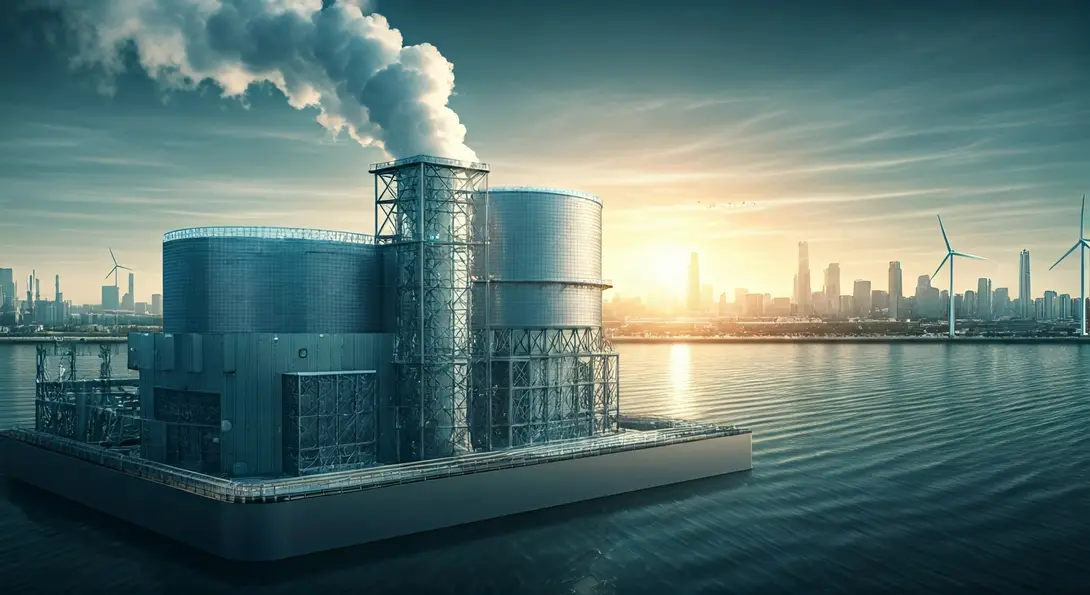
Poland faces a significant energy challenge, with an anticipated loss of approximately 2 gigawatts (GW) of stable baseload power in the coming years. This impending deficit has sparked an urgent search for new infrastructure to bridge the gap and secure the nation’s energy future. While the government is setting its sights on a combination of large-scale nuclear power and renewable energy sources (RES), a prominent voice in the private sector, billionaire Michał Sołowow, strongly advocates for an alternative strategy: investing heavily in Small Modular Reactors (SMRs).

Sołowow views the government’s current energy transformation plan as flawed, arguing that a strong reliance on intermittent renewable sources could jeopardize the consistent power supply crucial for energy-intensive industries. This disagreement highlights a broader debate on the optimal path for energy independence and sustainability.

Contents
The Great Energy Transformation Debate
Just recently, the Polish government adopted its National Energy and Climate Plan (NECP), outlining a future where the country will significantly increase its focus on Renewable Energy Sources—such as solar photovoltaics and wind farms—alongside the development of conventional nuclear power plants. This strategic shift aims to modernize Poland’s energy mix, reduce carbon emissions, and enhance energy security.
However, Michał Sołowow, one of Poland’s wealthiest individuals, posits that basing the energy transformation primarily on RES is a mistake. He contends that while renewables are vital, their inherent instability makes them unsuitable as the sole foundation for an economy heavily reliant on consistent, high-volume power. Sołowow argues that such installations cannot guarantee the steady electricity supply needed by industrial sectors, which could lead to operational inefficiencies and higher costs.
His vision centers on SMRs, which he believes represent the future of global energy. But what exactly are these SMRs, and why are they drawing such attention?
Understanding Small Modular Reactors (SMRs)
SMR stands for Small Modular Reactor. Despite the “small” in their name, these nuclear power installations are anything but insignificant. They are designed to generate tens to several hundred megawatts (MW) of power, enough to supply entire cities or large industrial facilities. Their modular design is a game-changer, allowing components to be mass-produced in factories, then transported and assembled on-site. This approach promises a relatively more affordable and straightforward deployment compared to traditional large-scale nuclear plants.
Beyond electricity generation, SMRs offer another significant advantage: the ability to utilize waste heat and process steam. This byproduct of energy production can be repurposed for industrial processes or district heating, making them highly efficient. For example, a nearby factory could be heated using the thermal output from an SMR. This multifaceted utility makes SMRs an attractive option for countries looking to decarbonize various sectors. Many European Union member states, for instance, aim to have between 17 GW and 53 GW of installed SMR capacity by 2050, with initial installations already emerging in Poland. For context, Poland’s peak electricity demand generated 27.7 GW net.
The potential for these reactors extends to supporting the rapidly growing demand for electric vehicle charging infrastructure, especially for high-power applications. As industries transition to cleaner energy, the stable and substantial power output of SMRs could be instrumental in supporting mega-watt charging stations. Learn more about the latest developments in high-capacity EV charging in Europe.
Challenges on the Path to Widespread SMR Adoption
Despite their promising potential, the journey to widespread SMR adoption is not without its hurdles. SMR technology is still relatively nascent, with Canada leading much of the commercial development. The country is currently pioneering a commercial fleet of these reactors, with other nations closely watching their progress.
A notable case in point is the Darlington New Nuclear Project in Ontario, Canada. Provincial authorities initially approved a budget of approximately CAD 20.9 billion (around USD 15.3 billion) for this ambitious venture. However, recent findings indicate that this figure was significantly underestimated. The construction of just the first of four planned reactors is now projected to consume nearly 40% of the entire initial budget, raising concerns about cost control and realistic project planning.
Another critical factor is the cost of electricity generated by SMRs. The operating company, OPG, estimated that the Darlington investment would become viable if electricity were sold at approximately USD 110 per megawatt-hour (MWh) over 60 years. While this might seem competitive, it poses a challenge for energy-intensive industries. For example, for heavy industry to remain profitable, energy prices typically need to be significantly lower. An energy price of USD 110/MWh is considerably higher than the roughly USD 75/MWh (equivalent to about 300 Polish Zloty (PLN)/MWh at the time of the original analysis) that many heavy industrial sectors can sustainably absorb. This disparity could impact the competitiveness of national industries if not managed effectively.
Moreover, the integration of such advanced energy solutions requires careful planning and public acceptance. Alongside large-scale energy projects, individual and community-level energy savings initiatives, such as installing solar panels, play a crucial role in reducing overall demand and fostering a sustainable energy ecosystem. Discover how solar panels are contributing to energy savings and reducing household energy bills.
Conclusion: A Complex Energy Future
The debate surrounding Poland’s energy future mirrors a global discussion on achieving energy security, sustainability, and economic competitiveness. While renewable energy sources offer immense potential for decarbonization, their intermittent nature necessitates stable baseload alternatives. Small Modular Reactors present a compelling solution, promising reliable power, industrial heat, and modular deployment advantages. However, as demonstrated by early projects, challenges related to cost estimation and the ultimate price of electricity need to be carefully addressed. The path forward will likely involve a balanced approach, integrating diverse technologies to build a resilient and sustainable energy infrastructure.
Frequently Asked Questions (FAQ)
The main point of contention lies between the government’s plan to focus on large-scale nuclear and renewable energy sources, and Michał Sołowow’s advocacy for Small Modular Reactors (SMRs) as a more stable and reliable alternative, especially for energy-intensive industries.
SMRs are smaller, modular in design, and can be mass-produced in factories before being transported and assembled on-site. This makes them potentially more cost-effective and faster to deploy compared to large, custom-built traditional nuclear reactors. They also offer the benefit of utilizing waste heat for industrial processes.
Key challenges include significant cost overruns in initial projects (like the Darlington New Nuclear Project), the high projected cost of electricity generated by SMRs which may be uneconomical for heavy industries, and the relatively nascent stage of the technology’s commercial deployment.
Proponents of SMRs argue that their constant, non-intermittent power output makes them superior for baseload energy and industrial applications, where a consistent and reliable electricity supply is crucial. Unlike solar or wind power, SMRs are not dependent on weather conditions, offering continuous operation.
Source: Unspecified industry reports and public statements; Opening photo: Vladimka production / Shutterstock
About Post Author
