

Sony Xperia 1 VIII Review
-
Design & Build Quality
-
Display & Audio
-
Battery Life & Charging
-
Camera System
-
Performance & Software
A Unique Flagship with Distinctive Charm
The Sony Xperia 1 VIII stands out with its premium, distinctive design, excellent display, and high-quality audio experience. It boasts top-tier performance and welcome features like a 3.5mm jack and microSD slot. However, its average battery life, slow charging, and good (but not exceptional) camera system, especially at night and with zoom, are notable drawbacks. Its premium price makes it a niche choice in a competitive market.
Advantages
- Distinctive, premium design and build quality
- IPX8/IP6X water and dust resistance
- Includes 3.5mm headphone jack
- Features a microSD card slot
- Tool-less SIM/SD card tray removal
- Excellent 6.5-inch LTPO OLED display with 120Hz
- Balanced, front-facing stereo speakers
- Top-tier Snapdragon 8 Elite Gen 5 processor for smooth performance
- Very good daytime photography
- Impressive 4K 120fps video recording capabilities
- Lightweight for a flagship (200g)
- Clean Android 16 software with minimal bloatware
Disadvantages
- Very high premium price point
- Average battery life (5000 mAh)
- Slow 30W wired charging (90 minutes for full charge)
- Device heats up and throttles under heavy load
- Camera system is good but “not truly exceptional” overall
- Disappointing digital zoom quality; limited optical zoom
- Poor night video performance (noise, autofocus issues)
- Modest front camera, especially in low light
- Slightly clunky camera app (slow white balance, exposure selection)
- Only 4 major Android updates promised
- Haptic feedback is not premium-level
Contents
Sony Xperia 1 VIII: Unveiling a Distinctive Flagship
Sony has made a bold statement with its latest flagship smartphone, the Sony Xperia 1 VIII. This device steadfastly maintains the distinctive characteristics of its predecessors, now presented within a refreshed design. Our comprehensive review explores the practical performance of this truly unique piece of hardware. The question remains: is this flagship from the Japanese manufacturer worth its premium price?
First Impressions: The Unboxing Experience
The Sony Xperia 1 VIII arrives in a surprisingly compact, eco-friendly cardboard box. From the moment you see it, the packaging suggests a minimalist approach, a notion confirmed by its contents. Inside, you’ll find very few extras, in fact, virtually no accessories at all.
Upon opening the box, the smartphone itself is the first thing that catches the eye. Below it, the manufacturer has included a substantial collection of documentation and manuals. And that’s it. There’s no charging cable, nor even a SIM tray ejector tool. The latter, however, is unnecessary, as the SIM tray mechanism is designed to be opened without a special tool.
Design and Premium Build Quality
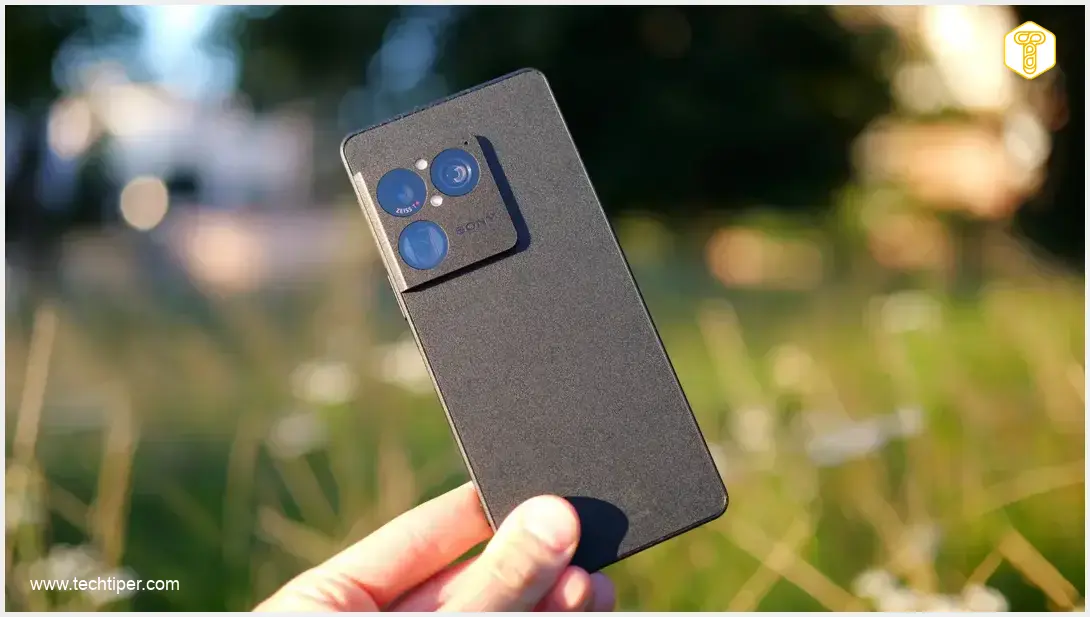
The Xperia 1 VIII maintains the classic, angular form factor seen in previous 1-series models, but Sony has given the design a noticeable refresh. Especially in the black version I tested, the device looks as if it were carved from stone. Its sharp angles and tactile, rough-textured casing present a stunning appearance in person. I cannot recall the last time a smartphone left such an impression due to its sheer distinctiveness.
The rear of the phone prominently features a ‘sculpted’ camera island that visually integrates well with the overall design. Alongside the three lenses, you’ll find the Sony and ZEISS logos. The review unit I tested had already been handled by several people, which unfortunately showed some wear on the edge of the camera island. Beneath the black finish, a shiny metal becomes visible. I have concerns that after extended use, the Sony Xperia 1 VIII might lose some of its initial charm. Interestingly, the smartphone lies perfectly flat without wobbling on surfaces.
Model markings are subtly printed on the lower back, largely unnoticeable on the black variant. The phone boasts a sealed construction, with separate IPX8 and IP6X certifications, meaning it’s well-protected against water ingress and dust. A commendable aspect is the complete absence of fingerprints on the device; its matte surface expertly conceals smudges. The edges, while sharp, do not make the phone feel heavy, ensuring a comfortable grip. At 200 grams, it’s relatively light for a flagship with a top-tier processor, as many competitors often weigh around 215 grams. The overall build quality is undeniably premium.
However, the vibration motor doesn’t quite match the premium feel. The haptic feedback seems rather flat, making the Xperia 1 VIII’s vibration closer to mid-range devices rather than the excellent haptics found in competitors like the OnePlus or top-tier OPPO models.

On the top edge, besides a microphone opening, lies a increasingly rare feature: a 3.5mm headphone jack. While I personally prefer wireless headphones for urban use, I appreciate that Sony has not abandoned this standard. For testing, I connected my somewhat demanding Beyerdynamic DT990 Pro 250 Ohm headphones, and they performed surprisingly well with the smartphone.
The left edge of the device is simply adorned with the Xperia logo. On the opposite side, you’ll find a short volume rocker that requires some getting used to. Below that, recessed into the frame, is the power button, which integrates a fingerprint reader. This reader works adequately, but for convenience, I personally prefer ultrasonic under-display sensors. Completing the button layout is a two-stage shutter key. In this area, there’s also an oddly shaped rectangular cutout, likely an antenna cover for 5G mmWave technology.
The bottom edge is relatively uncluttered, featuring a USB Type-C (3.2) port, a microphone opening, and a SIM card tray that can be opened with a fingernail. It accommodates a single SIM card, but on its reverse side, Sony has included another element that defies current market trends: a microSD card slot. This is a very welcome addition for expandable storage.
What about the speakers? They are front-facing, a design choice that significantly widens the top and bottom bezels, making the Xperia 1 VIII appear less ‘modern’ than some rivals. However, for audio playback, this configuration is arguably superior. The Sony Xperia 1 VIII’s speakers deliver identical power, resulting in a balanced stereo effect. While the bass might be slightly less prominent than on some larger devices, such as a Google Pixel 10 Pro XL, the overall audio experience from the Xperia is arguably more pleasing. Crucially, these front-facing drivers are almost impossible to obscure during use.
Aside from the slightly thicker bezels and front-facing speakers, the front of the Sony Xperia 1 VIII is straightforward. The display is protected by high-quality Gorilla Glass Victus 2. The wider bezels allow for the front-facing camera to be discreetly placed on the top left, meaning the screen itself has no distracting cutouts or notches.
Immersive Display Experience
Sony has opted for a 6.5-inch OLED screen with a resolution of 1080 x 2340 pixels. This gives the Xperia 1 VIII a rather standard 19.5:9 aspect ratio, moving away from the more panoramic 21:9 proportions seen in models prior to the fifth generation. Blacks are deep, colors are vibrant, and the 120 Hz refresh rate ensures smooth visuals. Media consumption on this smartphone is excellent, greatly enhanced by its outstanding speakers.
Unfortunately, I couldn’t find specific information regarding the maximum brightness. In practice, readability is very good, but the panel on the Sony Xperia 1 VIII doesn’t get quite as bright as screens on some competitors, such as the Google Pixel 10 Pro XL.
Battery Life and Charging Speed
The Xperia 1 VIII is somewhat unremarkable in terms of battery. It features a standard 5000 mAh capacity, which by current standards, might not seem as impressive as it did a couple of years ago. However, given its slightly smaller screen compared to most competitors, the actual battery life holds up quite well.
With typical daily usage, I consistently ended the day with approximately 25% battery remaining. Achieving two full days of use would likely only be possible for very light users. However, for those who charge their phone daily, there’s no concern about the Xperia lasting until the end of the day. So, it’s decent, but not exceptional.
Sony states that the Xperia 1 VIII supports “fast charging” via the Power Delivery standard, with a maximum output of 30W. Many mid-range phones now offer significantly faster charging. Even flagships like the Samsung Galaxy S26 Ultra and the Pixel 11 Pro XL, which aren’t known for record-breaking charging speeds, support up to 45W. Consequently, charging the Xperia 1 VIII feels incredibly slow by today’s standards.
For testing, I optimistically connected the Sony to a 90W charger. The first 50% charge was reached after 31 minutes, and a full charge took approximately 90 minutes. This charging speed is so slow that it truly requires planning. In comparison, some Chinese flagships with larger batteries can fully charge in under an hour.
Advanced Camera System
Sony is synonymous with high-quality cameras, and the Xperia 1 VIII’s camera island is further adorned with the ZEISS logo. However, the camera configuration itself doesn’t create the same impact as those found in this year’s “ultra-flagships.”
The device features three 48-megapixel units. The ultrawide and main cameras are virtually unchanged from the previous generation. They still utilize large sensors that, at least in theory, should produce excellent photos.
The telephoto lens, however, has undergone significant changes. The manufacturer has enlarged the sensor to capture more light and detail, but the focal length has been reduced. The 3.5x (85mm equivalent) zoom from previous models has been replaced with a 2.9x (70mm equivalent) zoom. This results in somewhat unconventional default zoom values in the camera app (2.9x and 5.8x). The 70mm focal length is quite practical for many scenarios.
The camera application itself is decent. Its interface visually aligns with the system, appearing simple and intuitive. Initially, the smartphone offers an AI assistant, but once dismissed, the app remains clean and easy to navigate. Beyond the automatic mode and “bokeh” (Sony’s term for portrait mode), there are dedicated video and “pro photo” modes. The manufacturer also provides “bokeh video,” reminiscent of cinematic mode on iPhones, though it’s limited to 1080p at 30 frames per second.
The overall photography experience is good, but not outstanding. The camera app can feel a bit clunky. In daylight, automatic white balance adjustment sometimes takes a second or two, a process that is almost instantaneous on other flagships. At night, illuminated buildings often appear overexposed in the preview, and the time it takes to select parameters and exposure for each lens averages 2 to 3 seconds. Flagship smartphones have accustomed me to much faster shooting.
Image Quality
Daytime photos are consistently excellent. Autofocus is precise, and parameters are expertly chosen. Colors in the default mode are close to natural, though users can experiment with attractive filters. It’s clear that Sony has refined its color science to near perfection. You can achieve very good photos with every lens.
The zoom capabilities, however, are somewhat disappointing. While the quality at lower digital zoom levels is fine—Sony emphasizes naturalness, and algorithms aren’t overly aggressive, which can be appealing—the maximum zoom of just 17.5x is a limitation. Many smartphones in a similar price range offer usable zoom levels of 20-30x, with maximums often exceeding 100x (though such extreme zooms are rarely truly useful). The quality at 17.5x zoom itself also leaves much to be desired.
At night, despite the slower exposure times mentioned earlier, the camera performs very well. Once again, each lens is capable of capturing good photos. The main camera never disappointed. The ultrawide lens occasionally lacks some detail, but the photos are perfectly suitable for social media. The telephoto lens and 5.8x digital zoom also perform admirably. Most night shots were sharp, bright, and very appealing.
Selfies are handled by a modest 12-megapixel front camera. This camera is located above the screen, shifted to the left side, but I had no issues with framing. Daytime selfie quality is good. At night, the screen automatically illuminates to provide light, but even with this additional light source, the results aren’t the best.
Video Capabilities
The video recording capabilities are impressive. While 8K recording is absent, perhaps that’s for the best, as it’s not a particularly practical resolution in everyday use. Crucially, every lens can record video in 4K resolution at up to 120 frames per second. During recording, focus and white balance adjustments are fast and accurate. The video quality is very good, as is the stabilization. However, switching between lenses during recording can cause the image to shake and jump.
Problems arise at night. The smartphone significantly boosts ISO sensitivity, leading to considerable noise in videos. With multiple light sources, the autofocus also struggles. Unfortunately, the Sony Xperia 1 VIII is not the best smartphone for recording after dark.
Software Experience and Performance
The tested smartphone runs Android 16 with Sony’s lightweight custom interface, which introduces minimal changes. It’s a shame that Sony only promises four major Android updates and six years of security patches. Competitors like Google and Samsung now offer seven years of support for their devices.
The system offers decent customization options, and users gain access to useful tools such as the side sensor (a floating element simplifying interactions) and a game enhancer. I appreciate the absence of unnecessary third-party applications in the software; only Sony’s own programs are pre-installed. Among these, I’d highlight the video editing application and the music player.
The Sony Xperia 1 VIII is powered by the top-tier, but also thermally demanding, Qualcomm Snapdragon 8 Elite Gen 5 processor. The review unit comes with 12GB of RAM and 256GB of internal storage.
In daily use, performance is definitely not an issue. Applications open instantly, the interface runs smoothly, and the smartphone handles demanding programs and games without significant problems.
When it comes to synthetic benchmarks, the higher the score, the better the performance. During typical usage, temperatures are not bothersome; the upper part of the device gets warm, but not uncomfortably hot, reaching around 34 degrees Celsius. However, when the Sony flagship is tasked with more demanding workloads, the processor and the entire chassis quickly reach high temperatures. After just 10 minutes under full load (e.g., an AnTuTu stress test), the casing heats up to approximately 47 degrees Celsius, indicating aggressive processor throttling to manage heat.
Technical Specifications and Pricing
One of the most significant drawbacks of the Sony Xperia 1 VIII is its pricing and release schedule. The device launched in mid-June, and after about two months, it still commanded a price equivalent to over 1600 US dollars (6499 Polish Zloty at time of writing). Availability is also a concern; at launch, the smartphone at its suggested retail price could primarily be found only through Sony’s own stores.
For several hundred dollars less, consumers could acquire a fantastic ultra-flagship like the Xiaomi 17 Ultra, and for under 1300 US dollars, there’s a wide array of flagship options from nearly every manufacturer. This competitive landscape is largely because most devices featuring this processor debuted earlier in the year. Rationalizing the purchase of the Sony Xperia 1 VIII at its current price point is challenging.
Key Specifications:
- Operating System: Android 16
- Display: 6.5-inch LTPO OLED, up to 120 Hz refresh rate, 1080 x 2340 pixels, 396 PPI, Gorilla Glass Victus 2
- Processor: Snapdragon 8 Elite Gen 5
- RAM: 12 GB
- Internal Storage: 256 GB
- Rear Cameras:
- 48 Mpx main (f/1.9, 24mm equivalent)
- 48 Mpx ultrawide (f/2.0, 16mm equivalent, 2.9x optical zoom)
- 48 Mpx telephoto (f/2.8, 70mm equivalent)
- Front Camera: 12 Mpx (f/2.0, 24mm equivalent)
- Connectivity: 5G, Wi-Fi 7, Bluetooth 6.0
- Other Features: IPX8, IP6X water and dust resistance, 3.5mm headphone jack, microSD card slot
- Battery: 5000 mAh, 30W wired charging, 15W wireless charging
- Dimensions: 162 × 74 × 8.3 mm
- Weight: 200 g
Conclusion: A Unique Proposition
The Sony Xperia 1 VIII is undoubtedly a unique smartphone. It stands out as one of the last high-end devices to offer both a memory card slot and a 3.5mm headphone jack. Additionally, its SIM and SD card tray can be removed without any special tools, a thoughtful design touch.
Most of its features and components are top-tier. The processor delivers excellent performance, and the display and speakers are highly commendable. The build quality and materials used left a lasting positive impression.
A product from the Japanese manufacturer should, in theory, offer phenomenal cameras. However, this isn’t entirely the case. In my assessment, the Sony Xperia 1 VIII boasts very good, but not truly exceptional, photographic capabilities. The battery life is also rather average, and the slow charging can be frustrating in daily use. Furthermore, the device tends to heat up quickly under heavy loads.
The tested Sony Xperia 1 VIII is not a bad device. However, at its current price point, it struggles to compete with rival flagships. For a similar investment, one could acquire a robust smartphone with ample storage, and still have funds left over for cloud storage or a portable DAC to connect wired headphones. Ultimately, its distinctiveness is both its greatest strength and its most significant challenge in a highly competitive market.
Frequently Asked Questions (FAQ)
Yes, the Sony Xperia 1 VIII is one of the few modern flagships that still includes both a 3.5mm headphone jack and a dedicated microSD card slot for expandable storage.
The Xperia 1 VIII features a 5000 mAh battery, which offers decent, but not outstanding, daily performance, typically lasting a full day with around 25% charge remaining. However, its 30W wired charging is relatively slow, taking about 90 minutes for a full charge, which is slower than many competitors.
The Sony Xperia 1 VIII features three 48-megapixel cameras (main, ultrawide, and telephoto). It excels in daytime photography with accurate colors and fast autofocus. Video recording is impressive, offering 4K at 120fps on all lenses. However, its zoom capabilities are limited to 17.5x, and night video performance is hampered by noise and autofocus struggles.
Powered by the Snapdragon 8 Elite Gen 5 processor and 12GB of RAM, the Xperia 1 VIII offers top-tier performance for daily use, demanding apps, and games. However, under sustained heavy load, the device can get quite warm (around 47°C), leading to processor throttling.
Source: Own work.
Opening photo: Krzysztof Wilamowski
About Post Author
