

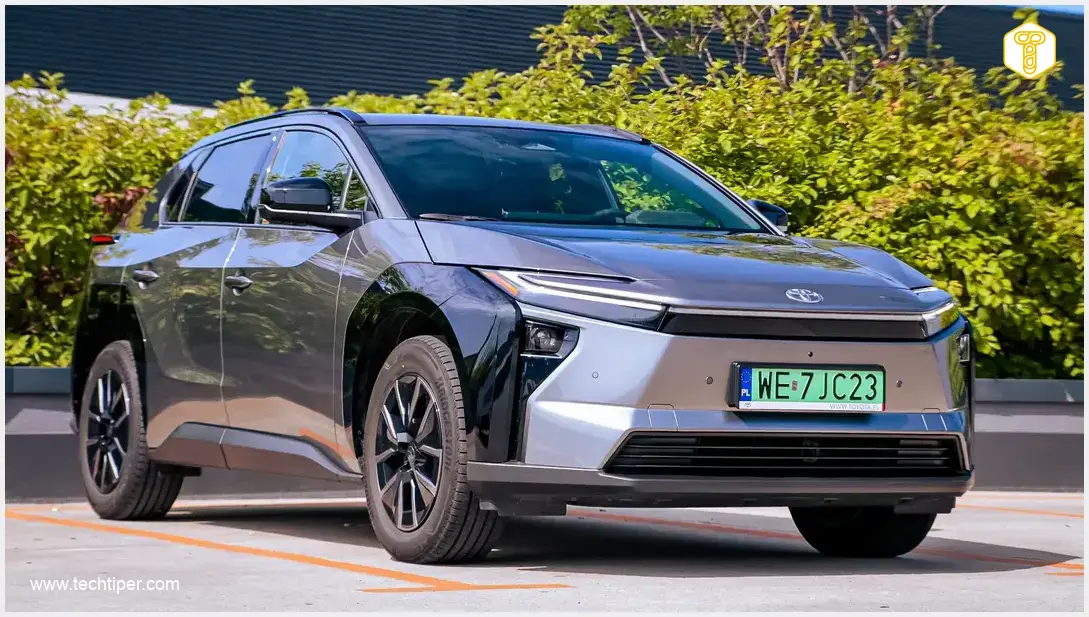
Toyota bZ4X Review
-
Comfort & Ride Quality
-
Interior & Practicality
-
Infotainment & User Interface
-
Energy Consumption & Efficiency
-
Driving Dynamics
-
Safety & Driver-Assistance
-
Trunk & Cargo Space
Toyota bZ4X: The Sensible Electric Shift
The Toyota bZ4X delivers on Toyota’s promise of practicality, comfort, and reliability in an all-electric package. It stands out with impressive energy efficiency and an intuitive, familiar user experience, making it a dependable choice for those seeking a no-nonsense EV.
Advantages
- Outstanding energy efficiency and low consumption
- Comfortable ride and predictable driving dynamics
- Intuitive and familiar infotainment system with physical controls
- Spacious interior, particularly legroom in the second row
- Comprehensive driver-assistance systems (adaptive cruise, lane-keep)
- Long battery warranty (up to 1 million km optionally)
- Rational pricing strategy for an EV
- Standard matrix LED headlights
Disadvantages
- Limited trunk space (due to sloping roofline, though Touring variant offers more)
- No front trunk (frunk)
- Overly sensitive traffic sign recognition system
- High floor position in the second row for adult passengers
- Infotainment screen can feel “cramped” despite its large size
- Conservative regenerative braking system
- No Plug&Charge or V2L functionality
- No glove compartment in front of the passenger
Contents
Toyota bZ4X Review: The Inevitable Electric Shift
Introduction: Toyota’s Leap into Full Electrification
We begin our review of the Toyota bZ4X, a truly unique vehicle within the Japanese automaker’s portfolio. Toyota has historically been deliberate in its approach to full electrification, prioritizing hybrids and exploring hydrogen fuel cell technology. However, the bZ4X marks a significant departure, as it is a battery-electric vehicle (BEV) designed purely for electric propulsion, with no provisions for hydrogen or other fuels. Toyota has ambitiously launched this model as a standalone offering within the highly competitive mid-size SUV segment, showcasing a clear commitment to the electric future. Despite its innovative electric powertrain, the bZ4X retains the core characteristics expected of a Toyota: comfort, practicality, and intuitive operation. Drivers familiar with any other Toyota model will immediately feel at home, both inside the cabin and behind the wheel of the bZ4X. The question remains: is this enough to conquer the burgeoning EV market? Join us as we delve into this comprehensive review to find out.Pricing and Trim Levels of the Toyota bZ4X
It’s important to note that the Toyota bZ4X is available in two primary variants: the standard bZ4X and the bZ4X Touring. The Touring model is larger and, consequently, more expensive (approximately 15,000 PLN more), offering more powerful drivetrains. Our focus for this review is the standard bZ4X, which comes in three trim levels and an equal number of powertrain configurations, with pricing for the Polish market provided in PLN (current approximate conversion rate: 1 PLN ≈ 0.25 USD).Style Trim:
- 167 hp, 57.7 kWh, FWD: 175,900 PLN (approx. $43,975 USD)
- 224 hp, 73.1 kWh, FWD: 194,900 PLN (approx. $48,725 USD)
- 343 hp, 73.1 kWh, AWD: 204,900 PLN (approx. $51,225 USD)
Tour de Pologne (Limited Edition):
- 167 hp, 57.7 kWh, FWD: 175,900 PLN (approx. $43,975 USD)
- 224 hp, 73.1 kWh, FWD: 194,900 PLN (approx. $48,725 USD)
- 343 hp, 73.1 kWh, AWD: 204,900 PLN (approx. $51,225 USD)
Executive Trim:
- 224 hp, 73.1 kWh, FWD: 211,900 PLN (approx. $52,975 USD)
- 343 hp, 73.1 kWh, AWD: 221,900 PLN (approx. $55,475 USD)
Estimated Insurance Costs for the Toyota bZ4X
According to data from insurance aggregators, comprehensive insurance (including third-party liability and collision coverage) for the bZ4X for an experienced driver could range from approximately 4,400 PLN (around $1,100 USD) for a full package. Costs will vary based on individual driver profiles, location, and coverage choices. For this review, we examined the Toyota bZ4X with the more powerful 224 hp engine and larger battery, specifically in the basic Style version, priced at 194,900 PLN. This represents a sensible choice, offering the highest declared range with an already generous standard equipment list. The only additional paid option is typically metallic paint (e.g., “Precious Metal” for 4,400 PLN). Excluding accessories, the final price remains under 200,000 PLN, even before factoring in potential discounts. Compared to its internal combustion engine counterparts, Toyota has adopted a very rational pricing strategy for the bZ4X.Technical Specifications of the Toyota bZ4X
Toyota vehicles, outside of their GR performance models and Plug-in Hybrids, are not typically known for exhilarating performance. However, the top-tier 343 hp AWD electric bZ4X can be surprisingly quick. The other variants offer a more subdued driving experience, aligning with Toyota’s pragmatic philosophy. It’s worth noting the benefit of upgrading to the mid-tier version for its significantly larger battery, as Toyota generally opts for moderately sized battery cells. From a practical standpoint, the bZ4X is a large SUV, featuring a design aesthetic similar to other models in the portfolio, including the C-HR. Its dimensions suggest a spacious cabin, though the sharply sloping roofline impacts cargo capacity, making it challenging to load items high up in the trunk.A Brief History of the Toyota bZ4X
Let’s start unusually, with the meaning behind the bZ4X name itself, which is quite unique for a Toyota. The “bZ” stands for “Beyond Zero,” which literally means “above zero,” but is intended to signify more than just zero emissions. In some markets, the vehicle is simply known as the bZ. This all-electric model represents an elevation of Toyota’s long-standing focus on hybrid technology and the “Stop Smoke Go Hybrid” philosophy. The “4” refers to the vehicle’s size, positioning it as an electric equivalent to the popular RAV4, while “X” denotes its SUV/crossover nature, similar to the Aygo X. Despite this new direction, electric cars have historically been a lower priority for Toyota. The Japanese automaker, largely justifiably, believes that hybrids and alternative fuels (such as hydrogen, exemplified by the Mirai) still hold immense future potential. Nevertheless, a powerful manufacturer like Toyota cannot afford to ignore battery-electric propulsion. There were earlier ventures, such as an electric variant of the RAV4, but it did not achieve global success. Additionally, electric commercial vehicles, often developed in partnership with Stellantis, are available. A more significant offensive began around 2025 (as mentioned in the original context, though the car was released earlier). The bZ4X entered the market in the latter half of 2022, with its initial concepts showcased in 2019. Toyota developed a dedicated platform (e-TNGA) specifically for electric vehicles. This platform is also shared with the Subaru Solterra, the upcoming Lexus RZ, and other electrified models. The bZ4X received a refresh around 2025 (based on the original text), significantly improving its theoretical range. Concurrently, a second variant, the Touring, debuted. This model is noticeably larger (14 cm / ~5.5 inches longer), which primarily translates to a much more spacious trunk (an additional 147 liters, bringing the total to 669 liters). It also features more powerful engines, with the top-tier bZ4X Touring achieving 0-100 km/h (0-62 mph) in a rapid 4.5 seconds. (Note: The article mentions a 2025 refresh and debut of the Touring variant. This might refer to a future model year or a regional market difference, as the bZ4X was released in 2022.) The bZ4X, as a D-segment (mid-size) electric SUV, faces stiff competition. Its main rivals include the Skoda Enyaq, Volkswagen ID.4, Hyundai Ioniq 5, Kia EV6, Nissan Ariya, Tesla Model Y, Cupra Tavascan, Renault Scenic E-Tech, and Ford Mustang Mach-E. Toyota is entering an already crowded and competitive market.Intuitive Infotainment System
Toyota has adopted software and a user interface directly from Lexus, which is consistent with what drivers expect from other Toyota models. This system is remarkably straightforward, both in operation and visual presentation. It takes very little time to understand its layout and functionality. The benefit is immediate usability, sacrificing some customization options and advanced features for a truly “get in and drive” experience. One minor critique is that while the system is displayed on a large, high-resolution screen, the interface can feel somewhat “cramped” in places, especially with longer text descriptions. Toyota could better utilize the substantial screen real estate. Regardless of the trim level, all bZ4X models feature the same displays: a 14-inch touchscreen for the central infotainment and a 7-inch digital instrument cluster. The only multimedia option is an upgraded audio system (6 vs. 9 JBL speakers), available exclusively with the Executive trim.Central Screen: Lexus-Inspired Simplicity
Toyota doesn’t force users to install additional smartphone apps or register a driver profile to access core functionalities. While remote vehicle management via an app is available and particularly useful for an electric car, it’s not mandatory. Full functionality is accessible immediately upon entering the vehicle. The simplicity of the bZ4X’s interface means there’s no complex dashboard with widgets or extensive personalization options. Instead, users navigate through specific modules via a sidebar. Importantly, the icons and switches are appropriately large. A minor improvement could be more descriptive labels for some switches, as the bZ4X lacks a built-in digital owner’s manual. A voice assistant is included, supporting various languages (including Polish in the original context). Its capabilities are limited to basic commands for managing select vehicle functions, such as climate control, phone calls, and navigation. For climate control, the touchscreen is used only indirectly, as Toyota wisely continues to prioritize physical knobs and buttons. More specific or advanced settings appear on the display when needed and remain consistently visible. Only the least frequently used options are tucked away in a separate, retractable menu, making this a sensible division of controls. Exploring the software reveals a range of basic options for central locking, lighting, and windows. There are also smaller additions, such as a suggestion to automatically close windows at higher speeds. These small touches genuinely enhance driving comfort. The Toyota bZ4X is equipped with a comprehensive suite of connectivity features. It can connect to external Wi-Fi networks, though it cannot share internet from its built-in module. The onboard module is used for functions like over-the-air (OTA) updates. An internet browser is also included, but beyond these, multimedia additions are relatively minimal. The basic sound system in our tested bZ4X (six speakers without special branding) offers acceptable audio quality. Don’t expect exceptional listening experiences for your favorite tracks. It’s a perfectly adequate system that doesn’t creak or rattle. However, we recommend avoiding excessive bass boosting, as it tends to distort the sound.Navigation: Functional, but Android Auto and Apple CarPlay Excel
The integrated navigation system in the Toyota bZ4X is generally effective, factoring in the electric powertrain by pre-heating the battery along the planned route for optimal charging. However, the database of charging stations is static, meaning not all stations are included, and real-time availability information is absent. The fundamental navigation functions, including map display and route calculation, are solid. It provides a standard set of features without attempting to be groundbreaking. The bZ4X’s navigation feels like an accessory, acknowledging that many users will opt for smartphone integration. Wireless Android Auto and Apple CarPlay are offered and perform flawlessly. Connection and responsiveness are excellent. Basic navigation and multimedia information are relayed to the digital instrument cluster. For more detailed EV route planning, users might find apps like Google Maps within Android Auto more dynamic and up-to-date. [/android-auto-ev-route-planning-google-maps/]Digital Instrument Cluster: Minimalist Yet Elevated
The digital instrument cluster in the bZ4X, a 7-inch screen, is familiar from other Toyota models like the Prius. Toyota has positioned this display above the steering wheel rim, essentially serving as a substitute for a head-up display. A separate head-up display is not offered and is largely unnecessary, as the 7-inch panel is highly readable and can display a wealth of information. The primary setting for the digital instrument cluster determines whether additional widgets are shown. The standard information set includes energy flow, remaining range, driver-assistance system status, and other vital data. During charging, all relevant details are also presented on this screen. The aforementioned widgets primarily consist of various trip computer views, which can be swapped for multimedia information, additional driver-assistance indicators, or navigation cues. Contextual messages, such as an open door warning, appear as needed.Toyota bZ4X Interior: Familiar Practicality
Following the theme of familiar systems, the entire interior of the Toyota bZ4X is assembled from components that will be instantly recognizable to users of newer Japanese models. Practicality and thoughtful solutions dominate the design. The materials used are consistent with Toyota’s usual standards, featuring a prevalence of plastics, softened by occasional soft-touch inserts, all meticulously assembled. Keyless entry is standard across all bZ4X trims. The Toyota does not unlock automatically upon approach; users must use the touch sensors on all door handles (and the tailgate). Locking the central system works similarly.Front Row: Classic Toyota Comfort
Opening the bZ4X doors reveals that they fully cover the sills, preventing soiled trousers in adverse weather. The doors open wide, and Toyota has opted for traditional, non-recessed door handles, offering classic solutions that are particularly appreciated in electric vehicles. The door panel emphasizes practicality. Dark plastics are prevalent throughout the cabin, but the armrest and corresponding side panel are soft to the touch, though not overly padded. Convenient, physical switches and a storage compartment large enough for substantial bottles are welcome features.Comfortable Front Seats
In the Style trim, the Toyota bZ4X features well-contoured fabric seats with synthetic leather accents. Full synthetic leather upholstery is available in the Executive trim, which also includes extensive power adjustments. In our tested vehicle, the seats proved comfortable for both short commutes and longer journeys. The driver’s seat offers power adjustments, while the passenger seat is manually adjustable. The driver also benefits from two-way lumbar support and seat cushion tilt adjustment. Power passenger seat adjustment (without lumbar) and ventilated seats for both front occupants, along with driver’s seat memory, are exclusive to the Executive trim. Heated front seats (three levels plus an automatic mode) are standard, a welcome feature. (Note: The original mentions “radiant heating” in the Executive trim, similar to the Lexus RX 450h+.)Steering Wheel: Unique Yet Comfortable
At first glance, the bZ4X’s steering wheel might appear bulky and complex, but the rim itself is relatively small and unembellished. Overall, it offers a comfortable grip and allows for confident control of the Toyota. In colder weather, the heated synthetic leather steering wheel is a boon. Adjustment is manual, with both tilt and telescopic movement. The vertical arrangement of physical switches may seem intricate, but it’s essentially an expanded version of controls found in other Toyotas. The left section manages the digital instrument cluster, the right controls the cruise control, and the lower sections handle multimedia functions. Paddle shifters behind the wheel allow adjustment of regenerative braking intensity. A driver distraction monitoring sensor is located on the steering column, thankfully not overly zealous. Near the driver’s left knee are buttons for opening the trunk, activating automatic high beams, and operating the headlight washers. Slightly above, you can adjust screen brightness and switch the displayed mileage mode on the digital instrument cluster.Dashboard: A Glimpse of Lexus
The Toyota bZ4X’s dashboard design is quite elaborate, creating a sense of being enveloped in the cabin, complemented by the wide center console. It feels modern yet retains a practical character. Build quality is typical for Toyota: plastics dominate, but they are meticulously fitted. Numerous contours on the dashboard’s upper surface add character to the bZ4X’s interior. Notably, the side mirrors are positioned further back on the doors, with a distinctive step in the window line. Back inside, the central screen with physical knobs and a few buttons for basic climate control functions draws attention. The engine start button is integrated nearby. A continuous indentation runs across the dashboard, housing the air vents. The Executive trim also offers a heated windshield and washer nozzles. Within the center tunnel, there are two inductive charging pads, which are a great idea, though smartphones tend to slide around on their surface. Further back, a rotary dial selects the driving direction, surrounded by buttons for driving modes and the electronic parking brake. Deeply recessed cup holders are located between the front seats. The armrest opens from the sides, revealing a moderately sized, yet well-finished, storage compartment. The Toyota bZ4X’s center tunnel features a two-tier design. The lower section provides two USB-C ports and a 12V socket. This space is generously sized, allowing for larger items within its softly lined base and high side walls. Interestingly, Toyota decided against including a glove compartment in front of the passenger, which is a missed opportunity. However, an auto-dimming rearview mirror is located in the headliner, upgraded to a digital mirror in higher (Executive) trims. A welcome detail is an additional button on the headliner, allowing quick deactivation of the interior monitoring system.Second Row: Comfortable, with Japanese Considerations
Accessing the second row is almost as convenient as the front. One must account for the cut-out for the additional window, which goes largely unnoticed from inside. The rear door panel mirrors the front in its finish and can accommodate a large beverage bottle. From the side, the bZ4X’s second-row space appears ample. However, after settling in for a longer journey, one notices the high floor—knees are unnaturally elevated. Headroom is similarly calculated for passengers up to 1.9 meters (approximately 6 feet 3 inches) tall. On the positive side, legroom is very generous. Helping to find an ideal position on the rear bench is the adjustable recline angle of the backrests. Further enhancing travel comfort are central air vents with two USB-C ports, an armrest with two cup holders and a smartphone slot, as well as seatback pockets and a single hook. Parents will appreciate the easily accessible Isofix mounting points. Upgrading to the Executive trim adds heated outboard rear seats.Lighting and Optional Sunroof
Toyota has never been known for elaborate lighting in its models, but the bZ4X offers welcome features like puddle lights in the side mirrors and an illuminated charging port. Inside, the basic ambient lighting is acceptable. The mood lighting is not particularly striking, though its brightness and color can be adjusted. A panoramic sunroof is an option on the bZ4X, typically requiring an additional cost. It is often bundled with the upgraded audio system and is usually available only in the Executive trim.Trunk/Cargo Space: A Single, Functional Design
The tested Toyota bZ4X is an SUV with a rapidly sloping roofline, which means effective loading is generally limited to the window line. For those requiring more cargo space, the bZ4X Touring variant offers approximately 150 liters (about 5.3 cubic feet) of additional volume and the ability to load items up to the roof. Nonetheless, the tested model features an electrically operated tailgate, providing excellent access and a low loading sill. A convenient addition is the ability to close the tailgate and lock the central system simultaneously. However, there is no automatic opening function, such as a foot-swipe sensor. The bZ4X’s standard trunk capacity is 452 liters (approximately 16 cubic feet), which is average for its class. The rear seatbacks can be folded down (40:60 split, no ski pass-through) to expand cargo space to over 1,500 liters (approximately 53 cubic feet), creating a flat loading surface. Some of this capacity is found under the adjustable floor and in an additional storage compartment beneath it, where charging cables and a tire repair kit can be stowed. The cargo cover also has dedicated storage points under the floor. The adjustable seatback recline also marginally helps with cargo organization. Stowable hooks are present, but there are no options for cargo nets or a 12V power outlet. It’s a pity that the bZ4X was not designed with a front trunk (frunk). However, Toyota does allow for towing a trailer weighing up to 750 kg (approximately 1,650 lbs). This capacity can be doubled by opting for a more powerful drivetrain. A tow hitch is an optional extra (approx. 3,300 PLN) but is not electrically controlled. A roof rack is also available (approx. 1,400 PLN).Driving Experience of the Toyota bZ4X
What one expects from a Toyota is confident, comfortable driving, and the bZ4X delivers exactly that. It’s a comfortable car that doesn’t strive for sporty thrills but offers complete predictability in its behavior. The electric powertrain naturally allows for smoother movement in various conditions, but there’s no overwhelming sensation of power. Although the bZ4X is a fully comfortable electric car, its steering system provides excellent precision. It maintains appropriate stiffness at higher speeds. The turning circle is fully acceptable (11.4 meters or about 37.4 feet), so overall, the driver will have no complaints during maneuvering. Similarly, the suspension effectively absorbs road imperfections without being overly soft. There’s a pleasant resilience that, combined with the reasonably sized 18-inch wheels, handles the vehicle’s unladen weight of just under two tons well. The low-mounted batteries contribute to stability, even during more dynamic cornering. All aspects of its behavior are entirely predictable.Driving Dynamics: Toyota Goes Electric
The tested Toyota bZ4X features the mid-range powertrain, which drives the front wheels, delivering 224 hp and 269 Nm (198 lb-ft) of torque, powered by a larger 73.1 kWh battery (69 kWh usable). This is a sensible choice, but those seeking more excitement or all-wheel drive can opt for the significantly more powerful 343 hp variant. This sensible approach translates to a claimed 0-100 km/h (0-62 mph) acceleration time of 7.4 seconds. While a good figure, achieving it can be challenging due to the tires quickly losing traction and the traction control system frequently intervening during aggressive starts. Top speed is limited to 160 km/h (100 mph), regardless of the powertrain. Toyota has chosen not to use a traditional drive mode selector. The bZ4X features separate “Eco” and “Snow” buttons. Snow mode limits power during startup and alters traction control behavior. Eco mode significantly reduces throttle response and restricts the operation of certain comfort systems, primarily climate control. Choosing the AWD version adds additional driving modes tailored for off-road conditions. Toyota boasts that this system is inspired by the Land Cruiser’s off-road capability, incorporating features like Grip Control cruise control. The tested Toyota bZ4X impressed us as a true Toyota. It possesses virtually all the characteristics of its hybrid counterparts, with only the cabin’s quietness betraying the absence of an internal combustion engine and eCVT transmission. At higher speeds, only wind noise is noticeable, as the cabin is adequately insulated. Interestingly, the acceleration from a standstill seems configured to deliver torque smoothly, without the immediate surge often typical of electric vehicles. Of course, when instantaneous acceleration is needed, the kickdown function is readily available. The aforementioned rationality is the overarching theme of the bZ4X’s driving experience. This car is not designed to impress or overwhelm with power, performance, or technology, but rather to be a dependable and comfortable means of transport. This is not a flaw; it’s a distinctive trait that is becoming increasingly rare in many modern vehicles. Whether you prefer city driving or longer journeys on highways, the Toyota bZ4X adapts to the driver’s needs. By default, it drives very smoothly, but overtaking at various speeds is effortless. There’s no need to switch drive modes, as sufficient power is always available, even if the on-paper figures aren’t the highest for an EV. Toyota has also taken a conservative approach to its regenerative braking system, which is somewhat regrettable. While paddle shifters allow adjustment of the braking force when lifting off the accelerator, even at its maximum setting, the bZ4X won’t slow down dramatically. This means the driver still plays a significant role in utilizing the brake pedal. Another technique, familiar from Toyota hybrids, is to activate cruise control (without setting a speed) so that the radars automatically detect vehicles ahead. This allows the car to utilize regeneration more effectively.Energy Consumption, Charging, and Range of the Toyota bZ4X
Our reviewed Toyota bZ4X is the variant with the potentially longest range on a single charge. It features the largest battery (69 kWh net, 73.1 kWh gross) powering a single electric motor. A heat pump is standard. The following measurements were taken at an ambient temperature of approximately 20 degrees Celsius (68°F). Toyota is synonymous with fuel efficiency, and this holds true for its electric models. We quickly adapted to the bZ4X’s characteristics and achieved remarkably low energy consumption results in urban driving. Regularly, city commutes concluded with the onboard computer showing around 9.5 kWh/100 km (equivalent to a range of approximately 720 km or 447 miles). Our record was 8.3 kWh/100 km. Even when requiring quicker travel, the Toyota maintained a very reasonable energy demand, typically up to 14 kWh/100 km. Outside urban areas, at a constant speed of approximately 80 km/h (50 mph), the bZ4X consumes about 11.5 kWh/100 km (providing a range of approximately 620 km or 385 miles). Higher speeds on highways naturally increase consumption, though still remaining relatively low for its class:- 100 km/h (62 mph): 13.5 kWh/100 km (approx. 510 km / 317 miles range)
- 120 km/h (75 mph): 17.8 kWh/100 km (approx. 380 km / 236 miles range)
- 130 km/h (81 mph): 19.5 kWh/100 km (approx. 350 km / 217 miles range)
- 140 km/h (87 mph): 22.6 kWh/100 km (approx. 300 km / 186 miles range)
Safety and Driver-Assistance Systems
Toyota is a manufacturer that consistently adds and refines driver-assistance systems in its vehicles. However, it often integrates these within its existing platforms without explicit software labels. From the central screen, you’ll primarily find basic on/off switches with general headings. Additional settings are minimal, and in some areas, more detailed descriptions explaining specific functions would be beneficial. The traffic sign recognition system is present in the bZ4X, and frankly, it could be improved. The audible alert that accompanies both the detection of a speed limit change and its exceeding is impossible to ignore. It sounds frequently because Toyota’s system is overly rigorous in its readings, often picking up data from side roads. The rearview mirrors in our tested vehicle are quite large but positioned closer to the driver’s line of sight (mounted on the doors). While this takes some getting used to, overall visibility is good. Toyota includes a blind-spot monitoring system and rear cross-traffic alert. In the higher Executive trim, these are complemented by memory settings and automatic mirror tilting during reversing. The adaptive cruise control in the bZ4X is a comprehensive implementation, including stop-and-go functionality and a degree of predictive capability. Aside from the last point (which can sometimes be overcautious), it’s a very effective system that accurately identifies other road users. There are no sudden jerks or hesitations, and acceleration to desired speeds is smooth and prompt. Toyota pairs the cruise control with a lane-keeping assist system that effectively recognizes lane markings. The bZ4X competently follows the designated path, though occasionally on straight stretches, it may give excessive warnings to keep hands on the steering wheel, even when they are present. Gentle movements are usually sufficient to dismiss these alerts. This is a common experience, and users looking for more advanced semi-autonomous driving features might also be interested in how different systems interact, as discussed in articles like our “Toyota Corolla Cross GR Sport Review”. [/toyota-corolla-cross-gr-sport-test-a-facelift-responding-to-customer-needs/] The headlights can be described as entirely adequate. The tested Toyota doesn’t particularly excel in any single aspect (brightness, spread, range, or fill), but they maintain a level that ensures good visibility during night driving. Headlight washers are also neatly integrated into the bZ4X’s bumpers. We were pleasantly surprised that Toyota does not charge extra for matrix LED headlights, as they are offered even in the base trims. Their operation is acceptable, though they sometimes react with a slight delay. However, their ability to selectively dim sections to avoid dazzling other drivers is quite precise. On the other hand, we felt that the brightness in this adaptive mode was somewhat reduced compared to the full high beam. Standard in the Toyota bZ4X is a 360-degree camera system, a classic implementation for the brand. This means the image quality is perfectly adequate, though we wouldn’t mind an upgrade in resolution, especially since competitors often offer more detailed views in low-light conditions. Nevertheless, we had no trouble identifying obstacles. The tested bZ4X does not offer an automatic parking system, as this feature is exclusive to the Executive trim. However, some users will appreciate the automatic activation of the cameras when driving at low speeds, such as approaching an intersection.Conclusion: Our Verdict on the Toyota bZ4X
The tested Toyota bZ4X proves to be a remarkably sensible electric vehicle. Primarily, it offers substantial interior space, and the Touring variant provides even more at a reasonable price—an exceptionally good value for a Toyota EV. Crucially, there’s no over-complication of features. This remains a quintessential Japanese car, prioritizing practicality, physical buttons, and potential longevity (backed by a battery warranty up to one million kilometers). The powertrain delivers adequate dynamism but, more importantly, achieves outstandingly low energy consumption. Furthermore, the bZ4X utilizes solutions familiar not only from other Toyotas but also from Lexus models. Consequently, drivers will appreciate the comfortable interior, the uncluttered multimedia system, and the well-tuned chassis. Many potential drawbacks of the bZ4X, such as limited second-row and trunk space, are partially addressed by the Touring variant. However, as is characteristic of Toyota, be prepared for frequent beeping from driver-assistance systems, particularly the speed limit recognition. Some users might also desire more advanced multimedia software. Ultimately, Toyota, a manufacturer not typically focused on full EV adoption, has created a truly excellent electric car in the bZ4X. It’s a full-fledged Toyota in terms of usability and ride comfort, yet it boasts impressive energy efficiency. Drivers accustomed to Toyotas or Lexuses will feel right at home, requiring no learning curve.Frequently Asked Questions (FAQ)
The Toyota bZ4X stands out as Toyota’s first dedicated battery-electric vehicle built on a bespoke EV platform (e-TNGA). It combines Toyota’s renowned practicality, comfort, and reliability with impressive energy efficiency, offering a familiar driving experience despite its all-electric powertrain. Its long battery warranty (up to 1 million km optionally) also highlights Toyota’s confidence in its EV technology.
The bZ4X’s interior emphasizes practicality and familiar Toyota ergonomics, featuring a mix of quality plastics and soft-touch materials. Its infotainment system, inspired by Lexus, is intuitive and easy to use, prioritizing simplicity over extensive customization. While some rivals may offer more advanced graphical interfaces or digital features, the bZ4X provides a user-friendly experience with physical controls for essential functions and seamless wireless Android Auto/Apple CarPlay integration.
The bZ4X demonstrates excellent energy efficiency, especially in urban environments, leading to competitive real-world ranges. While it uses a 400V architecture, its DC fast charging capability (up to 150 kW) allows for a 10-80% charge in under 30 minutes, which is standard for its class. AC charging is 11 kW by default, with a 22 kW option on the Executive trim. Potential buyers should note the absence of a front trunk (frunk) and advanced features like Plug&Charge or V2L.
Toyota’s bZ4X incorporates a comprehensive suite of driver assistance systems, including adaptive cruise control and lane-keeping assist, which generally perform well. However, users might find the traffic sign recognition system overly sensitive, leading to frequent audible alerts. While matrix LED headlights are standard, their adaptive performance can sometimes be slightly delayed. The 360-degree camera system is functional but could benefit from higher resolution compared to some competitors.
Source: Original article content. Opening photo: Łukasz Pająk

