Contents
The ‘Imperfect’ Generation: I’m Gen Z, and I’ll Die Without My Phone
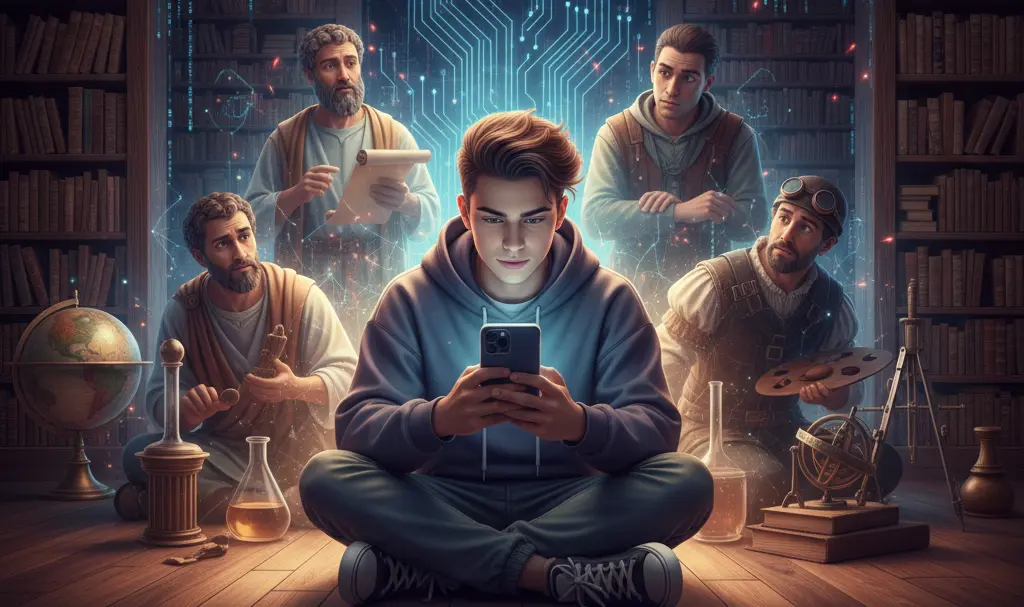
“We are flawed.” That’s how a friend of mine summed up our collective inability to navigate anywhere without GPS, recall bus numbers, remember family addresses, or even bake a cake without a recipe. We often don’t know how to clean a sink trap – or even what one is – and minor repairs are tackled with the help of a YouTube tutorial. It’s often said that if our phones were taken away, we’d become helpless and perhaps even perish.
Memory, in its traditional sense, is no longer considered essential. We have everything stored in our smartphones.
The Shifting Landscape of Memory: Why We Rely on Our Devices
“Gen Z can’t live without their phones!” screams a headline in an article about technology addiction. Below it, hundreds of comments, too embarrassing to quote, express frustration. Authors complain that young people are glued to their smartphones, endlessly scrolling, and seeking the simplest information online because their memory is failing. There’s some truth to this, but it’s often accompanied by unnecessary aggression.
The reality is, Generation Z doesn’t remember because we simply don’t have to. Thirty years ago, memory was a survival tool. You needed to memorize phone numbers, know which turn to take to reach a specific destination, and remember the schedule for the last bus.
Today, almost all information is available online, just a few clicks away. The ability to find information quickly has become more crucial than memorizing it permanently. Psychologists refer to this phenomenon as “transactive memory,” where individuals rely on external sources (like the internet or other people) to store and retrieve information.
Consequently, when someone asks for directions, I don’t try to recall them from memory; I pull out my smartphone and show them the route on a map. When I want a good meal, I search for nearby restaurants and choose those with the best ratings. And yes, I navigate my hometown with GPS because memorizing every street name is as useful to me as an altar boy’s incense to the dead.
Addressing the ‘Screen Addiction’ Criticisms
Am I “less intelligent” than previous generations because of this reliance? According to some studies, the answer might be yes. Neurobiologist and educator Jared Cooney Horvath noted that for the first time since the mid-19th century, younger generations have not outperformed their predecessors on cognitive tests. In many developed countries, Gen Z today achieves weaker results than millennials, particularly concerning attention, memory, reading comprehension, and reasoning.
The reason isn’t so much a fundamental “flaw” but rather a shift in how we acquire information. The generation raised in a world of screens tends to “scan” content rather than read it with focused attention. Instead of one long text, we often opt for several short ones, having become accustomed to rapidly switching between stimuli. This can impede deeper reasoning, which is often considered a hallmark of intelligence.
However, it’s vital to acknowledge that Gen Z did not design the education system, invent social media algorithms, or decide that school and learning would shift online during a global pandemic. Most of us didn’t buy our first smartphones or ask to be left unsupervised in front of computers. We simply grew up in a world that adults built faster than they could understand its consequences. For those looking to understand or manage their digital habits, exploring strategies like a digital detox can be insightful.

The Intergenerational Tech Divide: Who Helps Whom?
Perhaps I’ll add fuel to the fire, but those who are quick to criticize Gen Z often vent their own frustrations regarding a lack of technological competence (or even the fact that they are responsible for raising this “flawed generation”).
During my time working in a call center, I regularly received calls from much older customers who struggled immensely with navigating a simple website. Conversations could last half an hour as I painstakingly explained where to click to reach the correct section. I hardly need to add who bore the brunt of their frustration when they couldn’t complete a registration form.
Indeed, one only needs to observe who staffs marketing departments today, who repairs corporate computers, and who is hired for IT support roles. Yes, often it’s Gen Z, though, of course, representatives from other generations are also present. The point isn’t to assign blame or fuel intergenerational conflict, but to understand that the world is evolving. We live in a technological era, and people are almost integrated with it. If you had grown up in a world where you could repair a faucet yourself with a YouTube video, you would likely find yourself in a similar situation.
The Dual Nature of Technology: Empowerment and Its Costs
Herein lies the crux: Gen Z’s relationship with technology isn’t black and white, and we are not simply digital zombies with slack jaws and drooling mouths. On one hand, we feel perfectly at home in the technological world; on the other, we may lose skills once considered evidence of resourcefulness or intelligence. Whether arranging shapes according to a pattern – a common IQ test component – is truly relevant for modern life is a separate discussion.
How Technology Empowers Us
Technology itself is also not black and white. It provides us with a sense of agency and the knowledge that if we don’t know something, we can learn it. A quick search query or an instructional video is often all it takes. This empowerment allowed me to fix a washing machine, respond to a dishwasher-induced flood, and even clean vinyl records.
The Hidden Costs of Digital Convenience
However, this convenience comes at a price. We lose patience, curiosity about the world, and the drive for deep exploration. We have a lower tolerance for errors and an increasing need for instant gratification. We’re surprised by people who strike up conversations on the street simply to ask for directions – after all, they could just open a map. And we’re losing our concentration faster because we’re accustomed to an overload of stimuli. As Gen Z navigates economic challenges and the future of work, understanding the broader context of housing, wealth, and AI is crucial.
A Historical Perspective: Fears of New Technologies
It’s hard to disagree that technology both gives and takes away. A few days ago, I called my father – a representative of the boomer generation – for help with setting up a terrarium. He knew that shelves needed two support points and that I needed to buy an adhesive applicator. It was obvious to him to clear a foam tube with a wooden stick, even though I had already written it off as useless.
When I asked him how he knew all this, he simply replied, “It’s obvious.” And sure, schools teach basic physics principles, but they don’t necessarily explain how to apply them in real-world scenarios.
I only knew what YouTube showed me: that I needed specific types of paint and a foam-cutting device whose name I couldn’t even recall. When I went to the store for batteries for this device, I showed the salesperson a photo on my smartphone. Ultimately, I still bought the wrong ones.
Would I die without technology? Of course not. Waving my hands, I’d draw shapes in the air and explain to the salesperson that I needed a “square battery.” I found the store thanks to maps on my phone and navigated there with GPS. Before going, I also checked how much such a battery should cost to avoid overpaying.
And yes, that was as natural an action for me as asking someone for directions was for a boomer. Perhaps I wouldn’t have found that store without navigation, because for years I haven’t had to develop an exceptional sense of direction.
Challenging the ‘Digital Doom’ Narrative
So, if you take away my smartphone, I’ll probably run around the city, confuse addresses, and turn down the wrong street ten times. And if I miss the last bus, I’ll have to walk home – because without the option to order a ride-sharing service, it’s hard for me to imagine a Plan B today.
On public transport, I’ll be engrossed in my phone because I have an app that stores all my books. You’ll rarely see me with a paper newspaper; I subscribe to my favorite journals and read them online (though I know perfectly well that content on paper is often absorbed much better).
Is this, however, a reason to consider an entire generation lost? Looking at the comment sections under articles about Gen Z, without a doubt, many would say yes. In online discussions, it’s easy to conclude that a young person with a phone in hand symbolizes civilizational decline.
Yet, such catastrophic predictions accompany the advent of almost every new technology. When televisions entered homes, people declared the end of reading. When the internet emerged, the demise of knowledge was prophesied – “there’s no point in learning if everything is on Google.” Calculators, it was said, would strip us of our ability to perform arithmetic. Following this logic, we should have long forgotten how to make fire, because since the invention of the stove, none of us carry flint. And yet – ironically – we are still alive. And we live in a world full of possibilities that people centuries ago could only dream of.
Frequently Asked Questions (FAQ)
What is “transactive memory” and how does it relate to Gen Z’s tech use?
Transactive memory refers to a system where individuals collectively remember information by relying on external aids or other people. For Gen Z, this often means leveraging smartphones and the internet as external memory banks, allowing them to quickly access information rather than committing it to personal recall.
Are younger generations genuinely experiencing a decline in cognitive abilities due to technology?
Research suggests some shifts in cognitive test results, with younger generations occasionally showing weaker outcomes in areas like attention and focused reading compared to predecessors. This is often linked to the way digital natives “scan” information rather than deep-read. However, it’s a complex issue influenced by educational systems, social media algorithms, and the fast-paced digital environment they grew up in, rather than simply a “flaw” of the generation itself.
How can different generations bridge the gap in technological understanding and skills?
Bridging the gap requires mutual understanding and patience. Older generations can benefit from seeking guidance from younger, tech-savvy individuals for digital tasks, while Gen Z can learn valuable practical and traditional problem-solving skills from their elders. It’s about recognizing that each generation possesses unique competencies shaped by their environment and fostering a collaborative approach to shared knowledge.
Does increased reliance on technology mean we are becoming less resourceful or intelligent overall?
Not necessarily. While technology may reduce the need for certain traditional skills like rote memorization or navigating without tools, it fosters new forms of resourcefulness, such as rapid information retrieval, digital literacy, and problem-solving through online resources. Intelligence itself is multifaceted and evolves with societal needs and available tools. The key is understanding the balance between digital efficiency and maintaining foundational cognitive abilities.
Source: Original content and research. Opening photo: Gemini
About Post Author