

Contents

Sony AI’s Ace Robot: The Future of Table Tennis and Physical Artificial Intelligence
Engineers at Sony AI have achieved a historic breakthrough in the realm of physical artificial intelligence. They have developed an autonomous robot named Ace that can effectively compete in high-level table tennis. This advanced system does more than just keep pace with professionals; in many aspects, it demonstrates reaction times and precision that far exceed human capabilities.

This development marks a significant milestone in robotics, pushing the boundaries of what machines can achieve in fast-paced, unpredictable physical environments. It also hints at a broader revolution in hardware, similar to the rapid evolution seen in agile robotic systems designed for complex tasks.
Predicting Ball Spin with Superhuman Vision
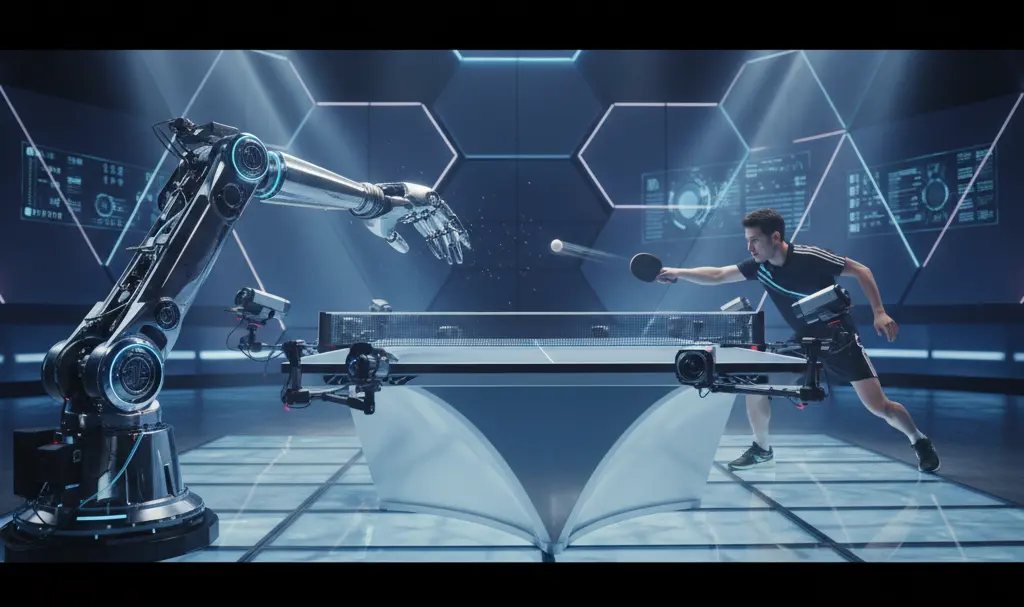
The foundation of the Ace robot’s success is its unique combination of a highly agile mechanical arm—featuring eight degrees of freedom—and an incredibly sensitive visual system. Unlike previous iterations of sports-playing machines, Ace relies on a sophisticated array of sensors to track the game.
Here is what makes the hardware configuration so groundbreaking:
- High-Speed Camera Array: A network of nine ultra-fast cameras positioned around the table tracks the ball at unprecedented frequencies.
- Spin Detection: The visual sensors can instantly analyze ball spin by reading the movement of the printed logo on the ball’s surface in a fraction of a second.
- Real-Time Adjustments: The precise mechanical arm executes instantaneous paddle adjustments required to return balls traveling at blistering speeds.
- Mobile Base: Because the robot is mounted on a mobile chassis rather than fixed to the floor, it can dynamically cover the entire playing area.
Crucially, the entire decision-making process occurs in real-time. This entirely eliminates the computational lag that has historically acted as the primary barrier for robots attempting to participate in dynamic physical sports. Detailed schematics and technical breakdowns of this technology were recently published in the scientific journal Nature, highlighting how the autonomous system outmaneuvered elite human athletes.
Thousands of Hours of Virtual Simulation Training
Ace’s extraordinary strategic capabilities were not hard-coded through traditional programming. Instead, engineers utilized a highly sophisticated AI training method known as model-free reinforcement learning.
Before facing human opponents, the robot spent thousands of hours within a virtual simulation environment. During this phase, it played millions of simulated matches against various algorithms. This extensive digital training allowed the AI to:
- Formulate optimal responses to complex, high-velocity shots.
- Counteract extremely heavy spins that are notoriously difficult for even experienced human players to read.
- Predict the opponent’s intentions by analyzing human body mechanics before the paddle even makes contact with the ball.
The results of this training were put to the ultimate test in a recent series of matches. In a landmark event, Ace won three competitive matches against human professionals, including Miyuu Kihara, who ranks among the top 25 female singles players in the World Table Tennis standings. This leap in AI capability mirrors the accelerated growth of automated physical tasks across multiple industries, from sports to child-sized robots designed for homes.
Is This the Future of Robotics in Sports?
The triumph of the Ace robot vividly illustrates that the boundary between digital intelligence and physical execution is rapidly dissolving. Over the next few years, this could fundamentally alter our understanding of automation and human-machine interaction.
Historically, engineering a robot intelligent and agile enough to outperform a human in a physically demanding sport was considered a nearly impossible feat. Today, that barrier has been broken. Artificial intelligence systems are now consistently defeating humans in a wide variety of domains, including complex strategy games like Chess and Go, e-sports, and physical endeavors like half-marathons.
Current Limitations and Human Counter-Strategies
Despite its spectacular successes—including notable victories against professionals in Tokyo—Ace still possesses specific limitations that clever human opponents can exploit. Rigorous testing revealed a surprising vulnerability: the robot actually struggles with very simple, slow-paced shots completely devoid of spin.
Because its algorithms and reinforcement learning models were heavily optimized to counter high-difficulty, high-speed scenarios, a standard amateur shot can cause a processing mismatch. Professional players discovered they could effectively disorient the machine by intentionally slowing down the pace of the game, introducing a level of chaos and unpredictability into the AI’s trajectory prediction models.
Frequently Asked Questions (FAQ)
How does the Ace robot accurately predict the spin of a table tennis ball?
The robot uses a sophisticated vision system comprising nine high-speed cameras. These cameras capture the ball’s movement at extremely high frame rates, allowing the AI to analyze the rotation of the logo printed on the ball’s surface. This data is processed in real-time to calculate the exact spin and trajectory.
What is model-free reinforcement learning, and how did it help the robot?
Model-free reinforcement learning is an AI training technique where the agent learns optimal actions through trial and error in an environment, without relying on a pre-programmed mathematical model of that environment. By playing millions of simulated ping-pong matches, the robot independently discovered the best paddle angles and movement strategies to defeat various play styles.
Can professional table tennis players beat the Ace robot?
Yes, while the robot is highly skilled against fast, complex shots, human professionals have found strategic workarounds. By drastically slowing down the game’s pace and hitting simple, spin-free shots, players can disrupt the robot’s prediction algorithms, which are heavily over-optimized for high-difficulty plays.
Source: Gizmodo, Robohub, TechSpot, Nature, Associated Press. Opening photo: Gemini.
About Post Author
