

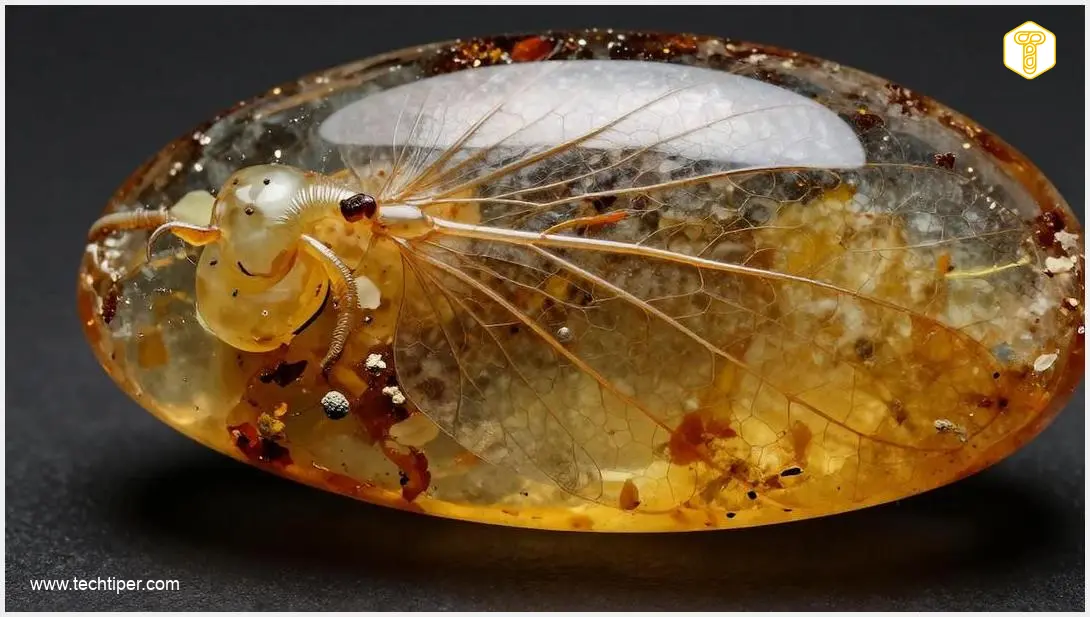
In a groundbreaking discovery, scientists have unearthed a perfectly preserved insect, dating back approximately 100 million years, encased in amber from Myanmar. This ancient creature, boasting unusual pincer-like limbs reminiscent of crabs, is set to revolutionize our understanding of arthropod evolution. Its unique characteristics were so exceptional that researchers have established an entirely new genus for this remarkable find.
Contents
Ancient Insect with Crab-like Claws Rewrites Evolutionary History
Amber has long been an invaluable treasure trove, offering unparalleled insights into Earth’s ancient ecosystems. Its unique ability to rapidly encase organisms, cutting off access to oxygen, allows for the preservation of even the most delicate structures. This includes intricate details like hairs, wings, and antennae of insects, providing paleontologists with snapshots of prehistoric life frozen in time.
The Remarkable Discovery of Carcinonepa libererrantes
As detailed by researchers, an extraordinary insect specimen from the Cretaceous period was discovered in the Kachin region of Myanmar, preserved within a piece of amber. This newly identified species has been christened Carcinonepa libererrantes.
What immediately captured the attention of scientists were its front limbs, which terminate in massive pincers strikingly similar to those found on crabs or shrimp. Such specialized anatomical features are exceedingly rare within the insect world, making this discovery particularly significant.
Unraveling Ancient Anatomy Through Advanced Technology
To thoroughly investigate this ancient marvel, scientists employed micro-computed tomography (micro-CT scanning). This advanced imaging technique allowed them to create a detailed three-dimensional model of the entire organism, revealing its intricate structure without damaging the precious amber specimen. Following the 3D reconstruction, researchers meticulously compared the structure of its pincers with thousands of gripping appendages found in both contemporary and extinct species of arthropods.
Convergent Evolution: Nature’s Ingenious Solutions
The comprehensive analysis revealed a fascinating insight: the pincers of this primeval insect bore a closer resemblance to the limbs of distantly related crustaceans than to any previously known insect species. Researchers interpret this as a compelling example of convergent evolution – the independent development of similar evolutionary traits in different groups of organisms. This phenomenon highlights how nature often arrives at similar solutions when faced with comparable environmental pressures or ecological niches.
According to the study’s authors, comparable structures have previously been observed in only three other insect groups. The discovery of Carcinonepa libererrantes thus provides further compelling evidence that evolution frequently converges on similar adaptive strategies across disparate lineages. Just as scientists piece together the incubation habits of ancient dinosaurs like the Oviraptor, this insect reveals another intricate detail of Cretaceous life.
From Ancient Claws to K-Pop Inspiration
The naming of this new genus and species reflects both its biological uniqueness and a touch of modern cultural inspiration.
- The genus name, Carcinonepa, draws from the Greek word for crab (karkinos), aptly describing its distinctive pincer-like appendages.
- Even more uniquely, the species name, libererrantes, was inspired by the popular Korean K-Pop group Stray Kids. The researchers noted that the characteristic arrangement of the insect’s pincers strikingly resembled a particular gesture performed by members of the group, a “step out” pose that became the unlikely muse for the scientific name.
Based on their morphological analysis, scientists hypothesize that this insect likely led a predatory lifestyle. All indications suggest that it inhabited the humid Cretaceous forests located near ancient coastlines, utilizing its powerful pincers to grasp and capture smaller organisms, much like modern predatory insects or crustaceans. This remarkable discovery, alongside breakthroughs such as astronomers witnessing a planetary collision, continually expands our understanding of the universe, from the microscopic to the cosmic.

Frequently Asked Questions (FAQ)
What makes the Carcinonepa libererrantes insect so unique?
Its most unique feature is the presence of large, crab-like pincers on its front limbs, a rare anatomical trait for insects. This led scientists to create an entirely new genus for it.
What is convergent evolution, and how does this discovery exemplify it?
Convergent evolution is when unrelated species independently evolve similar traits or features due to adapting to similar environments or ecological roles. The Carcinonepa libererrantes exemplifies this because its crab-like pincers evolved independently, resembling those of crustaceans, even though insects and crustaceans are distantly related.
How does amber help preserve ancient organisms so well?
Amber, fossilized tree resin, acts as a natural time capsule. When resin quickly envelops an organism, it cuts off access to oxygen, preventing decomposition. This allows for the exceptional preservation of even delicate structures like wings, hairs, and internal tissues over millions of years.
Why was this ancient insect named partially after a K-Pop group?
The species name, libererrantes, was inspired by the K-Pop group Stray Kids. Researchers noted that the distinctive arrangement of the insect’s pincers resembled a specific “step out” hand gesture commonly performed by members of the group.
Source: Illustreret Videnskab
Opening photo: Gemini
About Post Author
